Bone Health and Fracture Risk on a Vegan Diet
This is one of the few places where the evidence on vegan diets is genuinely uncomfortable, and pretending otherwise would not help anyone. In the largest prospective study to look at it, vegans had more than twice the rate of hip fracture of meat eaters. That finding is real, it has been repeated in other cohorts, and it is measured rather than assumed. On the evidence available it is also, at least in part, about what the diet supplies rather than about the absence of animal foods in itself — and one study shows the excess risk disappearing altogether in vegans who took calcium and vitamin D.
What the cohorts found
The central study is EPIC-Oxford, published in BMC Medicine in 2020. It recruited people in the UK between 1993 and 2001, deliberately over-sampling non-meat eaters: at baseline the fracture analysis included 29,380 meat eaters, 8,037 fish eaters, 15,499 vegetarians and 1,982 vegans. Fractures were identified through hospital records and death certificates, not self-report, and participants were followed for an average of 17.6 years. Diet group and the main confounders were updated at a follow-up questionnaire around 2010.
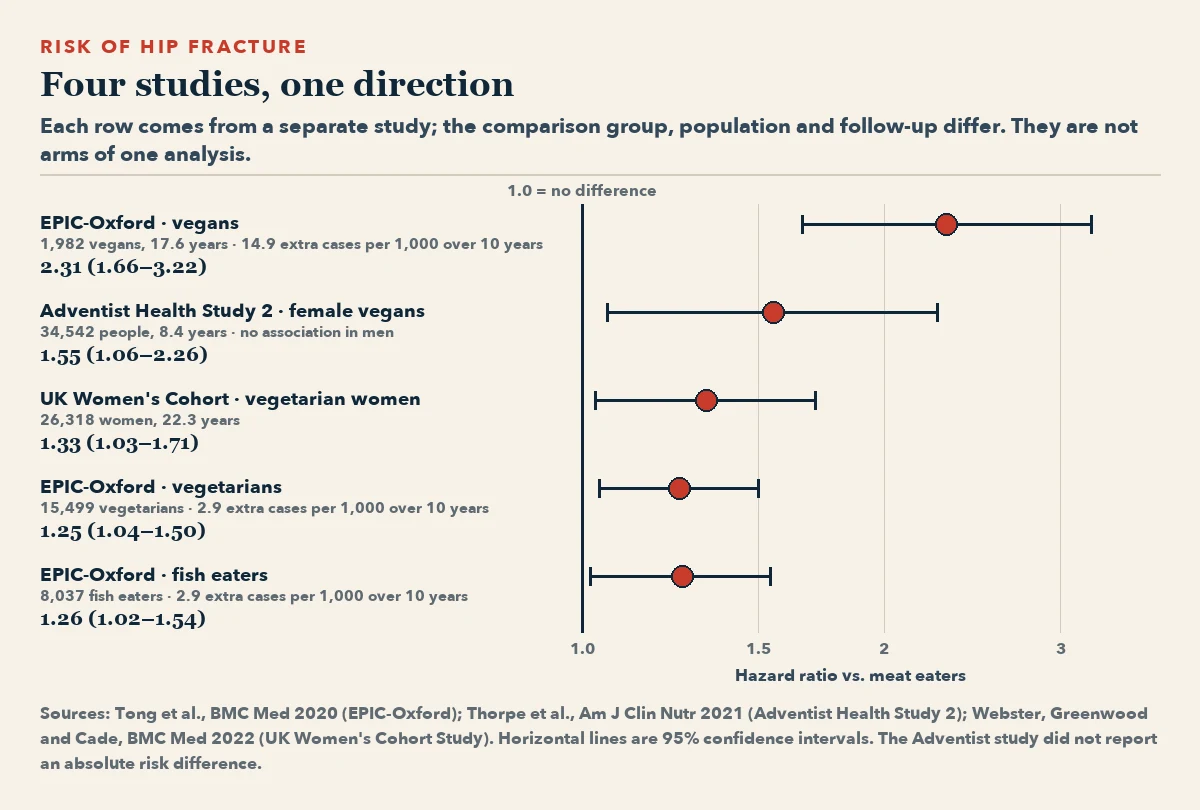
The hazard ratio of 2.31 is the number that gets quoted. The one that tells you what it means for a person is in the note line of the chart: about 15 extra hip fractures for every 1,000 vegans over ten years. Hip fracture is uncommon in middle age, so a doubling of an uncommon event is still an uncommon event — but hip fracture is also the fracture that matters most, because it is the one that takes away independence.
In EPIC-Oxford, vegans also had a higher risk of total fractures (1.43; 1.20–1.70), leg fractures (2.05; 1.23–3.41) and fractures of the clavicle, ribs and vertebrae combined (1.59; 1.02–2.50). There was no difference between diet groups in wrist or ankle fractures. That pattern matters: wrist and ankle fractures are usually caused by a fall onto a hard surface, while hip and vertebral fractures track bone strength more closely.
Before these cohorts reported, the evidence was mostly cross-sectional. A 2019 systematic review and meta-analysis in Nutrition Reviews pooled 20 studies and 37,134 participants and found lower bone mineral density at the femoral neck and lumbar spine in both vegetarians and vegans, and higher fracture rates in vegans. Bone density measured at one point in time is a weaker kind of evidence than fractures counted over two decades, but the two now point the same way.
Why the difference exists
Three explanations are on the table, and they are not rivals — they add up.
Body weight. Non-meat eaters are, on average, lighter. Low body weight is an established risk factor for hip fracture, partly through lower bone mass and partly through less soft tissue over the hip in a sideways fall. In EPIC-Oxford the associations were stronger before adjusting for BMI, which is what you would expect if part of the effect runs through body weight.
Calcium. Vegans have substantially lower calcium intakes than other groups in these cohorts. This is not intrinsic to the diet — fortified plant drinks, calcium-set tofu, tahini and some leafy greens supply it — but it is what the average vegan diet actually delivers unless it is planned.
Protein. Both vegetarians and vegans take in less dietary protein. The older worry that high protein leaches calcium from bone has not held up; more recent evidence points the other way, with protein supporting bone.
Adjusting for dietary calcium and total protein in EPIC-Oxford slightly weakened the associations but did not remove them. That is the honest state of the evidence: these factors explain part of the gap, not all of it. What remains could be vitamin D, vitamin B12, body composition, measurement error in the diet questionnaires, or something not yet identified.
The finding that changes what you do
The Adventist study did something the others did not: it separated vegans by whether they took supplements. When female vegans were stratified by use of both vitamin D and calcium, those taking both were at no greater risk of hip fracture than anyone else in the study, including the non-vegetarians. The excess risk was concentrated in vegans who were not supplementing.
This is a subgroup analysis in an observational cohort, so it cannot prove that the supplements did the work; people who take supplements differ from people who do not in ways a statistical model cannot fully capture. But it points the same way as the randomised evidence on fracture prevention, where combined calcium and vitamin D reduces fractures while vitamin D alone does not. A 2024 review in Current Nutrition Reports reached the same conclusion: much of the excess risk appears to be attributable to lower BMI and lower intakes of calcium, vitamin D and protein, and combined supplementation may attenuate it.
What kind of plant-based diet
A 2024 analysis in JAMA Network Open approached the question from a different angle. Following 70,285 postmenopausal women in the Nurses’ Health Study for up to 30 years and recording 2,038 hip fractures, it scored diets not by label but by quality, using a healthful and an unhealthful plant-based diet index. Whole grains, fruit, vegetables, nuts, legumes, vegetable oils, tea and coffee counted positively in the healthful index; fruit juice, sugary drinks, refined grains, potatoes and sweets counted positively in the unhealthful one.
Long-term adherence to either index showed no association with hip fracture (healthful 0.97; 0.83–1.14 — unhealthful 1.02; 0.87–1.20). Recent intake did: the healthful pattern was associated with 21 per cent lower risk (0.79; 0.68–0.92) and the unhealthful pattern with 28 per cent higher risk (1.28; 1.09–1.51).
Two cautions before this is read as reassurance. These women were overwhelmingly not vegan — the indices measure the balance of a mostly omnivorous diet, not the absence of animal foods. And the authors themselves note that the association with recent intake, but not long-term intake, may reflect reverse causality: people already losing bone or becoming frail may change how they eat. The result is best read as evidence that the composition of a plant-based diet matters, not as a licence to ignore the cohort findings above.
One thing that closed the gap entirely
A study at St. Vincent Hospital in Vienna scanned the bone microarchitecture of 43 healthy non-obese people who had eaten a plant-based diet for at least five years and 45 omnivores, using high-resolution peripheral quantitative computed tomography — a finer measure than a standard bone density scan. Trabecular and cortical structure were altered in the vegan group overall. But the comparison that matters is the one they made next: vegans who did not report resistance training had diminished bone microarchitecture compared with omnivores who did not train; among those who did report resistance training, bone structure was similar in the two groups.
This is a small cross-sectional study and self-reported training, so it cannot establish cause. It is worth knowing anyway, because it is the only finding here where the difference between diet groups disappeared entirely, and because loading bone is something anyone can act on this week.
What this means in practice
Nothing in this evidence says a vegan diet cannot support a healthy skeleton. It says that the average unplanned vegan diet in these cohorts did not, and that the factors involved are known and modifiable.
- Calcium is the first thing to check. Some plants do supply absorbable calcium, but a 1999 review in the American Journal of Clinical Nutrition concluded that the quantity of vegetables needed to reach an adequate intake makes an exclusively plant-based approach impractical for most people unless fortified foods or supplements are included. In practice that means fortified plant drinks and calcium-set tofu doing much of the work.
- Vitamin D and calcium belong together. The randomised fracture-prevention evidence cited by the EPIC-Oxford authors is for the combination: combined vitamin D and calcium reduced fractures, vitamin D alone did not.
- Do not neglect protein. Legumes, soy foods, seitan, nuts and grains across the day. The old worry that high protein leaches calcium from bone has not survived; recent evidence points to protein supporting bone.
- Weight matters in both directions. Being very lean is not a neutral state for the skeleton, and in EPIC-Oxford the associations were stronger before body mass index was accounted for.
- Load the bone. See the Vienna finding above.
What we still do not know
The cohorts are overwhelmingly white, European and North American; the Nurses’ Health Study analysis was 100 per cent white women. Men are badly under-represented — the Adventist study found no association in men at all, and nobody knows whether that is a real sex difference or a shortage of cases. Vegan groups are small in absolute terms (1,982 in EPIC-Oxford), which is why the confidence interval around 2.31 is wide. And no randomised trial has tested whether a planned, calcium-adequate vegan diet carries the same fracture risk as the unplanned one, because such a trial would have to run for decades.
What can be said is this: the risk signal is consistent enough to take seriously, the mechanisms are largely nutritional, and the nutrients are ones a vegan diet can supply if someone decides to supply them.
References
- Tong TYN, Appleby PN, Armstrong MEG, et al. Vegetarian and vegan diets and risks of total and site-specific fractures: results from the prospective EPIC-Oxford study. BMC Med. 2020;18(1):353. doi:10.1186/s12916-020-01815-3.
- Webster J, Greenwood DC, Cade JE. Risk of hip fracture in meat-eaters, pescatarians, and vegetarians: results from the UK Women’s Cohort Study. BMC Med. 2022;20(1):275. doi:10.1186/s12916-022-02468-0.
- Thorpe DL, Beeson WL, Knutsen R, et al. Dietary patterns and hip fracture in the Adventist Health Study 2: combined vitamin D and calcium supplementation mitigate increased hip fracture risk among vegans. Am J Clin Nutr. 2021;114(2):488-495. doi:10.1093/ajcn/nqab095.
- Sotos-Prieto M, Rodriguez-Artalejo F, Fung TT, et al. Plant-Based Diets and Risk of Hip Fracture in Postmenopausal Women. JAMA Netw Open. 2024;7(2):e241107. doi:10.1001/jamanetworkopen.2024.1107.
- Iguacel I, Miguel-Berges ML, Gómez-Bruton A, et al. Veganism, vegetarianism, bone mineral density, and fracture risk: a systematic review and meta-analysis. Nutr Rev. 2019;77(1):1-18. doi:10.1093/nutrit/nuy045.
- Kraselnik A. Risk of Bone Fracture on Vegetarian and Vegan Diets. Curr Nutr Rep. 2024;13(2):331-339. doi:10.1007/s13668-024-00533-z.
- Wakolbinger-Habel R, Reinweber M, König J, et al. Self-reported Resistance Training Is Associated With Better HR-pQCT-derived Bone Microarchitecture in Vegan People. J Clin Endocrinol Metab. 2022;107(10):2900-2911. doi:10.1210/clinem/dgac445.
- Weaver CM, Proulx WR, Heaney R. Choices for achieving adequate dietary calcium with a vegetarian diet. Am J Clin Nutr. 1999;70(3 Suppl):543S-548S. doi:10.1093/ajcn/70.3.543s.
Editor: Anıl Güler, Pharmacist
Last scientific review: 29 September 2026