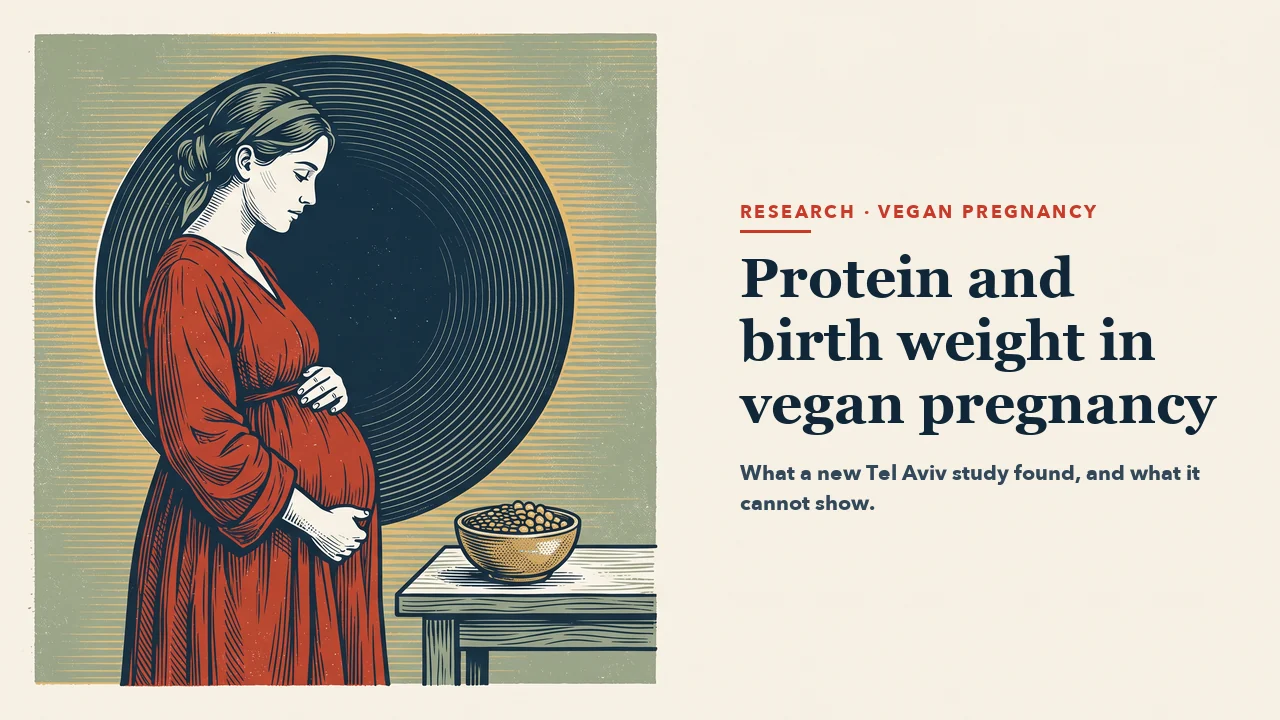
Protein and Birth Weight in Vegan Pregnancy: What a New Study From Israel Found
Short answer: A study from a hospital in Tel Aviv, published online in October 2026, compared the diets of 54 vegan and 176 non-vegan pregnant women. The vegan women ate less protein: 60 grams a day, compared with 82 grams in non-vegan women. They also had a higher rate of babies who were small for their gestational age. A higher share of protein in the diet, and more of the amino acid leucine within that protein, went with higher birth weight. The vegan diets were also lower in calcium, vitamin D, vitamin B12, DHA and choline from food, and higher in fibre, folate and iron. This is an observational study from a single hospital, so it shows associations, not cause and effect. The study does not change existing advice, but it adds weight to two parts of it: plan varied protein sources, and cover B12, iodine, calcium, vitamin D and DHA. All women planning a pregnancy or pregnant are advised to take folic acid and, in the UK, vitamin D.
What the study did
The study is a secondary analysis of a prospective observational study at Tel Aviv Sourasky Medical Center. It included women carrying one baby who gave birth at the hospital and had followed the same diet consistently. In the third trimester, the women filled in a validated food frequency questionnaire, a form that asks how often a person eats different foods. They also reported their supplement use. Birth outcomes came from the hospital’s records.
Of the 230 women, 54 followed a vegan diet. The researchers compared what vegan and non-vegan women ate, and looked at whether protein and amino acid intake was linked to the baby’s birth weight and to being small for gestational age (SGA). SGA means a birth weight below the 10th percentile for the length of the pregnancy.
What vegan women ate differently
The figures below come from the food questionnaire the women filled in during the third trimester. The summary of the study does not say whether they are group averages (means) or medians, or whether supplements were counted, so low intake here does not by itself mean that a woman’s levels were low.
| Daily intake | Vegan (54 women) | Non-vegan (176 women) |
|---|---|---|
| Protein | 60 g | 82 g |
| Protein per kilogram of pre-pregnancy weight | 1.10 g | 1.44 g |
| Carbohydrate | 256 g | 217 g |
| Fibre | 48 g | 30 g |
| Folate | 627 µg | 416 µg |
| Iron | 17 mg | 12 mg |
| Fat | 72 g | 79 g |
| Calcium | 764 mg | 1053 mg |
| Vitamin D | 0.24 µg | 5.5 µg |
| Vitamin B12 | 1.5 µg | 4.6 µg |
| DHA | 0 g | 0.07 g |
| Choline | 270 mg | 394 mg |
Vegan diets were higher in carbohydrate, fibre, folate and iron, and lower in fat, calcium, vitamin D, B12, DHA and choline. All of the differences in the table were statistically significant.
Protein, leucine and birth weight
A higher protein percentage in the diet went with a lower risk of SGA (odds ratio 0.80, 95% confidence interval 0.67 to 0.96). The researchers also used a decision-tree method to find which protein or amino acid measure best separated heavier from lighter babies. The strongest was leucine, an essential amino acid, as a share of total protein. Above a cut-off of 5.636%, the average birth weight was 3341 g; at or below it, 3074 g, a difference of 267 g. In exploratory analyses, babies’ growth measures showed modest positive links with the protein percentage of the diet, with leucine intake, and with leucine, tyrosine and valine as shares of total protein.
The authors conclude that vegan women had a higher rate of SGA than non-vegan women, and that this increased risk “may be partly related” to differences in the amount and make-up of the protein they ate. The summary does not give the SGA rates for each group.
Earlier reports from the same hospital
The same hospital team published an earlier report in 2021. It included 273 women; the groups are shown in the table below. A vegan diet was linked to a higher risk of an SGA baby compared with an omnivore diet (relative risk 5.9, 95% confidence interval 1.2 to 21.8; the wide range reflects the small numbers involved). Compared with the other groups, the difference was not statistically significant. The babies’ average birth weights were:
| Mother’s diet | Women | Babies’ average birth weight |
|---|---|---|
| Omnivore | 112 | 3328 g |
| Fish-eater | 37 | not reported |
| Lacto-ovo-vegetarian | 64 | 3285 g |
| Vegan | 60 | 3015 g |
Babies of vegan mothers were lighter on average than those of omnivore and lacto-ovo-vegetarian mothers; the difference from fish-eaters was not significant. Preterm birth rates were similar in all groups.
A further report from the same study measured B12 in the women’s blood and in the umbilical cord. Overall, B12 levels did not differ significantly between diet groups. When women who took multivitamin, B12 and iron supplements were compared with women who did not, the supplement users had higher B12 in their own blood and in cord blood; this difference was seen in vegans but not in omnivores. The authors concluded that vegans who do not take any vitamin supplements are at greater risk of B12 deficiency than omnivores.
Because these reports come from the same team, they should not be read as independent confirmation of one another.
What the study cannot tell us
- It shows a link, not a cause. Women who choose a vegan diet may differ from other women in ways that also affect birth weight. Without randomised studies, the effect of diet cannot be separated from these other factors, and a 2015 review found none.
- One hospital, a small vegan group. The results come from 54 vegan women in Tel Aviv and may not apply elsewhere.
- Diet was measured by questionnaire in the third trimester only. Food frequency questionnaires give an estimate, not an exact measure, of what people eat.
- We have read the summary, not the full paper. The full text was not available to us. Details such as the SGA rate in each group, how supplements were handled and which other factors the analyses took into account are not in the summary.
The wider evidence is also mixed. A 2015 systematic review of vegan and vegetarian diets in pregnancy (studies up to 2013) found that five studies reported lower birth weight in babies of vegetarian mothers, while two reported higher birth weight. The length of pregnancy was similar. The reviewers concluded that the evidence is heterogeneous and scant, and that, within these limits, vegan and vegetarian diets may be considered safe in pregnancy, provided that attention is paid to vitamin and trace element requirements.
What this means if you are vegan and pregnant
The British Nutrition Foundation (BNF) says that with careful meal planning, vegetarian and vegan women should be able to get all the nutrients they and their baby need in pregnancy. Its main points for vegans:
- Protein: the BNF says most vegans get enough protein but should eat a range of sources. In the Tel Aviv study, vegan women ate less than non-vegan women; the summary does not say whether this was below recommended amounts. Soya contains a good range of essential amino acids. Other sources include beans and other pulses, nuts, tofu and fortified soya drinks and yogurts. Our comparison of soya and oat drinks shows why the protein in a plant drink depends on what it is made from.
- Vitamin B12: the only reliable sources for vegans are fortified foods or a supplement. Our vitamin B12 guide covers the options.
- Iron: iron from plant foods is absorbed less well than iron from animal foods, so a higher intake does not guarantee enough. Pulses, green leafy vegetables, wholemeal bread, quinoa and iron-fortified cereals help, and your iron levels are checked in routine blood tests during pregnancy.
- Iodine: vegans are at risk of iodine deficiency, and plant drinks are not always fortified with it. Seaweed, particularly brown seaweed such as kelp, can provide too much iodine, so the BNF advises against eating it more than once a week, especially in pregnancy. Iodine supplements are available; ask your GP or midwife which product and dose suit you.
- Omega-3 (DHA): supplements made from algal oil are a vegan source of DHA. Check that they do not contain vitamin A and are suitable for pregnancy. The BNF notes that there is no strong evidence of harm to health from the lower intake of these fats in vegans and vegetarians.
- Calcium: calcium-fortified plant drinks and yogurts, calcium-set tofu and some green leafy vegetables.
The NHS recommends 400 micrograms of folic acid a day from before pregnancy (ideally three months before) or as soon as you find out you are pregnant, until week 12. This applies even if your diet is rich in folate, because it is difficult to get enough from food alone, and some women are advised to take a higher dose prescribed by a GP. The NHS also recommends 10 micrograms (400 IU) of vitamin D a day between early October and late March (all year for some women), and advises not to take more than 100 micrograms (4000 IU) a day, as it could be harmful. It advises against cod liver oil and supplements containing vitamin A (retinol) during pregnancy, because too much vitamin A can harm the baby’s development. Choline intake was also lower among the vegan women in this study; our article on choline for vegans explains where it comes from.
Talk to your midwife, doctor or a dietitian about your diet and supplements, ideally before pregnancy or as early in it as possible.
Limits of this article
This article is based on the published summary of the Tel Aviv study, two earlier reports from the same hospital, a 2015 systematic review and guidance from the BNF and the NHS. The full text of the new study was not available to us. The study is observational and cannot show that a vegan diet, or low protein, causes lower birth weight. This article is general information and does not replace individual advice from a health professional during pregnancy.
Sources
- Dubinsky EP, Avnon T, Shaham S, Shiff YE, Yogev Y, Anbar R. Characterization of nutritional intake in vegan pregnant women and its association on birth weight. Clin Nutr ESPEN 2026;76:105172.
- Avnon T, Paz Dubinsky E, Lavie I, Ben-Mayor Bashi T, Anbar R, Yogev Y. The impact of a vegan diet on pregnancy outcomes. J Perinatol 2021;41(5):1129-1133.
- Avnon T, Anbar R, Lavie I, Ben-Mayor Bashi T, Paz Dubinsky E, Shaham S, Yogev Y. Does vegan diet influence umbilical cord vitamin B12, folate, and ferritin levels? Arch Gynecol Obstet 2020;301(6):1417-1422.
- Piccoli GB, Clari R, Vigotti FN, et al. Vegan-vegetarian diets in pregnancy: danger or panacea? A systematic narrative review. BJOG 2015;122(5):623-633.
- British Nutrition Foundation. Vegetarian and vegan diets during pregnancy.
- NHS. Pregnancy vitamins and supplements.
Editor: Anıl Güler, Pharmacist
Last reviewed: 15 October 2026