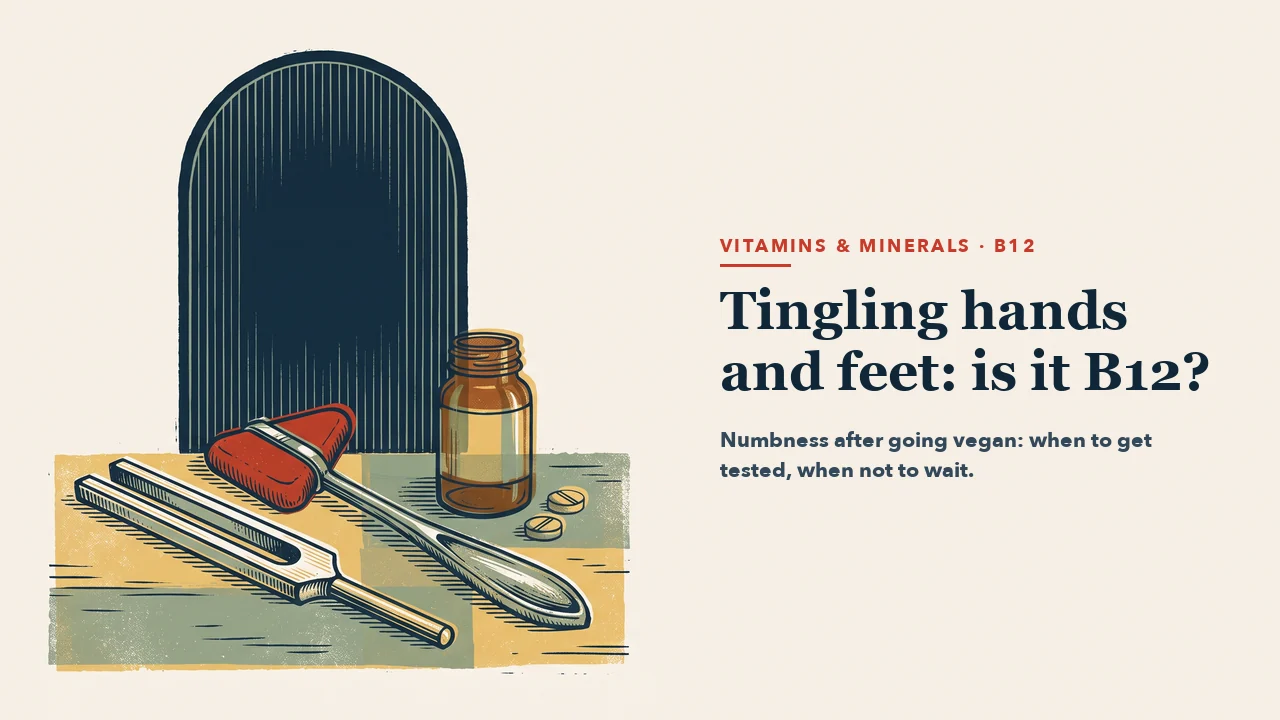
Numbness or Tingling in Your Hands and Feet After Going Vegan: When to Think of B12
Short answer: Pins and needles or numbness in the hands and feet is one of the common signs of vitamin B12 deficiency, and a vegan diet without regular B12 from supplements or fortified foods is one of its common risk factors. When both are present, the UK’s national guideline (NICE) recommends a B12 blood test. Two points are easy to miss. First, the body’s B12 stores can last around 2 to 5 years, so symptoms can appear years after a change in diet, not weeks. Second, a lack of B12 can damage nerves without causing anaemia, so a normal blood count does not rule it out. Numbness has many other causes, from diabetes to a trapped nerve in the wrist, and sudden numbness or weakness on one side of the body is an emergency.
Why B12 deficiency affects the nerves
Vitamin B12 is needed for the nervous system as well as for making blood cells. When it runs low, the nerves can be affected before, or without, anaemia.
A study of 153 episodes of B12 deficiency affecting the nervous system, seen at two New York hospitals, shows how this looks in practice. Neurological complaints, most commonly pins and needles (paraesthesia) or unsteadiness (ataxia), were the first symptoms in most episodes. The haematocrit was normal in 42 of the 153 episodes (27.4%). The median time from first symptoms to diagnosis and treatment was 4 months. The most common underlying cause in this series was pernicious anaemia, an autoimmune condition that stops B12 being absorbed, rather than diet. The series therefore shows how a lack of B12 affects the nerves, not how often this happens in vegans.
This is why NICE tells doctors not to rule out B12 deficiency based solely on the absence of anaemia or of enlarged red blood cells.
When B12 should come to mind
NICE lists pins and needles or numbness, balance problems, difficulty walking, unexplained fatigue and memory or concentration problems among the common symptoms and signs of B12 deficiency. Its list of common risk factors includes a diet that excludes animal-source foods, such as a vegan diet, without the regular use of B12 supplements or fortified foods. The guideline recommends offering a test to people who have at least one common symptom or sign and at least one common risk factor.
So the question for a vegan with tingling hands or feet is not only “Am I vegan?” but “Have I been taking B12 regularly?” Someone who has relied on plant foods without regularly taking a B12 supplement or eating B12-fortified foods is in the risk group. A review of 18 studies found B12 depletion or deficiency among vegetarians and vegans of all ages and in every region studied, with higher rates in vegans than in vegetarians.
Timing can mislead. The NHS notes that B12 stores can last around 2 to 5 years without being replenished, so it can take a long time for problems to develop after a dietary change. Numbness that starts three years after going vegan can still be linked to diet.
Diet is not the only possible cause. NICE’s risk factors also include metformin, acid-reducing medicines (proton pump inhibitors and H2-receptor antagonists), coeliac disease, autoimmune conditions, stomach or bowel surgery, a family history of B12 deficiency or an autoimmune condition, and recreational nitrous oxide use. NICE reminds doctors that a vegetarian or vegan diet may not be the cause, or the only cause, of a person’s deficiency.
Numbness has many other causes
Brief pins and needles after sitting or lying on an arm or leg is common and usually stops within a few minutes. The NHS advises seeing a GP if pins and needles lasts a long time, is constant or keeps coming back.
Long-lasting numbness or tingling has many possible causes besides B12. Diabetes is the most common cause of peripheral nerve damage (peripheral neuropathy) in the UK. Others include an underactive thyroid gland, drinking too much alcohol for years, some medicines and carpal tunnel syndrome, where a nerve is squeezed at the wrist and causes tingling, pain or numbness in the fingers. Where the symptoms are, how they started and what else is going on all help a doctor narrow this down. For this reason, a B12 test is a starting point, not the whole assessment.
When not to wait
Some numbness needs urgent medical care, not a routine blood test:
- Sudden weakness or numbness on one side of the body, a drooping face, or difficulty speaking can be signs of a stroke. Call the emergency number straight away (112 in Turkey and the EU; 999 in the UK), even if the symptoms have stopped. Do not drive yourself to hospital.
- Tingling or numbness in the feet and hands followed by muscle weakness that gets worse can be a sign of Guillain-Barré syndrome, a rare nerve condition that needs urgent treatment in hospital. Its symptoms usually get worse over the first 2 to 4 weeks. Get urgent medical advice the same day. Call the emergency number if you also have a drooping face, trouble swallowing, breathing or speaking, or cannot lift one or both arms.
Getting tested
- The first test. NICE recommends total B12 (serum cobalamin) or active B12 (holotranscobalamin) as the first test. The exceptions are pregnancy and recreational nitrous oxide use. In pregnancy, active B12 is used as the first test. Nitrous oxide inactivates B12, so blood levels can look normal even when there is a deficiency, and a different test (MMA or homocysteine) is used instead. Tell your doctor if this applies to you.
- Reading the result. On total B12, below 180 ng/L (133 pmol/L) confirms deficiency, 180 to 350 ng/L (133 to 258 pmol/L) is indeterminate, and above 350 ng/L (258 pmol/L) makes deficiency unlikely. On active B12, the matching cut-offs are 25 and 70 pmol/L. A laboratory may use its own validated thresholds. If your result is given in pg/mL, the number is the same as in ng/L. An indeterminate result in someone with symptoms can be followed by a methylmalonic acid (MMA) test. Our article on blood tests for vegans explains what each test can and cannot show.
- Before you start a supplement. NICE advises taking blood samples before starting B12 treatment, because a supplement can raise B12 levels without fully treating a deficiency. If you are already taking B12, tell your doctor which type and how much.
- Treatment may start before the result. Once your blood sample has been taken, NICE advises doctors not to delay B12 treatment while waiting for results if a person has suspected megaloblastic anaemia (the type of anaemia caused by a lack of B12 or folate) and symptoms affecting the nerves.
- Do not treat yourself with folic acid alone. Folic acid can sometimes improve symptoms so much that it hides an underlying B12 deficiency, and a B12 deficiency that is missed can go on to affect the nervous system. This is why doctors check B12 before starting folic acid.
Treatment and recovery
B12 is given as tablets or injections; the choice depends on the cause and how severe the symptoms are. A family-medicine review notes that high-dose oral B12 (1 to 2 mg a day) is as effective as injections for correcting anaemia and neurological symptoms, while injections lead to faster improvement and should be considered when the deficiency or the neurological symptoms are severe. NICE advises doctors to tell patients that symptoms could start to improve within 2 weeks but this may take up to 3 months, and that it can take much longer for them to disappear altogether. Symptoms can get a little worse at first before they improve. If they do not improve, get worse, come back, or new symptoms appear, contact your doctor without waiting for the next appointment.
The New York series shows why delay matters. Recovery could be assessed in 121 of the 153 episodes. All of these patients responded to treatment, and in 47.1% of episodes recovery was complete, with no remaining symptoms or findings on examination. Residual moderate or severe disability remained after only 6.3% of episodes. The longer the symptoms had lasted before diagnosis, the more severe the nerve damage was and the less it improved. The NHS also warns that some problems caused by B12 deficiency can be irreversible if left untreated.
Preventing it
For vegans, prevention is simpler than treatment: a regular B12 supplement or B12-fortified foods. NICE advises choosing an oral supplement that contains cyanocobalamin, methylcobalamin or adenosylcobalamin, because some supplements do not contain enough, or the right type, of B12. Our guide to vitamin B12 for vegans covers sources and intake, and our article on nutritional yeast explains why only fortified yeast counts as a source.
Limits of this article
This article is based on the UK’s NICE guideline (NG239, 2024), NHS patient pages, a family-medicine review and two earlier studies. The New York series is from 1991; its most common cause of deficiency was pernicious anaemia, and it does not tell us how often vegans with tingling have B12 deficiency. The test thresholds above are NICE’s; laboratories in other countries may report results in different units or use different cut-offs. This article explains when B12 is worth considering; it cannot diagnose the cause of your symptoms. If you have numbness or tingling that does not go away, see a doctor.
Sources
- National Institute for Health and Care Excellence (NICE). Vitamin B12 deficiency in over 16s: diagnosis and management. NICE guideline NG239. 2024.
- NHS. Vitamin B12 or folate deficiency anaemia: symptoms, causes, treatment.
- NHS. Pins and needles.
- NHS. Peripheral neuropathy: symptoms, causes.
- NHS. Stroke: symptoms.
- NHS. Guillain-Barré syndrome.
- NHS. Carpal tunnel syndrome.
- Langan RC, Goodbred AJ. Vitamin B12 deficiency: recognition and management. Am Fam Physician 2017;96(6):384-389.
- Healton EB, Savage DG, Brust JC, Garrett TJ, Lindenbaum J. Neurologic aspects of cobalamin deficiency. Medicine (Baltimore) 1991;70(4):229-245.
- Pawlak R, Parrott SJ, Raj S, Cullum-Dugan D, Lucus D. How prevalent is vitamin B12 deficiency among vegetarians? Nutr Rev 2013;71(2):110-117.
Editor: Anıl Güler, Pharmacist
Last reviewed: 14 October 2026