Certified Plant Based or Certified Vegan? What Each Seal Actually Promises
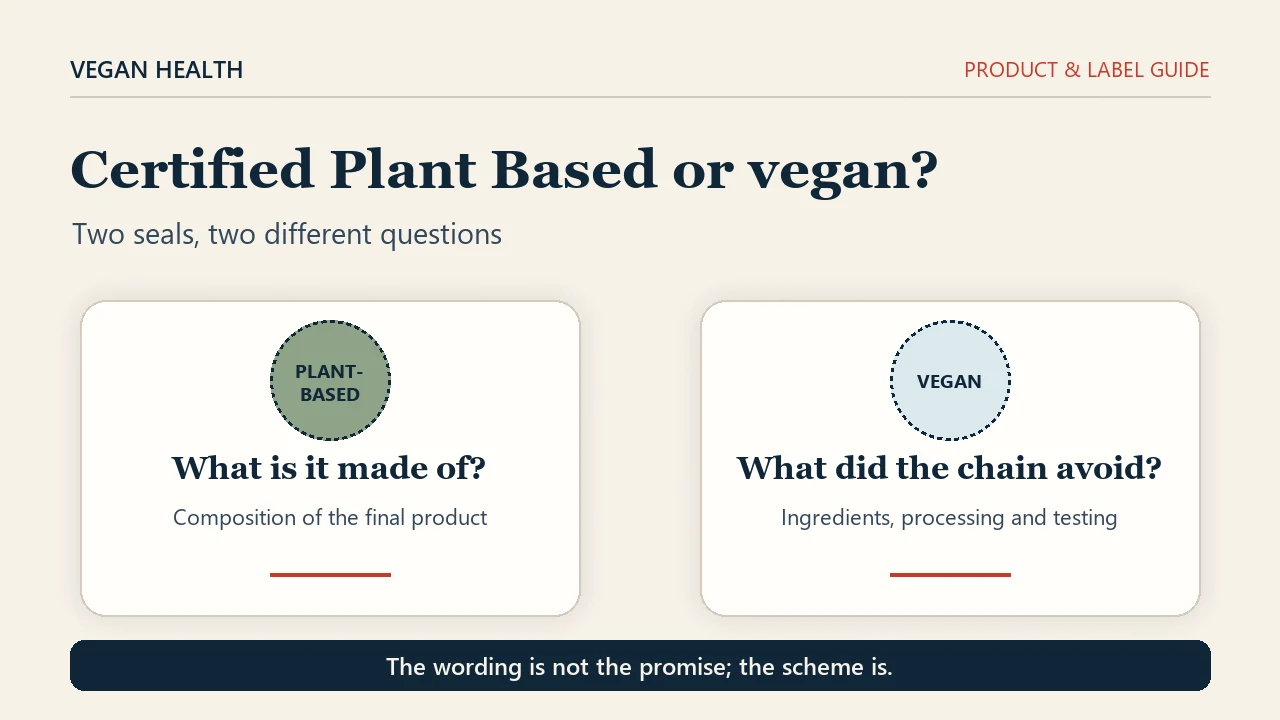
Two seals on two packets can both be honest and still mean different things. One is telling you what the food is made of. The other is telling you how far the maker went to keep animals out of the whole production chain. Neither is a legal term in most of the world, so the meaning does not come from the wording on the front of the pack. It comes from the scheme behind the mark, and those schemes are published documents you can read.
The two claims answer different questions
A plant-based claim is a statement about composition: what went into the finished food. A vegan claim, as the certifiers use it, is a statement about scope: which uses of animals the producer undertook to avoid across ingredients, processing aids and, in most schemes, testing.
The Plant Based Foods Association makes this explicit in its own protocol. The certification is assessed on the final product and not the process used to produce it. Plant-based foods are defined there as foods made from plants that contain no animal-derived ingredients, with whole grains, nuts, seeds, legumes, vegetables, fruits, fungi and algae all counted as plant origin for the purposes of the scheme.
Vegan certifiers start from a different sentence. The Vegan Society, which has run the Vegan Trademark since 1990 and reports more than 70,000 certified products worldwide, defines veganism as a philosophy that seeks to exclude, as far as is possible and practicable, all forms of exploitation of and cruelty to animals. That phrase is doing real work. It is why vegan schemes reach past the ingredient list into testing policy and factory practice, and also why they promise diligence rather than the absence of every last molecule.
The 10% rule is the most misread line on the page
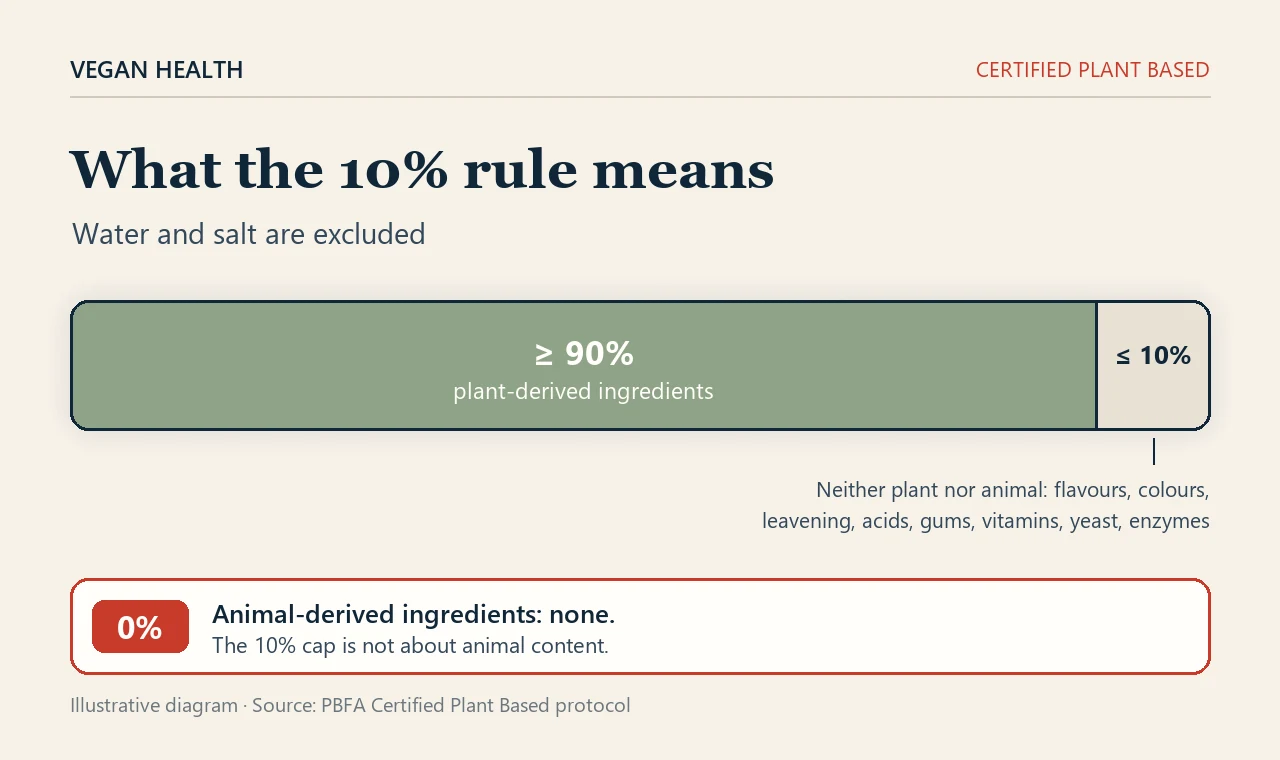
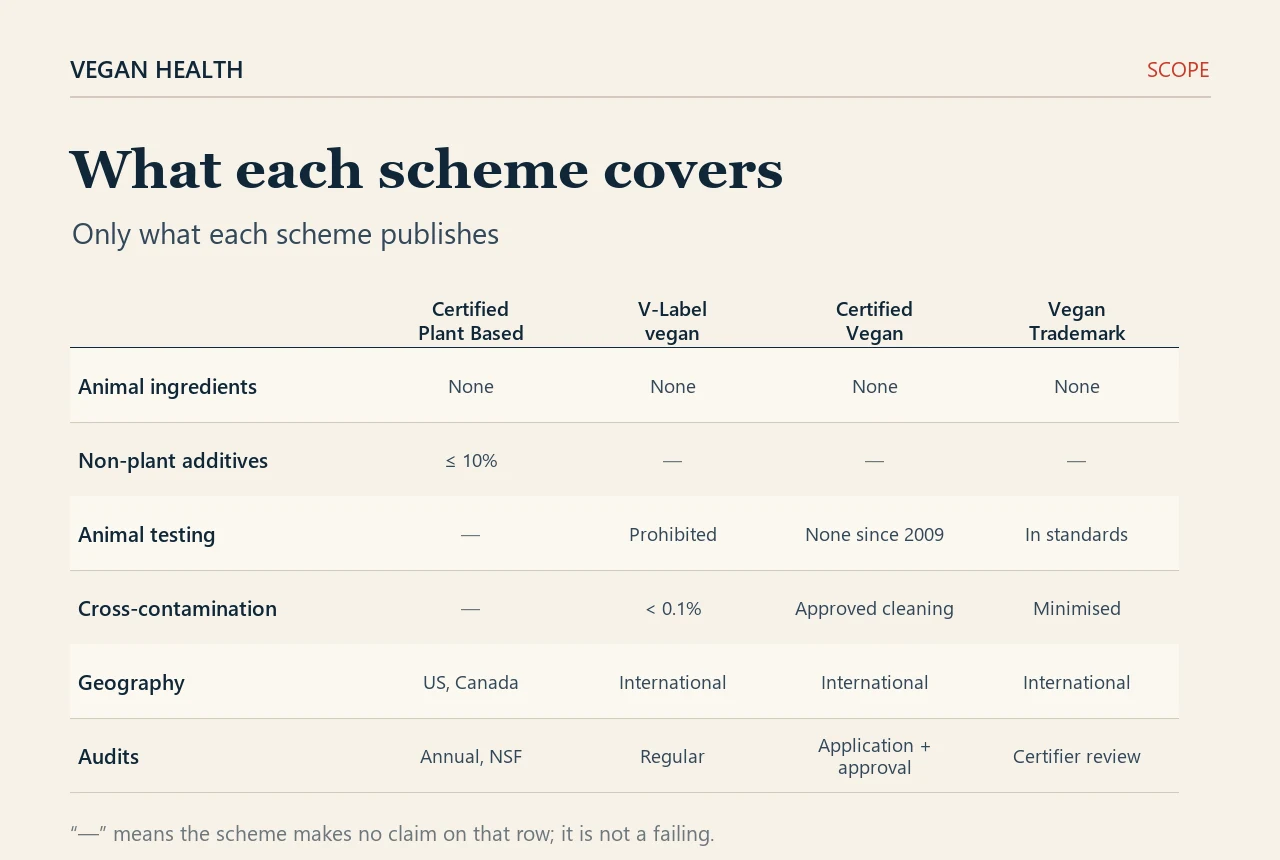
The Certified Plant Based protocol says that ingredients which are not derived from plants or animals may be used as long as they do not exceed 10% by weight of the product formula, individually or combined, excluding water and salt. In the same clause it says that no percentage of the product may contain animal-derived ingredients.
Read quickly, the first half sounds like a loophole. It is not. The 10% cap governs a third category that is neither plant nor animal: flavours and colours, leavening agents such as baking soda, acids, gums, vitamins and minerals, mined minerals such as calcium carbonate and potassium chloride, micro-organisms such as yeast and probiotics, and enzymes. Animal-derived ingredients are not capped at 10%. They are excluded entirely.
Two boundaries come with it. Single raw or single frozen ingredients, such as a bag of frozen broccoli, are outside the scope, because a plant-based seal on a vegetable adds nothing. And since 2024 the programme’s eligibility has widened from meat, egg and dairy alternatives to all plant-based food with no animal-derived ingredients, plus pet food, vitamins and supplements.
What a vegan seal adds
Three of the schemes shoppers meet most often publish their criteria in full. They differ in detail, and the differences are the point.
The V-Label, coordinated by a Switzerland-based trademark holder and registered as a mark in 1996, requires that no animal-derived substance be used at any stage of production and processing. It follows the chain into biotechnology: the culture media, fermenter substrates and carrier materials last used in making an ingredient must themselves meet the criteria. Products that require GMO labelling under applicable law cannot be licensed. Animal testing of the end product is prohibited, as is testing of individual ingredients or processing aids carried out specifically for that end product, with a narrow exception where the benefit is for the species being tested and welfare is not affected, such as feeding a vegetarian dog food to volunteers’ dogs under veterinary supervision. Licensees accept regular audits.
Certified Vegan, run by Vegan Action, the Vegan Awareness Foundation, excludes meat, fish, fowl, animal by-products including silk and insect-derived dyes, eggs, milk, honey and bee products, and products clarified or finished with animal products such as sugar filtered through bone char. Its animal testing rule is unusually explicit: no testing by the manufacturer since 2009, for any research purpose whatsoever, including environmental safety, feed or nutrition trials, toxicity testing, contracted third-party testing, and testing carried out “as required by law”, confirmed for ingredients as well as the finished product. Where a company shares machinery between vegan and non-vegan runs, it must submit cleaning and sanitation steps for approval.
The Vegan Trademark requires that cross-contamination be minimised as far as possible, and the Vegan Society states on its own site that it does not claim registered products are suitable for people with allergies to animal products. That is why a product carrying the mark can also carry a “may contain milk” warning.
Where the schemes draw the contamination line
Every scheme has to answer the same awkward question: shared factory lines exist, and traces travel. They answer it differently, and the wording matters more than it looks.
The V-Label sets a number. The unintended presence of non-vegan substances should be less than 0.1%, or 1 gram per kilogram, in the final product. If that benchmark is exceeded, the producer must improve every stage of production, processing and distribution, and must give reasons if optimisation is not possible. Where the producer has made all the arrangements to avoid contamination, exceeding the benchmark does not automatically remove the label.
This is an unintended presence threshold, not permission to formulate with 0.1% animal ingredient. Deliberately adding whey to a product and staying under a gram per kilogram would not pass; the ingredient rules are absolute and separate.
The Vegan Trademark takes the qualitative route, requiring contamination to be minimised as far as possible rather than naming a figure. Certified Vegan focuses on the procedure, requiring approved cleaning and sanitation between runs on shared equipment. Certified Plant Based, being a composition claim about the final product, does not publish a contamination rule of this kind.
Why the law is not doing this work for you
In the European Union there is still no binding legal definition of “vegan” or “vegetarian” for food labelling. Article 36(3)(b) of Regulation (EU) No 1169/2011 instructs the Commission to adopt an implementing act on exactly this, and that act has not been adopted; industry and consumer bodies including FoodDrinkEurope and the European Vegetarian Union have repeatedly asked for it. Voluntary information must still be accurate and must not mislead, but the word itself has no fixed content in law.
There is an international standard, and it is often misunderstood. ISO 23662:2021 sets definitions and technical criteria for foods and food ingredients suitable for vegetarians or vegans, and for labelling and claims. Its criteria apply only post-harvest. It explicitly does not cover human safety, environmental safety, socio-economic considerations such as fair trade and animal welfare, religious beliefs, or packaging materials. It is a reference document, not a certification programme with a logo, so a claim of being “ISO certified vegan” deserves a follow-up question about who audited what.
The practical consequence is the same everywhere: because the word is not defined by law, the certifier’s published rules are the definition in force for that pack.
No seal on this page is an allergen guarantee
This is the one line worth carrying out of the article. A vegan or plant-based certification is about avoiding animal use, not about protecting people with allergies. The Vegan Society says so directly. The V-Label’s 0.1% benchmark is an animal-content benchmark, not a clinical safety threshold, and it can be exceeded without the label being withdrawn if the producer has taken all reasonable steps.
If you have a milk, egg, fish or crustacean allergy, the information you need is the allergen declaration and any precautionary “may contain” statement, on the current packaging, every time. A vegan logo does not replace either. This article is general information and does not assess any specific product or replace advice from your own clinician or a dietitian.
What to check when you see either mark
- Is it a scheme or a sentence? A logo belongs to a named certifier with published criteria. The words “plant-based” printed on a wrapper are a marketing description, and because the term is not defined in law they can appear on a product that also contains milk or egg.
- Which question is it answering? Composition of the finished food, or scope across ingredients, processing and testing.
- Does the scheme cover animal testing? The V-Label and Certified Vegan publish testing rules. A plant-based composition claim does not.
- Where does it apply? Certified Plant Based is a United States and Canada programme with NSF as the exclusive certifier. Seeing the mark elsewhere is a reason to check, not to assume.
- What is covered, and is it current? Each scheme draws this line differently. Certified Plant Based is granted product by product, with NSF reviewing certified products annually; Certified Vegan licenses the company rather than a single item. Look for a certificate number or registry entry rather than assuming the whole brand is covered.
- Read the allergen line anyway. Every time, on the pack in your hand.
Our shorter overview, Vegan Certification Labels: What They Mean, covers the individual schemes at a glance. For cosmetics, where “vegan” and “cruelty-free” answer two separate questions, see How to Read a Vegan Cosmetics Label. For the nutrition side of a package, How to Read a Fortified Food Label explains why a claim on the front never replaces the nutrition declaration.
A short answer to the question in the title
Certified Plant Based and a vegan seal are not competitors, and neither is a diluted version of the other. On animal ingredients they agree completely: none. They part company on how much else they promise to have checked. If your reason for reading labels is what the food is made from, a plant-based certification answers it. If your reason extends to testing and to how seriously a factory keeps the lines apart, a vegan scheme with published criteria on those points is the mark that carries the answer.
Medical note: This article is general information about food labelling schemes. It does not assess any specific product, does not diagnose or treat any condition, and is not a substitute for individual advice. If you have a food allergy or a medical dietary restriction, rely on the allergen declaration on the current packaging and consult a qualified health professional.
Sources
- Plant Based Foods Association. Plant Based Foods Claim Certification Program, Version 2, Issue 2, 14 February 2022.
- Plant Based Foods Association. Certified Plant Based, programme scope, eligibility and fees.
- Plant Based Foods Association. How is PBFA’s Certified Plant Based Seal Different from Vegan?
- NSF. Certified Plant Based Label.
- V-Label. Criteria for the V-Label.
- Vegan Awareness Foundation. Certified Vegan Logo certification standards.
- The Vegan Society. Vegan Trademark standards.
- The Vegan Society. Definition of veganism.
- FoodNavigator, 2 February 2024. “Vegan” labels don’t always mean free from animal products, quoting the Vegan Society on cross-contamination and allergy suitability.
- Regulation (EU) No 1169/2011 on the provision of food information to consumers, consolidated text, Article 36.
- European Commission. Food information to consumers legislation.
- ISO. ISO 23662:2021 — Definitions and technical criteria for foods and food ingredients suitable for vegetarians or vegans and for labelling and claims.
Editor: Anıl Güler, Pharmacist
Scientific review date: 7 September 2026