Diet for a Small Planet: Frances Moore Lappé’s 1971 Book and the Protein Myth She Corrected
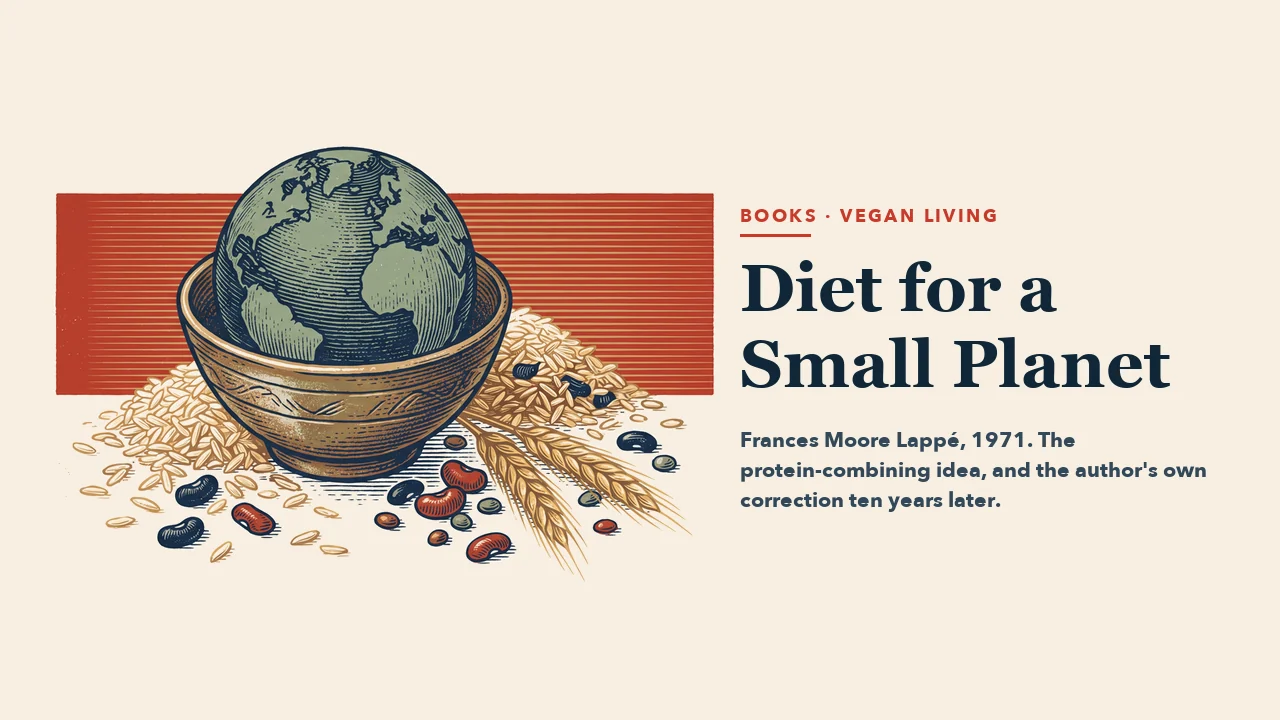
Diet for a Small Planet by Frances Moore Lappé appeared in 1971 from Ballantine Books. It has sold more than three million copies, according to the author’s Small Planet Institute, and it has been reissued several times; the 50th anniversary edition came out in 2021. Our earlier reviews covered Peter Singer’s Animal Liberation and Tom Regan on animal rights. Lappé’s book belongs on the same shelf for a different reason: its starting point was not ethics but waste. Much of it is devoted to protein combining, an idea Lappé herself scaled back ten years later.
Where it started
In a passage from the 20th anniversary edition (1991), read on air by Indiana Public Media, Lappé describes what she found in the United States: “In 1969 I discovered that half of our harvested acreage went to feed livestock”. She learned that “for every 7 pounds of grain and soybeans fed to livestock, we get on the average only one pound back in meat on our plates”, and that cattle are the poorest converters: “It takes 16 pounds of grain and soybeans to produce just one pound of beef.”
In an interview broadcast by Indiana Public Media, she recalled the shock of that discovery and the name she gave it: “I called it the protein factory in reverse.” The book began, she said, as a one-page handout; the recipes were the publisher’s idea.
The book is in four parts. The first deals with protein in US agribusiness, the second with protein in human nutrition, the third with food values and costs, and the fourth, “Combining Non-Meat Foods to Increase Protein Values”, with guidelines and recipes.
Protein combining, and the correction ten years later
Lappé knew her readers would doubt that a meatless diet could supply enough protein. Her answer was protein complementarity: grains are relatively low in one essential amino acid and legumes in another, so eating them together makes a protein closer to the body’s needs. The fourth part of the book taught readers how to combine foods to achieve this.
In the tenth-anniversary edition of 1981, she wrote that she had overstated the case: “In 1971 I stressed protein complementarity because I assumed that the only way to get enough protein … was to create a protein as usable by the body as animal protein. In combating the myth that meat is the only way to get high-quality protein, I reinforced another myth.” She had given the impression, she wrote, that “in order to get enough protein without meat, considerable care was needed in choosing foods. Actually, it is much easier than I thought.”
She named three exceptions: diets very heavily dependent on fruit, on some tubers such as sweet potatoes or cassava, or on junk food (refined flours, sugars and fat). In all other diets, she wrote, “if people are getting enough calories, they are virtually certain of getting enough protein.”
What the science says now
Lappé’s correction has held up. A 1994 review by Vernon Young and Peter Pellett concluded that “mixtures of plant proteins can serve as a complete and well-balanced source of amino acids for meeting human physiological requirements.” At the time, plant foods made up about 65% of the world’s per capita protein supply (about 32% in North America).
A 2019 review by François Mariotti and Christopher Gardner looked at the question in more detail:
- Same meal or same day? The authors found “no evidence yet” that single plant proteins need to be supplemented with other proteins in the same meal; a reasonable variety of sources over the course of the day appears to be appropriate. Mixing complementary sources in one meal may simply be a practical way to secure adequacy when total protein intake is low.
- Lysine, the usual weak point. Using EPIC-Oxford data and assuming an average body weight of 65 kg, they calculated daily lysine intakes of 58 mg/kg in lacto-ovo vegetarians and 43 mg/kg in vegans, well above the estimated average requirement of 30 mg/kg. They noted that inadequate lysine could be more likely in vegans who get a very high proportion of their protein from cereals alone, which the authors call unrealistic in developed countries.
- Overall, when diets are at least slightly varied, strict attention to complementary amino acid patterns is, in their words, “simply over-precautious”.
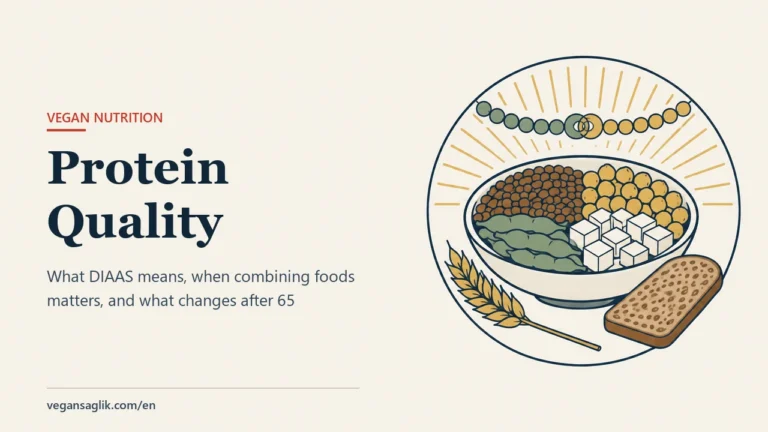
The complementarity itself is real. A 2020 review by Robert Davies and Philip Jakeman gives an example using DIAAS, a modern measure of protein quality: on their own, rice scores 0.74 and lentils 0.54, both classed as low-quality, while a mix of 65 g of rice and 35 g of lentils scores 1.0, because rice lacks lysine and lentils lack the sulphur amino acids. As Mariotti and Gardner note, this balancing can happen across the day; it does not have to be calculated plate by plate. Our guide to protein quality in a vegan diet explains DIAAS in more detail, and seitan is a good example of a protein that is very low in lysine.
The Academy of Nutrition and Dietetics states in its 2016 position paper that appropriately planned vegetarian, including vegan, diets are healthful, nutritionally adequate and appropriate for all stages of the life cycle. The same paper adds that vegans need reliable sources of vitamin B12, such as fortified foods or supplements.
The feed argument fifty years later
Lappé’s ratios counted all the grain and soybeans fed to livestock. A 2017 analysis by Anne Mottet and colleagues asked a narrower question: how much of what livestock eat could people eat? It estimated that livestock consume 6 billion tonnes of feed (dry matter) a year, including one third of global cereal production, but that 86% of that feed is made of materials that are currently not eaten by humans. On average, producing 1 kg of boneless meat required 2.8 kg of human-edible feed in ruminant systems and 3.2 kg in monogastric systems, such as pigs and poultry. The same analysis estimates that livestock use 2.5 billion hectares of land.
These figures are not directly comparable with Lappé’s. Her figures describe grain-fed American livestock and count every pound of grain and soy; Mottet’s are global averages that count only food people could eat, and they cover the full range of production systems, including animals grazing on pasture. Even on that narrower measure, producing 1 kg of meat takes about three times its weight in human-edible feed. On this basis ruminants come out slightly better than pigs and poultry, the reverse of Lappé’s ranking.
Not a vegan book
Diet for a Small Planet is a vegetarian book, not a vegan one. Some of its recipes use dairy products such as cheese, and when Anna Lappé, the author’s daughter, updated the recipes for the 50th anniversary edition, some of them switched from margarine to butter. Vegan readers will need to adapt some recipes, such as the Walnut Cheddar Loaf, which uses cheese and eggs. The feed argument, though, applies to dairy and eggs as much as to meat.
How to read it today
- The central idea holds: feeding crops to animals loses much of the food value of those crops. A 2017 global analysis that counts only human-edible feed puts the loss lower, but meat still takes about three times its weight in such feed.
- The protein-combining chapters are dated, and the author said so herself in the tenth-anniversary edition. For most adults, a varied plant diet with enough energy and regular protein-rich foods such as legumes supplies enough protein; combining within a meal is optional.
- The book’s real legacy is the question it asks: what does a single plate of food cost the planet? As WBUR put it at the 50th anniversary, many of its ideas went from counterculture in 1971 to mainstream in 2021.
Lappé’s later work moved from food to politics. She has argued from the beginning, she says, that hunger is caused not by a scarcity of food but by a scarcity of democracy.
Sources
- Lappé FM. Diet for a Small Planet. New York: Ballantine Books; 1971. 10th anniversary edition, Ballantine, 1981 (dated 1982 in the Small Planet Institute’s list), p. 162, quoted via Wikipedia; 20th anniversary edition 1991; 50th anniversary edition, Ballantine Books, 2021.
- Small Planet Institute. Frances Moore Lappé (author page).
- Young K. Earth Eats: Frances Moore Lappé. Indiana Public Media, 5 May 2023 (rebroadcast; recorded in November 2021).
- Celebrating 50 years of “Diet for a Small Planet”. WBUR Here & Now, 11 October 2021.
- Young VR, Pellett PL. Plant proteins in relation to human protein and amino acid nutrition. Am J Clin Nutr 1994;59(5 Suppl):1203S–12S.
- Mariotti F, Gardner CD. Dietary Protein and Amino Acids in Vegetarian Diets—A Review. Nutrients 2019;11(11):2661.
- Davies RW, Jakeman PM. Separating the Wheat from the Chaff: Nutritional Value of Plant Proteins and Their Potential Contribution to Human Health. Nutrients 2020;12(8):2410.
- Melina V, Craig W, Levin S. Position of the Academy of Nutrition and Dietetics: Vegetarian Diets. J Acad Nutr Diet 2016;116(12):1970–80.
- Mottet A, et al. Livestock: On our plates or eating at our table? A new analysis of the feed/food debate. Glob Food Sec 2017;14:1–8.
Editor: Anıl Güler, Pharmacist
Last reviewed: 21 October 2026