Creatine on a Vegan Diet
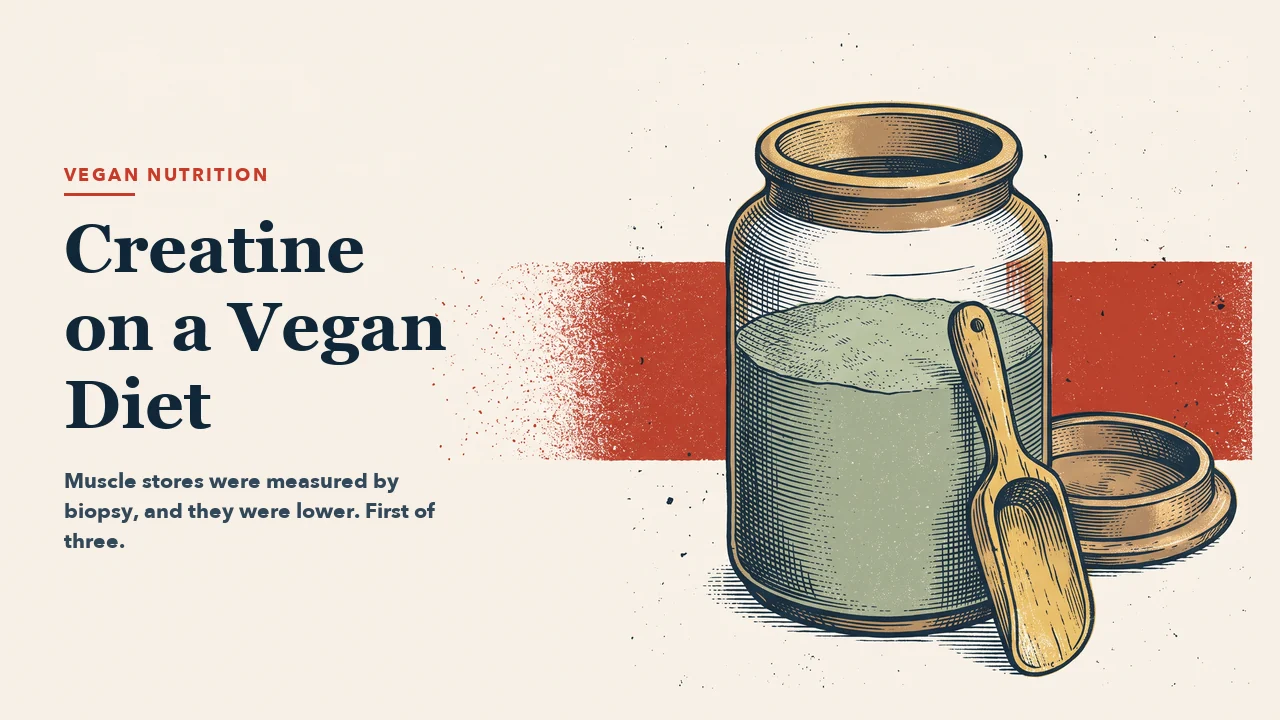
Vegans carry less creatine in their muscles than meat eaters — that part is not a marketing claim, it has been measured by biopsy. What follows from it is a narrower question than the supplement industry suggests, and it has reasonably good answers. This is the first of three short pieces on creatine, carnitine and taurine: the three substances that get sold together and have almost nothing in common once you look at the evidence.
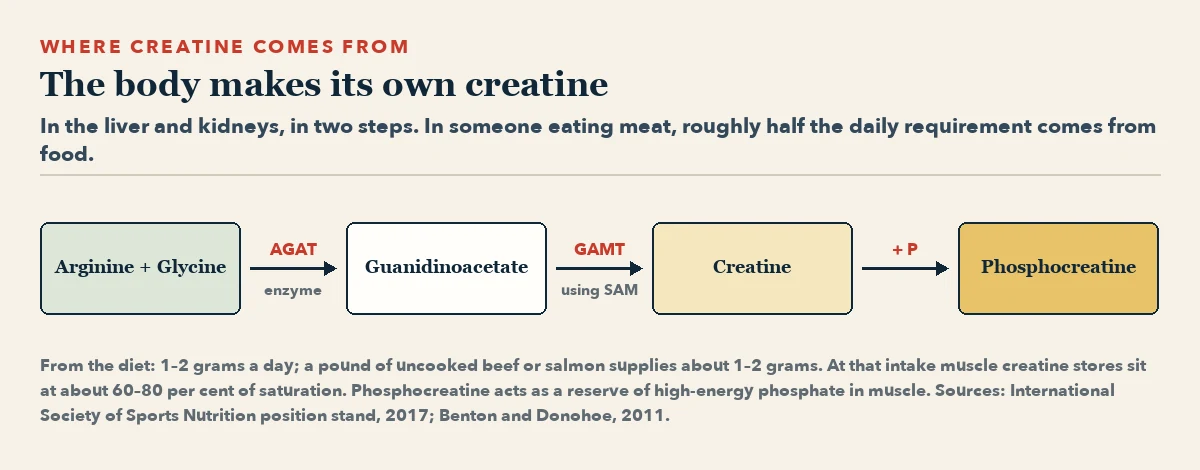
Creatine is made in the liver and kidneys from arginine and glycine. In someone eating meat, roughly half the daily requirement comes from food — a pound of uncooked beef or salmon supplies about 1 to 2 grams — and the body makes the rest. On a diet supplying 1 to 2 grams a day, muscle creatine stores sit at about 60 to 80 per cent of saturation. Take the dietary half away and the body keeps synthesising, but the stores settle lower.
The stores really are lower
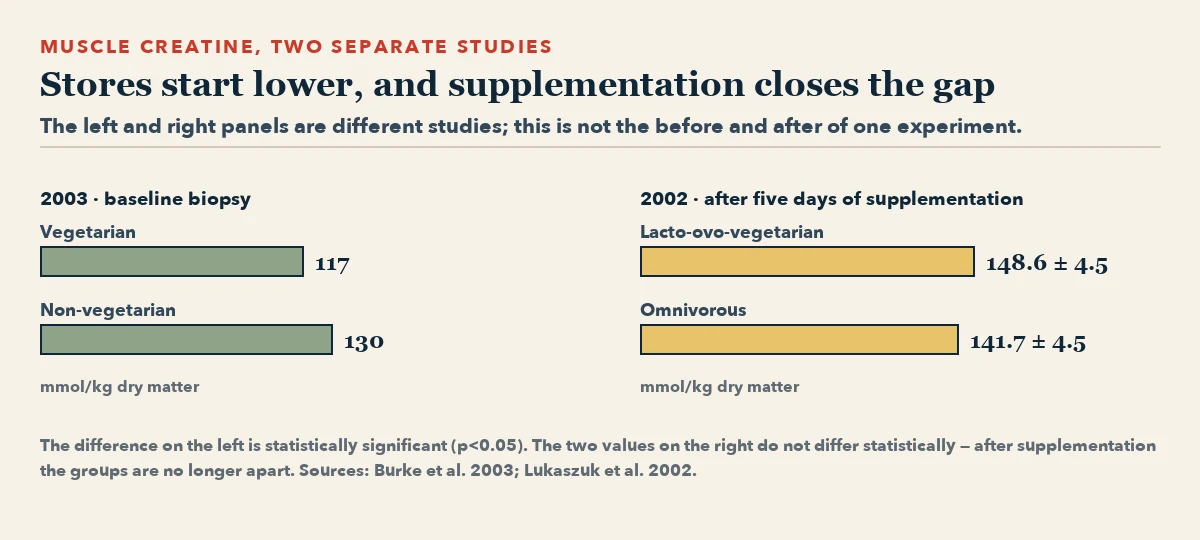
This is not an inference from diet records. Muscle biopsies show it. In a 2003 trial that put 18 vegetarians and 24 non-vegetarians through the same eight-week resistance-training programme, baseline total creatine in the vastus lateralis was 117 mmol/kg in the vegetarians against 130 mmol/kg in the non-vegetarians (p<0.05).
A 2002 study approached it from the other direction. 32 men who normally ate meat were put on a weight-maintaining lacto-ovo-vegetarian diet for 26 days, and 21 days of that diet was enough to lower muscle creatine concentration significantly (p<0.01). The effect is dietary, not constitutional: change the diet and the number moves.
The useful part is what happens next. In the 2003 trial, the vegetarians who took creatine gained more total creatine, more phosphocreatine, more lean tissue and more total work performance than the non-vegetarians who took the same supplement. Starting lower left more room to move. The 2002 study found the same thing from its own angle: after five days of supplementation, muscle total creatine in the vegetarian group no longer differed statistically from the omnivorous group (148.6 ± 4.5 versus 141.7 ± 4.5 mmol/kg dry matter). The gap closes.
The first trial in vegans specifically
Until this year the vegan-specific evidence was thin. A 2026 trial in the European Journal of Applied Physiology is the first randomised, triple-blind, placebo-controlled study we have found in physically active vegan adults. Twenty participants aged 18 to 45 were randomised to creatine monohydrate at 0.1 g per kg of body weight per day or placebo, five women and five men in each arm, for four weeks on a normocaloric vegan diet.
After four weeks the creatine group showed increases in skeletal muscle mass (+0.3 kg), total body water (+1.4 kg) and BMI (+0.3 kg/m²), and a reduction in body fat (−1.4 kg) relative to controls (p<0.05). Performance improved in lower-body explosive measures — the countermovement jump, and maximal height and flight time in repeated jumps (p<0.001–0.04) — with no change in sprint or strength tests. Serum creatinine and serum creatine both rose, which matters for a reason we come to below.
One inconsistency in the published abstract should be flagged rather than smoothed over: the conclusion states that creatine “enhances muscle strength and lower-body muscular power”, while the results section reports no change in the strength tests. The results are the more specific statement, and that is what we have reported.
Two limits are worth stating plainly. Twenty people over four weeks is a small, short trial, and the authors themselves call for longer studies to confirm effectiveness and safety in this population. And the full text sits behind a subscription, so the figures above are those the authors published in the abstract; we have not read the effect sizes or the renal biomarker tables in full.
How big is the effect, in general?
For scale, the largest recent synthesis pooled 69 studies with 1,937 participants. Creatine combined with resistance training produced statistically significant but small improvements: bench or chest press strength +1.43 kg, squat strength +5.64 kg, vertical jump +1.48 cm, and Wingate peak power +47.81 watts. Handgrip strength (+4.26 kg, p=0.10) and leg press strength (+3.13 kg, p=0.11) did not reach significance.
The subgroup findings deserve more attention than they usually get. Benefits were consistent in younger adults and in men; in older adults and in women, several outcomes were smaller or not statistically significant. The authors are explicit that more well-powered trials in women and older adults are needed. If you are an older woman reading a supplement advert built on this literature, that caveat is about you.
Memory, and why vegetarians keep appearing in these studies
The brain uses creatine too. In a 2011 double-blind trial, 128 young women took either 20 g of creatine a day for five days or placebo. Verbal fluency and vigilance did not change. Memory did — but only in the vegetarians, not in the meat eaters.
Two meta-analyses have since pooled the general literature. A 2023 systematic review and meta-analysis of randomised trials found creatine improved memory overall (standardised mean difference, SMD 0.29; 95% confidence interval, CI 0.04–0.53; I² 66%; p=0.02), with a markedly larger effect in adults aged 66 to 76 (SMD 0.88; 95% CI 0.22–1.55) than in those aged 11 to 31 (SMD 0.03; 95% CI −0.14 to 0.20). A 2024 meta-analysis of 16 randomised trials in 492 adults found a significant effect on memory (SMD 0.31; 95% CI 0.18–0.44) and on attention and processing speed times, but no significant improvement in overall cognitive function or executive function. Its GRADE assessment rated the certainty of evidence as moderate for memory and low for everything else.
A modest memory effect, best supported in older adults, plausibly larger in people who start with lower stores. Not a nootropic. Not nothing.
Dose and form, as published
The International Society of Sports Nutrition position stand describes two established protocols. The fastest way to fill muscle stores is 5 g of creatine monohydrate (about 0.3 g/kg body weight) four times a day for five to seven days. The alternative is 3 g a day for 28 days, which raises stores gradually and therefore takes longer to affect performance. Some individuals may need 5 to 10 g a day to maintain stores; taking creatine with carbohydrate improves retention. Creatine monohydrate is the most extensively studied and clinically effective form; the other forms on sale do not have a comparable evidence base behind them.
The kidney question
This is the question readers actually ask, and it has a specific, answerable form. Creatine supplementation raises serum creatinine. Serum creatinine is the number your doctor uses to estimate kidney function. So does the supplement damage kidneys, or does it just move the marker?
A 2025 systematic review and meta-analysis in BMC Nephrology addressed exactly this. Twenty-one studies were reviewed and 12 pooled (177 participants on creatine, 263 controls). Serum creatinine rose by a small but statistically significant amount (mean difference 0.07 µmol/L; 95% CI 0.01–0.12; p=0.03). Glomerular filtration rate showed no statistically significant change. The authors’ reading is that the creatinine rise reflects metabolic turnover rather than renal impairment, with kidney function preserved. An earlier 2019 meta-analysis in the Journal of Renal Nutrition, which screened 290 studies and pooled six, concluded that creatine supplementation does not induce renal damage at the amounts and durations studied.
One note of editorial caution about that 2019 paper: its abstract states that creatine “did not significantly alter” serum creatinine while reporting a standardised mean difference of 0.48 with a confidence interval of 0.24 to 0.73 and p=0.001 — a result that, as reported, does not describe an unchanged value. We cite its overall conclusion and lean on the 2025 analysis for the numbers.
The practical consequence is not “avoid creatine”. It is this: if you take creatine and you are about to have a blood test that includes creatinine or eGFR, tell whoever ordered it. A raised creatinine in someone who never mentioned a supplement can start an investigation that did not need to happen.
What this adds up to
Of the three substances in this series, creatine is the one where a vegan has a specific, measured reason to consider supplementing and a clear conversation to have with a pharmacist: the stores are demonstrably lower, the response to supplementation is larger in people who start lower, the effects on strength and power are real but small, and the kidney concern resolves into a practical instruction rather than a risk. That is already more than can be said for the other two.
Limits of this article
- The only randomised trial of creatine in vegans specifically had 20 participants and ran four weeks, and its full text is behind a subscription; the figures cited are from the published abstract.
- The performance and cognition meta-analyses were conducted in general populations, not in vegans. Applying them to a vegan reader is an inference, though one supported by the biopsy data on lower starting stores.
- No study cited here examined children, pregnancy or breastfeeding.
- This is information, not a recommendation. Decisions about supplements belong with your own doctor or pharmacist, who knows your medication and your test results.
Sources
- Kreider RB, Kalman DS, Antonio J, Ziegenfuss TN, Wildman R, Collins R, Candow DG, Kleiner SM, Almada AL, Lopez HL. International Society of Sports Nutrition position stand: safety and efficacy of creatine supplementation in exercise, sport, and medicine. J Int Soc Sports Nutr. 2017;14:18. doi:10.1186/s12970-017-0173-z.
- Burke DG, Chilibeck PD, Parise G, et al. Effect of creatine and weight training on muscle creatine and performance in vegetarians. Med Sci Sports Exerc. 2003;35(11):1946-55. doi:10.1249/01.MSS.0000093614.17517.79.
- Lukaszuk JM, Robertson RJ, Arch JE, et al. Effect of creatine supplementation and a lacto-ovo-vegetarian diet on muscle creatine concentration. Int J Sport Nutr Exerc Metab. 2002;12(3):336-48. doi:10.1123/ijsnem.12.3.336.
- López-Moreno M, Muñoz A, Aguilar-Navarro M, et al. Does creatine supplementation improve strength and power in physically active individuals on a vegan diet? a randomized, triple-blind, placebo-controlled trial. Eur J Appl Physiol. 2026. doi:10.1007/s00421-026-06323-5.
- Kazeminasab F, Kerchi AB, Sharafifard F, et al. The Effects of Creatine Supplementation on Upper- and Lower-Body Strength and Power: A Systematic Review and Meta-Analysis. Nutrients. 2025;17(17). doi:10.3390/nu17172748.
- Benton D, Donohoe R. The influence of creatine supplementation on the cognitive functioning of vegetarians and omnivores. Br J Nutr. 2011;105(7):1100-5. doi:10.1017/S0007114510004733.
- Prokopidis K, Giannos P, Triantafyllidis KK, et al. Effects of creatine supplementation on memory in healthy individuals: a systematic review and meta-analysis of randomized controlled trials. Nutr Rev. 2023;81(4):416-427. doi:10.1093/nutrit/nuac064.
- Xu C, Bi S, Zhang W, et al. The effects of creatine supplementation on cognitive function in adults: a systematic review and meta-analysis. Front Nutr. 2024;11:1424972. doi:10.3389/fnut.2024.1424972.
- Naeini EK, Eskandari M, Mortazavi M, et al. Effect of creatine supplementation on kidney function: a systematic review and meta-analysis. BMC Nephrol. 2025;26(1):622. doi:10.1186/s12882-025-04558-6.
- de Souza E Silva A, Pertille A, Reis Barbosa CG, et al. Effects of Creatine Supplementation on Renal Function: A Systematic Review and Meta-Analysis. J Ren Nutr. 2019;29(6):480-489. doi:10.1053/j.jrn.2019.05.004.
Editor: Anıl Güler, Pharmacist
Last scientific review: 5 October 2026