Chia or Flaxseed? How They Compare on Omega-3, Fibre, Grinding and Safety
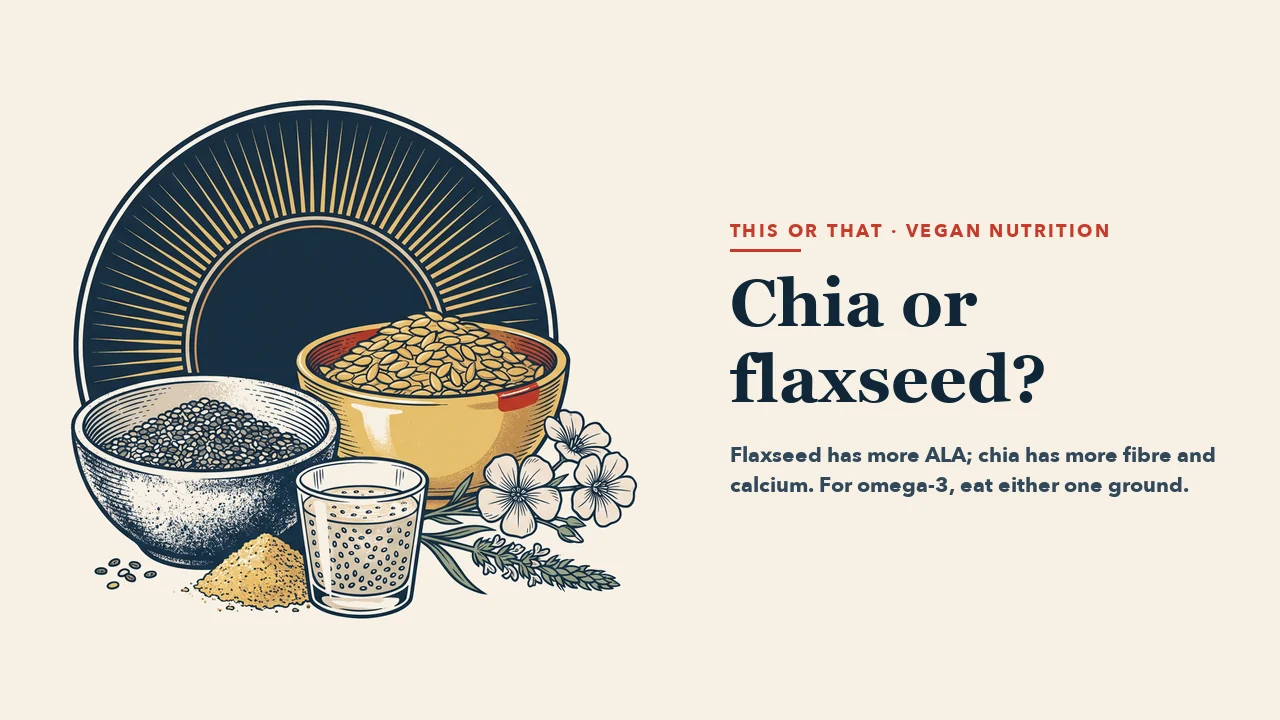
Short answer: Both are rich plant sources of the omega-3 fatty acid ALA, and the form you eat matters more than which seed you choose. Per 100 g, flaxseed has more ALA and potassium; chia has more fibre, calcium and iron. In one trial for each seed, whole seeds did not significantly raise blood ALA, while milled seeds did. The clinical evidence is stronger for flaxseed, with small reductions in LDL cholesterol and blood pressure; for chia it is thinner and less consistent. Neither seed is a meaningful source of DHA.
Two small seeds, two plants
Chia (Salvia hispanica) is a plant in the mint family; its name comes from a Nahuatl word meaning “oily”, and it has been used for thousands of years. Flaxseed, also called linseed (Linum usitatissimum), has been grown in Europe and Asia for more than 8,000 years for its fibre and oil. Both seeds are high in fat, fibre and protein, and both are eaten raw, soaked or ground. The practical difference starts in the kitchen: chia seeds absorb up to 12 times their weight in water and form a gel, while flaxseed is usually eaten ground.
Per 100 g: what the numbers show
The figures below come from the U.S. Department of Agriculture’s FoodData Central (SR Legacy), per 100 g of dried seeds.
| Per 100 g | Chia seeds | Flaxseed |
|---|---|---|
| Energy | 486 kcal | 534 kcal |
| Protein | 16.5 g | 18.3 g |
| Fat | 30.7 g | 42.2 g |
| ALA (omega-3) | 17.8 g | 22.8 g |
| Linoleic acid (omega-6) | 5.8 g | 5.9 g |
| Fibre | 34.4 g | 27.3 g |
| Calcium | 631 mg | 255 mg |
| Iron | 7.7 mg | 5.7 mg |
| Magnesium | 335 mg | 392 mg |
| Potassium | 407 mg | 813 mg |
| Zinc | 4.6 mg | 4.3 mg |
| Thiamin (B1) | 0.62 mg | 1.64 mg |
In a 10 g serving, flaxseed provides about 2.3 g of ALA and chia about 1.8 g; chia provides about 3.4 g of fibre and flaxseed about 2.7 g. Both seeds contain roughly three to four times more omega-3 than omega-6. Values vary by crop and product: in the same database, a separately analysed sample of ground flaxseed has 19.4 g of ALA, 23.1 g of fibre and 0.54 mg of thiamin per 100 g. The nutrition panel on the pack is a better guide than any average.
Whole or ground: the most important difference
Whole seeds can pass through the gut without releasing much of their oil, and the two trials below suggest this makes a real difference to how much ALA reaches the blood.
- Flaxseed. In a 2008 Canadian study, healthy adults ate 30 g of flaxseed a day baked into muffins, either whole or milled, or flaxseed oil providing the same 6 g of ALA. After one month, plasma ALA rose significantly in the milled seed and oil groups but not in the whole seed group. Some participants in the whole seed and oil groups withdrew because of digestive complaints; no one withdrew from the milled seed group.
- Chia. In a 2012 US trial, 62 overweight postmenopausal women took 25 g of chia a day, whole or milled, or a poppy seed placebo, for 10 weeks. In the milled chia group, plasma ALA rose by 58% and EPA by 39%; in the whole chia group, the changes were not significant. A smaller study by the same research group gave 25 g of milled chia a day to 10 women for seven weeks: plasma ALA rose by 138% and EPA by 30%.
If you want the omega-3 from either seed, eat it ground. Whole chia soaked into a gel is still whole chia; the studies above did not test soaked seeds.
ALA, EPA and DHA: what the seeds can and cannot do
ALA is the plant omega-3. The body can convert part of it into EPA and DHA, the long-chain forms found in fish and algae, but conversion is limited. In the studies above, milled chia raised EPA but not DHA, which fell slightly by the end of the seven-week study, and the 2008 flaxseed study found no significant change in either EPA or DHA.
A 2025 German study (NuEva) gave 168 adults following Western, flexitarian, vegetarian or vegan diets 3 g of ALA a day as flaxseed oil for nine months, together with nutrient-optimised menu plans. Red blood cell EPA rose by 27–41% and DHA by 13–26% across all diet groups, and the rise was larger in people who started with low EPA levels; even so, EPA in the vegan group stayed lower than in the other groups throughout. The study was not randomised and had no control group, and it used a high, steady dose of oil within a planned diet, so it shows that ALA can improve long-chain omega-3 status, not how much a spoonful of seeds will do. Our guide to omega-3 for vegans explains when an algal oil supplement is worth considering.
In observational research, ALA intake itself is linked with better outcomes. A 2021 BMJ meta-analysis of 41 cohort study articles with about 1.2 million participants found that each additional gram of ALA a day was associated with a 5% lower risk of death from all causes and from cardiovascular disease; higher ALA intake was also linked with a slightly higher risk of death from cancer. Cohort studies show associations, not cause and effect.
Clinical evidence: stronger for flaxseed
- Cholesterol. A 2020 meta-analysis of 62 randomised trials with 3,772 participants found that flaxseed lowered total cholesterol by about 5 mg/dL, LDL cholesterol by about 4 mg/dL and triglycerides by about 9 mg/dL, with no effect on HDL. A 2021 meta-analysis in people with lipid disorders found larger effects from the seed itself (LDL about 10.5 mg/dL lower) than from flaxseed oil, which did not lower blood lipids.
- Blood pressure. A 2023 meta-analysis of 33 trials with 2,427 participants found that flaxseed lowered systolic blood pressure by about 3 mmHg and diastolic by about 2.6 mmHg, although results varied widely between trials. Effects were larger with at least 30 g a day, with more than 20 weeks of use and in people with high blood pressure.
- Chia. A 2018 meta-analysis of 12 trials found no significant pooled effects; only subgroups at higher doses showed lower blood sugar after meals, lower diastolic blood pressure and also lower HDL (“good”) cholesterol, and the quality of evidence was rated low or very low. A 2024 meta-analysis in overweight adults found no change in blood lipids or blood sugar, but small reductions in systolic blood pressure (about 3 mmHg), waist circumference (about 2.8 cm) and CRP, a marker of inflammation.
These are modest effects that add up within an overall diet. Neither seed replaces treatment prescribed for high cholesterol or high blood pressure.
Safety: cyanide in flaxseed, a daily limit for chia
Flaxseed naturally contains cyanogenic glycosides, compounds that release cyanide when the seed is ground or chewed. The European Food Safety Authority (EFSA) assessed these compounds in 2019. Cyanide is released more slowly from flaxseed than from cassava or apricot kernels, and blood levels stay lower. In EFSA’s worst-case calculation, using the highest cyanide level in its database, a toddler could exceed the safe single-meal limit with only a few grams of freshly ground flaxseed (about 4 g, roughly a teaspoon, in EFSA’s summary; 1.3–2.3 g in its detailed table); for an average-weight adult the figure is about 11 g. EFSA notes that intact flaxseed that has not been freshly ground is expected to lead to much lower exposure. In practice, ground flaxseed is best kept to small amounts for young children, and large single servings of freshly ground flaxseed are worth avoiding.
Chia is authorised in the EU as a novel food. According to a 2019 review of EU rules, pre-packaged chia must carry a statement that daily intake should not exceed 15 g. Both seeds are high in fibre: increase the amount gradually and drink enough fluid.
How to choose
- For omega-3 (ALA), flaxseed has more per gram, and either seed should be eaten ground.
- For fibre and calcium, chia is ahead per 100 g.
- For cholesterol and blood pressure, the evidence is stronger for flaxseed than for chia.
- For DHA, neither: see our omega-3 guide.
- In the kitchen, chia gel works as an egg replacer and in puddings; ground flaxseed mixes into porridge, yoghurt and baking. Ground seeds are more exposed to air than whole seeds, so buy them in small amounts or grind them as you need them.
Eating both is a reasonable choice.
Sources
- U.S. Department of Agriculture, Agricultural Research Service. FoodData Central (SR Legacy and Foundation): Seeds, chia seeds, dried (170554); Seeds, flaxseed (169414); Flaxseed, ground (2262075).
- Austria JA, et al.. Bioavailability of alpha-linolenic acid in subjects after ingestion of three different forms of flaxseed. J Am Coll Nutr 2008;27(2):214–21.
- Nieman DC, et al.. Chia seed supplementation and disease risk factors in overweight women: a metabolomics investigation. J Altern Complement Med 2012;18(7):700–8.
- Jin F, et al.. Supplementation of milled chia seeds increases plasma ALA and EPA in postmenopausal women. Plant Foods Hum Nutr 2012;67(2):105–10.
- Klein L, et al.. Impact of α-linolenic acid supplementation on long-chain n-3 fatty acid profiles in Western, flexitarian, vegetarian, and vegan diets. Front Nutr 2025;12:1727308.
- Naghshi S, et al.. Dietary intake and biomarkers of alpha linolenic acid and risk of all cause, cardiovascular, and cancer mortality: systematic review and dose-response meta-analysis of cohort studies. BMJ 2021;375:n2213.
- Hadi A, et al.. Effect of flaxseed supplementation on lipid profile: An updated systematic review and dose-response meta-analysis of sixty-two randomized controlled trials. Pharmacol Res 2020;152:104622.
- Yang C, et al.. Comparisons of the effects of different flaxseed products consumption on lipid profiles, inflammatory cytokines and anthropometric indices in patients with dyslipidemia related diseases: systematic review and a dose–response meta-analysis of randomized controlled trials. Nutr Metab (Lond) 2021;18:91.
- Li L, et al.. Effect of flaxseed supplementation on blood pressure: a systematic review, and dose-response meta-analysis of randomized clinical trials. Food Funct 2023;14(2):675–90.
- Teoh SL, et al.. Clinical evidence on dietary supplementation with chia seed (Salvia hispanica L.): a systematic review and meta-analysis. Nutr Rev 2018;76(4):219–42.
- Karimi M, et al.. Effects of chia seed (Salvia hispanica L.) supplementation on cardiometabolic health in overweight subjects: a systematic review and meta-analysis of RCTs. Nutr Metab (Lond) 2024;21:74.
- EFSA CONTAM Panel. Evaluation of the health risks related to the presence of cyanogenic glycosides in foods other than raw apricot kernels. EFSA J 2019;17(4):e05662.
- Kulczyński B, et al.. The Chemical Composition and Nutritional Value of Chia Seeds—Current State of Knowledge. Nutrients 2019;11(6):1242.
Editor: Anıl Güler, Pharmacist
Last reviewed: 20 October 2026