A Low-Fat Vegan Diet and Type 2 Diabetes: What a New 16-Week Study Found
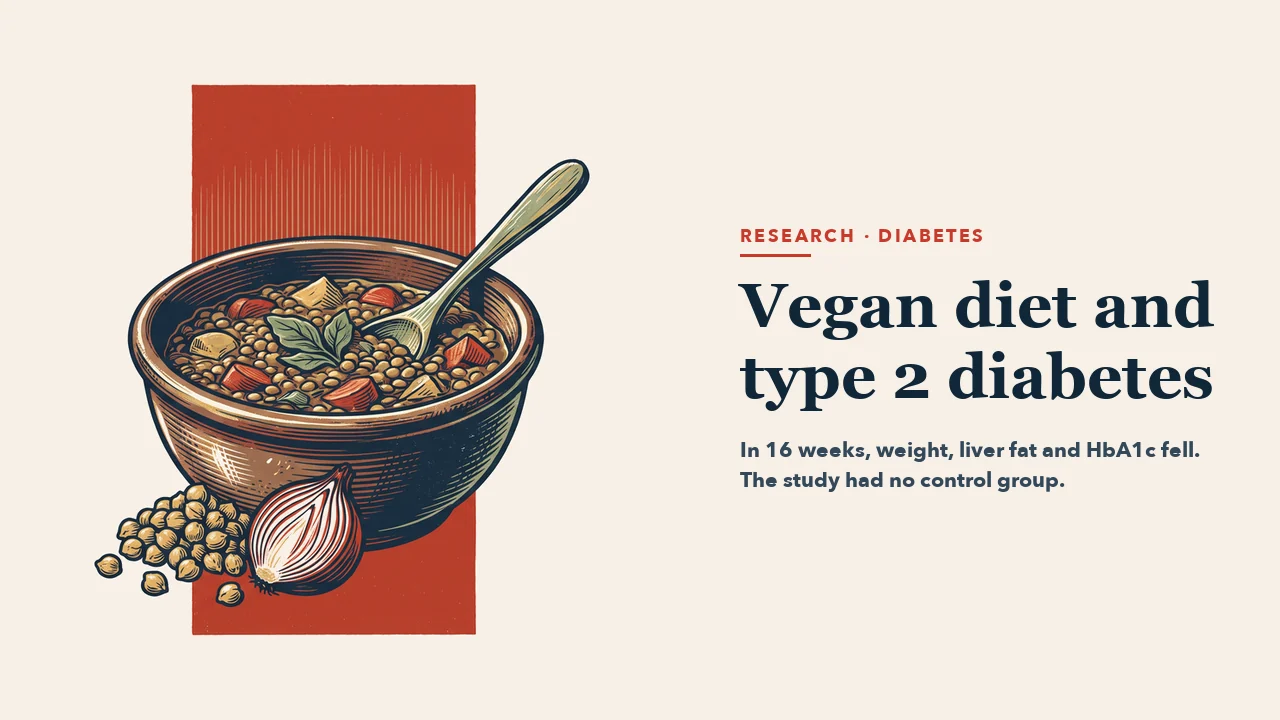
Short answer: In a small US study published on 8 October 2026 in BMJ Open Diabetes Research & Care, 25 adults with type 2 diabetes switched to a low-fat vegan diet for 16 weeks. They were not given a calorie target and were told to eat until full. On average they lost 6.0 kg, the fat inside their liver fell by 33%, and HbA1c, a blood test that reflects average blood sugar over the previous two to three months, fell from 7.6% to 6.6%. The study had no comparison group, so it cannot show how much of this came from the type of food and how much from eating less and losing weight. It was funded by the Physicians Committee for Responsible Medicine (PCRM), an organisation that promotes plant-based diets, and by grants from the US National Institutes of Health.
What the participants ate
The participants were adults with type 2 diabetes, on average 59 years old and with a body mass index of about 31. They were asked to eat vegetables, grains, legumes and fruit, and to avoid animal products and added fats such as oil. The planned diet was about 75% of energy from carbohydrate, 15% from protein and 10% from fat. No meals were provided: people cooked at home or ate out. Each week they had group support and individual advice from a dietitian, who taught them how to choose and prepare low-fat plant foods but did not set a calorie limit.
Everyone took a vitamin B12 supplement (500 µg a day). People were asked not to change their exercise habits and to keep taking their usual medicines unless their own doctor changed them.
According to food diaries kept for three days, the diet did change. Fat intake fell from 76.7 g to 24.6 g a day, and fibre rose from 24.0 g to 41.4 g. People also ate less overall: about 346 kcal a day fewer, even though nobody asked them to.
What changed after 16 weeks
Of the 25 people who started, 24 finished. The main changes, as averages:
- Weight: down 6.0 kg, or 6.6% of starting weight. A body scan showed fat mass fell by 4.2 kg and lean mass by 2.4 kg; the authors estimate that about 60% of the weight lost was fat and 40% lean mass.
- Fat deep in the belly, around the organs (visceral fat): down 290 cm³, from 2,168 to 1,878 cm³ (estimated by the body scan).
- Liver fat: down by a third on average (33%). Fat inside muscle cells fell by 13.1%, but this change was not statistically significant and may be due to chance.
- HbA1c: down 1.0 percentage point, from 7.6% to 6.6%.
- Fasting blood sugar: down from 155.1 to 115.5 mg/dL.
- Insulin resistance: HOMA-IR, an estimate of insulin resistance worked out from fasting blood sugar and insulin, roughly halved, from 5.0 to 2.5.
- Insulin production (beta-cell function): beta cells in the pancreas make insulin. After a standard breakfast drink, several measures of how well these cells release insulin as blood sugar rises improved. Two tests of how well the body responds to insulin after a meal also improved. These meal-test results come from 21 people, because data for three were lost to a laboratory error.
- LDL cholesterol: down 22 mg/dL. HDL cholesterol, often called “good” cholesterol, also fell, by 8.0 mg/dL; triglycerides did not change significantly.
The researchers also measured advanced glycation end products (AGEs), compounds formed when sugars attach to proteins; they build up in tissues faster when blood sugar stays high. A device that shines ultraviolet light on the skin estimates how much has built up. The score fell from 3.1 to 2.7.
Medicines
Of the 17 people taking metformin at the start, one dropped out, nine stayed on the same dose, five had their dose reduced and two stopped taking it. No one started a new diabetes medicine or increased a dose. Under the study rules, any change to medicines was left to the participants’ own doctors.
The study did not include people treated with insulin or sulfonylureas, or anyone taking weight-loss medicines, including GLP-1-type drugs. The only diabetes medicine used in the group was metformin, and eight of the 25 participants took no diabetes medicine at all. Insulin and sulfonylureas can cause low blood sugar, especially when eating habits change. If you take diabetes medicine and plan a large change in your diet, speak to your doctor first, so that doses can be adjusted if your blood sugar falls. Do not reduce or stop a medicine on your own.
Metformin can also lower vitamin B12 levels, and the NHS lists it among medicines that can affect B12. A vegan diet needs a reliable B12 source in any case. Our article on numbness and tingling after going vegan explains when low B12 should be considered.
What the study cannot tell us
There was no comparison group. Everyone followed the same diet, and there was no group that kept eating as before or followed a different diet. Without one, changes that would have happened anyway, or that came from the extra attention of weekly support, cannot be separated out. The authors write that the single-arm design “precludes causal attribution to the dietary intervention”.
Eating less and losing weight may explain much of it. People ate about 346 kcal a day fewer and lost 6.6% of their weight. Weight loss on its own lowers liver fat and improves blood sugar. The authors state that the effects of the vegan diet “cannot be distinguished from those attributable to this reduced energy intake and the accompanying weight loss”. What the study does show is that this weight loss happened without a calorie target or calorie counting.
Some of the weight lost was muscle and other lean tissue. About 40% of the weight lost was lean mass. Protein intake fell from 79.4 g to 59.2 g a day, and physical activity also decreased. The authors suggest that future studies look at resistance exercise and protein to protect lean mass, given that participants were older adults.
The group was small and motivated. The study was planned for at least 16 completers. Most participants had a graduate degree, and the authors describe them as health conscious and willing to make big changes to their diet. They may not represent the general population, though the authors note they may resemble people who seek help for weight problems or type 2 diabetes. Food intake was self-reported. The authors call it an exploratory pilot study: many outcomes were tested without adjusting for multiple comparisons, so a few of the smaller “significant” changes could be chance findings. And 16 weeks is short; the study cannot say whether the changes last.
Who funded it. The study was funded by PCRM and by grants from the US National Institutes of Health; the authors state that the funders had no role in the design, analysis or writing. Five authors, including the lead author Hana Kahleova, were paid by PCRM for their work on the study. Neal Barnard, the senior author, is PCRM’s unpaid president and receives royalties and fees from books and lectures on nutrition. The other four authors, including the Yale School of Medicine researchers who carried out the liver and muscle fat scans, reported no conflicts of interest.
How it fits with earlier work
The same research group found similar changes in people without diabetes: in a 2020 randomised trial in overweight adults, a low-fat vegan diet reduced liver and muscle fat. Our article on how a vegan diet cut dietary energy density looks at another study from the same group and how the diet changed the energy density of what people ate. The authors describe the new study as, to their knowledge, among the first to measure liver fat, muscle fat, visceral fat and AGEs together in people with type 2 diabetes on a plant-based diet. They add that controlled trials are needed to separate the effects of the diet itself from those of eating less and losing weight.
What this means in practice
For an adult with type 2 diabetes, the study suggests that a diet built on vegetables, grains, legumes and fruit, with little added fat, was followed by weight loss and better blood sugar without counting calories. It does not show that this diet works better than other ways of losing a similar amount of weight. The practical points: plan the change with your doctor if you take diabetes medicine, take vitamin B12, keep protein-rich foods such as legumes, tofu and tempeh on the plate, and stay active.
Limits of this summary
This article is based on one study of 25 people without a control group, plus the NHS page on vitamin B12 deficiency. It is not a recommendation to change or stop any medicine. The results are group averages.
Sources
- Kahleova H, Petersen K, Shulman GI, Znayenko-Miller T, Dufour S, Brennan H, Maracine C, Tura A, Holubkov R, Barnard ND. Changes in ectopic lipids, insulin sensitivity, and beta cell function after a low-fat vegan diet in adults with type 2 diabetes: a 16-week single-arm clinical trial. BMJ Open Diabetes Research & Care 2026;14(5):e006472.
- NHS. Vitamin B12 or folate deficiency anaemia: causes.
Editor: Anıl Güler, Pharmacist
Last reviewed: 18 October 2026