Animal Liberation: Peter Singer’s 1975 Book and What Has Changed Since
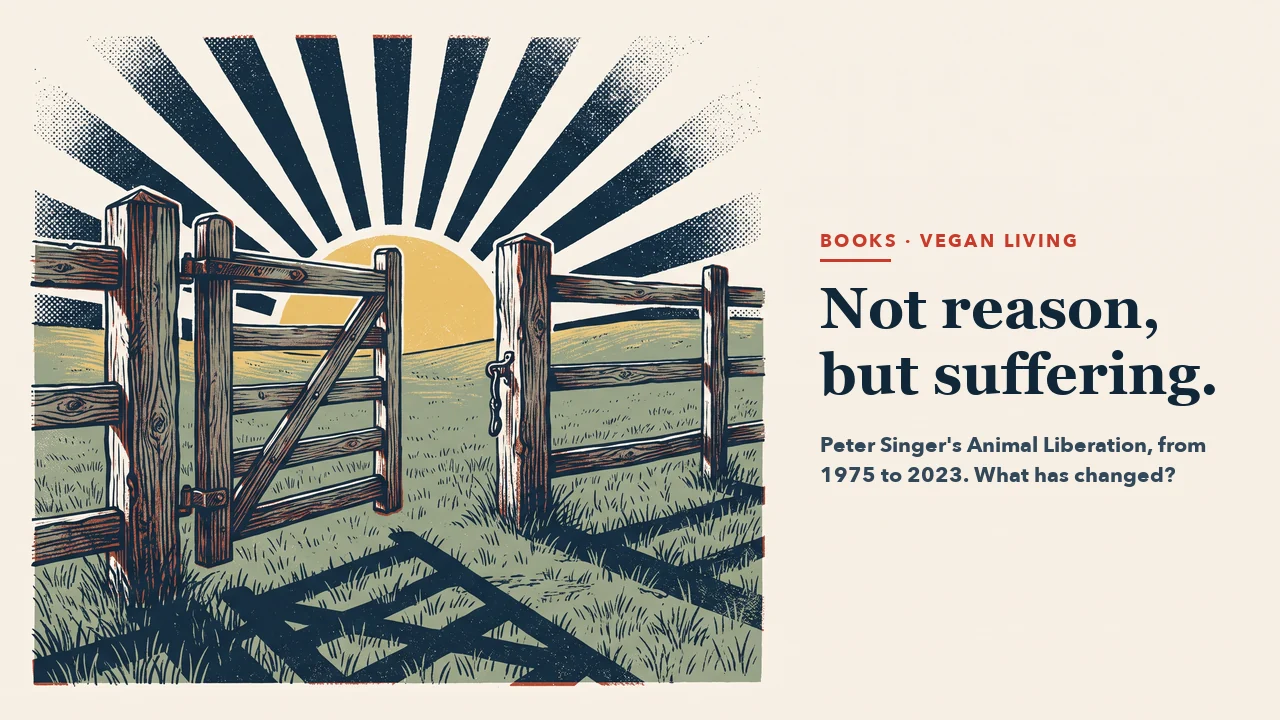
Peter Singer’s Animal Liberation appeared in 1975, and according to its publisher it has never gone out of print. In 2023 he published a rewritten version, Animal Liberation Now. Both have been translated into Turkish. Our earlier reviews covered Tom Regan on animal rights and Carol J. Adams on meat and gender. Singer’s book adds a third approach, the utilitarian one, which historically came first. This review reads the book through the 1973 essay that grew into it; the comparisons with today come from official and reference sources.
Where it started
In April 1973 Singer, then a young Australian philosopher, reviewed a collection called Animals, Men and Morals for The New York Review of Books. He read the collection as “a manifesto for an Animal Liberation movement”, and the review is the essay that grew into the book.
He opened with liberation movements. Each one, he wrote, “demands an expansion of our moral horizons, so that practices that were previously regarded as natural and inevitable are now seen as intolerable.”
The argument
Singer anticipated the obvious objection. Humans and animals are not equal in intelligence or ability, so why treat them as equals? His answer was that moral equality has never depended on factual equality. Humans differ widely in intelligence too. “If possessing greater intelligence does not entitle one human to exploit another, why should it entitle humans to exploit nonhumans?”
The test he proposed came from Jeremy Bentham: “The question is not, Can they reason? nor Can they talk? but, Can they suffer?” If a being can suffer, Singer wrote, “there can be no moral justification for refusing to take that suffering into consideration”.
To name the bias he borrowed a word coined by the psychologist Richard Ryder, one of the collection’s contributors: “speciesism”, the belief that we may treat members of other species in ways it would be wrong to treat our own. Singer admitted the term “is not euphonious, but it neatly makes the analogy with racism.” (See speciesism in our glossary.)
His sharpest test case was animal research. Singer asked whether a researcher would experiment on a human orphan under six months old if that were the only way to save many lives. If the answer is no, he argued, using an adult ape, cat or mouse instead is “simple discrimination”, because such animals are, he wrote, “more conscious of what is happening to them” and just as sensitive to pain as a human infant. It is a deliberately uncomfortable comparison, and one application of the principle rather than the principle itself.
Not a health book
This matters for a health site. Nowhere in the essay does Singer argue from health. He observed that the collection he was reviewing “does not tell us that we will become healthier, or enjoy life more, if we cease exploiting animals.” To Singer, raising nutrition as an objection to the moral case was like a slave-owner’s claim that the economy would collapse without slave labour; he put the question “Is a vegetarian diet nutritionally adequate?” in that light.
In 1973 he endorsed the collection’s conclusion that the challenge “requires us to become vegetarians”. Whether a plant-based diet is adequate, and what it needs, is a separate question that ethics cannot answer. The clearest practical example is vitamin B12.
What has aged
Singer’s arguments are not tied to dates, but his examples are. Three of the 1973 essay’s examples now look different.
Cages. Singer described a British battery cage holding four or five laying hens on a floor of twenty by eighteen inches, about 51 × 46 cm. That is about 2,320 cm², or roughly 465 to 580 cm² per hen. In the European Union such cages have been banned since 1 January 2012. Hens still kept in cages must have enriched cages with at least 750 cm² per bird, along with a nest, perching space and litter, according to the European Commission. That is more space, but it is still a cage.
Numbers. Singer’s book was about suffering, not totals, but the totals have grown. According to Our World in Data, based on FAO figures, about 13.4 billion chickens were slaughtered for meat worldwide in 1975. In 2024 the figure was about 78.5 billion.
Where the line falls. In 1973 Singer thought the analogy with our own suffering still held for fish and other vertebrates, was “much weaker” for molluscs such as oysters, and that on insects, in the present state of knowledge, “we must be agnostic”. Since then the debate has moved. The United Kingdom’s Animal Welfare (Sentience) Act 2022 defines “animal”, for the purposes of the Act, to include not only vertebrates but also cephalopod molluscs, such as octopuses, and decapod crustaceans, such as crabs and lobsters. Octopuses are molluscs, the group for which Singer found the analogy “much weaker” in 1973; the law now brings some of them inside the definition.
The 2023 edition
Animal Liberation Now is not an old book with a new preface. The publisher describes it as “revised from top to bottom”, the first time Singer had returned to the major arguments and examples since 1975. According to HarperCollins, it covers reforms in the European Union and several US states, the expansion of factory farming driven by demand in China, the environmental cost of meat, and the risk that factory farms spread new viruses “even worse than COVID-19”. If you are choosing between the two Turkish editions, choose the newer one: it was revised throughout, and the older translation is out of stock at the publisher.
The main criticism
Singer’s view is often described as an animal rights position. Strictly, it is not. The Stanford Encyclopedia of Philosophy says the utilitarian position “most commonly associated with Peter Singer” is “popularly, though erroneously, referred to as an animal rights position”. For a utilitarian, it explains, “what matters are the strength and nature of interests, not whose interests these are”. Such a position “would condemn a large number of practices that involve the suffering and death of billions of animals”, but harming one being can be justified if, all things considered, more interests are satisfied than frustrated.
That is exactly where Tom Regan objected. For Regan, some things may not be done to an individual even when the totals come out ahead. Readers who want the rights-based alternative will find it in our review of Empty Cages.
His own view has also shifted. According to the SEP, Animal Liberation defended a theory in which well-being means getting what one prefers; since a 2016 book written with Katarzyna de Lazari-Radek, Singer holds that well-being is a matter of pleasure and pain.
Bibliographic details
- Original: Animal Liberation, Peter Singer, 1975. Revised edition: Animal Liberation Now: The Definitive Classic Renewed, HarperCollins (Harper Perennial imprint), 23 May 2023.
- Turkish (new edition): Hayvan Özgürleşmesi Hemen Şimdi, Ayrıntı Yayınları, translated by Akın Emre Pilgir, June 2024, 368 pages, first printing.
- Turkish (earlier edition): Hayvan Özgürleşmesi, Ayrıntı Yayınları, translated by Hayrullah Doğan, first published in Turkish 2005; second printing 2018, 400 pages. Shown as out of stock on the publisher’s site.
Sources
- Singer P. Animal Liberation. The New York Review of Books, 5 April 1973.
- Ayrıntı Yayınları. Hayvan Özgürleşmesi Hemen Şimdi, book page and bibliographic record (Turkish).
- Ayrıntı Yayınları. Hayvan Özgürleşmesi, book page and bibliographic record (Turkish).
- HarperCollins. Animal Liberation Now: The Definitive Classic Renewed, publisher description.
- Gruen L, Monsó S. The Moral Status of Animals. Stanford Encyclopedia of Philosophy.
- European Commission. Laying hens (Council Directive 1999/74/EC).
- Our World in Data. Animals slaughtered for meat (FAO data).
- United Kingdom. Animal Welfare (Sentience) Act 2022, section 5. legislation.gov.uk.
Editor: Anıl Güler, Pharmacist
Last reviewed: 1 October 2026