Taurine on a Vegan Diet
Taurine is the one with the uncomfortable answer: nobody has looked properly. The measurements that exist are real, small, and forty years old. What is missing is not a negative result — it is any result at all connecting taurine status in vegans to health. This is the last of three short pieces on creatine, carnitine and taurine.
Taurine is a product of cysteine metabolism. Unlike creatine it is not held in large, measurable muscle depots. A vegan diet contains essentially none of it.
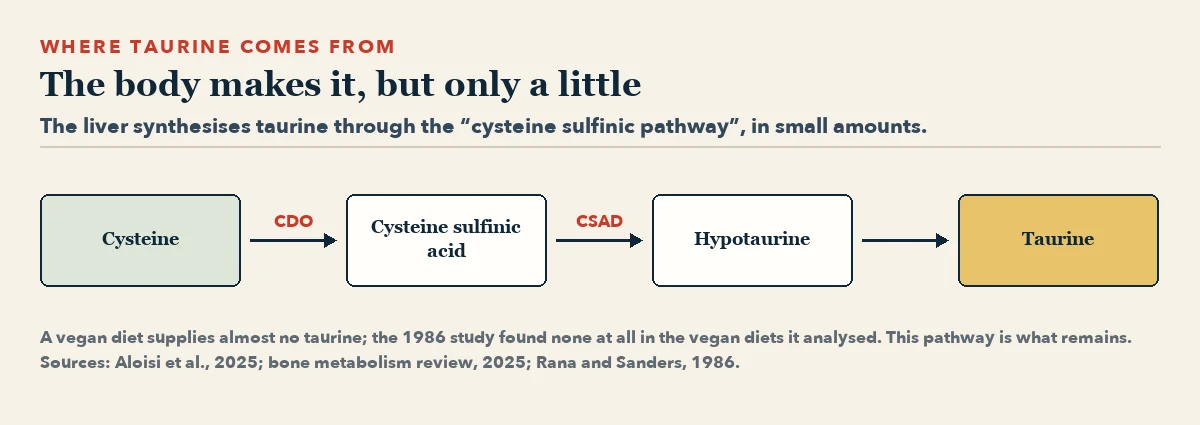
The primary data are from the 1980s
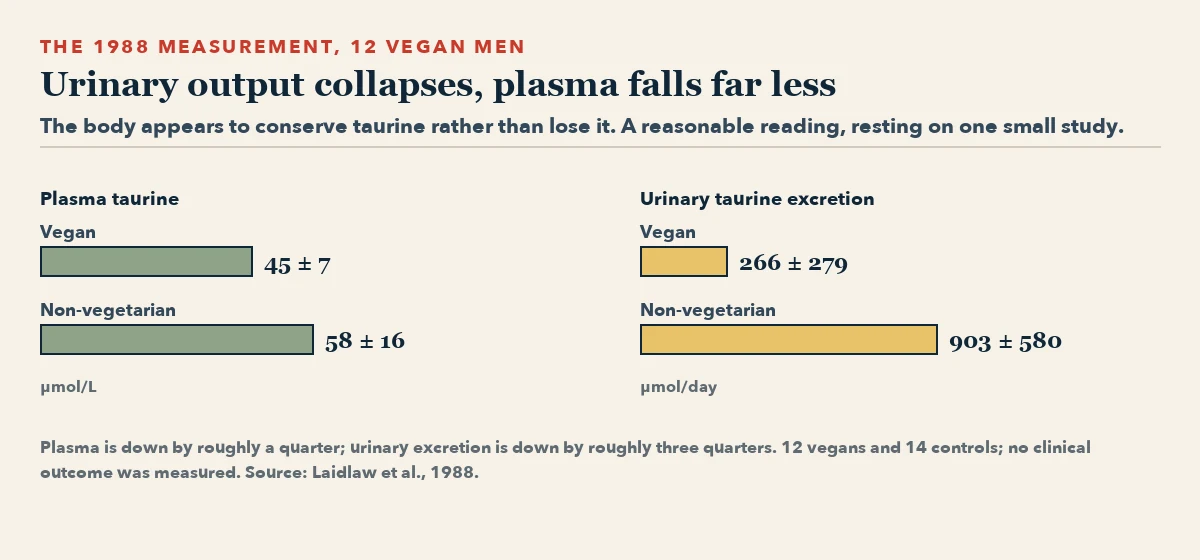
A 1988 study measured 12 vegan men who had been vegan for 53 ± 26 months against 14 non-vegetarian men. Plasma taurine was 45 ± 7 versus 58 ± 16 µmol/L. Urinary taurine excretion was 266 ± 279 versus 903 ± 580 µmol/day. Their dietary diaries showed negligible taurine intake — and, separately worth noting, inadequate zinc.
A 1986 British study found taurine entirely absent from the vegan diets it analysed, and urinary taurine less than half that of omnivores. But plasma and breast-milk concentrations were only slightly lower.
Look at those two studies together and the pattern is consistent: intake near zero, urinary output sharply down, circulating levels down much less. The body appears to conserve rather than collapse. That is a reasonable reading — but it rests on 12 men in one study and a comparable handful in the other, measured before most readers of this article were born.
The breast-milk finding is the one that tends to reassure people most, and it is built on the smallest amount of data of anything here. It deserves less weight than it usually gets, in both directions.
The most recent measurement comes with a decisive caveat
A 2017 study of 36 adults followed plasma amino acids through six weeks of abstaining from meat, poultry, eggs and dairy as a religious fast. Plasma taurine fell from 92 ± 7 µmol/L to 66 ± 6 after one week and 65 ± 6 at six weeks (p=0.003).
That is a clear, fast drop. It is also not a vegan diet: the fast was enriched with fish, and fish is itself a taurine source. So the study tells us that removing meat, eggs and dairy lowers plasma taurine even when fish is still being eaten. It does not tell us where a fully plant-based diet settles over years, which is the question a vegan reader actually has.
What is missing is the part that matters
There is no study we could find connecting taurine status in vegans to a clinical outcome. No trial of taurine supplementation in vegans with a health endpoint. Nothing measuring whether the lower plasma level in the 1988 study mattered to those 12 men in any way that could be observed.
So the correct statement is narrow and should be said plainly: plasma and urinary taurine are lower on a plant-based diet, and no one has shown that this causes harm — because no one has properly tested it.
“No evidence of an effect” and “evidence of no effect” are different claims. Only the first is available here. Anyone who tells you confidently that vegans must supplement taurine, and anyone who tells you confidently that the lower level is certainly harmless, is filling the same gap with the same confidence and no more data than we have.
The energy drink footnote
Most people meet taurine in energy drinks rather than in supplement tubs, and the amounts are not small. A 2022 exposure and risk assessment reported taurine content in energy drinks usually around 4,000 mg per litre, giving intakes of 1,000 to 2,000 mg — 12.5 to 50 mg per kg of body weight — in the consumption scenarios modelled. Consumption above 500 mL was estimated to push intake past the reference value, which works out at 35 mg/kg per day for a 40 kg person, 23.3 mg/kg for a 60 kg person and 17.5 mg/kg for an 80 kg person. The same assessment put the caffeine in those drinks at 80 to 160 mg per serving.
Whatever the taurine question is for vegans, energy drinks are not the answer to it. The caffeine load is the more immediate issue, and the paper’s recommendations are about limiting volume, not about nutrition.
Where this leaves you
Taurine is the clearest example in this series of a gap between what is sold and what is known. The measurements say intake is near zero and circulating levels are modestly lower. Everything after that — whether it matters, whether supplementing helps, what dose would even be appropriate — is unstudied in this population. There is no established dose for this purpose because there is no established purpose.
That is not a reason for alarm and not a reason for reassurance. It is a reason to know which of the three substances in this series actually has evidence behind it, and which does not.
Limits of this article
- The core human data on taurine in vegans are from 1986 and 1988, with 12 participants in one study and a comparable number in the other.
- The most recent measurement came from a diet that included fish, so it does not describe a vegan diet.
- No study cited here measured a clinical outcome, and none examined children, pregnancy or breastfeeding beyond the single breast-milk measurement noted above.
- We searched for post-2000 human studies on taurine status in vegans and found nothing that replaces the 1980s data. That is an absence we are reporting, not a claim that none exists anywhere.
- This is information, not a recommendation. Decisions about supplements belong with your own doctor or pharmacist.
Sources
- Laidlaw SA, Shultz TD, Cecchino JT, et al. Plasma and urine taurine levels in vegans. Am J Clin Nutr. 1988;47(4):660-3. doi:10.1093/ajcn/47.4.660.
- Rana SK, Sanders TA. Taurine concentrations in the diet, plasma, urine and breast milk of vegans compared with omnivores. Br J Nutr. 1986;56(1):17-27. doi:10.1079/bjn19860082.
- Elshorbagy A, Jernerén F, Basta M, et al. Amino acid changes during transition to a vegan diet supplemented with fish in healthy humans. Eur J Nutr. 2017;56(5):1953-1962. doi:10.1007/s00394-016-1237-6.
- Rubio C, Cámara M, Giner RM, et al. Caffeine, D-glucuronolactone and Taurine Content in Energy Drinks: Exposure and Risk Assessment. Nutrients. 2022;14(23). doi:10.3390/nu14235103.
Editor: Anıl Güler, Pharmacist
Last scientific review: 7 October 2026