What Do Vegans in Australia Eat? Nutrient Gaps in a New Study of 66 Adults
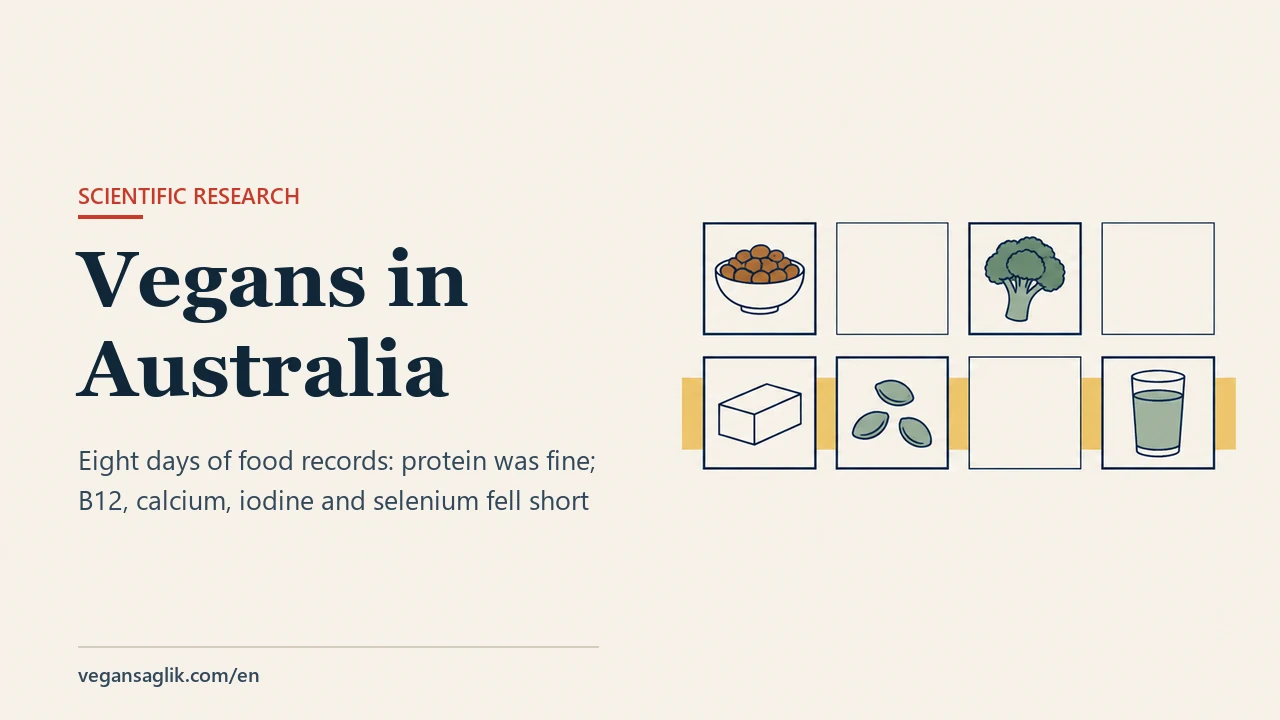
An Australian study that analysed eight days of food records from 66 adult vegans found that protein intake, and the balance of protein, fat and carbohydrate, were within recommended ranges. Many participants, however, ate less than the estimated requirement for vitamin B12, calcium, iodine and selenium, and many of the men for zinc. Supplements narrowed these gaps but did not close them. The study measured what a small group of volunteers ate, not their blood levels.
What was published
The paper, “Nutrient and Discretionary Food Intake in Vegan Adult Australians: A Cross-Sectional Study”, was published online in Nutrition Bulletin on 12 August 2026 (September 2026 issue, volume 51, pages 366–378). The three authors are from the University of Canberra and declare no conflicts of interest.
How the study worked
Participants were recruited through Australian vegan Facebook groups and had followed a vegan diet for at least 12 months. Of the 66 adults, 53 were women and 13 were men; the median age was 35. Between October 2023 and March 2024, each person kept a semi-weighed food diary in a smartphone app for four days on two separate occasions. After likely under-reported days were removed, 466 days were analysed.
Intake from food alone, and from food plus supplements, was compared with Australia’s Nutrient Reference Values. For most nutrients the benchmark was the Estimated Average Requirement (EAR), the amount that meets the needs of half of healthy people. For nutrients without an EAR, such as omega-3 fats, the Adequate Intake was used.
What they found
Protein was not the problem. All participants except one man ate more protein than the EAR from food. Median intake, including supplements, was 1.2 g per kilogram of body weight a day in women and 1.5 g/kg in men.
Several micronutrients were. Share of participants below the EAR, first from food alone and then with supplements:
- Vitamin B12: 57.7% and 30.8% of women; 38.5% and 23.1% of men.
- Calcium: 63.5% and 53.8% of women; 38.5% and 30.8% of men.
- Selenium: 73.1% and 61.5% of women; 46.2% and 38.5% of men.
- Iodine: 46.2% and 32.7% of women; 30.8% of men in both cases.
- Zinc: 53.8% and 46.2% of men.
From food alone, every participant was below the Adequate Intake for long-chain omega-3 fats (EPA and DHA), which the authors link to avoiding fish; some women took a vegan omega-3 supplement, which brought 23.1% of women above it. Only four participants met the EAR for every nutrient assessed, and on average each participant was below it for 3.5 nutrients.
Supplement use was common but patchy. About 77% of participants took at least one supplement, most often a multivitamin (39.4%), protein powder (37.9%), vitamin B12 (33.3%) or iron (27.3%). Only a third took a B12 supplement, compared with 68% to 92% in other studies, and the authors suggest that inconsistent or nutrient-specific supplement use may explain why some intakes stayed low.
Discretionary foods, such as vegan chocolate, sweet baked goods, desserts, crisps and some meat alternatives, provided 24.2% of energy, about 3.3 serves a day. That is less than the 31% to 37% reported for Australian adults in 2011–2012, but above the Australian recommendation of no more than three serves a day for most adults.
What the study cannot tell us
- Intake is not status. No blood tests were done. The study estimates what people ate; it cannot say whether anyone was actually deficient.
- A small, self-selected group. Only 13 of the 66 volunteers were men, and the authors note that participants may have been more health-conscious than vegans who did not respond.
- One snapshot. A cross-sectional study describes one period and cannot show what caused the gaps.
- Older food data. Foods were analysed with the AUSNUT 2011–2013 database, which contained few plant-based meat alternatives.
How it fits with other research
The pattern is familiar. A systematic review of 141 studies, mostly from Europe, South and East Asia and North America, found that intake and status of vitamin B12, vitamin D, iron, zinc, iodine and calcium were generally lower with plant-based diets than in meat-eaters, and that vegans had the lowest vitamin B12, calcium and iodine intakes. The same review found meat-eaters at risk of inadequate intakes of fibre, folate, vitamins D and E, calcium and magnesium, and concluded that there were nutrient inadequacies across all dietary patterns. Its two authors work for Unilever, which sells fortified foods and supplements.
What to take from it
The authors conclude that a well-planned vegan diet can in theory be nutritionally adequate, but support is needed to achieve that in practice. The nutrients worth checking:
- Vitamin B12: vegans are advised to eat B12-fortified foods and use a B12 supplement. See our vitamin B12 guide.
- Calcium: calcium-fortified plant drinks, calcium-set tofu and green leafy vegetables. See calcium in a vegan diet.
- Iodine: reliable sources and the risks of seaweed are covered in our iodine guide.
- Selenium: see selenium for vegans.
- Zinc: see zinc for vegans.
- Omega-3: the authors mention that several researchers recommend a microalgal vegan omega-3 supplement. See our omega-3 guide.
Taking a supplement is not the same as covering a nutrient, so check what each product actually contains. Only a blood test, not a food diary, shows your own status. And a single study is one piece of evidence; our guide on how to read nutrition research explains why.
Sources
- Smillie L, Minehan M, Knight-Agarwal CR. Nutrient and discretionary food intake in vegan adult Australians: a cross-sectional study. Nutr Bull. 2026;51(3):366–378. doi:10.1111/nbu.70065.
- Neufingerl N, Eilander A. Nutrient intake and status in adults consuming plant-based diets compared to meat-eaters: a systematic review. Nutrients. 2022;14(1):29.
Editor: Anıl Güler, Pharmacist
Last scientific review: 16 September 2026