Calcium in a Vegan Diet: Sources, Absorption, Labels and Supplement Safety
Calcium is often discussed as if the question were simply “Which foods contain it?” A useful assessment needs two further questions: how much calcium does a normal portion provide, and how reliably is that calcium absorbed? This distinction is particularly important in a vegan diet because products that look similar — plant drinks and tofu, for example — can differ greatly in calcium content.
How much calcium do adults need?
European Food Safety Authority population reference intakes are 1,000 mg a day for adults aged 18–24 and 950 mg a day from age 25 onward. Other national systems use somewhat different age bands and values. These numbers are population reference values for generally healthy people; they are not a diagnosis, a personalised prescription or an automatic supplement dose.
Almost all calcium in the body is stored in bone. Blood calcium, by contrast, is regulated within a narrow range. A normal serum calcium result therefore does not show that dietary calcium intake is adequate. Dietary history, age, vitamin D status, medication use, medical conditions and — when clinically indicated — bone assessment provide different pieces of information.
Which vegan foods are dependable calcium sources?
Calcium-fortified plant drinks
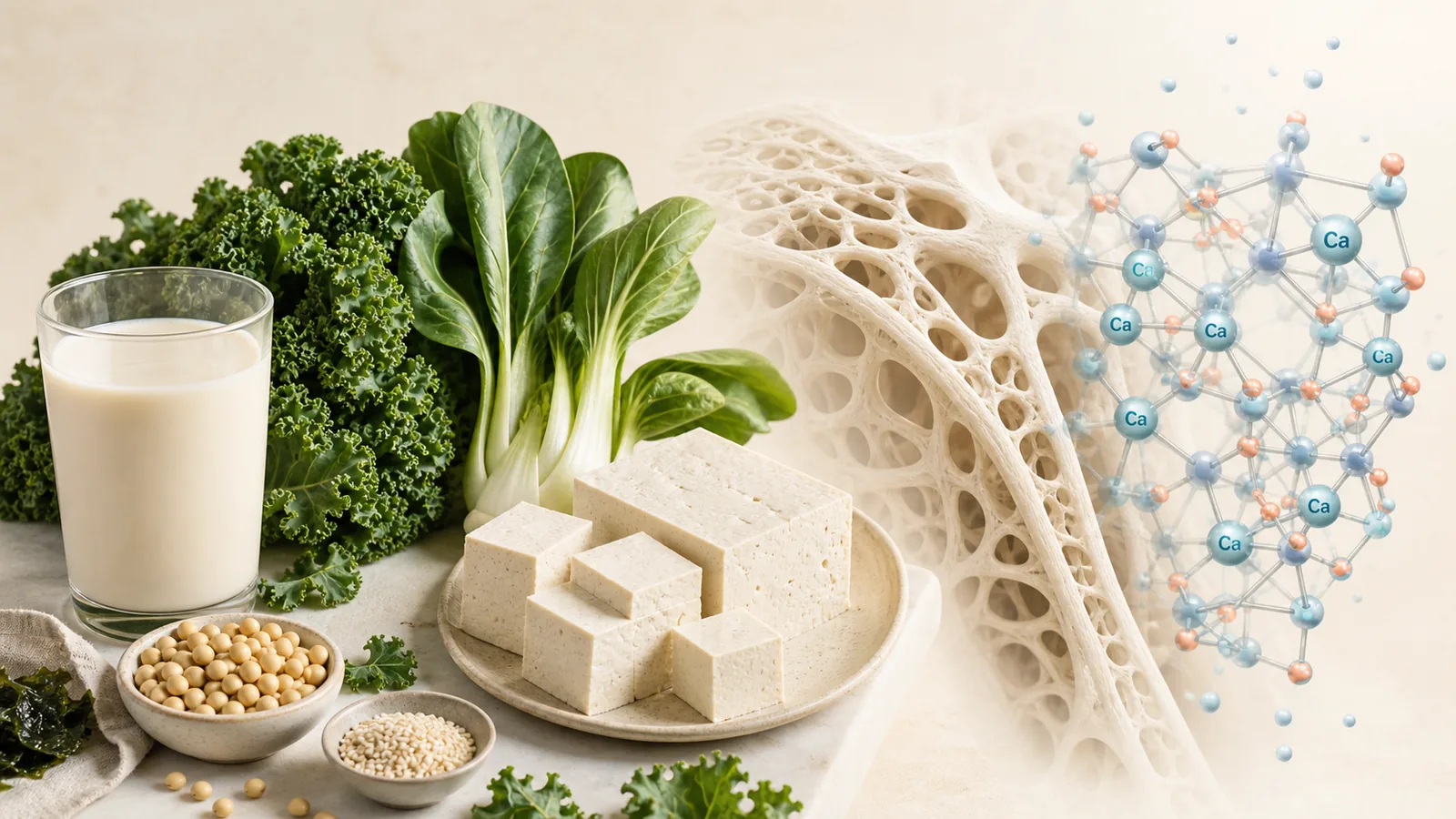
A fortified plant drink can provide a substantial amount of calcium in a familiar portion. As a practical example, a drink containing 120 mg per 100 ml supplies 300 mg in a 250 ml glass. This is only an illustration: products vary, formulations change and unfortified versions may contain very little calcium.
Read the amount of calcium in milligrams per 100 ml and per portion. Also assess protein, added sugars, vitamin B12, vitamin D and iodine according to how the drink will be used. Follow the package instructions, including shaking before use when the manufacturer advises it.
Calcium-set tofu
Tofu can be a major source or only a modest contributor. The difference depends partly on the coagulant used and the product’s water content. Look for calcium sulfate or another calcium salt used as a coagulant in the ingredients, then confirm the calcium amount in the nutrition declaration when it is provided. The word “tofu” alone is not enough to estimate its calcium content.
Lower-oxalate green vegetables
Kale, broccoli and Chinese cabbage can contribute well-absorbed calcium. A small human crossover study found fractional calcium absorption from kale to be at least comparable with milk under the test conditions. Calcium per typical portion still matters: these vegetables generally provide less total calcium per usual serving than a calcium-fortified drink or calcium-set tofu.
Spinach illustrates why total content and absorption are not the same. In a human crossover study, average calcium absorption was about 5% from spinach and about 28% from milk. Spinach remains a nutritious food, but it should not be counted as a primary calcium anchor.
Foods that make smaller contributions
Cooked soybeans and other legumes, chia, sesame or tahini, almonds, whole grains and some mineral waters can add calcium across the day. Their amounts vary by food, portion, processing and brand. They are useful contributors, but small portions of nuts or seeds should not automatically be assumed to cover a large share of the daily reference intake.
Does calcium from fortified foods absorb well?
It depends on the calcium compound and the food matrix. In a crossover study in young women, calcium absorption from soy drink fortified with calcium carbonate was similar to that from cow’s milk at comparable calcium loads, while absorption from the product fortified with tricalcium phosphate was somewhat lower. This does not establish that every fortified drink is equivalent; it shows why the fortificant and formulation matter.
Vitamin D supports active calcium absorption in the intestine. That does not mean that taking increasingly large vitamin D doses will continually improve absorption. Vitamin D adequacy and calcium intake should be considered together, while excessive supplementation of either nutrient should be avoided.
A practical way to plan the day
Rather than trying to obtain calcium from one “superfood,” identify reliable sources that you can use regularly:
- Choose two or three reliable sources: for example, a labelled calcium-fortified drink, calcium-set tofu and a lower-oxalate green vegetable.
- Use the amount you actually consume: convert per-100 ml or per-100 g values to your glass, bowl or portion.
- Let other foods add to the total: legumes, seeds, nuts, grains and mineral water may make useful contributions.
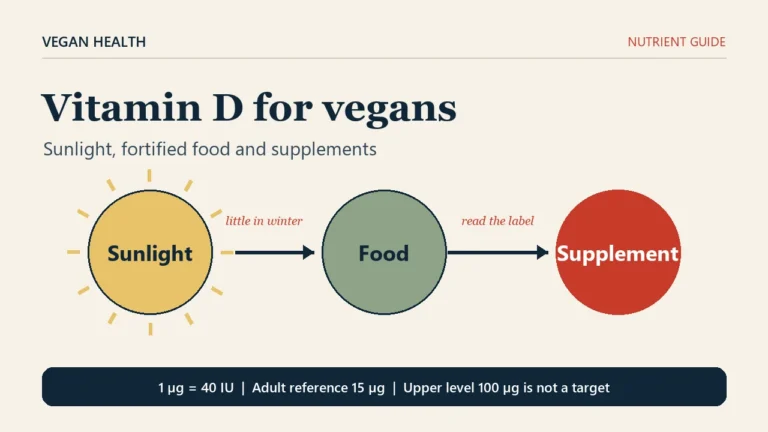
- Review vitamin D separately: a calcium-rich diet does not automatically provide vitamin D.
- Recheck labels periodically: fortification levels and product recipes can change.
Our Plant Drink Label Comparator can place the calcium and other nutrient values of up to three products on the same scale. Database results should still be checked against the current package.
What do fracture studies tell us about vegan diets?
In the EPIC-Oxford cohort, vegans had higher risks of total and some site-specific fractures, particularly hip fractures, than meat eaters. The associations were attenuated but did not disappear completely after additional adjustment for calcium and protein. This was an observational study: it cannot show that avoiding animal products caused the fractures, and factors such as body mass index, energy and protein intake, vitamin D, physical activity and residual confounding complicate interpretation.
The responsible conclusion is neither “vegan diets weaken bones” nor “calcium does not matter.” Bone health is influenced by calcium, vitamin D, adequate energy and protein, resistance and weight-bearing activity, age, hormones, smoking, alcohol, medicines and medical conditions. A well-planned vegan diet needs to address this whole picture.
When should a supplement be considered?
Start by assessing intake from foods and fortified products. A supplement may be considered when intake remains inadequate, but the appropriate amount depends on the dietary gap and individual circumstances. A 2026 systematic review of randomised trials found little to no clinically meaningful benefit from calcium, vitamin D or combined supplementation for preventing fractures and falls in adults not receiving medicines for osteoporosis. Most participants lived in the community and were not at high fracture risk, so the findings do not settle care for people at high risk or living in residential care. “More” is not automatically better.
On a supplement label, read the amount of elemental calcium rather than trying to calculate it from the compound name. Calcium carbonate is more dependent on stomach acid and is generally taken with food; calcium citrate is less dependent on stomach acid. Fractional absorption falls as a single dose becomes larger, and NIH notes that absorption from supplements is highest at doses of 500 mg or less. This is a pharmacokinetic principle, not a personal dosing recommendation.
Calcium supplements can reduce the absorption or blood levels of medicines including levothyroxine, some quinolone antibiotics and dolutegravir. Lithium raises a different concern: long-term use can cause hypercalcaemia, and adding calcium supplements may increase that risk. The required separation or monitoring is medicine-specific, so check the product instructions and ask a pharmacist or clinician. People with kidney disease, a history of kidney stones, hypercalcaemia, parathyroid disease or diagnosed osteoporosis should not create a supplement plan from a general article.
EFSA’s tolerable upper intake level for adults is 2,500 mg a day from all sources. An upper limit is a safety ceiling, not a goal.
Sources
- European Food Safety Authority. Dietary Reference Values for nutrients: Summary report.
- European Food Safety Authority. Summary of Tolerable Upper Intake Levels, version 10, June 2024.
- NIH Office of Dietary Supplements. Calcium: Fact Sheet for Health Professionals, updated 22 June 2026.
- Massé O, et al. Calcium, vitamin D, or combined supplementation to prevent fractures and falls: systematic review and meta-analysis. BMJ. 2026;393:e088050.
- Heaney RP, Weaver CM, Recker RR. Calcium absorbability from spinach. Am J Clin Nutr. 1988;47(4):707–709.
- Heaney RP, Weaver CM. Calcium absorption from kale. Am J Clin Nutr. 1990;51(4):656–657.
- Zhao Y, Martin BR, Weaver CM. Calcium bioavailability of calcium carbonate fortified soymilk is equivalent to cow’s milk in young women. J Nutr. 2005;135(10):2379–2382.
- Tong TYN, et al. Vegetarian and vegan diets and risks of total and site-specific fractures: results from the prospective EPIC-Oxford study. BMC Med. 2020;18:353.
- Republic of Türkiye Ministry of Health. Türkiye Beslenme Rehberi (TÜBER) 2022.
Editor: Anıl Güler, Pharmacist
Scientific review date: 27 August 2026