Vitamin D for Vegans: Sunlight, Fortified Foods, D2 vs D3 and Supplement Safety
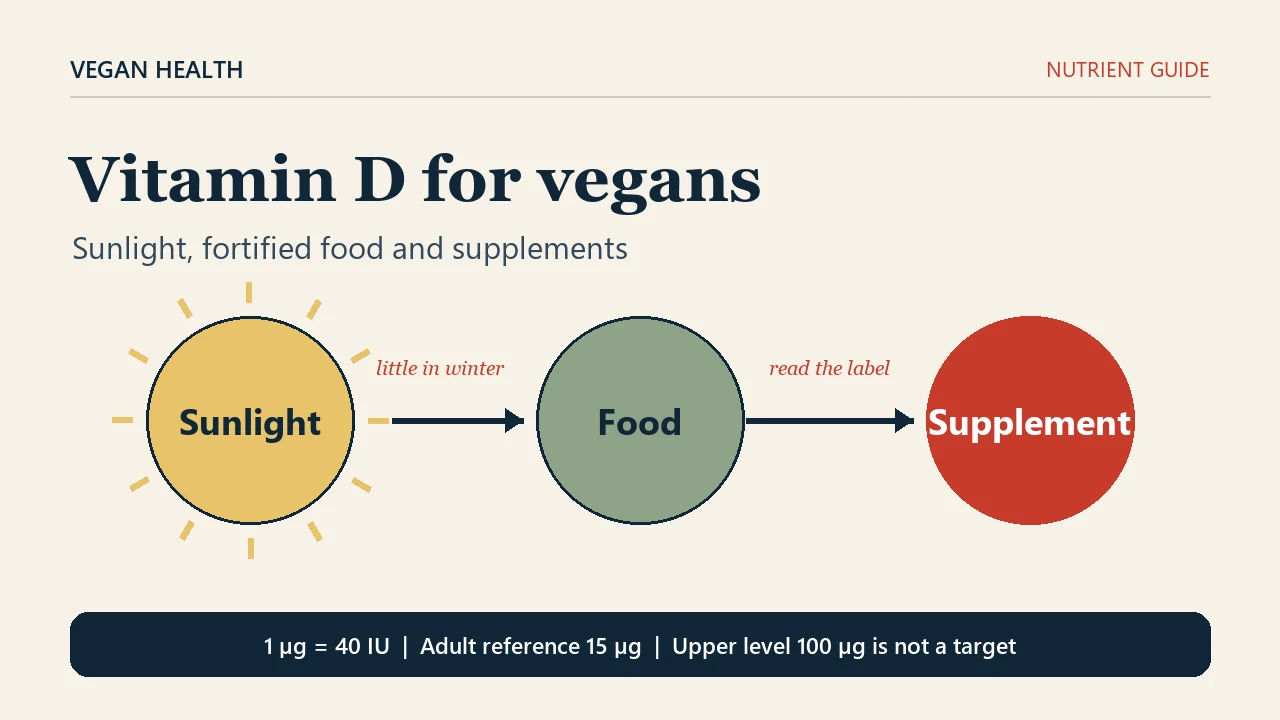
Vitamin D is the nutrient that almost no diet supplies well, and a vegan diet supplies least of all. Unfortified plant foods contain practically none, and the few natural animal sources are modest anyway. What changes when you eat vegan is that the small contribution from eggs and oily fish falls to zero, so the plan rests on three things you can actually check: sunlight in the right season, fortified products with a readable label, and a supplement whose form and dose you understand.
Why does vitamin D need a plan on a vegan diet?
Vitamin D is a family name for two compounds. Vitamin D2 (ergocalciferol) is made by fungi and yeasts when ultraviolet light acts on ergosterol. Vitamin D3 (cholecalciferol) is made in human and animal skin when UVB light acts on 7-dehydrocholesterol. Both forms are inert until the liver converts them to 25-hydroxyvitamin D, written 25(OH)D, and the kidney then makes the active hormone. Because 25(OH)D reflects sun, food and supplements together, it is the measure laboratories report.
Food is a minor source in most eating patterns. Türkiye’s national dietary guideline lists vitamin D as the nutrient with the largest intake gap across all age groups, and a systematic review of 141 studies found meat-eaters, not only vegetarians and vegans, at risk of inadequate intake. What a vegan diet removes is the last small food contribution: in the EPIC-Oxford cohort, vegans obtained about 0.7 µg a day from food, compared with 3.1 µg among meat-eaters. Neither figure is close to 15 µg. The difference is that a vegan plan cannot rely on food by accident; it has to be deliberate.
How much vitamin D do adults need?
Reference bodies use different words for a similar number. The European Food Safety Authority (EFSA) sets an Adequate Intake of 15 µg a day for everyone from age 1, including pregnancy and lactation, derived under conditions of minimal skin synthesis; EFSA adds that when the skin does make vitamin D, the dietary requirement is lower “or may even be zero.” The US National Academies set a Recommended Dietary Allowance of 15 µg (600 IU) up to age 70 and 20 µg (800 IU) after 70, also assuming minimal sun. The Turkish guideline (TÜBER) adopts the same 15 µg for adults and 20 µg from age 70. The United Kingdom sets a lower figure of 10 µg and pairs it with seasonal supplement advice for the whole population.
| Framework | Adults | How to read it |
|---|---|---|
| EFSA (Europe), Adequate Intake | 15 µg/day (600 IU) | Assumes minimal skin synthesis; targets serum 25(OH)D of 50 nmol/L. |
| US National Academies, RDA | 15 µg/day; 20 µg after age 70 | Assumes minimal sun exposure; used by NIH. |
| TÜBER (Türkiye), Adequate Intake | 15 µg/day; 20 µg from age 70 | Upper level 100 µg/day from age 11. |
| UK Reference Nutrient Intake | 10 µg/day (400 IU) | Supplement advised for everyone from October to early March. |
How much does sunlight actually provide?
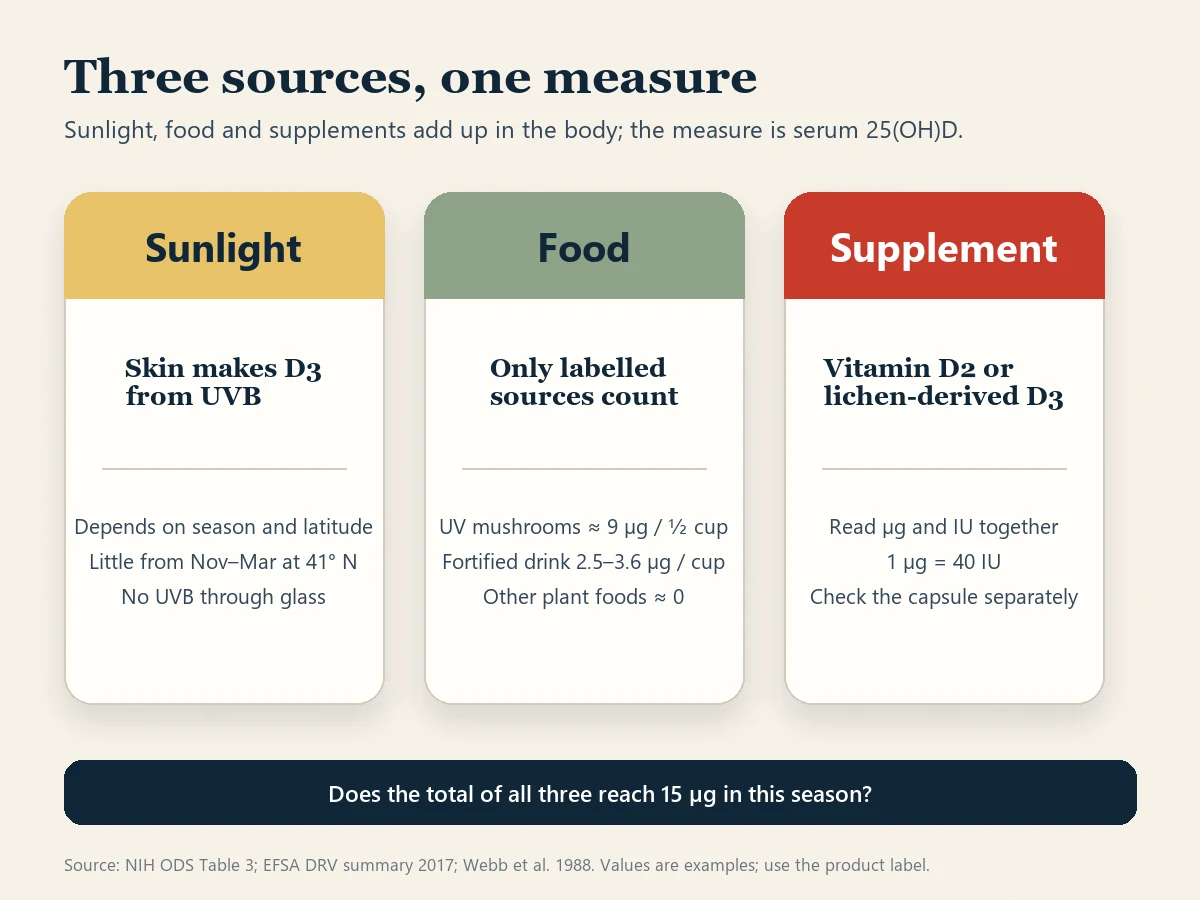
The skin makes vitamin D3 only from UVB, and UVB reaching the ground depends on season, time of day, latitude, cloud, air pollution, skin pigmentation, clothing, sunscreen and age. UVB does not pass through window glass, so sunshine indoors does not count. NIH concludes that these variables make it “difficult to provide guidelines on how much sun exposure is required,” and this article does not attempt a minutes-per-day prescription.
Latitude and season set the limits. In a classic experiment, skin exposed to cloudless winter sunlight in Boston (42.2° N) produced no previtamin D3 from November through February, whereas at 34° N some synthesis continued in midwinter. Türkiye spans roughly 36° to 42° N. Northern cities such as İstanbul sit close to the Boston latitude, so winter synthesis there is likely to be minimal; the south is less restricted, but short days, cloud cover and indoor life still reduce exposure. The Turkish guideline makes the same point: serum vitamin D peaks in summer, and at higher latitudes very little is synthesised from November to March.
Summer sunlight can cover the need on its own. Winter sunlight at Turkish latitudes usually cannot, and no amount of sunlight through a window helps.
Sun exposure also carries skin-cancer risk, and dermatology advice on protection does not change because vitamin D is useful. If sunscreen, covering clothing, shift work or an indoor routine limits your exposure, the practical response is not to abandon protection but to secure vitamin D from food or a supplement in the months when the sun cannot provide it.
Which vegan foods contain vitamin D?
| Food and example serving | Vitamin D | How to read it |
|---|---|---|
| White mushrooms exposed to UV light, raw, sliced, ½ cup (US database) | 9.2 µg (366 IU) | Only mushrooms treated with UV, or deliberately exposed to sun, reach this; the form is D2. |
| Portobello mushrooms, untreated, ½ cup | 0.1 µg (4 IU) | Ordinary supermarket mushrooms grown in the dark contain almost none. |
| Fortified soy, almond or oat drink, 1 cup (US brands) | 2.5–3.6 µg (100–144 IU) | Fortification is voluntary and varies; the Turkish label is the only reliable figure. |
| Unfortified grains, legumes, vegetables, fruit, nuts and seeds | 0 µg | These foods matter for other reasons, not for vitamin D. |
Mushrooms are the one unfortified plant food that can carry a meaningful amount, and only because of light. When common mushrooms are exposed to UV, from a lamp or from sunlight, they generate vitamin D2 from ergosterol; a 2018 review found that UV-exposed mushrooms consumed before their best-before date are likely to stay above 10 µg per 100 g fresh weight, even though storage and cooking reduce the content. Whether a product on a Turkish shelf was UV-treated has to come from the label; unlabelled mushrooms should be assumed to contain very little.
Fortified drinks are the everyday option, and the rules for reading them are the same as in our fortified-food label guide. In Türkiye, adding vitamins to food is permitted and regulated under the Turkish Food Codex, which requires nutrition labelling for fortified products, but no manufacturer is obliged to add vitamin D. Compare the microgram figure per 100 ml with the amount you actually drink, and check whether the same product also carries calcium and vitamin B12.
Do vegans actually have lower vitamin D status?
Measured status follows diet and season together. In the EPIC-Oxford study of 2,107 British adults, mean plasma 25(OH)D was 55.8 nmol/L in vegans and 77.0 nmol/L in meat-eaters. The gap was 38% in samples taken in winter and 20% in summer: as sunlight contributes less, the difference that comes from diet grows. Even so, the proportion with clearly low values (below 25 nmol/L) in winter and spring ranged only from under 1% to 8% across diet groups. A lower average is a real dietary difference; it is not a diagnosis for every vegan.
The systematic review of 141 studies reached the same conclusion: vitamin D intake and status were generally lower in vegetarians and vegans, while inadequacies existed in every dietary pattern. Türkiye adds a local caution. In more than 108,000 samples analysed by one national laboratory between 2011 and 2016, mean adult 25(OH)D was about 18 to 22 ng/mL (45 to 55 nmol/L), close to the threshold NIH and EFSA regard as adequate. Those were people sent for testing, not a population survey, but the pattern shows that low vitamin D in Türkiye is a general problem rather than a vegan one; a vegan diet simply removes one of the small buffers.
Vitamin D2 or D3, and is D3 vegan?
Both forms raise 25(OH)D and both cure rickets. NIH summarises the evidence as showing that D3 raises 25(OH)D to a greater extent and maintains it longer than D2. In a 2012 meta-analysis of randomised trials, D3 outperformed D2 overall, with the clearest difference after large single doses and no significant difference with daily dosing. A later 12-week trial then tested exactly the daily situation that matters to consumers: 335 women received 15 µg a day of D2 or D3 in juice or biscuits through a British winter, and the D3 groups gained about 15 to 17 nmol/L more than the D2 groups. The practical conclusion is that daily D2 works, and daily D3 works somewhat better.
Most vitamin D3 supplements are made from lanolin, the grease of sheep’s wool, which is not vegan. Vitamin D2 is made from yeast or fungi and is vegan by nature. A vegan D3 produced from lichen is now widely available and is the form to look for if you prefer D3. As with algal oil in our omega-3 guide, the source of the active ingredient and the capsule material are two separate checks: a lichen D3 in a gelatin softgel is not a vegan product.
How do you read a vitamin D supplement label?
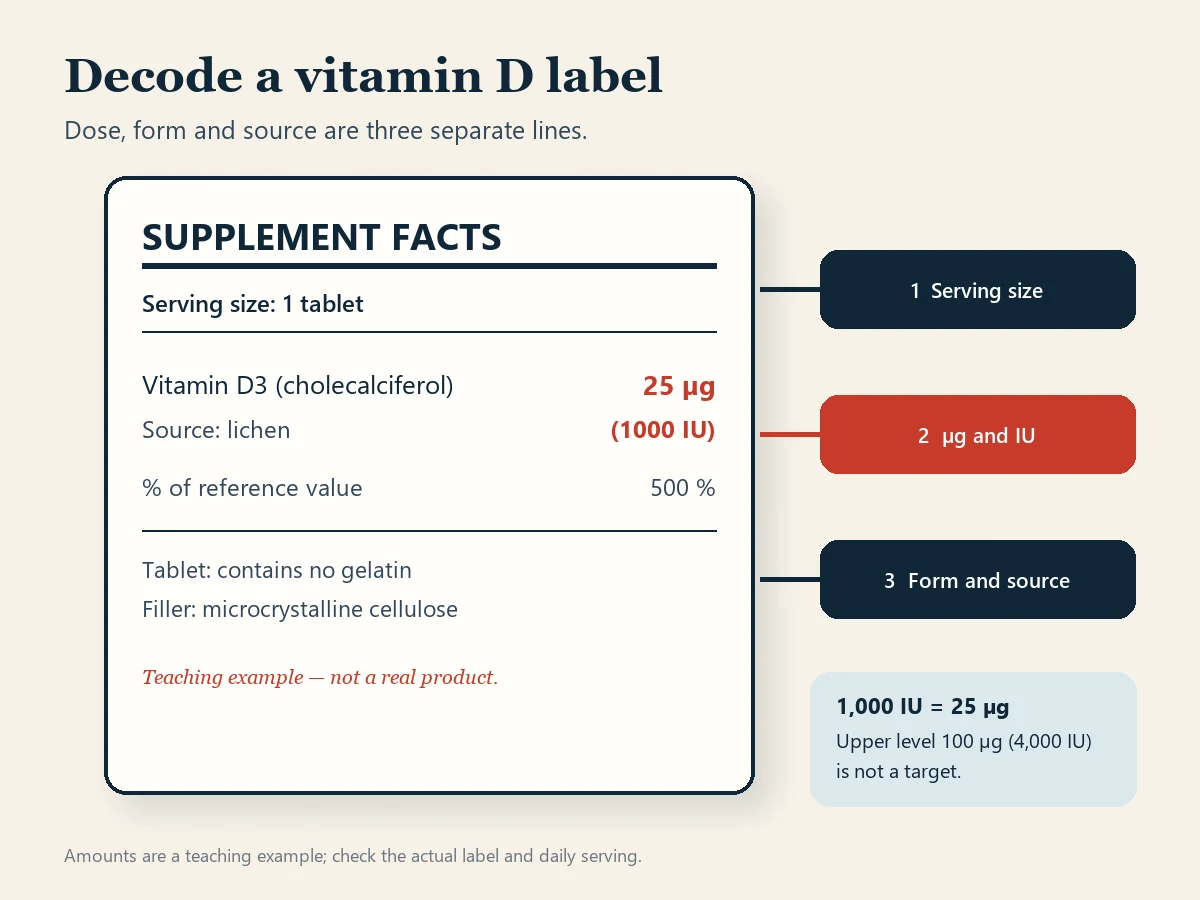
- Find the daily serving. Is the dose stated per tablet, per capsule, per drop or per millilitre? With drops, check how many drops make the labelled dose.
- Read the amount in micrograms and IU. A label showing “25 µg (1,000 IU)” and one showing “1,000 IU” describe the same dose. Percent figures refer to a labelling reference value, not to your requirement.
- Identify the form and source. “Vitamin D2 (ergocalciferol)” is vegan. “Vitamin D3 (cholecalciferol)” needs a source: lichen is vegan, lanolin is not, and an unnamed source should be assumed to be lanolin.
- Check the whole product. Softgel shells, coatings and carrier oils can contain gelatin, fish oil or dairy derivatives; a vegan claim should cover the finished product.
- Read combined products separately. Vitamin D sold with calcium, magnesium or other nutrients needs each dose assessed on its own; our calcium guide explains why more calcium is not automatically better.
Does every vegan need a supplement?
The reference intakes were derived for people who make little vitamin D in their skin, and that describes most adults in Türkiye for several months a year. A fortified drink supplies perhaps 2 to 4 µg per glass and unfortified plant foods supply none, so reaching 15 µg from food alone in winter is unusual. That is why the UK advises everyone, not only vegans, to consider a daily 10 µg supplement from October to early March, and advises groups with little sun exposure to take one all year.
Current evidence does not support a single prescription for every vegan adult, and this article does not give one. It supports a plan: decide whether sunlight, fortified food and a supplement together reach the reference intake in the current season, and adjust the supplement rather than the sunscreen. Pregnancy and breastfeeding, childhood, older age, obesity, dark skin, covered clothing, malabsorption, kidney disease, osteoporosis treatment and regular medicines move beyond a general adult article; Türkiye runs national vitamin D programmes for infants and for pregnancy precisely because those groups need individual dosing.
Where are the safety boundaries?
A safety ceiling is not a target. EFSA reconfirmed in 2023 that the tolerable upper intake level for adults, including pregnancy and lactation, is 100 µg (4,000 IU) a day, with 50 µg for children aged 1 to 10. The panel chose persistent hypercalciuria, excess calcium in the urine, as the earliest warning sign of excess and applied a safety factor to the 250 µg a day at which trials began to show it. NIH uses the same 100 µg adult ceiling, and the NHS states it plainly: do not take more than 100 µg a day.
Vitamin D toxicity is almost always caused by supplements, not by sunlight or food. Because vitamin D increases calcium absorption, excess produces hypercalcaemia, with nausea, vomiting, weakness, frequent urination and, in severe cases, kidney damage, soft-tissue calcification and heart-rhythm disturbance. Taking calcium supplements alongside vitamin D increases the risk of these effects. High-dose weekly or monthly regimens exist as prescription treatments for diagnosed deficiency; they are a clinical decision, not a consumer product choice.
Some medicines interact. Orlistat reduces vitamin D absorption; corticosteroids impair its metabolism; thiazide diuretics combined with vitamin D can raise blood calcium, especially in older adults and people with kidney impairment; and vitamin D and some statins compete for the same metabolising enzyme. Anyone using these or other regular medicines should discuss a supplement with their doctor or pharmacist rather than adding it silently.
Should I have a vitamin D blood test?
The test is serum 25(OH)D. NIH groups results as follows: below 30 nmol/L (12 ng/mL) is associated with deficiency and, over time, osteomalacia; 30 to below 50 nmol/L is generally considered inadequate; 50 nmol/L (20 ng/mL) and above is generally adequate for bone health; and values above 125 nmol/L (50 ng/mL) are linked to potential adverse effects. EFSA used 50 nmol/L as its target when setting the European intake. Laboratories in Türkiye often report ng/mL; multiply by 2.5 to convert to nmol/L.
Routine screening of healthy adults is not established. In 2021 the US Preventive Services Task Force found the evidence insufficient to assess the benefits and harms of screening asymptomatic adults, noting that there is no agreed cut-off for deficiency, that different assays give different results for the same sample, and that treating a low value in an otherwise healthy person has not been shown to change outcomes such as fractures. NIH adds that no national professional organisation recommends population screening. A clinician may still test when symptoms, bone disease, malabsorption, kidney disease or medicines make the result actionable; an isolated number found on a check-up should not be self-interpreted or self-treated with high doses.
Frequently asked questions
Is vitamin D2 useless if D3 works better?
No. D2 raises 25(OH)D, treats rickets and, at ordinary daily doses, closes much of the gap that trials measure against D3. If D2 is what you have or prefer, take it daily rather than in large occasional doses, where the difference from D3 is largest.
Can I rely on a sunny balcony behind glass?
No. UVB does not penetrate ordinary window glass, so light through a closed window or a car windscreen produces no vitamin D, however bright it feels.
Is a fortified plant drink enough on its own?
Rarely in winter. At 2.5 to 3.6 µg per cup, reaching 15 µg would take four or more glasses a day. A fortified drink is a useful base, particularly when it also carries calcium and B12, but it is usually one part of the plan rather than the whole of it.
Does dark skin or a higher body weight change the plan?
Both are listed by NIH among the groups at higher risk of inadequacy: melanin reduces skin synthesis, and vitamin D is sequestered in body fat. The reference intake does not change, but the assumption that summer sun will cover the need becomes weaker, and individual advice is more useful.
A 30-second vegan vitamin D check
- Name the season: Between November and March at Turkish latitudes, assume sunlight contributes little.
- Add up food: Count only labelled UV-exposed mushrooms and fortified products, in micrograms per portion actually eaten.
- Read the supplement label: Micrograms and IU per daily serving, the form (D2 or D3) and, for D3, the source (lichen).
- Complete the vegan check: Capsule shell, carrier oil and coating as well as the active ingredient.
- Separate special circumstances: Seek individual advice for pregnancy or breastfeeding, childhood, older age, kidney disease, malabsorption, osteoporosis treatment or regular medicines.
Vitamin D sits alongside the other nutrients that a vegan diet has to plan rather than assume. Our guides to calcium, vitamin B12, iodine and omega-3 cover the others, and the balanced vegan plate guide shows where fortified foods fit in a day of meals.
Sources
- NIH Office of Dietary Supplements. Vitamin D: Fact Sheet for Health Professionals. Accessed 3 September 2026.
- European Food Safety Authority. Dietary Reference Values for nutrients: Summary report. 2017; section 5.12 and Tables 9 and 11.
- EFSA Panel on Nutrition, Novel Foods and Food Allergens. Scientific opinion on the tolerable upper intake level for vitamin D, including the derivation of a conversion factor for calcidiol monohydrate. EFSA Journal. 2023;21(8):e08145.
- NHS. Vitamin D. Reviewed 3 August 2020.
- T.C. Sağlık Bakanlığı. Türkiye Beslenme Rehberi TÜBER 2015. Ankara, 2016; section 4.5 and Appendices 1.5.1, 1.5.3 and 4.1.2.
- Tripkovic L, et al. Comparison of vitamin D2 and vitamin D3 supplementation in raising serum 25-hydroxyvitamin D status: a systematic review and meta-analysis. Am J Clin Nutr. 2012;95(6):1357–1364.
- Tripkovic L, et al. Daily supplementation with 15 μg vitamin D2 compared with vitamin D3 to increase wintertime 25-hydroxyvitamin D status in healthy South Asian and white European women: a 12-wk randomized, placebo-controlled food-fortification trial. Am J Clin Nutr. 2017;106(2):481–490.
- Crowe FL, et al. Plasma concentrations of 25-hydroxyvitamin D in meat eaters, fish eaters, vegetarians and vegans: results from the EPIC-Oxford study. Public Health Nutr. 2011;14(2):340–346.
- Neufingerl N, Eilander A. Nutrient intake and status in adults consuming plant-based diets compared to meat-eaters: a systematic review. Nutrients. 2022;14(1):29.
- Cardwell G, et al. A review of mushrooms as a potential source of dietary vitamin D. Nutrients. 2018;10(10):1498.
- Webb AR, Kline L, Holick MF. Influence of season and latitude on the cutaneous synthesis of vitamin D3: exposure to winter sunlight in Boston and Edmonton will not promote vitamin D3 synthesis in human skin. J Clin Endocrinol Metab. 1988;67(2):373–378.
- US Preventive Services Task Force. Screening for Vitamin D Deficiency in Adults: Recommendation Statement. 13 April 2021.
- Yeşiltepe-Mutlu G, et al. Vitamin D status across age groups in Turkey: results of 108,742 samples from a single laboratory. J Clin Res Pediatr Endocrinol. 2020;12(3):248–255.
- Tarım ve Orman Bakanlığı. Türk Gıda Kodeksi Gıdalara Vitaminler, Mineraller ve Belirli Diğer Öğelerin Eklenmesi Hakkında Yönetmelik. Resmî Gazete, 7 March 2017; amended 7 May 2020.
Editor: Anıl Güler, Pharmacist
Scientific review date: 3 September 2026