The Fortified Plant Drink Checklist: What to Look For on the Label
A plant drink is not automatically a replacement for milk. Whether it can stand in for milk in your diet depends almost entirely on one thing: whether the manufacturer added nutrients to it, and which ones. Two drinks sitting side by side on the same shelf, both labelled oat drink, can differ completely in this respect: one fortified with calcium, vitamin B12 and vitamin D, the other with none of them. The label tells you which one you are holding, and it takes about fifteen seconds to check once you know where to look.
What milk supplies, and what a plant drink has to replace
If you are swapping out milk, it helps to know what you are swapping out. In a 2022 analysis published in Frontiers in Nutrition, researchers at Agroscope in Switzerland measured the composition of plant-based drinks sold on the Swiss market and compared them with cow’s milk. Milk contained more energy, fat, carbohydrate, vitamins C, B2 and B12, vitamin A, biotin, pantothenic acid, calcium, phosphorus and iodine than most of the plant drinks.
Soy drinks came closest. They provided slightly more protein than milk, and markedly more vitamins B1 and B6, folic acid, vitamin E, vitamin K1, magnesium, manganese, iron and copper, along with vitamin D2 where it had been added.
The gap between soy and everything else is larger than most shelves suggest. Cow’s milk and soy drinks contained more than 3% protein; most other milk alternatives contained 1% or less, which, in the authors’ words, means they cannot be considered good protein sources. On protein quality, measured as DIAAS, milk was ahead of every plant drink in the study.
The authors’ conclusion was blunt: the drinks they analysed are not real alternatives to milk in terms of nutrient composition, even when the fortification actually present is taken into account, and replacing milk entirely without adjusting the rest of the diet can lead to shortfalls of certain important nutrients over the long term. That is not an argument against plant drinks. It is an argument for reading the label and covering the gaps deliberately.
How often are these products actually fortified?
Less often than most people assume. The most recent measurement comes from an adjacent product category. On 11 August 2026, researchers published a survey in Frontiers in Nutrition of fermented plant-based yogurt alternatives on the Swiss market. They identified 98 products, dominated by soy-based (36.6%) and coconut-based (26.8%) formulations. Only 18.4% of them were fortified with micronutrients.
The same team modelled what happens when someone replaces dairy yogurt with an unfortified plant alternative one for one. Intakes of calcium, iodine, phosphorus, zinc, vitamin A, vitamin B2, vitamin B5 and vitamin B12 all went down. Folate went up when the substitute was soy-based.
Those numbers describe yogurts, not drinks, and one national market rather than yours. But the mechanism is identical, and it is the reason the checklist below exists: fortification is a choice each manufacturer makes product by product, not a property of the plant.
The checklist
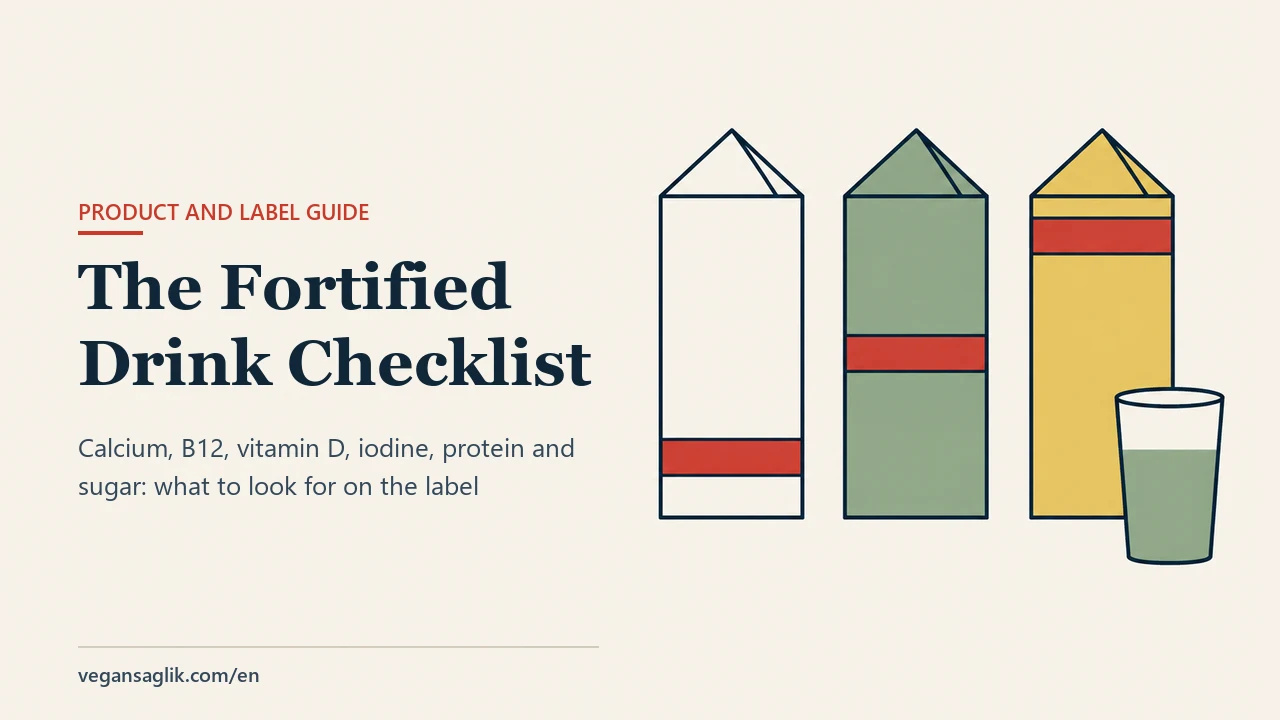
Turn the carton around and look at the nutrition table and the ingredient list. Six things are worth checking, and they take one pass.
1. Calcium: is it there, and in what form?
This is the single most important line. In the Swiss analysis, every drink without fortification had significantly less calcium than milk. Fortified ones varied by method: drinks fortified with calcareous red algae (Lithothamnium calcareum) reached a calcium concentration comparable to milk, while drinks fortified with tricalcium phosphate were higher still.
Higher on the label is not automatically better in the body. The authors note that the bioavailability of tricalcium phosphate has been shown to be 25% lower in a soy-based beverage than the calcium in milk. A drink that matches milk on paper may therefore deliver somewhat less. This is a reason to prefer a fortified drink over an unfortified one, not a reason to agonise over which calcium salt was used.
In the ingredient list, added calcium usually appears under its chemical name rather than the word calcium: in the Swiss samples it was either tricalcium phosphate or calcium-rich red algae, listed by its species name. If you see either of those, the drink is fortified even if the front of the pack says nothing about it.
Here the label rules help you. Under EU legislation, a beverage counts as containing a significant amount of a vitamin or mineral when 100 ml supplies at least 7.5% of the nutrient reference value, and only nutrients present in that amount may be declared. The reference value for calcium is 800 mg, so the threshold works out at 60 mg per 100 ml. Turkey’s own labelling regulation is built the same way: vitamins and minerals are declared only when present in what it calls a significant amount, defined in its Annex 9, and the nutrition declaration is given per 100 g or 100 ml.
The practical rule is the same in both systems. If calcium appears in the nutrition table, the drink has been fortified with a meaningful quantity of it. If it does not appear, it has not.
2. Vitamin B12: never assume
Plants do not make vitamin B12, so any B12 in a plant drink was added. For vegans this is the nutrient with the least margin for error, and a fortified drink is a convenient way to spread intake across the day. The reference value is 2.5 µg, putting the significant-amount threshold at roughly 0.19 µg per 100 ml.
A fortified drink is a contribution, not a strategy. The Vegan Society advises either fortified foods eaten consistently across the day or a supplement, and most vegans find the supplement simpler to get right. Our B12 guide covers the amounts.
3. Vitamin D
Added vitamin D appears in some soy drinks as D2, the plant-derived form. The reference value is 5 µg, so the threshold for a beverage is 0.375 µg per 100 ml. Treat what a drink provides as a useful addition rather than the plan; for most people the plan is sunlight in season and, when that is not enough, a supplement. Our vitamin D guide goes into the detail.
4. Iodine: usually the gap nobody notices
Milk is a meaningful iodine source in many countries, and plant drinks generally are not. In the Swiss analysis, milk contained more iodine than most plant drinks. Seaweed fortification changed this somewhat: iodine appeared to be higher in one soy drink, one oat drink and three rice drinks that had been fortified with calcareous red algae, but the concentrations still stayed significantly below milk.
So if you have replaced milk with a plant drink, iodine is the nutrient most likely to have quietly disappeared from your diet without anything appearing in its place. Iodised salt and, where appropriate, a supplement are the usual answers. Our iodine article explains why seaweed is an unreliable substitute.
5. Protein, if the drink is doing a job
If the drink goes into your coffee, protein hardly matters. If it is a meaningful part of a child’s diet, or you are over 65 and counting protein across the day, it matters a great deal. As the Swiss figures above show, soy is the only common base that reaches milk’s range; the rest sit at 1% protein or below. Check the protein line per 100 ml and decide accordingly; our article on protein quality in a vegan diet covers what that protein is worth.
6. Sugars
Nutrition labels declare total sugars only. They do not separate sugars that come from the raw material and its processing from sugar the manufacturer added, which is why researchers working from labels cannot quantify added sugar and have to read the ingredient list instead. Do the same: if sugar, glucose syrup, fruit juice concentrate or similar appears in the ingredient list, it was added. A figure in the sugars line, on its own, does not tell you that.
Two traps
Organic products are usually not fortified
This one catches people who are deliberately trying to buy well. Under the EU organic regulation, minerals, vitamins, amino acids and micronutrients may be used in organic food only where their use is directly legally required, or for the specific categories covered by EU Regulation 609/2013, such as infant formula and foods for special medical purposes. Calcium and B12 are not legally required in a plant drink. The practical consequence: an organic oat drink is very likely to be unfortified, while the conventional version of the same product on the next shelf may be fortified with calcium, B12 and D.
If you buy organic and rely on the drink for nutrients, check the table rather than assuming, and cover the difference elsewhere.
Per 100 ml, not per glass
Manufacturers may declare nutrients per portion in addition to the mandatory per-100-ml figure. A 250 ml glass makes every number look two and a half times better. When you compare two products, compare the per-100-ml column, and check what the package calls a portion before reading any percentage next to it.
A shortcut
We built a tool that does this comparison for you. The plant drink label comparator takes a barcode, a product name or values typed in by hand, and lines up protein, sugars, calcium, B12, vitamin D, iodine and price per 100 ml across products. It is the same six checks, in a table.
What this article does not say
It does not say plant drinks are inadequate. It says their nutrient content is a decision made by the manufacturer, and the label is where that decision is recorded.
The evidence has limits worth naming. The compositional analysis reflects products sold in Switzerland and was published in 2022; formulations change and markets differ, so the specific products are not yours. The 18.4% fortification figure comes from fermented yogurt alternatives, not drinks, and from the same national market. Neither study measured what happens in people who use these products, only what is in the package and what a substitution model predicts. And a fortified drink is one contribution to an intake, not proof that an intake is adequate.
What generalises is the habit. Turn the carton around, look for calcium, B12, D and iodine in the table, check the protein line if the drink has a job to do, and read the ingredient list for added sugar. Once, per product. After that you just buy the one you already checked.
Sources
- Walther B, Guggisberg D, Badertscher R, et al. Comparison of nutritional composition between plant-based drinks and cow’s milk. Frontiers in Nutrition. 2022;9:988707. doi:10.3389/fnut.2022.988707
- Barth M, et al. Fermented plant-based yogurt alternatives in Switzerland: nutritional adequacy and fortification practices. Frontiers in Nutrition. 2026. doi:10.3389/fnut.2026.1899857
- European Parliament and Council. Regulation (EU) No 1169/2011 on the provision of food information to consumers, Annex XIII (nutrient reference values; significant amount).
- European Parliament and Council. Regulation (EU) 2018/848 on organic production and labelling of organic products, Annex II (use of minerals, vitamins, amino acids and micronutrients).
- Ministry of Food, Agriculture and Livestock (Türkiye). Turkish Food Codex Regulation on Food Labelling and Informing Consumers, Official Gazette, 26 January 2017 (repeated issue).
- The Vegan Society. Vitamin B12.
Editor: Anıl Güler, Pharmacist
Last scientific review: 19 September 2026