How to Read Nutrition Research Without Being Misled
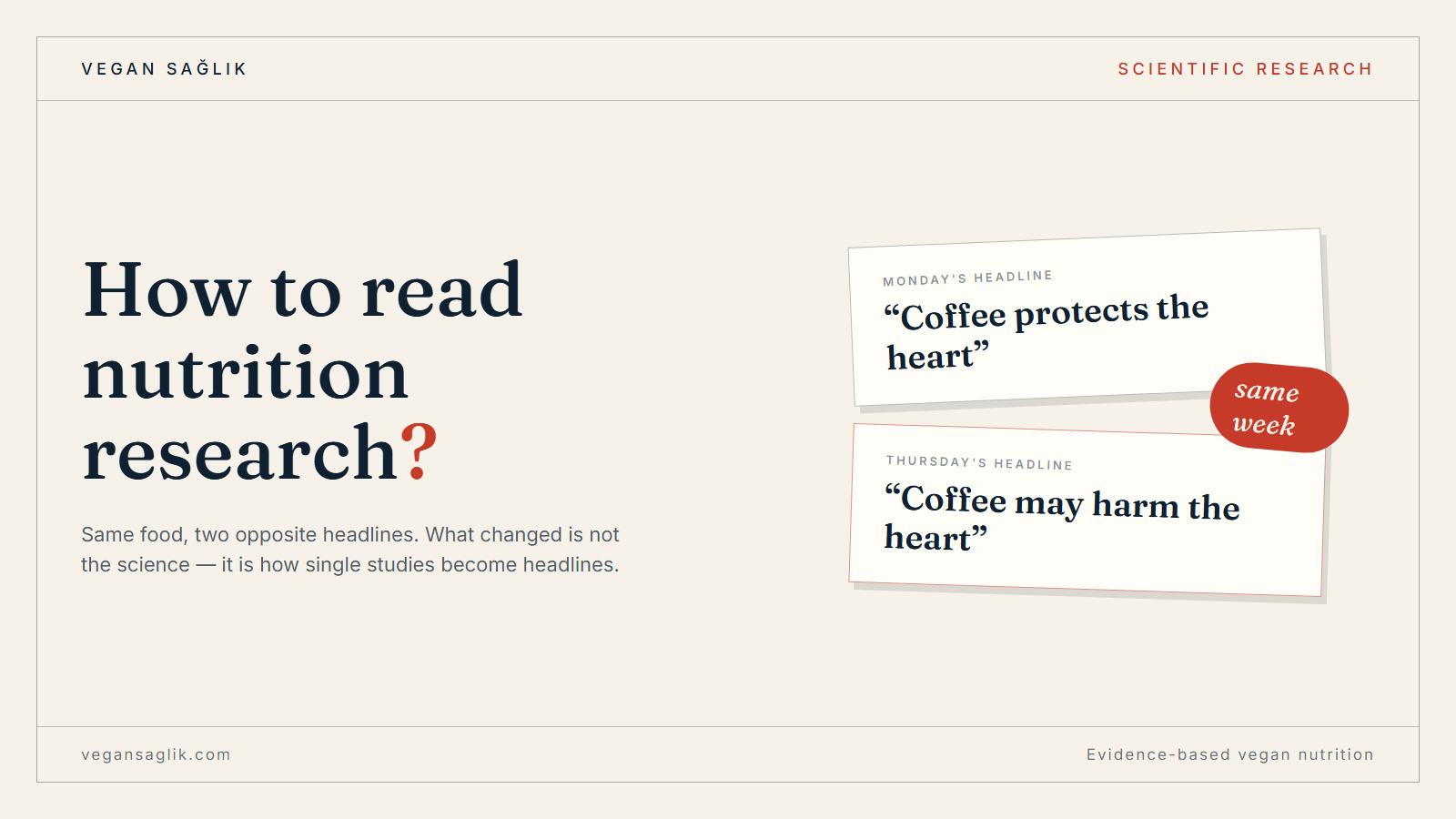
One week a headline says coffee protects the heart; the next week it apparently harms it. Nutrition news often feels contradictory, and it is tempting to conclude that “scientists keep changing their minds.” Usually the science has not changed much at all—what changes is how single studies are selected, simplified and dramatised on the way to a headline. Learning a few basic ideas about how nutrition research works makes it much easier to tell a genuinely important finding from noise.
Why nutrition is a genuinely hard thing to study
Nutrition research faces obstacles that drug research largely avoids, and knowing them explains a lot of the conflicting headlines:
- Measuring diet is difficult. Large studies usually rely on self-reported questionnaires about what people ate over months or years. People forget, estimate portions poorly and sometimes report what they think they should eat. Researchers know this and use statistical corrections, but some measurement error always remains.
- Effects are small and slow. A food eaten today rarely produces a measurable disease outcome for decades. Studies therefore need many people followed for a long time, which is expensive and imprecise.
- There is no true “zero” group. A drug trial can compare medicine against placebo. In nutrition, eating less of one thing always means eating more of something else, so results depend partly on what the comparison food is.
- Diets travel with lifestyles. People who eat a lot of vegetables often differ from people who do not—in smoking, exercise, income and healthcare use. Separating the effect of the food from the effect of the lifestyle is a central, and imperfect, task of nutrition science.
None of this means nutrition science is useless. It means single studies should be read modestly, and conclusions should be built from many studies together.
Know the main study types
The type of study determines what a result can and cannot tell you.
Laboratory and animal studies
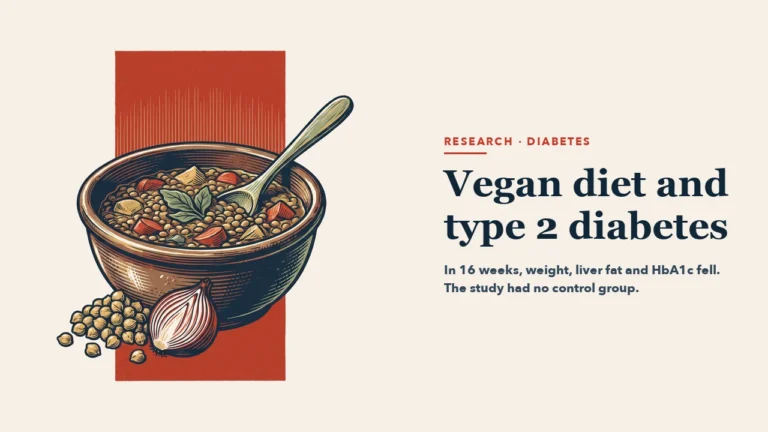
Experiments on cells or animals are useful for exploring mechanisms, but they cannot show what a food does in humans at realistic intakes. A compound that kills cancer cells in a dish at high concentration says almost nothing about eating the food that contains it. Headlines built on these studies deserve the most caution.
Observational studies
Here researchers observe people without changing their behaviour. Common designs include:
- Cross-sectional studies take a snapshot of diet and health at one moment. They cannot show which came first.
- Case-control studies compare people who already have a condition with people who do not, asking about past diet—which memory can distort.
- Cohort studies follow large groups for years and record who develops which outcomes. These are the strongest observational design in nutrition, but they still show associations, not proof of cause and effect.
Randomised controlled trials (RCTs)
Participants are randomly assigned to an intervention or a comparison group. Randomisation balances out other differences between groups, which is why RCTs are the best tool for testing cause and effect. In nutrition their weakness is practical: most diet trials are short, participants know what they are eating, and not everyone follows the assigned diet—so many trials measure intermediate markers such as blood lipids rather than actual disease events.
Systematic reviews and meta-analyses
A systematic review collects all eligible studies on a question using a predefined method; a meta-analysis combines their numbers statistically. When done well, these give the most reliable overall picture, which is why this site prefers them. But they are only as good as the studies they include and the care with which they were assembled—a sloppy meta-analysis can be more misleading than a single good study.
Association is not causation
Most nutrition headlines come from observational studies, so they describe associations. An association can reflect a real effect—or a confounder: a third factor linked to both the diet and the outcome. Classic example: in early studies, people who took vitamin supplements were healthier, largely because supplement users also exercised more, smoked less and saw doctors more often. Good studies adjust statistically for known confounders, but no adjustment is perfect, and unknown confounders cannot be adjusted for at all.
Signals that researchers themselves treat an association as more credible include: a large and consistent effect across different populations, a plausible mechanism, a dose-response pattern (more exposure, more effect), and support from randomised trials of intermediate markers.
Relative risk sounds bigger than it is
“Food X raises disease risk by 50%” is a relative statement, and it means little until you know the starting point. If a disease affects 2 people in 1,000, a 50% relative increase moves it to 3 in 1,000—one extra case per thousand people. The relative number is not wrong, but the absolute numbers tell you whether the finding matters for daily life. Serious reporting gives both; headlines almost always give only the dramatic one.
Check who was studied, for how long, and what was actually measured
- Who: A result in middle-aged Finnish men may not apply to young women in Turkey. Results in people with a disease may not apply to healthy people, and vice versa.
- How many, how long: Small and short studies produce unstable results. Dramatic findings from a two-week study of 20 people rarely survive replication.
- What outcome: A change in a blood marker (cholesterol, an inflammation score) is not the same as fewer heart attacks or longer life. Marker changes are informative but weaker evidence.
- Compared with what: “Plant protein was better than red meat” and “plant protein was better than nothing” are very different claims.
Follow the money—but sensibly
Industry funding does not automatically make a study wrong, and public funding does not make it right. But funding sources and author conflicts of interest are worth checking (journals require them to be declared, usually at the end of the paper), especially when a study’s conclusion conveniently favours the funder’s product. The same healthy scepticism applies to studies promoted by anyone selling something—including supplement sellers and diet-book authors, whatever diet they advocate.
One study is never the whole story
Science works by accumulation. A single surprising result is the beginning of a question, not the end of one; many early dramatic findings shrink or disappear when larger and better studies repeat them. When a headline claims one new study “overturns everything we knew”, the safest response is to wait and see what systematic reviews conclude. Also note that a press release or a preprint (a paper shared before peer review) has not yet been through the checks that a published, reviewed paper has—peer review is imperfect, but it is a meaningful filter.
A one-minute checklist for any nutrition headline
- Is the actual study linked or named—or only a press release?
- Was it in humans? If in cells or animals, treat it as early-stage.
- What design was it—observational (association) or randomised (cause and effect)?
- How many people, for how long?
- Are the numbers absolute, or only relative percentages?
- Was the outcome a real health event or a blood marker?
- Who funded it, and do the conclusions match the data or exceed them?
- What do systematic reviews on the same question say?
You do not need to answer every question to benefit. Even asking two or three of them will filter out most misleading headlines.
How we use these principles on this site
Vegan Sağlık applies the same rules to itself: articles are built preferentially on systematic reviews, official dietary guidelines and position papers rather than single studies; associations are described as associations; and where evidence is weak or mixed, we say so. Evidence-based also means accepting inconvenient findings—for example, that unfortified plant foods are not a reliable source of vitamin B12. A vegan diet does not need exaggerated claims; it needs accurate ones.
Sources
- InformedHealth.org, Institute for Quality and Efficiency in Health Care (IQWiG). In brief: What types of studies are there?
- Cochrane. Evidence Essentials: an introduction to evidence-based medicine, clinical trials and systematic reviews.
- MRC/CSO Social and Public Health Sciences Unit, University of Glasgow. Understanding Health Research: a tool for making sense of health studies.
- Satija A, Yu E, Willett WC, Hu FB. Understanding nutritional epidemiology and its role in policy. Advances in Nutrition. 2015;6(1):5-18.
- National Cancer Institute. Dietary Assessment Primer: Key concepts about measurement error.
- Cancer Research UK. Absolute versus relative risk: making sense of media stories.
- Irwig L, Irwig J, Trevena L, Sweet M. Relative risk, relative and absolute risk reduction, number needed to treat and confidence intervals. In: Smart Health Choices. NCBI Bookshelf.
Editor: Anıl Güler, Pharmacist
Scientific review date: 23 August 2026