How to Spot Animal-Derived Ingredients in Medicines and Supplements
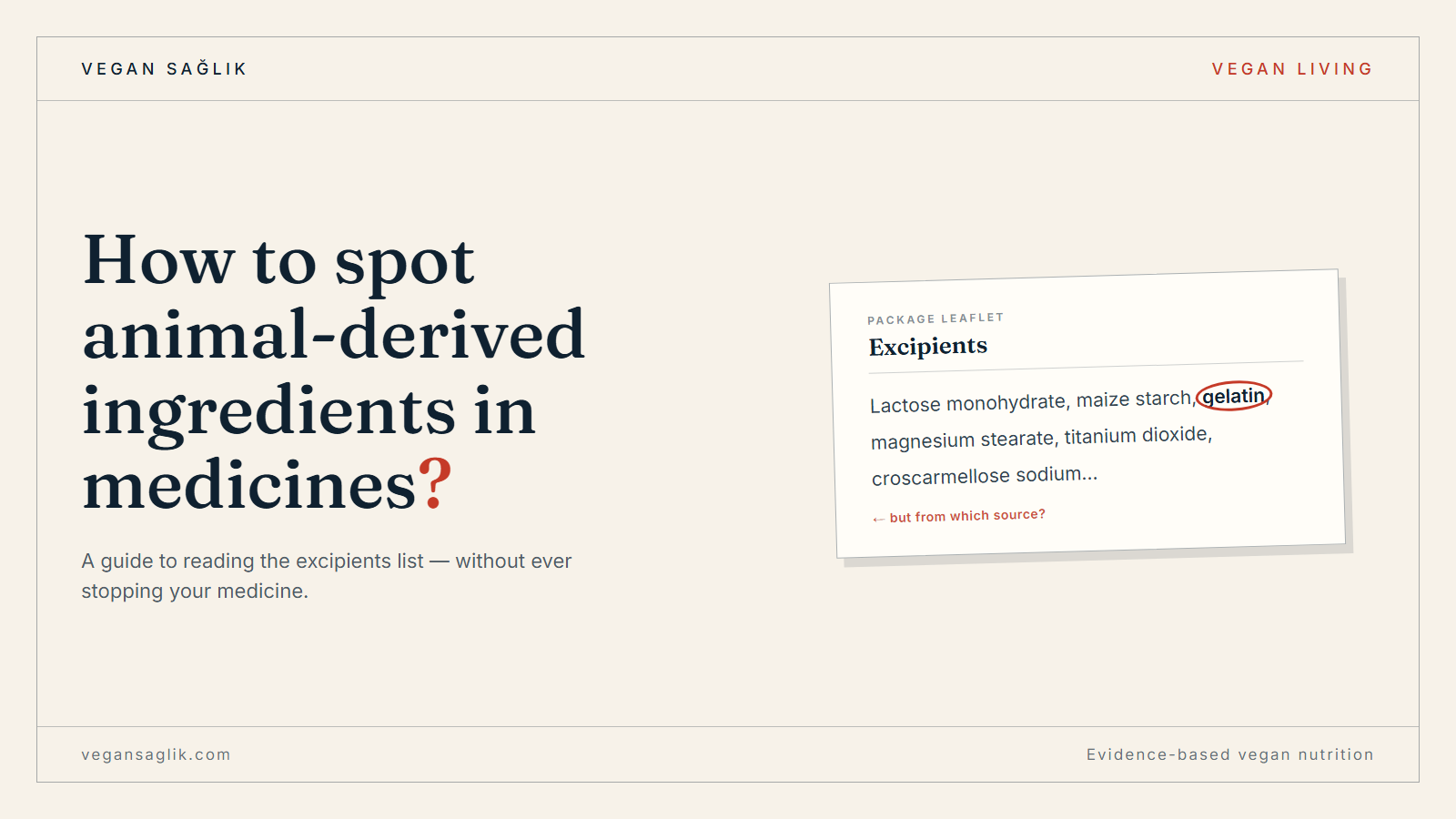
Many vegans are surprised to learn that the tablet or capsule they take may contain animal-derived ingredients — not in the active drug itself, but in the excipients: the fillers, coatings, colours and lubricants that hold a medicine together. Unlike food, medicines carry no “suitable for vegans” labelling requirement, so knowing which ingredient names to look for is genuinely useful. This guide explains what to check, what the label cannot tell you, and — most importantly — where the limits of avoidance lie.
How common is this?
More common than most people expect. A 2025 analysis published in Frontiers in Pharmacology found that 74 of the 100 most commonly prescribed primary-care medicines in the United Kingdom contained at least one of three excipients that are, or can be, animal-derived: lactose, gelatin or magnesium stearate. Avoiding them entirely is often not realistic; knowing about them lets you ask the right questions when alternatives do exist.
The usual suspects
Gelatin
The best-known example. Most hard capsules and almost all softgels are made from gelatin, produced from the skin and bones of pigs, cattle or fish. The leaflet usually just says “gelatin” without naming the species. Plant-based alternatives exist and are increasingly common: capsules made from HPMC (hypromellose, a cellulose derivative) or pullulan, and pregelatinised starch — which, despite the similar name, is plant-derived. The same active drug is often also available as a plain tablet or a liquid.
Lactose
One of the most widely used tablet fillers, produced from cow’s milk. It appears in a very large share of tablets, including many inhalers. For strict avoidance there is often a lactose-free brand or formulation of the same drug — your pharmacist can check.
Magnesium stearate and stearic acid
A lubricant found in most tablets. Here is the catch: it can be made from either animal fat or vegetable sources, and the label does not say which. Much of today’s supply is plant-derived, but the only way to know for a specific product is to ask the manufacturer. This is a good example of an ingredient where certainty is simply not available from the packaging.
Glycerol/glycerin
Used in syrups, gels and softgels; like stearates, it can be of animal or plant origin, and the name alone does not tell you which.
Shellac
A glossy coating used on some tablets and sweets, secreted by the lac insect. Not vegan; listed as “shellac” when present.
Carmine / cochineal (E120)
A red colouring made from cochineal insects, occasionally used in coated tablets and liquids. In the United States, the FDA has required it to be declared by name (“carmine” or “cochineal extract”) on food and cosmetic labels since 2011, largely because of rare allergic reactions; in ingredient lists in Europe it appears as carmine or E120.
Lanolin — the hidden source of most vitamin D3
Most vitamin D3 (cholecalciferol) in supplements and fortified foods is manufactured from lanolin, the grease of sheep’s wool. Vegan-certified D3 made from lichen exists, and vitamin D2 (ergocalciferol) is produced without animal inputs. If the label does not state a vegan source, D3 is usually lanolin-derived.
Omega-3 softgels
A double check is needed here: the oil itself is usually fish-derived unless the product explicitly says algal (algae-based EPA/DHA), and the softgel shell is usually gelatin unless stated otherwise.
How to actually check a product
- Read the excipients list. For medicines, the package leaflet lists excipients (in the EU and Turkey this disclosure follows regulatory labelling guidance). For supplements, read the full ingredient list, including the capsule shell.
- Scan for the key names: gelatin, lactose, magnesium stearate, stearic acid, glycerol, shellac, carmine/cochineal/E120, lanolin.
- Accept the label’s limits. For stearates and glycerol, origin cannot be determined from the label; only the manufacturer can confirm it.
- Ask your pharmacist. Pharmacists can look up excipients across brands and tell you whether the same active substance is available as a tablet, liquid or plant-capsule formulation.
- Re-check on every change. Formulations differ between brands and can change over time; a product that was free of animal-derived excipients last year may not be today.
- For supplements, prefer certified products. A registered vegan trademark or an explicit “capsule of plant origin” statement saves most of the detective work.
When there is no vegan option
Sometimes there isn’t one — the only licensed form of a needed medicine may be a gelatin capsule or a lactose-containing tablet. In that situation the answer from both medical bodies and vegan organisations is the same: take the medicine. NHS patient guidance encourages people with dietary or religious concerns to discuss alternatives with a pharmacist rather than declining treatment, and the Vegan Society explicitly advises vegans to take the medicines they are prescribed. Health is the foundation that makes an ethical life possible; protecting it is not a failure of veganism.
Sources
- The Vegan Society. Is my medication vegan?
- NHS Specialist Pharmacy Service. Avoiding animal contents within medicines.
- NHS Specialist Pharmacy Service. Understanding excipients in medicines.
- Frontiers in Pharmacology (2025). Animal-derived ingredients in medicines: a framework for ethical prescribing practices.
- Worcestershire Acute Hospitals NHS Trust. Medicines derived from animal products — patient information.
- U.S. Food and Drug Administration. 21 CFR 73.100 — Cochineal extract; carmine.
- NIH Office of Dietary Supplements. Vitamin D: Fact Sheet for Health Professionals.
- The Pharmaceutical Journal. Going vegan: the rise of animal-free medicines.
Editor: Anıl Güler, Pharmacist
Scientific review date: 23 August 2026