How to Read a Vegan Cosmetics Label: Vegan, Cruelty-Free and Bunny Logos Explained
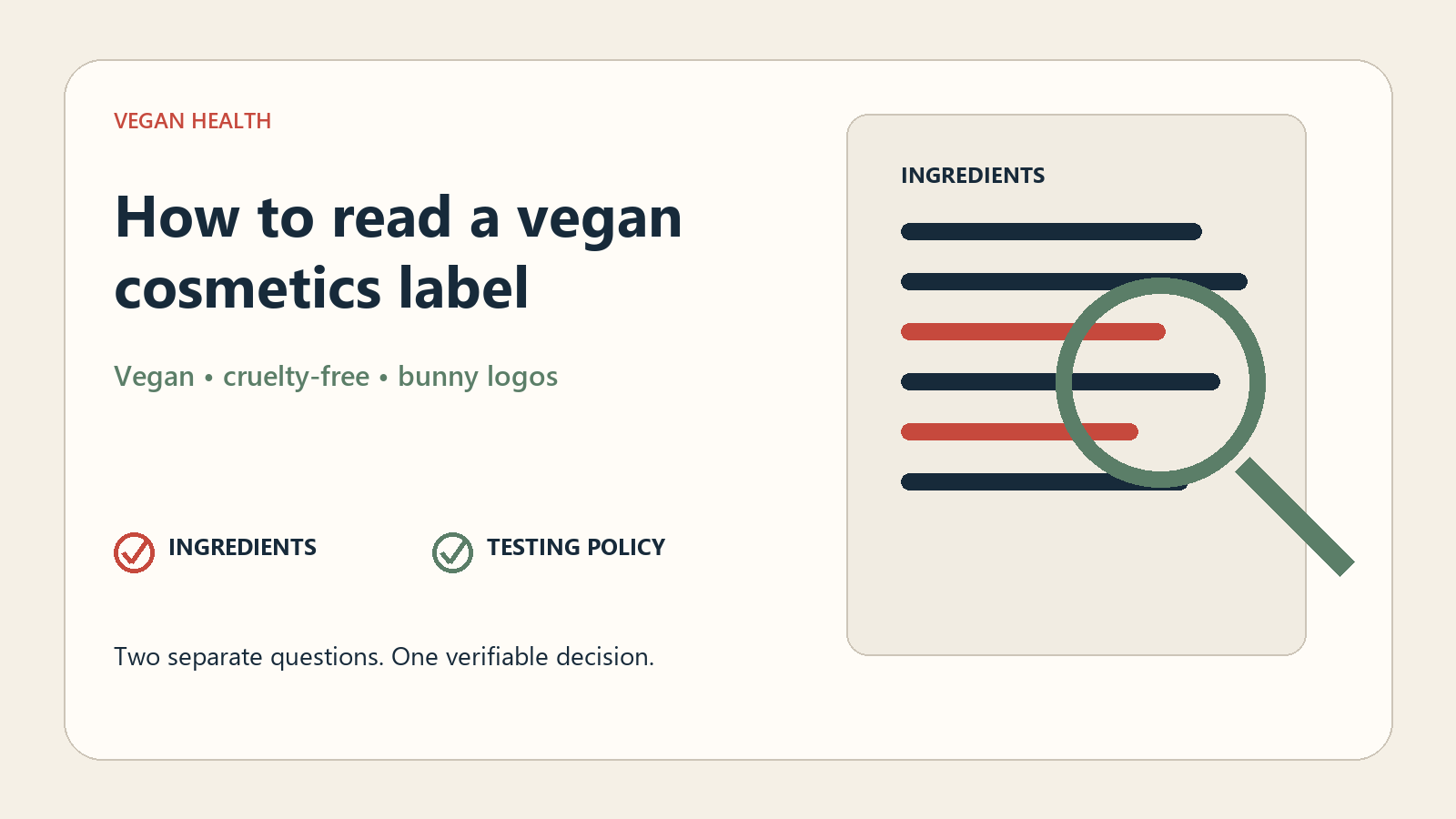
A bunny symbol, the word “vegan” and a cruelty-free claim answer different questions. A cruelty-free programme may assess an animal-testing policy without certifying that every ingredient is animal-free. A vegan claim may address ingredients alone. Check its standard to see whether it also covers the testing policy. Check two things separately: what the product contains and which testing standard it follows.
- “Vegan” should mean no animal-derived ingredients under the stated standard.
- “Cruelty-free” concerns animal testing; it does not automatically mean vegan ingredients.
- A bunny drawing is useful only when you can identify the programme behind it and verify the brand or product in that programme’s directory.
Start with two separate questions
Cosmetic labels become much easier to read when you stop treating “vegan” and “cruelty-free” as synonyms.
- Ingredient question: Does the formula contain an animal-derived ingredient, by-product or processing aid?
- Testing question: What does the company require of itself, its suppliers and third parties regarding animal testing?
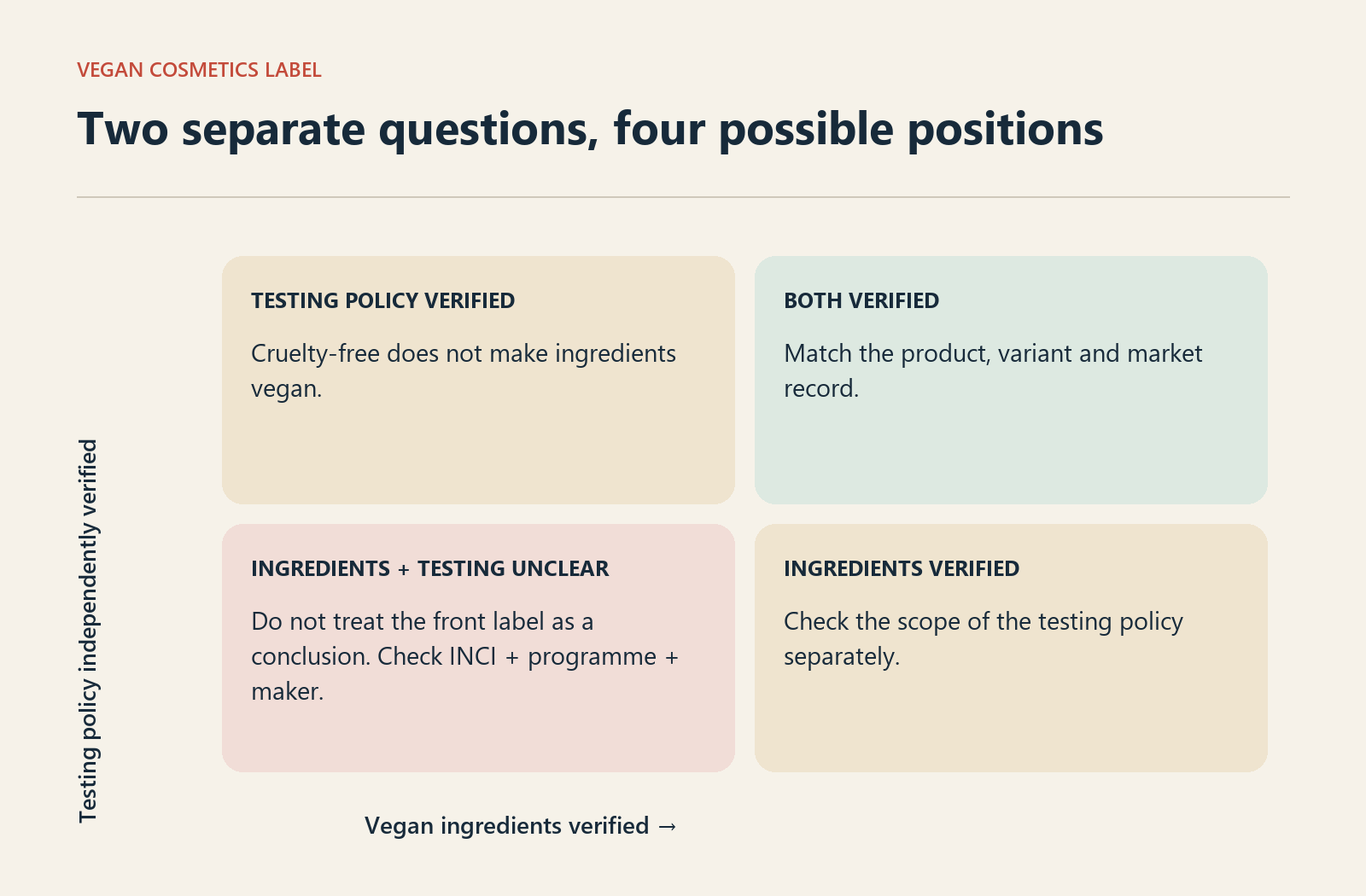
A product can sit in any of four positions. Both its ingredients and testing policy may be independently verified. Alternatively, only one may be verified. Some products make claims without enough information to verify either. That last category does not prove that a product fails. It means the label gives you too little evidence to decide.
What the words and logos can—and cannot—tell you
| Label element | What it may tell you | What it does not prove by itself | How to verify |
|---|---|---|---|
| Vegan | The formula meets the company’s or a named programme’s animal-derived ingredient rules. | That every vegan standard has the same testing, supply-chain or cross-contamination rules. | Find the standard owner and read its scope; for a certification, search its official directory. |
| Cruelty-free | The company claims a defined animal-testing policy. | That the formula contains no beeswax, lanolin, carmine or other animal-derived material. | Look for a named programme, its cut-off and supplier-monitoring rules, and a current directory entry. |
| Bunny symbol | It may point to an established approval programme. | That any bunny-shaped icon is licensed or independently audited. | Match the exact programme name and verify the company or product on the programme owner’s site. |
| Plant-based / natural / clean | A marketing description whose scope should be explained nearby. | Vegan status, cruelty-free status, hypoallergenicity or superior safety. | Return to the INCI list, the claim’s definition and supporting certification. |
Self-declared claim or independent certification?
A claim can be true without carrying a third-party logo. It can also be too vague to audit from the package. The practical distinction is traceability. An independent programme publishes a standard, controls use of its mark and provides some way to confirm approval. A self-declared statement depends on the evidence held by the responsible company.
This does not make every certified product perfect or every uncertified product unsuitable. Certification has fees, documentation requirements and scope limits. Smaller brands may choose not to apply. Your task is simply to distinguish “I found no animal ingredient in this list”, “the brand says this product is vegan” and “a named programme has assessed this product under published rules.” They are three different levels of evidence.
Vegan certification marks are used on food, drink and household products as well as cosmetics. Our guide Vegan Certification Labels: What They Mean explains how to check who issued a mark, what it covers and how to verify it.
What do the better-known programmes cover?
Vegan Society’s Vegan Trademark
The Vegan Trademark standard covers animal ingredients, animal by-products and derivatives. Its published standard also includes animal-testing criteria for the product and its ingredients when testing is conducted by the company, on its behalf or by parties over which it has effective control. It requires precautions against cross-contamination, but that should not be rewritten as a promise of absolute zero trace contamination.
Cruelty Free International’s approval programme
Cruelty Free International focuses on animal-testing controls. Its programme describes a fixed cut-off date, supplier monitoring and independent audit. Its own programme material tells consumers to check vegan suitability separately. In plain language: approval under a cruelty-free programme answers the testing question; it does not turn beeswax or lanolin into vegan ingredients.
Programme names and visual identities can change. Check the scope of approval, not just the logo. Approval may cover an entire brand, selected products or one national market. Match the product name, shade and market to the directory entry. Approval for a similarly named range may not cover the product in your hand.
Read the INCI list, but know its limit
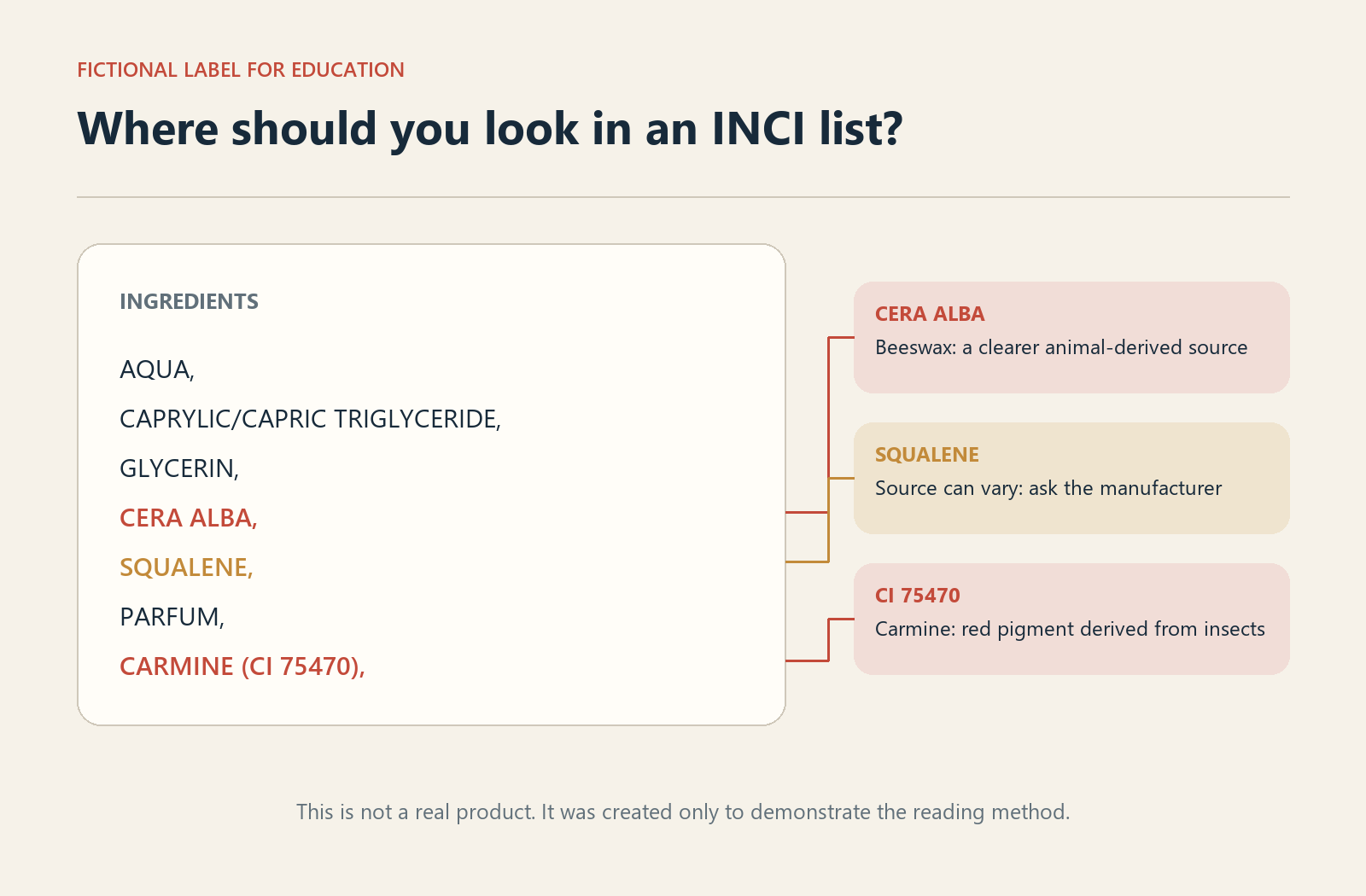
The ingredients list uses standardised cosmetic ingredient names, commonly called INCI names. This makes products easier to compare across languages, but an INCI list is not a full supply-chain record. Some names clearly point to an animal-derived material; others can be produced from more than one source.
| Name you may see | Why it matters | Next check |
|---|---|---|
| Cera Alba / Beeswax | Beeswax; not vegan under established vegan standards. | Choose a verified plant- or synthetic-wax alternative if vegan status is required. |
| Lanolin | A waxy material obtained from sheep’s wool. | Do not assume “natural moisturiser” means plant-derived. |
| Carmine / CI 75470 | A red colourant derived from insects. | Check colour cosmetics especially; names may appear as carmine or the colour-index number. |
| Shellac | A resinous material produced by lac insects. | It can appear in coatings, nail and hair products; verify the finished product claim. |
| Squalene | The same label name can be associated with plant or animal sourcing. | Ask for the source or rely on a relevant vegan certification. |
This is a decision list, not a complete dictionary. Formulas change, synonyms exist and processing aids may not be obvious from a short consumer label. The European Commission’s CosIng database is useful for identifying cosmetic ingredient names and functions, but the Commission states that it is informative and does not itself certify that a material is vegan or approved for a particular use.
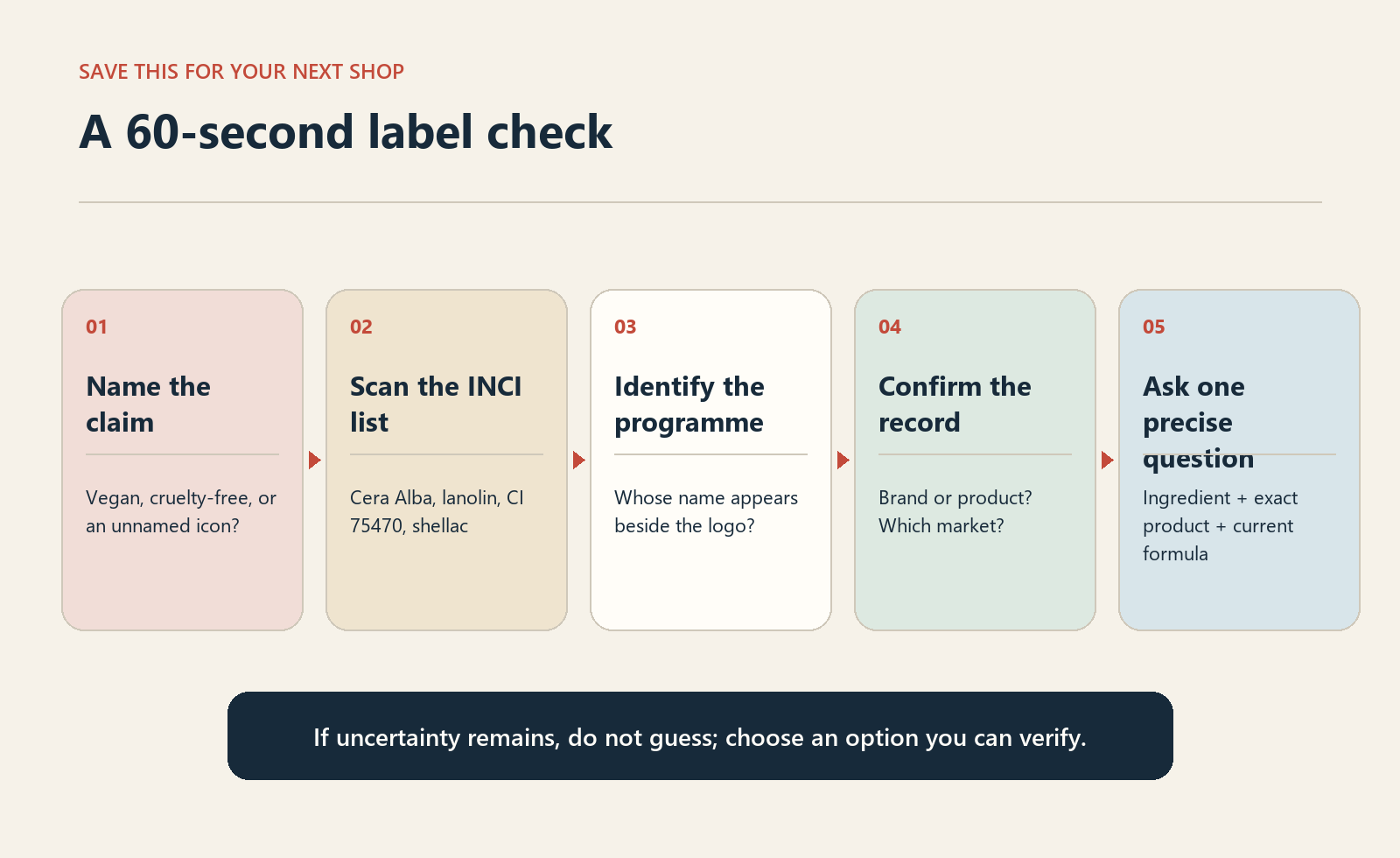
A 60-second vegan cosmetics label check
- Name the claim. Does the pack say vegan, cruelty-free, both, or only show an unexplained icon?
- Scan the INCI list. Look first for clearer animal-derived examples such as Cera Alba, lanolin, carmine/CI 75470 and shellac.
- Identify the programme. Read the small print around the logo. A recognisable picture without a programme name is still an unverified picture.
- Confirm the record. Search the programme owner’s directory. Check whether approval is for the whole brand, selected products or a market-specific range.
- Resolve one uncertainty. If a source-variable ingredient remains, ask: “Is the [ingredient name] in product [exact name/variant] animal-derived, and can you confirm this for the current formula and market?”
Three label cases
Case 1: named vegan certification and named cruelty-free approval
The pack carries two identifiable marks. You find the product in the vegan programme directory and the brand in the cruelty-free programme directory. This is the clearest case, provided that the exact product, variant and market match the records. Still read the label for allergens or ingredients you personally avoid; certification is not an allergy assessment.
Case 2: cruelty-free claim, but Cera Alba in the ingredients
There is no contradiction. The claim concerns animal testing, while Cera Alba is beeswax. If you need a vegan product, this one does not meet that ingredient requirement even if its testing claim is properly substantiated.
Case 3: the online product image and the pack do not match
An older retailer image shows a vegan mark. However, the current pack has no mark, and its INCI list has changed. Do not treat the product page as final evidence: online images can lag behind formula or packaging updates. Record the product name, shade and ingredients from the pack. Add batch details if available. Then request current confirmation for that version and market.
What do the law and EU bans change?
Turkey’s Cosmetic Products Regulation says cosmetic claims must not imply characteristics or functions the product does not have. It also places conditions on claims that no animal testing was carried out, including relevant actions by manufacturers and suppliers. This matters because a graphic on the front of a pack is still a product claim; visual confidence is not a substitute for evidence.
In the European Union, the Cosmetics Regulation established animal-testing and marketing bans in the cosmetics framework, fully implemented in 2013. The legal picture is more nuanced at ingredient level. The European Commission has explained that REACH may still require animal testing as a last resort for worker or environmental risks that fall outside cosmetic consumer-safety assessment. Therefore, “sold in the EU” is not a complete substitute for reading a programme’s scope.
EU common criteria also require cosmetic claims to be truthful, supported by adequate and verifiable evidence, honest and useful for informed decisions. Compliance with minimum legal requirements should not be presented as a special advantage. These rules improve the evidence framework, but they do not make every marketing word a certification.
Frequently asked questions
Does one certification cover every product in a brand?
Not always. Some programmes assess a company- or brand-level testing policy, while vegan registrations may be issued for individual products and variants. Do not stop at seeing the brand name in a directory; read the scope statement, product name and any market limitation.
Does an older vegan approval still apply after a formula change?
An old pack, screenshot or manufacturer email does not automatically cover a new formula. Read the current INCI list again and compare it with the date and product details in the certification directory. Include the batch, shade and market when contacting the company.
What if an online listing conflicts with the physical pack?
Start with the current pack in your hand; retailer pages can retain old copy or images. Then check the responsible company’s current product page and the relevant certification directory. If the conflict remains, request written confirmation rather than basing the purchase on an assumption.
Are all cosmetics sold in China animal-tested?
No single sentence can cover every product category, route to market and regulatory exception. Requirements have changed over time. Check the brand’s current, market-specific policy and a programme’s current approval rather than relying on an old blanket claim.
Are vegan cosmetics safer for sensitive skin?
Vegan status describes source criteria; it does not mean hypoallergenic, fragrance-free, natural or suitable for every skin condition. Read the full label and follow professional advice for known allergies or persistent reactions.
A better question to send the manufacturer
Avoid sending only “Is this vegan?” Give the exact product, shade or variant and market, then ask:
“Can you confirm whether product [exact name, shade and market] contains any animal-derived ingredient, by-product or processing aid in its current formula? If an ingredient can have more than one source, please confirm the source used in this product. Which independent standard, if any, covers the product’s vegan status and animal-testing policy?”
A precise question creates a reply you can compare with the label and the certification directory. Save the date of the reply because formulations and suppliers can change.
Sources and further verification
- Republic of Türkiye — Cosmetic Products Regulation
- Regulation (EC) No 1223/2009 on cosmetic products
- Commission Regulation (EU) No 655/2013 on common criteria for cosmetic claims
- European Parliament — answer on cosmetics and REACH animal-testing requirements, 18 March 2025
- European Commission — CosIng database
- The Vegan Society — Vegan Trademark Standards
- Cruelty Free International — Approval Programme
- Cruelty Free International — Approved Brands
Last scientific and regulatory review: 31 August 2026
Editor: Anıl Güler, Pharmacist
Editorial disclosure: This guide is independent educational content. No brand or certification programme paid for inclusion.