Young Vegans Get Almost All Their B12 and Vitamin D From Ultra-Processed Food
Public health gives two pieces of advice side by side: eat more plant foods, eat fewer ultra-processed foods. For most people these do not collide. For a young vegan they collide head on, because the foods that carry the nutrients a vegan diet is short of — fortified plant milks above all — are classified as ultra-processed.
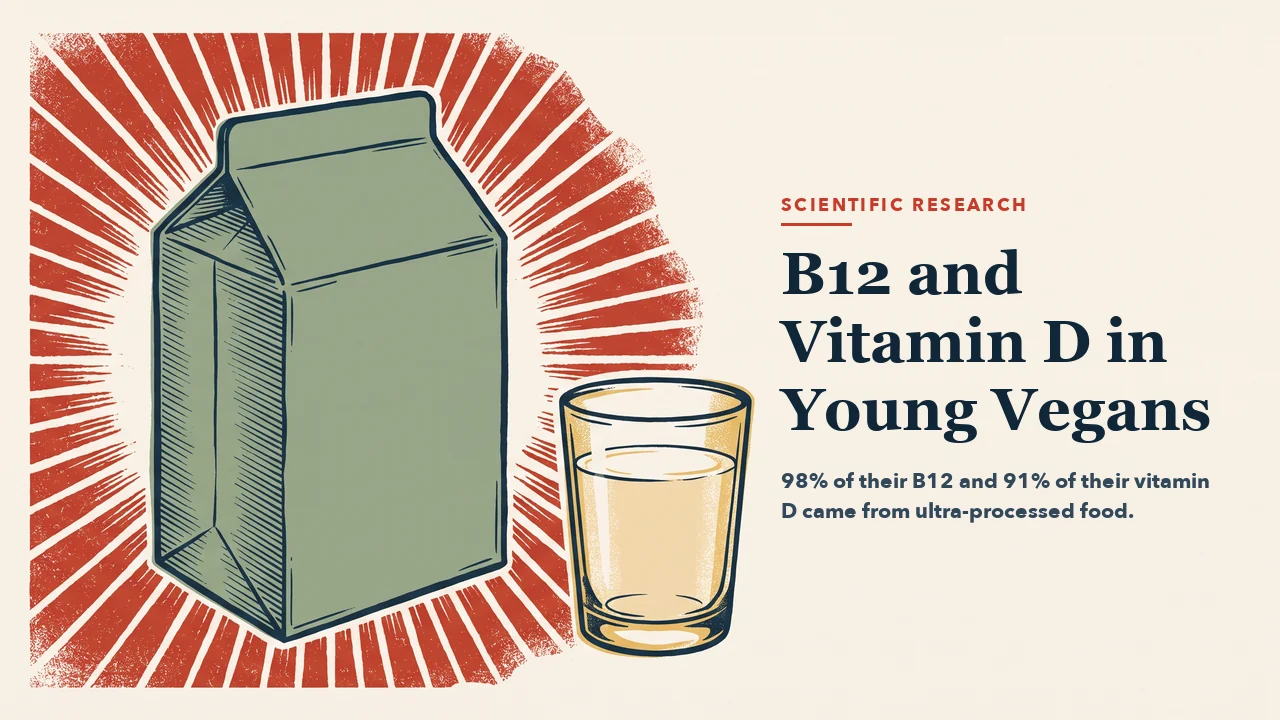
A Swedish study published in Nutrition Journal on 4 August 2026 measured how hard they collide. Among young vegans, a median of 98 per cent of vitamin B12 and 91 per cent of vitamin D came from ultra-processed food. And yet, by every dietary marker the study looked at, those same vegans were not eating worse than anyone else.
What was measured
VeggiSkills-Sweden recruited 244 young people aged 16 to 24; 235 were included after exclusions. Of these, 60 followed a vegan diet, 59 lacto-ovo-vegetarian, 55 pescatarian and 61 omnivore. Almost all of them completed four 24-hour dietary recalls, together covering every day of the week and the whole year, and each reported food was classified as ultra-processed or not using the Nova system. Blood samples gave iron, B12 and vitamin D status.
One methodological point matters for reading the headline figures: dietary supplements were excluded from the analysis. The percentages below describe where the nutrients in food came from. Separately, 90 per cent of the vegans reported taking some supplement — the highest share of the four groups.
The numbers
Ultra-processed food supplied a median of 46.7 per cent of the vegans’ energy, against roughly 35 per cent in the other three groups (35.4 lacto-ovo-vegetarian, 35.1 pescatarian, 35.6 omnivore). The nutrient picture is sharper:
| Share coming from ultra-processed food (median) | Vegan | Omnivore |
|---|---|---|
| Vitamin B12 | 98.0% | 31.5% |
| Vitamin D | 91.2% | 34.2% |
| Saturated fat | 68.7% | 38.3% |
| Riboflavin | 60.1% | 37.0% |
| Calcium | 50.0% | 30.0% |
| Salt | 50.0% | 37.2% |
| Zinc | 38.4% | 26.9% |
| Iodine | 28.7% | 15.1% |
Read the B12 row again: the interquartile range in the vegan group was 90.5 to 100 per cent. For vitamin D it was 81.0 to 99.0. This is not a tendency. For these young vegans, fortified ultra-processed food was effectively the only dietary route to those two nutrients.
The part that complicates the headline
If ultra-processed food were simply bad, the vegans should have come out worse. They did not.
- Fibre: 35 g a day in vegans, against 27, 24 and 25 g in the other three groups.
- Polyunsaturated fat: 8 per cent of energy, against 7, 7 and 6.
- Saturated fat: 8 per cent of energy, against 11, 12 and 13.
- Free sugars, salt, total energy and BMI: no significant difference between the groups.
So the group taking the most of its diet from ultra-processed food also had the most fibre, the most unsaturated fat and the least saturated fat, without eating more sugar, more salt or more calories. The authors put it plainly: despite the higher intake of ultra-processed food, the vegans did not appear to eat less healthily than the other groups.
There is a real caution inside that table too. Ultra-processed food supplied 68.7 per cent of the vegans’ saturated fat and half of their salt. Their salt intake was no different from the other groups and their saturated fat was the lowest — but the levers that could move those totals sit in the processed part of the shelf.
How you classify changes the answer
This is the finding a careful reader should keep. The researchers classified the same foods twice: once conservatively, once with a more experimental approach. With the conservative classification, vegans took significantly more of their energy from ultra-processed food than every other group. With the experimental classification, the difference between the groups disappeared — p = 0.105 for kilocalories and p = 0.055 for energy percentage.
In other words, a result that looks like a fact about diets is partly a fact about where a classification system draws its lines. Nova sorts foods by the extent of industrial processing and, as the authors note, includes no nutritional dimension at all. A fortified soy drink and a sugary soft drink land in the same box.
Did it show up in their blood?
No. Across the study population there was no association between ultra-processed food intake and nutrient status, and none with the proportion of participants at risk of insufficiency for iron, B12 or vitamin D. One exception appeared: among vegans, haemoglobin was higher in the lowest third of ultra-processed intake than in the middle third, but it did not differ from the highest third, and no participant had values corresponding to anaemia. The authors call this unlikely to be of clinical importance and say it should be interpreted cautiously. That is the right reading.
One association did hold across the whole sample. Participants in the highest quartile of ultra-processed intake had lower general nutrition knowledge: a median score of 50 against 55 in the second quartile, with more of them in the low-knowledge band. Within the vegan group alone, that association was not present.
What to do with this
The authors address their conclusion to public health authorities, not to shoppers. As ultra-processed food is defined today, they write, authorities should be careful about discouraging it while promoting a more plant-based diet among young people. Delivered together and without qualification, those two messages tell a vegan teenager to stop drinking the fortified plant milk that supplies almost all of their B12 and vitamin D.
For a reader the practical translation is narrower:
- Do not drop fortified foods to lower your “ultra-processed” score. Remove fortified plant milk and put nothing in its place, and you have removed a nutrient source, not a health risk.
- Check that the product is actually fortified. Not all of them are, and the label is the only way to know — our fortified plant drink checklist covers what to look for.
- B12 has two routes and no third one: a supplement, or fortified food. If you rely on the second, this study is a reminder that the supply is concentrated in a few products. Our B12 guide and vitamin D guide set out the amounts.
- The processed part of the shelf is where the salt and the saturated fat sit. That is where to look first if either needs to come down.
Limits
This is a cross-sectional study: it describes one group at one moment and cannot show cause. Participants were recruited by convenience and snowball sampling, so, as the authors say, the sample probably over-represents young people already interested in diet and health; 78 per cent were female. The classification was carried out by a single researcher, and published best-practice protocols for applying Nova could not be followed strictly. 7 per cent of participants under-reported their intake, with no difference between the dietary groups. And the study measured BMI, dietary intake and nutrient status only; nothing about glucose, cardiovascular outcomes or body composition can be read from it.
It is also Sweden. The fortification landscape there is not Turkey’s, and a reader here cannot assume the same plant milks carry the same nutrients. That is an argument for reading labels, not for dismissing the finding.
Sources
- Turesson Wadell A, Mulkerrins I, Larsson C. Ultra-processed food intake and its nutritional consequences among youth when consuming vegan, lacto-ovo-vegetarian, pescatarian or omnivore diets: a cross-sectional study. Nutr J. 2026;25(1):83. doi:10.1186/s12937-026-01378-8.
Editor: Anıl Güler, Pharmacist
Last scientific review: 27 September 2026