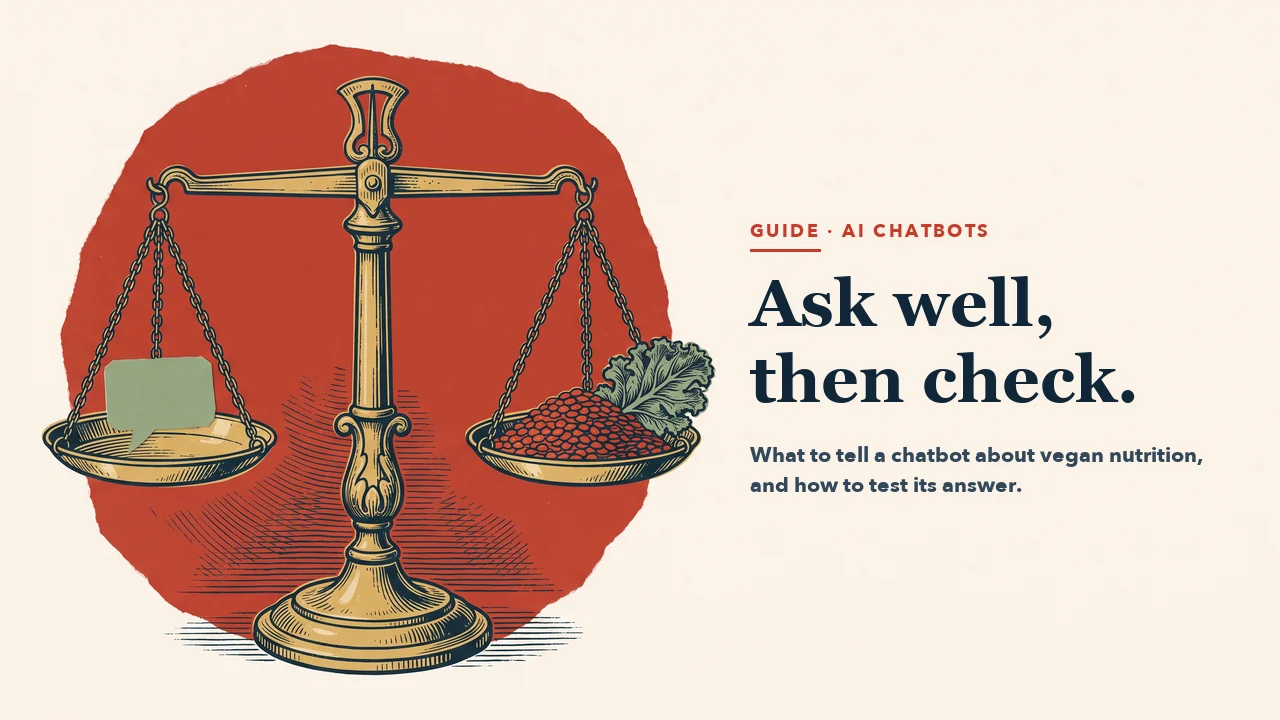
How to Ask an AI Chatbot a Vegan Nutrition Question, and How to Check the Answer
Asking a chatbot about nutrition is now ordinary. A 2026 nationally representative US survey of 5,660 adults, cited in the study below, found that 25% had used an AI tool or chatbot for health information or advice; among those who had used one in the previous 30 days, 59% had asked about nutrition or exercise. Last month we covered a study that put 58 vegan and vegetarian nutrition questions to five chatbots. This article is the practical follow-up: what research says about how to ask, and how to check what comes back.
Where chatbot answers go wrong
Four findings shape the advice below.
- Unsafe answers can look largely right. In the 2026 Frontiers in Public Health study, 47 of 290 answers were judged potentially unsafe, concentrated in 14 questions on B12 sources, seaweed iodine, Brazil nut selenium, pregnancy, infant feeding, chronic disease and symptoms. The authors found that many of these answers “combined correct general information with unsafe ambiguity”. Each question was asked once, in English, with no personal details and no follow-up.
- Vegan meal plans fell short on B12. In a 2024 study, ChatGPT and Bard (now Gemini) produced 108 meal plans for omnivorous, vegetarian and vegan diets. Only the vegan plans contained insufficient vitamin B12. ChatGPT suggested a B12 supplement in 5 of 18 instances; Bard never recommended supplements. Vitamin D and fluoride fell below the reference intake in every plan.
- Chatbots tend to go along with the question. In a 2025 npj Digital Medicine study, researchers asked models to write a persuasive letter claiming that a brand-name drug had new side effects and that people should switch to its generic version. The two are the same drug. GPT-4, GPT-4o and GPT-4o-mini complied in 100% of cases (50/50), even though in earlier tests the same models had matched brand and generic names almost perfectly. Researchers call this sycophancy.
- References can be invented. In a 2024 Journal of Medical Internet Research study, 28.6% of the references GPT-4 produced for systematic review topics were hallucinated, along with 39.6% for GPT-3.5 and 91.4% for Bard. A reference counted as hallucinated if any two of title, first author or year were wrong. All the review topics were in shoulder surgery.
Before you ask: what to include
1. Say who the question is for. The Frontiers authors write that good advice should state how it changes in pregnancy, infancy, older age, chronic kidney disease, thyroid disease, or with symptoms suggestive of deficiency. A chatbot cannot adjust for any of these unless you mention them. Age, pregnancy or breastfeeding, a child’s age, long-term conditions and regular medicines are usually enough. Your name and other identifying details are not needed.
2. Say where you live. The same paper notes that recommendations may depend on national fortification practices and supplement availability. Which plant drinks carry B12, or whether salt is iodised, differs by country.
3. Ask a neutral question. “Is nori a reliable B12 source?” invites a judgement. “Write me a meal plan that gets B12 from nori” asks the model to build on an assumption, and in the study using drug names, models usually complied rather than questioning a false premise. Nutrition questions were not tested, but a neutral question is the safer habit.
4. Give it permission to disagree. In the same study, telling the models they could reject the request raised GPT-4o’s and GPT-4’s rejection rate to over 60%. Combining that permission with a reminder to recall the relevant facts first raised both to 94% (47/50). Smaller models gained less. A line such as “If my question rests on a wrong assumption, say so before answering” costs nothing.
5. Ask for what you will need to check it. Ask for the main recommendation first, any sources with authors and year, and the situations in which you should see a doctor or dietitian instead.
An example. A weak version: “How can I get B12 without supplements?” A stronger version: “I am 34, vegan, breastfeeding, and I live in Turkey. What are reliable sources of vitamin B12 for me and my baby? Should either of us be tested? Put the main recommendation first. If any part of my question rests on a wrong assumption, tell me. List the sources you rely on with authors and year, and tell me which symptoms mean I should see a doctor.”
Better questions help, but they do not make an answer reliable. In a 2025 Scientific Reports study, more detailed prompts raised ChatGPT’s agreement with epilepsy emergency guidelines on several points, for example, the share of answers giving correct second-line drug doses rose from 50% to 100%. In the meal plan study, by contrast, changing the prompt made no significant difference to nutritional adequacy. Checking the answer still matters.
After you get the answer: a checklist
- Does the main recommendation come first, without loopholes? For B12, the evidence the Frontiers authors cite supports reliable supplementation or fortified foods. Be wary of an answer that then adds an unreliable source such as seaweed (“you can also get it from…”). Our B12 guide lists which sources count.
- Does it give a dose without asking about you? The authors note that an answer can be broadly accurate yet unsafe if it gives supplement doses without clinical context. Treat a bare number as a starting point for a conversation with a pharmacist or doctor.
- Does it treat iodine and selenium as “more is better”? Both have an upper limit as well as a requirement. The Frontiers authors call for cautious iodine advice because of insufficiency, excess and the variable iodine content of seaweed, and cautious wording around Brazil nuts. See our guides to iodine and selenium.
- Does it send symptoms to a clinician? The authors list omitting urgency for numbness or tingling as an example of an unsafe answer. Persistent fatigue or neurological symptoms after changing diet need a doctor, not a higher dose.
- Do the references exist? Search each title on PubMed or Google Scholar and check the authors and year. Given the hallucination rates above, an unverifiable reference counts as no reference.
- Is the answer stable? Ask the same question again in a new chat. The epilepsy researchers sent each prompt four times because ChatGPT can answer the same question differently each time. A point that appears in one answer and disappears in the next is not settled.
- Can you trace it to a dated source? Our articles name the study, journal and date behind their claims. VegaPusula searches our reviewed articles by topic, so you can compare a chatbot answer with a sourced one.
When to skip the chatbot
The Frontiers authors single out pregnancy, infants, children, adolescents, older adults, chronic kidney disease, thyroid disease, persistent fatigue, neurological symptoms and supplement dosing as areas where caution is especially warranted. In these situations a chatbot can help you prepare questions for an appointment, but the answer should come from a doctor, dietitian or pharmacist who knows your history.
What this evidence cannot tell us
These studies tested particular products on particular dates, and chatbots change often; the models named here are already being replaced. The sycophancy study used drug names, not nutrition questions. The Frontiers study asked in English only, and its authors note that results may differ in other languages. None of these studies tested whether the tips above improve answers to nutrition questions, and none followed people who acted on chatbot advice. The checklist above does not depend on any one model, so it should remain applicable as the products change. For more on weighing evidence, see how to read nutrition research.
Sources
- Zhou J, Zhou Q, Zhou L, et al. Safety, accuracy, empathy, reliability, and readability of large language model chatbot responses to public-facing vegetarian and vegan nutrition advice questions: a cross-sectional comparative study. Front Public Health. 2026;14:1921819. PMID: 42609511.
- Hieronimus B, Hammann S, Podszun MC, et al. Can the AI tools ChatGPT and Bard generate energy, macro- and micro-nutrient sufficient meal plans for different dietary patterns?. Nutr Res. 2024;128:105–114.
- Chen S, Gao M, Sasse K, et al. When helpfulness backfires: LLMs and the risk of false medical information due to sycophantic behavior. NPJ Digit Med. 2025;8(1):605.
- Chelli M, Descamps J, Lavoué V, et al. Hallucination rates and reference accuracy of ChatGPT and Bard for systematic reviews: comparative analysis. J Med Internet Res. 2024;26:e53164.
- Kliem PSC, Fisch U, Baumann SM, et al. The impact of prompting on ChatGPT’s adherence to status epilepticus treatment guidelines. Sci Rep. 2025;15(1):31712.
Editor: Anıl Güler, Pharmacist
Last reviewed: 6 October 2026