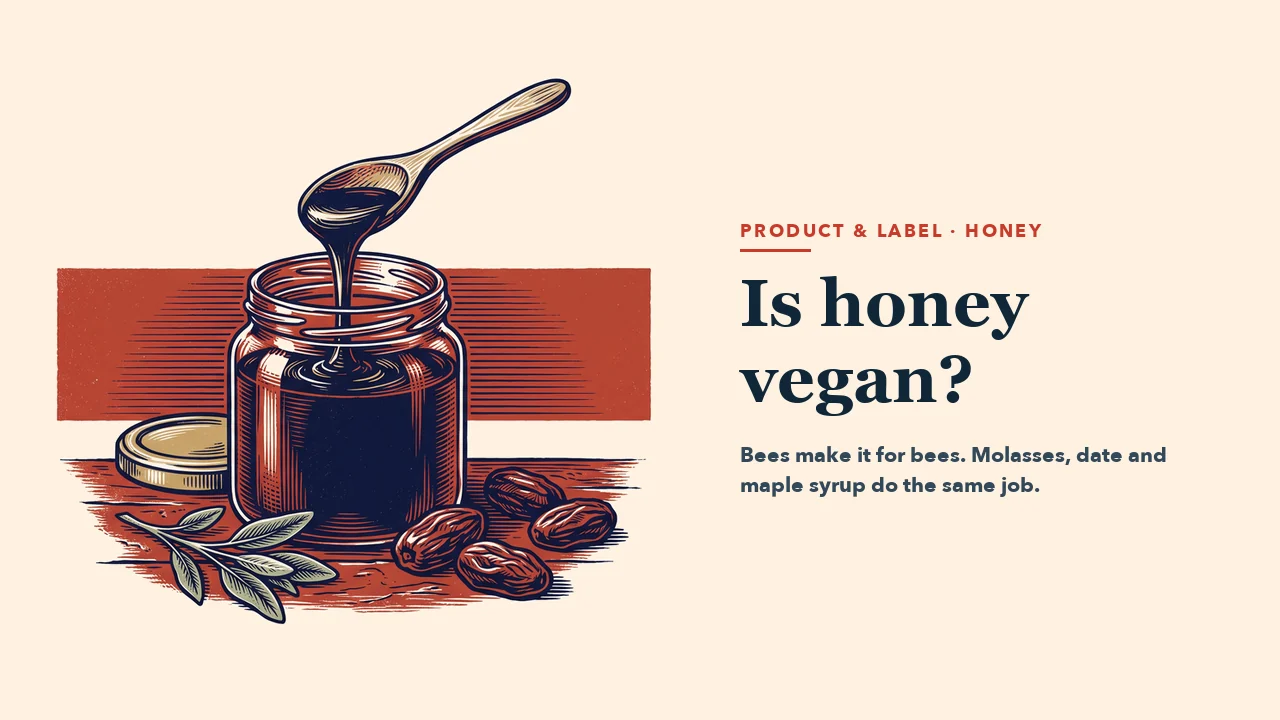
Is Honey Vegan? Why Vegans Leave It Out, and What to Use Instead
Short answer: No. Honey is made by bees, from nectar they collect and process, and stored in the comb as the colony’s food. The Vegan Society defines veganism as a way of living that seeks to exclude, as far as possible and practicable, “all forms of exploitation of, and cruelty to, animals”; in dietary terms, it means leaving out all products “derived wholly or partly from animals”. The Society names honey explicitly as something vegans avoid. By the same definition, beeswax, propolis, royal jelly and bee pollen are excluded too. Nutritionally, honey adds little: it is about four-fifths sugar, and the World Health Organization counts it as a free sugar, alongside table sugar and syrups. Date syrup, grape molasses (pekmez), maple syrup and other plant syrups do the same job in the kitchen.
Why honey counts as an animal product
Turkey’s Honey Communiqué (Bal Tebliği, 2020/7) describes how honey is made: honey bees collect nectar, plant secretions or the secretions of plant-sucking insects (the source of pine honey), combine them with substances of their own, reduce their water content, and store them in the comb to mature. The same communiqué says that nothing, including food additives, may be added to honey. So honey is not a plant product that bees merely carry; it is a substance bees make.
For the Vegan Society, the central point is who honey is for. In its words, honey “is made by bees for bees”. It is the colony’s energy source and its reserve for poor weather and winter. The Society notes that each bee produces only about a twelfth of a teaspoon of honey in its lifetime. This is also why honey from a small or careful beekeeper does not change the answer: the Society’s definition seeks to exclude, in its words, “not just cruelty, but exploitation”.
What the hive gives up
Beekeepers take honey and often give the colony sugar in its place. A study in Scientific Reports states the practice plainly: beekeepers often feed high-fructose corn syrup or sucrose after harvesting honey or when nectar is scarce. The researchers fed bees honey, sucrose or corn syrup in the laboratory and compared gene activity in the fat body, a tissue that works like a liver and fat store. Compared with honey, the sugar diets changed the activity of 220 genes (sucrose) and 104 genes (corn syrup), including genes involved in protein metabolism. The authors conclude that bees get nutritional components from honey that the replacement feeds do not provide. The study measured gene activity in caged bees; it did not measure colony health or survival.
The Vegan Society also points to other routine practices: selective breeding for productivity, the culling of hives after harvest in some operations, and the clipping of queens’ wings so that a colony cannot swarm and leave.
Can bees suffer?
This question affects how much weight the practices above carry. In a 2022 experiment published in PNAS, bumblebees chose between feeders that were heated to a harmful 55 °C and feeders that were not. They avoided the heated feeders when the unheated ones offered a strong sugar solution, but used them more as the reward elsewhere became weaker. They made the trade-off using colours they had learned, which points to processing in the brain rather than a simple reflex. The authors write that this ability “is consistent with a capacity for pain experiences in insects”.
A 2025 position paper in Veterinary Sciences, which argues for bringing honey bees under animal welfare law, notes that EU animal welfare law recognises mammals, birds and cephalopods as sentient but not honey bees. It also notes that the 2024 New York Declaration on Animal Consciousness acknowledged a realistic possibility of consciousness in invertebrates, honey bees among them. The science does not prove that bees feel pain as we do. It does make the possibility hard to dismiss.
Does keeping honey bees help bees?
The “save the bees” message is usually about wild pollinators, not about hives. There are thousands of bee species, but, as the Vegan Society notes, only seven recognised species of honey bee. Large numbers of managed hives can affect wild bees. A systematic review in PLoS ONE sorted studies on managed honey bees and bumblebees:
- Competition for flowers and nesting sites: 53% of studies reported negative effects on wild bees, 28% no effect and 19% mixed effects.
- Changes in plant communities: 36% reported positive and 36% negative effects.
- Disease: 70% reported potential negative effects through the spread of pathogens.
The review adds two caveats. Where managed bees were native, as honey bees are in Turkey, competition effects were smaller, but effects through disease were potentially greater. And most studies showed that an effect was possible, for example that competition or pathogens occurred, but did not measure wild bee numbers or survival directly. A separate review describes how hundreds of thousands of hives are moved across countries each year, and how this can introduce parasites or raise disease levels in wild bees. Buying honey is therefore not a way to protect wild bees. The Vegan Society suggests supporting a conservation charity instead.
Is honey healthier than sugar?
Not in any meaningful way. According to the US Department of Agriculture’s nutrient database, 100 g of honey contains 82 g of carbohydrate (41 g fructose and 36 g glucose), 17 g of water and 304 kcal. A tablespoon (21 g) supplies about 64 kcal and 17 g of sugar. Its vitamins and minerals are present only in trace amounts: a tablespoon provides about 11 mg of potassium and less than 0.1 mg of iron.
The World Health Organization defines free sugars as sugars added to foods and drinks plus “sugars naturally present in honey, syrups, fruit juices and fruit juice concentrates”. It advises keeping free sugars below 10% of daily energy, about 50 g for a person eating 2,000 kcal a day. Three tablespoons of honey already go slightly over it. The plant syrups below are free sugars too, so swapping honey for date syrup is an ethical choice, not a health upgrade.
Babies under one year old should never be given honey. Honey can carry spores of the bacterium that causes botulism, and in some infants these spores grow in the gut and produce the toxin. It is the only food proven to cause infant botulism. The California Department of Public Health, which runs an infant botulism treatment and prevention programme, states that spores have been found in honey in many countries and that all major health and food safety groups agree on this rule.
Where honey and other bee products hide
- Ingredient lists. Look for “bal” or “honey” in granola, cereal bars, breakfast cereals, biscuits, bread, sauces and dressings, and in honey-flavoured drinks.
- E901. Beeswax is an approved food additive, listed as “E901 Beeswax, white and yellow”. The plant waxes next to it on the list, candelilla wax (E902) and carnauba wax (E903), are plant-based alternatives. Our article on animal-derived food additives covers it with E904 (shellac) and E120 (carmine).
- Other bee products. Propolis, royal jelly and bee pollen are sold as supplements and can appear in throat sprays, lozenges and cosmetics; beeswax can also appear in lip balms and creams.
- Vegan labels. In Turkey, the Ministry’s labelling guideline allows statements such as “Suitable for vegans”. Our article on vegan label rules in Turkey explains how they work.
What to use instead
- Grape molasses (pekmez). Thick and dark, with a fruity taste; works on bread, in tahini mixes and in baking. Carob and mulberry molasses are similar.
- Date syrup. Close to honey in thickness and colour; good in porridge, dressings and baking.
- Maple syrup. Thinner and milder; suits pancakes, yoghurt alternatives and glazes.
- Agave syrup and golden syrup. Neutral sweetness; agave dissolves easily in cold drinks, and golden syrup suits baking.
- “Vegan honey”. Some products imitate honey with plant ingredients and sugar. The Vegan Society lists a bee-free honey registered with its Vegan Trademark.
All of these count as free sugars, so the WHO limit applies to them as much as to honey.
Limits of this summary
The definition of veganism used here is the Vegan Society’s. The bee studies cited are laboratory experiments, reviews and one position paper, and few of them measure effects on whole colonies or wild bee populations. How common the beekeeping practices described by the Vegan Society are, in Turkey or elsewhere, is not measured in these sources. Nutrient values are for honey in general; they vary with the floral source.
Sources
- The Vegan Society. Definition of veganism.
- The Vegan Society. The honey industry.
- Türk Gıda Kodeksi Bal Tebliği (Tebliğ No: 2020/7). Resmî Gazete 22.04.2020, sayı 31107.
- Wheeler MM, Robinson GE. Diet-dependent gene expression in honey bees: honey vs. sucrose or high fructose corn syrup. Scientific Reports 2014;4:5726.
- Gibbons M, Versace E, Crump A, Baran B, Chittka L. Motivational trade-offs and modulation of nociception in bumblebees. PNAS 2022;119(31):e2205821119.
- Bava R, Formato G, Liguori G, et al. Honeybee sentience: scientific evidence and implications for EU animal welfare policy. Veterinary Sciences 2025;12(7):661.
- Mallinger RE, Gaines-Day HR, Gratton C. Do managed bees have negative effects on wild bees?: A systematic review of the literature. PLoS ONE 2017;12(12):e0189268.
- Graystock P, Blane EJ, McFrederick QS, Goulson D, Hughes WOH. Do managed bees drive parasite spread and emergence in wild bees? International Journal for Parasitology: Parasites and Wildlife 2016;5(1):64–75.
- U.S. Department of Agriculture. FoodData Central: Honey (SR Legacy, FDC ID 169640).
- World Health Organization. Healthy diet (fact sheet).
- California Department of Public Health, Infant Botulism Treatment and Prevention Program. For parents and families.
- Food Standards Agency. Approved additives and E numbers.
- Türk Gıda Kodeksi Gıda Etiketleme ve Tüketicileri Bilgilendirme Yönetmeliği Kılavuzu. T.C. Tarım ve Orman Bakanlığı, Gıda ve Kontrol Genel Müdürlüğü; Revizyon 002, 10.03.2026.
Editor: Anıl Güler, Pharmacist
Last reviewed: 17 October 2026