World Osteoporosis Day: A Five-Point Bone Checklist for Vegans
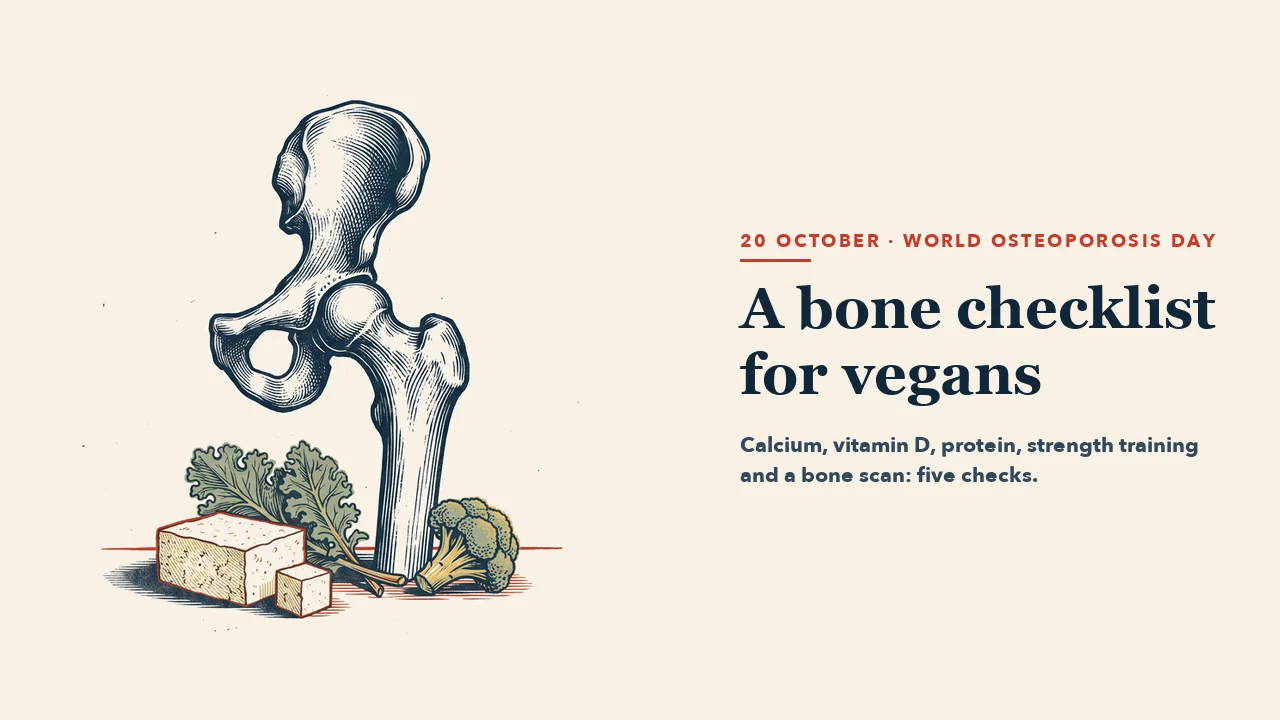
Short answer: In large studies, vegans have had a higher risk of hip fracture than meat eaters. The reasons are only partly understood. Lower body weight and lower intakes of calcium and protein seem to explain part of the difference, and vitamin D also appears to matter. In one large study, the extra risk in vegan women disappeared among those who took both calcium and vitamin D. Five checks cover most of what matters: calcium, vitamin D, protein, strength training, and knowing when to ask for a bone scan.
Why this matters on 20 October
20 October is World Osteoporosis Day, organised by the International Osteoporosis Foundation (IOF). Osteoporosis makes bones thin and fragile, usually without symptoms until a bone breaks. According to the IOF, worldwide, 1 in 3 women and 1 in 5 men over 50 will have a fracture caused by osteoporosis.
For vegans, the main evidence comes from EPIC-Oxford, a UK study that followed people for an average of 17.6 years. Even after taking body weight into account, vegans had a hip fracture risk 2.31 times that of meat eaters. In everyday terms, that meant about 15 more hip fractures for every 1,000 vegans over 10 years. The gap was larger before body weight was considered, and it shrank only slightly, without disappearing, when calcium and protein intake were also taken into account. We go through these studies in detail in our article on bone health and fracture risk on a vegan diet. This article is the practical checklist.
1. Calcium: a daily target of 950 mg
The European Food Safety Authority (EFSA) sets the reference intake for adults aged 25 and over at 950 mg of calcium a day. Not every plant food counts equally, because some calcium is poorly absorbed.
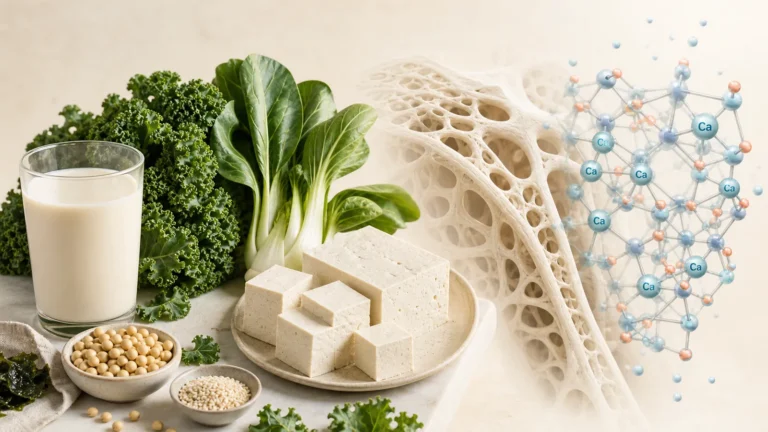
- Reliable sources: calcium-fortified plant drinks and tofu made with calcium sulfate or calcium chloride (check the ingredients list). Check the label for the amount of calcium in milligrams and add it up across the day towards 950 mg.
- Good extras: low-oxalate greens such as kale, broccoli and bok choy, whose calcium is absorbed well.
- Do not count spinach. Spinach contains a lot of calcium, but very little of it is absorbed: in absorption studies, only about 5%.
Our calcium guide shows how to build a day around these sources.
2. Vitamin D: plan for winter
Vitamin D helps the body absorb calcium. EFSA sets an adequate intake of 15 µg (600 IU) a day for adults, for times when the skin makes little vitamin D. Few plant foods supply much vitamin D unless they are fortified, so in the darker months many vegans will need a fortified product or a supplement. How much you need from food depends on how much sun reaches your skin. Our vitamin D guide explains vegan forms (D2 and lichen-derived D3) and safe doses.
The strongest reason to take the first two checks seriously comes from the Adventist Health Study 2 in North America. Vegan women had a 55% higher risk of hip fracture than non-vegetarian women; no such difference was seen in men. Vegan women who took both calcium and vitamin D supplements had no higher risk than women on other diets. This is an observational finding, and the researchers say it still needs to be confirmed.
3. Protein: enough for your body weight
Bone is built on a protein framework, and muscle strength protects against falls. EFSA’s reference intake for adults is 0.83 g of protein per kg of body weight a day, about 58 g for a 70 kg adult. This figure is based on high-quality protein, so vegans do well to aim at or a little above it. Legumes, tofu, tempeh, soy drink and seitan help most vegans reach this.
A 2017 review of 16 trials and 20 cohort studies found no harm to bone from higher protein intakes. It found a small benefit for the spine, but not for the hip. The old idea that protein “washes calcium out of bones” is not supported by this evidence. See our article on protein quality for vegans.
4. Strength training: at least twice a week
Bone is a tissue that gets stronger when it is loaded. The World Health Organization (WHO) describes bone-strengthening activities as movements that put an impact or tension force on bone, which promotes bone growth and strength; its examples are jumping, running and lifting weights. Lifting weights strengthens muscle at the same time. WHO recommends muscle-strengthening activities for all major muscle groups on 2 or more days a week for adults. For people aged 65 and over, it adds activities that combine balance and strength on 3 or more days a week, to help prevent falls.
A small 2022 study from Austria points the same way for vegans. Vegans who did not do resistance training had weaker bone structure than meat eaters who did not train. Among people who did resistance training, bone structure was similar in vegans and meat eaters. Weights, resistance bands and bodyweight exercises such as squats all count; the Austrian researchers advise making them gradually harder over time.
5. Know your risk and ask about a bone scan
The usual test is a bone density scan (DXA). The US Preventive Services Task Force recommends screening for osteoporosis in all women aged 65 and over. It also recommends screening for postmenopausal women under 65 when a doctor’s assessment shows a higher risk of fracture. For men, it found the evidence insufficient to recommend for or against routine screening.
For women under 65, the risk factors the Task Force names include menopause, low body weight, a parent who has had a hip fracture, smoking and drinking too much alcohol. A vegan diet is not among them, so it is worth raising yourself. If you have been vegan for many years, mention it to your doctor, especially if you also have one of these risk factors or have broken a bone in a minor fall, and ask whether a scan is right for you. Not smoking and keeping alcohol low help your bones as well.
The checklist in short
- Calcium: a daily target of 950 mg, from reliable sources (fortified drink, calcium-set tofu).
- Vitamin D from a fortified product or supplement, especially in winter.
- Enough protein: at least 0.83 g per kg of body weight (about 58 g at 70 kg).
- Strength training on at least 2 days a week; balance training after 65.
- Know your risk and ask your doctor about a bone scan when it applies.
This article is general information and does not replace advice from a doctor. If you already have osteoporosis or take medicines that affect bone, discuss supplements with your doctor or pharmacist.
Sources
- International Osteoporosis Foundation. World Osteoporosis Day; Epidemiology of osteoporosis and fragility fractures.
- Tong TYN, et al. Vegetarian and vegan diets and risks of total and site-specific fractures: results from the prospective EPIC-Oxford study. BMC Med 2020;18:353.
- Thorpe DL, et al. Dietary patterns and hip fracture in the Adventist Health Study 2: combined vitamin D and calcium supplementation mitigate increased hip fracture risk among vegans. Am J Clin Nutr 2021;114(2):488–495.
- European Food Safety Authority (EFSA). Dietary Reference Values for nutrients: Summary report. EFSA Supporting Publications 2017:e15121.
- Shkembi B, Huppertz T. Calcium Absorption from Food Products: Food Matrix Effects. Nutrients 2022;14(1):180. (Funded by the Dutch Dairy Association; one author works for FrieslandCampina.)
- Shams-White MM, et al. Dietary protein and bone health: a systematic review and meta-analysis from the National Osteoporosis Foundation. Am J Clin Nutr 2017;105(6):1528–1543.
- Bull FC, et al. World Health Organization 2020 guidelines on physical activity and sedentary behaviour. Br J Sports Med 2020;54(24):1451–1462.
- Wakolbinger-Habel R, et al. Self-reported Resistance Training Is Associated With Better HR-pQCT-derived Bone Microarchitecture in Vegan People. J Clin Endocrinol Metab 2022;107(10):2900–2911.
- US Preventive Services Task Force. Screening for Osteoporosis to Prevent Fractures: US Preventive Services Task Force Recommendation Statement. JAMA 2025;333(6):498–508.
Editor: Anıl Güler, Pharmacist
Last reviewed: 20 October 2026