Zinc for Vegans: How Much You Need, Phytate, Best Plant Sources and Supplement Safety
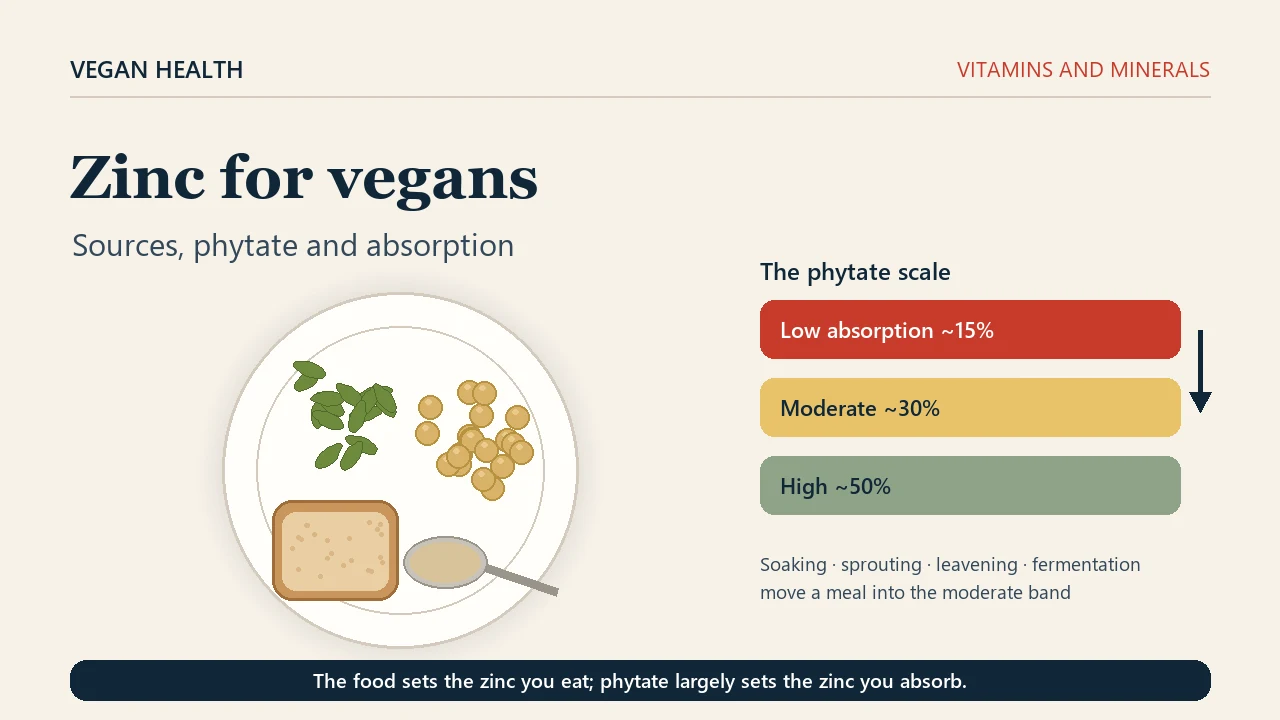
Zinc is not scarce in plant foods. What changes on a vegan diet is how much of it your gut can take up. Legumes, whole grains, nuts and seeds carry plenty of zinc, but they also carry phytate, the phosphorus store of the plant, which binds zinc in the intestine and carries part of it out unabsorbed. That single fact explains why reference bodies give vegetarians a higher target and why a vegan zinc plan is about preparation as much as about food lists.
Why does zinc need attention on a vegan diet?
Zinc has a catalytic or structural role in every one of the six enzyme classes and in roughly 2,500 zinc-finger proteins that regulate which genes are read. It is needed for growth, wound healing, reproduction, neurological function and normal immune function, and the body has no dedicated zinc store, so a steady daily supply matters.
The amount of zinc absorbed from a meal ranges from about 5% to more than 50%, depending mainly on the phytate in the meal, which forms an insoluble complex with zinc that the human gut cannot break apart. In a controlled experiment with white bread rolls, adding increasing amounts of phytate to the same 3.1 mg of zinc cut absorption from 22% to 6%. Meat contains no phytate and its zinc is highly available; a vegan diet replaces that meat with the foods richest in phytate. This is not a reason to avoid whole grains and legumes, whose benefits are well established, but it is the reason the arithmetic is different.
Measured intakes reflect this. In the EPIC-Oxford cohort of about 30,000 British adults, men who ate meat averaged 10.9 mg of zinc a day and vegan men 9.4 mg; for women the figures were 10.4 and 8.4 mg. Against the British average requirement, 27% of vegan men and 10% of vegan women fell short from food alone, compared with 8% and 2% of meat-eaters, and those are unadjusted intakes: once lower absorption is factored in, the gap widens.
How much zinc do adults need?
Reference bodies answer in different ways, and the differences are informative rather than contradictory. The European Food Safety Authority (EFSA), whose values Türkiye’s national guideline adopts, gives four figures rather than one, for daily phytate intakes of 300, 600, 900 and 1,200 mg, because the same physiological requirement needs more dietary zinc as phytate rises. The United States gives a single Recommended Dietary Allowance with an explicit caveat: the requirement “may be as much as 50 percent greater for vegetarians”, particularly where grains and legumes are staples and the phytate-to-zinc molar ratio exceeds 15. WHO/FAO sorts whole diets into high, moderate and low bioavailability, assuming 50%, 30% or 15% absorption.
| Framework | Women | Men | How to read it |
|---|---|---|---|
| EFSA and TÜBER 2022, Population Reference Intake by phytate intake (300 / 600 / 900 / 1,200 mg per day) | 7.5 / 9.3 / 11.0 / 12.7 mg | 9.4 / 11.7 / 14.0 / 16.3 mg | A whole-food vegan diet usually sits in the upper two steps. Pregnancy adds 1.6 mg, lactation 2.9 mg. |
| US National Academies, RDA (2001) | 8 mg | 11 mg | Derived for a mixed diet; the report itself allows up to 50% more for vegetarians with high-phytate diets. |
| WHO/FAO 2004, Recommended Nutrient Intake by bioavailability (high / moderate / low) | 3.0 / 4.9 / 9.8 mg | 4.2 / 7.0 / 14.0 mg | Low bioavailability means unrefined, unfermented, ungerminated cereal-based diets with a phytate:zinc ratio above 15. |
Which step applies to you depends on your phytate load, which nobody measures at home. Türkiye’s guideline estimates that the average adult diet, with about 500 to 620 mg of phytate a day, has “high to moderate” zinc bioavailability; that estimate is for a mixed diet, and a vegan diet built on bread, bulgur, legumes, nuts and seeds is likely to carry more. The practical reading of the table is therefore the upper EFSA range, roughly 11 to 13 mg a day for women and 14 to 16 mg for men, as a planning range rather than a diagnosis of what any individual needs. Lowering phytate by preparation, discussed below, moves you down the table without changing what you eat.
Which vegan foods contain zinc?
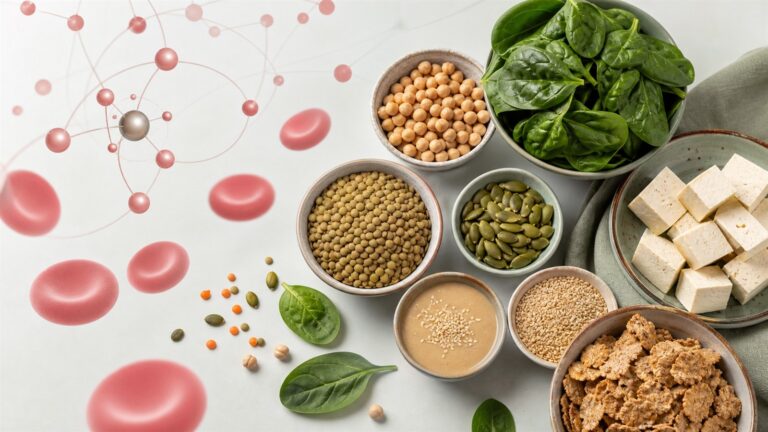
Seeds are the densest sources, legumes and whole grains the bulk sources. The figures below come from the US Department of Agriculture database, which is the most complete public source; Turkish products may differ, and a label with a declared zinc value takes precedence.
| Food | Zinc per 100 g | Realistic portion | Zinc in that portion |
|---|---|---|---|
| Hemp seeds, hulled | 9.9 mg | 2 tablespoons (20 g) | about 2.0 mg |
| Pumpkin seeds, dried kernels | 7.8 mg | A small handful (28 g) | about 2.2 mg |
| Sesame seeds, whole | 7.8 mg | 1 tablespoon (10 g) | about 0.8 mg |
| Cashews, raw | 5.8 mg | A small handful (28 g) | about 1.6 mg |
| Sunflower seed kernels | 5.0 mg | 2 tablespoons (20 g) | about 1.0 mg |
| Tahini | 4.6 mg | 1 tablespoon (15 g) | about 0.7 mg |
| Oats, dry | 3.6 mg | A bowl of porridge (40 g dry) | about 1.5 mg |
| Peanuts, raw | 3.3 mg | A small handful (28 g) | about 0.9 mg |
| Almonds or walnuts | 3.1 mg | A small handful (28 g) | about 0.9 mg |
| Whole-wheat bread | 1.8 mg | 2 slices (60 g) | about 1.1 mg |
| Firm tofu (calcium sulfate) | 1.6 mg | A 150 g serving | about 2.4 mg |
| Chickpeas, boiled | 1.5 mg | A generous ladle (150 g) | about 2.3 mg |
| Lentils, boiled | 1.3 mg | A bowl of lentil dish (150 g) | about 1.9 mg |
| Tempeh | 1.1 mg | A 100 g serving | about 1.1 mg |
| Quinoa or kidney beans, cooked | 1.0–1.1 mg | A serving (150 g) | about 1.6 mg |
| Bulgur, cooked | 0.6 mg | A serving (150 g) | about 0.9 mg |
| White rice or white bread | low | ½ cup or 1 slice | 0.2–0.3 mg |
A day that includes porridge with a handful of pumpkin seeds, a lentil dish with two slices of whole-grain bread, a tofu main, a spoon of tahini and a handful of cashews adds up to about 11 mg without any exotic ingredient; a second legume portion or a fortified cereal lifts it into the planning range. What the table cannot show is the phytate that travels with each figure: seeds, nuts and unleavened whole grains carry the most, while leavened bread, canned or long-soaked legumes and fermented soy carry less per milligram of zinc. Cereals fortified with zinc can add 2 to 3 mg per serving, but in Türkiye fortification is voluntary and only the label says whether zinc was added; our fortified-food label guide explains how to read that line.
How do you get more zinc out of the same foods?
Because phytate is the main brake, the methods that reduce phytate are the methods that matter. All of them work by activating phytase, the enzyme in grains and seeds that breaks phytate down, or by letting microbes do the same job.
- Soak legumes, grains and seeds for several hours before cooking and discard the water; NIH lists this as the first practical step for vegetarian and vegan diets.
- Choose leavened bread over flatbread. In one study of whole-wheat bread, yeast leavening removed about half of the phytate and sourdough about 70%; Türkiye’s guideline gives the same advice for cereal products.
- Sprout and ferment when practical. Germination raises phytase activity, and WHO/FAO names it alongside fermentation as a way to lower phytate; tempeh, sourdough and fermented vegetables also supply organic acids that may help absorption.
- Canned and pre-cooked legumes count. The long processing lowers phytate, so a tin of chickpeas is a reasonable choice, not a compromise.
- Move tea and coffee away from the meal. Türkiye’s guideline advises an hour before or two hours after eating, because they reduce iron and zinc absorption.
- Eat protein with the zinc. The protein content of a meal improves zinc absorption, and organic acids such as citrate help; a squeeze of lemon on lentils is not decorative.
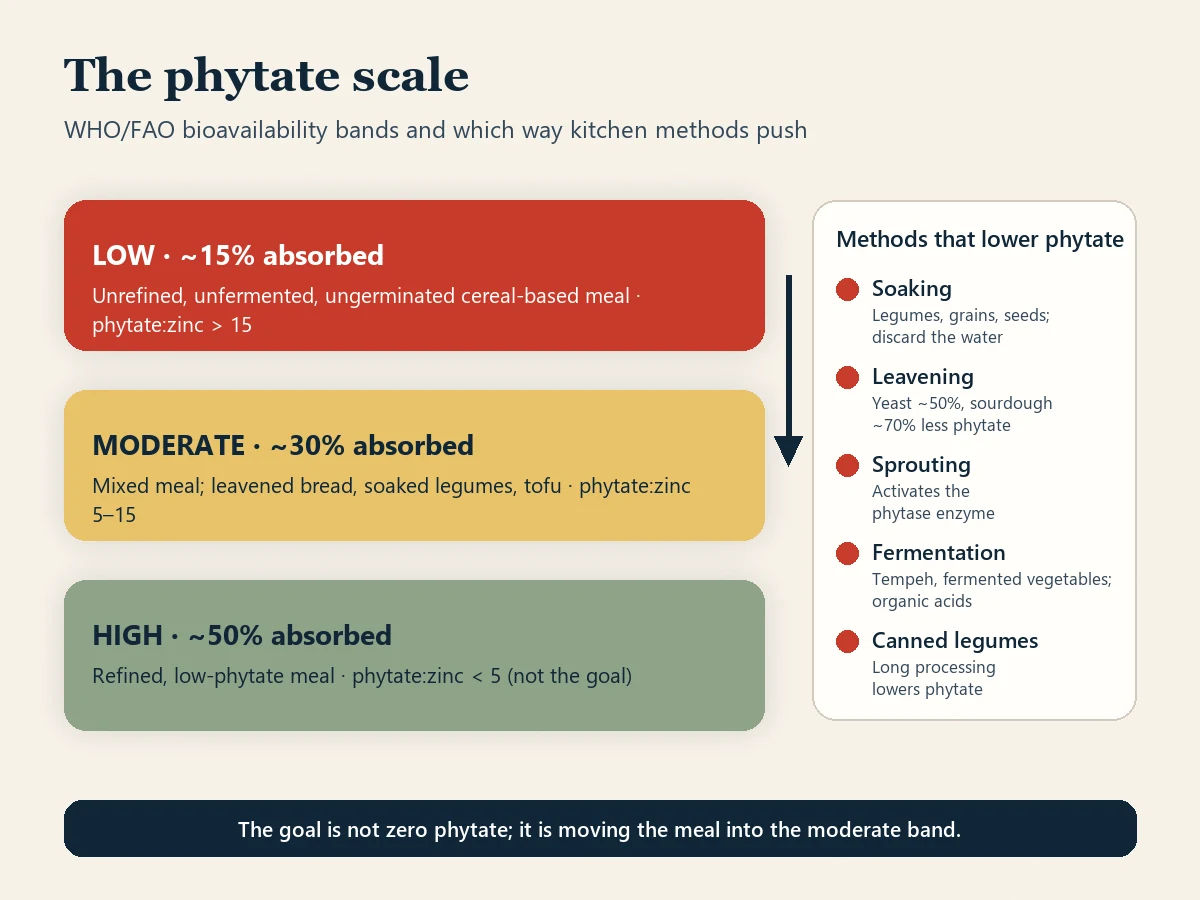
None of these steps eliminates phytate, and none needs to. The aim is to shift a high-phytate meal into the moderate band rather than to chase a refined, low-fibre diet that would trade one problem for several others.
Do vegans actually have lower zinc status?
On average, slightly, and with wide overlap. A meta-analysis of 26 studies found that people on vegetarian diets consumed about 0.9 mg less zinc a day and had serum zinc about 0.9 µmol/L lower than non-vegetarians, with a larger effect in vegans and in women. A 2022 systematic review of 141 studies reported mean serum zinc of 0.79 mg/L in vegans against 0.90 mg/L in meat-eaters, and estimated that once absorption is taken into account about 30% of vegans had inadequate intakes, compared with about 14% of vegetarians and meat-eaters alike. These are real differences, but they are averages, and inadequacy is common in every diet group: in Türkiye’s 2017 national survey, roughly a third of adults, few of them vegan, consumed less zinc than the estimated average requirement.
Whether these lower averages harm health is less clear than the numbers suggest: a review of trace-mineral bioavailability found no demonstrated adverse effect of lower zinc absorption with varied vegetarian diets in countries with an abundant food supply, while calling for better ways to assess zinc status. The reasonable conclusion is neither “vegans are deficient” nor “phytate does not matter”. A vegan diet needs a deliberate zinc plan, and most people who follow one do fine.
Can a blood test settle it?
Not reliably. EFSA states that plasma or serum zinc and other proposed biomarkers “are not useful” for judging adequacy at the level needed to set reference values, and NIH notes that serum zinc varies with age, sex and time of day and does not always track intake. Mild deficiency has no specific sign; slow wound healing, hair loss, frequent infections or loss of appetite have many causes. A clinician may test zinc when there is a medical reason such as malabsorption, bowel disease, alcohol-related illness or bariatric surgery. For a healthy adult, the useful question is not “what is my serum zinc” but “does my diet, prepared the way I prepare it, plausibly reach the planning range”.
When does a supplement make sense, and how much?
The evidence does not support a blanket rule that every vegan should take zinc. NIH says people on vegetarian or vegan diets “might benefit” from a supplement, and the meta-analysis authors suggested bioavailability-improving practices, fortified foods or low-dose supplementation for those with low intakes. A supplement is most defensible when the food plan cannot realistically reach the range: a diet low in seeds and legumes, a period of higher need, or a medical condition affecting absorption, which is a matter for a doctor or dietitian.
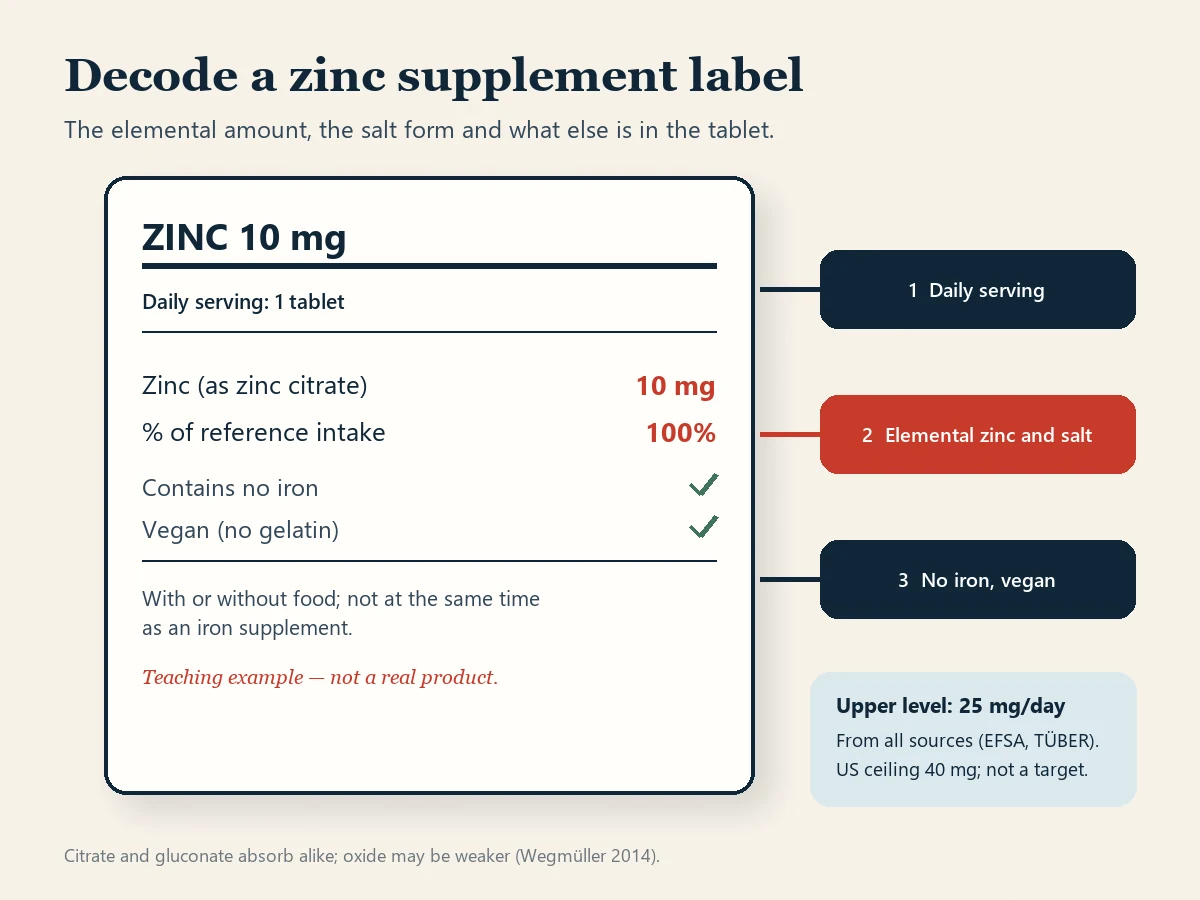
If you do use one, the dose is where caution lies. The European tolerable upper intake level for adults, adopted in Türkiye’s guideline, is 25 mg a day from all sources; the US level is 40 mg. Both rest on the same endpoint, disturbed copper status, because zinc and copper compete for absorption. NIH reports that 50 mg a day or more for several weeks can inhibit copper absorption, reduce immune function and lower HDL cholesterol, and chronic gross excess, described in people who swallowed large amounts of zinc-containing denture cream, has caused copper deficiency with anaemia and nerve damage. A supplement of 5 to 15 mg of elemental zinc on top of a plant-based diet stays well inside the ceiling; a “high-potency” 50 mg tablet does not.
Read the label for three things. First, the elemental zinc per dose, not the weight of the salt. Second, the form: in a tracer study in healthy adults, zinc citrate and zinc gluconate were absorbed equally well, at about 61%, while zinc oxide came in at 50% and was barely absorbed by some participants. Third, what else is in the tablet: NIH notes that 25 mg or more of iron taken at the same time reduces zinc absorption, so a combined iron-and-zinc product works against itself; our iron guide covers the other side of that pairing.
Zinc also interacts with medicines. Quinolone and tetracycline antibiotics bind zinc in the gut, and NIH advises taking the antibiotic at least two hours before or four to six hours after zinc; penicillamine should be separated from zinc by at least an hour, and thiazide diuretics increase zinc losses in urine. In Türkiye, food supplements reach the market with approval from the Ministry of Agriculture and Forestry; buy from a pharmacy rather than an unverified online seller, and let the pharmacist check the elemental content and any conflict with your medicines.
What about zinc lozenges for colds?
This is a different use of zinc and should not be confused with daily nutrition. A 2024 Cochrane review of 34 randomised trials found that zinc probably does little or nothing to prevent colds and may shorten a cold that has already started by about two days, with low certainty because the trials disagreed widely. The lozenge doses studied, 45 to 276 mg a day for up to three weeks, exceed the upper intake level several times over and increased unpleasant but non-serious side effects such as bad taste and nausea; if you try lozenges, treat them as a short course, not a daily habit. Intranasal zinc is a separate matter: in 2009 the US Food and Drug Administration warned that zinc nasal gels and swabs had been linked to more than 130 reports of loss of smell, some lasting. This article does not recommend them.
Frequently asked questions
If phytate blocks zinc, should I eat fewer whole grains and legumes?
No. Whole grains and legumes are the backbone of a vegan diet and are themselves the main zinc sources. Prepare them well and add seeds and tahini; a refined diet would lower phytate while removing most of the zinc with it.
Does the iron I take for a vegan diet interfere with zinc?
Only when both are swallowed together as supplements: NIH reports that 25 mg or more of iron taken at the same time reduces zinc absorption, whereas iron in a meal or as a food fortificant does not. Take the two supplements at different times of day.
Is zinc picolinate better absorbed?
Picolinate is marketed as superior, but the best-controlled human comparison we found tested citrate, gluconate and oxide and showed citrate and gluconate performing equally well. Either at a modest dose is a well-supported choice; an untested claim is not a reason to pay more.
A 30-second vegan zinc check
- Count the anchors: Do most days include seeds or tahini, a legume dish, whole grains and a soy food such as tofu or tempeh?
- Check the preparation: Leavened rather than flat bread, soaked or canned legumes, some fermented or sprouted foods.
- Separate the tea: Tea and coffee an hour before or two hours after meals, not with them.
- Read any supplement label: Elemental zinc per dose, salt form, and no iron in the same tablet; stay under 25 mg a day from all sources.
- Refer the special cases: Pregnancy or breastfeeding, childhood, older age, bowel disease, bariatric surgery, kidney disease, alcohol-related illness or regular medicines need individual advice.
Zinc belongs with iron, calcium, iodine, vitamin B12 and vitamin D on the short list of nutrients a vegan diet has to plan rather than assume. Our guides to iron, calcium, vitamin B12 and vitamin D cover the others, and the tofu and soy foods and balanced vegan plate guides put the anchors into a day of meals.
Sources
- EFSA NDA Panel. Scientific Opinion on Dietary Reference Values for zinc. EFSA Journal. 2014;12(10):3844. Values also in Dietary Reference Values for nutrients: Summary report, 2017, section 4.13 and Tables 4–7.
- Institute of Medicine. Zinc. In: Dietary Reference Intakes for Vitamin A, Vitamin K, Arsenic, Boron, Chromium, Copper, Iodine, Iron, Manganese, Molybdenum, Nickel, Silicon, Vanadium, and Zinc. Washington, DC: National Academies Press; 2001.
- Scientific Committee on Food. Opinion on the Tolerable Upper Intake Level of Zinc, 5 March 2002. In: Tolerable Upper Intake Levels for Vitamins and Minerals. EFSA; 2006.
- T.C. Sağlık Bakanlığı. Türkiye Beslenme Rehberi TÜBER 2022. Ankara, 2022; Appendices 1.5.2, 1.5.3, 1.5.5 and 4.1.5, and section on vegetarian diets.
- WHO/FAO. Chapter 16: Zinc. In: Vitamin and mineral requirements in human nutrition. 2nd ed. Geneva; 2004.
- NIH Office of Dietary Supplements. Zinc: Fact Sheet for Health Professionals. Accessed 5 September 2026.
- U.S. Department of Agriculture. FoodData Central, SR Legacy. Accessed 5 September 2026.
- Fredlund K, et al. Absorption of zinc and retention of calcium: dose-dependent inhibition by phytate. J Trace Elem Med Biol. 2006;20(1):49–57.
- Lönnerdal B. Dietary factors influencing zinc absorption. J Nutr. 2000;130(5S):1378S–1383S.
- Lopez HW, et al. Making bread with sourdough improves mineral bioavailability from reconstituted whole wheat flour in rats. Nutrition. 2003;19(6):524–530.
- Foster M, et al. Effect of vegetarian diets on zinc status: a systematic review and meta-analysis of studies in humans. J Sci Food Agric. 2013;93(10):2362–2371.
- Sobiecki JG, et al. High compliance with dietary recommendations in a cohort of meat eaters, fish eaters, vegetarians, and vegans: results from the EPIC-Oxford study. Nutr Res. 2016;36(5):464–477.
- Neufingerl N, Eilander A. Nutrient intake and status in adults consuming plant-based diets compared to meat-eaters: a systematic review. Nutrients. 2022;14(1):29.
- Hunt JR. Bioavailability of iron, zinc, and other trace minerals from vegetarian diets. Am J Clin Nutr. 2003;78(3 Suppl):633S–639S.
- Wegmüller R, et al. Zinc absorption by young adults from supplemental zinc citrate is comparable with that from zinc gluconate and higher than from zinc oxide. J Nutr. 2014;144(2):132–136.
- Nations SP, et al. Denture cream: an unusual source of excess zinc, leading to hypocupremia and neurologic disease. Neurology. 2008;71(9):639–643.
- Nault D, et al. Zinc for prevention and treatment of the common cold. Cochrane Database Syst Rev. 2024;5:CD014914.
- U.S. Food and Drug Administration public health advisory on intranasal zinc cold products, 16 June 2009, as reported by CNN and NBC News.
Editor: Anıl Güler, Pharmacist
Scientific review date: 5 September 2026