Vegetarian Diets After 65: Why a New Study Linked Them to Higher Mortality
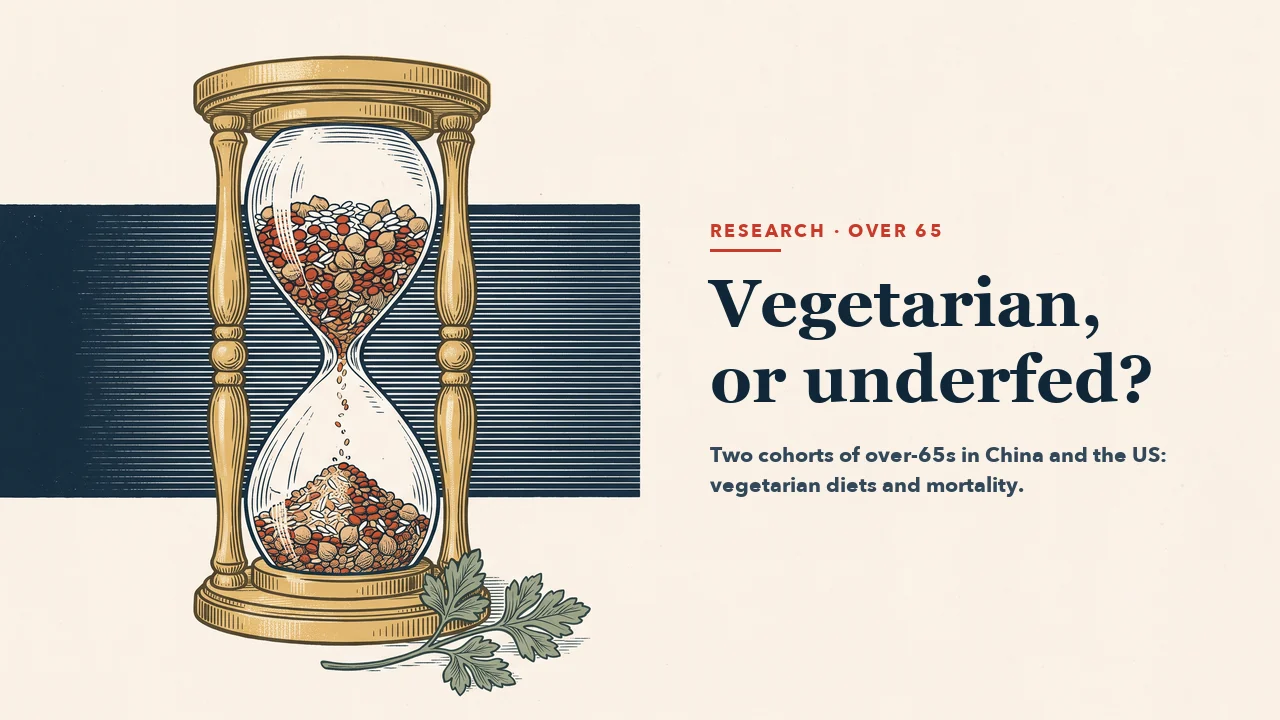
Most of the research we cover on this site points in a reassuring direction for plant-based eating. Tonight’s study does not. In two large groups of older adults, one in China and one in the United States, people classed as vegetarian had a higher risk of dying during follow-up than people who ate animal foods. Here is what the study measured and where its limits lie.
The study
The paper was published online on 19 August 2026 in Nutrition, Metabolism and Cardiovascular Diseases, by a team from the School of Public Health of Jilin University in China. It looked at adults aged 65 and over in two nationally representative surveys:
- China: the Chinese Longitudinal Healthy Longevity Survey (CLHLS), 6,678 people, 2008–2018.
- United States: the National Health and Nutrition Examination Survey (NHANES), 6,305 people, 2005–2018.
Nobody was asked whether they were vegetarian. Instead, the researchers defined vegetarian status from how much animal-source food people reported eating, and used the same rules in both countries. In the Chinese survey, diet was asked about more than once, so the team could also follow how people’s diets changed over the years.
What they found
In both countries, people classed as vegetarian had higher all-cause mortality (death from any cause):
- China: 19% higher risk (hazard ratio 1.19; 95% confidence interval 1.07–1.32).
- United States: 52% higher risk (1.52; 1.11–2.08).
A hazard ratio above 1.00 means higher risk; below it, lower risk.
None of the vegetarian subtypes showed a protective link. In the Chinese survey, people who stayed vegetarian over time, and people who switched from eating animal foods to a vegetarian diet, also had higher risk.
The authors do not conclude that plants are harmful. Their abstract points instead to “nutritional adequacy, overall dietary quality, and age-specific dietary considerations in ageing populations”. This article draws on the published abstract.
Who counts as “vegetarian” here?
This is the most important question, and the abstract uses a telling phrase: “operationally defined” vegetarian diets. People who reported little or no animal-source food were counted as vegetarian, whatever the reason; the exact cut-offs are set out in the full paper. In older adults those reasons vary widely.
Earlier papers from the same Chinese survey describe who these people tend to be. In one, vegetarians had lower income and lower education than omnivores, and the authors noted that people with less money may eat a vegetarian diet because plant foods cost less in China. Another paper, on frailty, reasoned that vegetarians “could be a mix of people who adopted vegetarian diet either by choice or due to lack of resources”, and noted among its limitations that people with chewing or swallowing problems may avoid meat. That is the opposite of the usual picture of a vegan who plans meals and takes B12.
This also helps explain the switching result. Someone who stops eating meat at 80 because of poor appetite, illness or dental problems may already be at higher risk. In that case the illness comes first and the diet change follows, and a study like this one can mistake one for the other. Researchers call this reverse causation. Statistical adjustment reduces it but cannot remove it.
The US result needs care for a different reason: its confidence interval runs from 11% to 108% higher risk, so the true size of the link is very uncertain.
What else the same Chinese survey has shown
This is not a one-off. Three earlier analyses of the same survey found similar patterns in older Chinese adults:
- Frailty (2025): among 27,917 people aged 65 and over, vegetarians had a 13% higher risk of becoming frail (1.13; 1.07–1.20).
- Healthy ageing (2025): among 2,888 healthy older adults, vegetarians had lower odds of ageing well (odds ratio 0.65; 0.47–0.89). But vegetarians with higher diet quality did not differ significantly from omnivores.
- Reaching 100 (2026): among 5,203 people aged 80 and over, vegetarians were less likely to become centenarians (0.81; 0.69–0.96). The link was clearer in people who were underweight (BMI below 18.5; 0.72), though the difference between weight groups was not statistically firm.
These patterns fit “a restricted, low-quality diet is risky after 65” better than “plants are risky after 65”, though none of these studies can fully separate diet from the circumstances behind it.
Other populations tell a different story
Results from other countries do not match. In Adventist Health Study 2, a North American cohort of 73,308 people, vegetarians had 12% lower all-cause mortality than non-vegetarians (0.88; 0.80–0.97). In a pooled UK analysis of 60,310 people, mortality in vegetarians was about the same as in regular meat eaters (1.02; 0.94–1.10). A 2017 meta-analysis of cohort studies found no significant link between vegetarian diets and all-cause mortality, though it did find a 25% lower risk of ischaemic heart disease. These groups are very different from the older Chinese adults above: they are likely to include more people who chose their diet freely, and neither cohort was limited to older adults.
Diet quality seems to matter at older ages as well. In a Spanish study of 597 adults aged 65 and over, moderate adherence to a healthy pro-vegetarian pattern was linked to 41% lower all-cause mortality (0.59; 0.43–0.82), while high adherence to an unhealthy one was linked to 53% higher mortality (1.53; 1.07–2.19). As with our REGARDS article, the kind of plant food seems to make the difference.
What to take from it
This study does not show that a well-planned vegan or vegetarian diet shortens life after 65. It does show that, in some older populations, eating few animal foods can go along with lower income, frailty, low weight and illness. Those circumstances carry their own risks, and a study like this cannot fully separate them from diet. For older vegans and their families, the practical points are:
- Enough protein and energy. Whether older adults need more protein is still debated, but expert groups such as ESPEN recommend more for healthy older people than the general adult reference, and eating too little overall is often the real problem. Our guide to protein quality and needs after 65 explains how to plan for it.
- Keep muscle working. In a 12-week trial in older adults, people who switched to a self-selected vegan diet lost measurable muscle; those who also did resistance exercise lost noticeably less.
- B12 and other nutrients. Our B12 guide lists older age among the reasons to have B12 checked. Vitamin D, calcium and bone health matter too: see bone health and fracture risk.
- Watch weight and appetite. Unplanned weight loss, chewing problems or a shrinking diet in an older person are reasons to see a doctor or dietitian, whatever lies behind the diet.
This study is observational, its definition of vegetarian is broad, and some of the people it counted as vegetarian may not have chosen that diet freely. For a refresher on weighing results like these, see how to read nutrition research.
Sources
- Liu B, Liang Z, Li X, et al.. Vegetarian diets, dietary trajectories, and mortality risk among older adults: evidence from two nationally representative cohorts. Nutr Metab Cardiovasc Dis. 2026:104963. PMID: 42722563.
- Huang Y, Jigeer G, Lv Y, et al.. Association between vegetarian diet and risk of frailty in Chinese older adults: a prospective study. BMC Med. 2025;23(1):352.
- Jigeer G, Wang K, Lv Y, et al.. Vegetarian diet and healthy aging among Chinese older adults: a prospective study. NPJ Aging. 2025;11(1):25.
- Li Y, Wang K, Lv Y, et al.. Vegetarian diet and likelihood of becoming centenarians in Chinese adults aged 80 y or older: a nested case-control study. Am J Clin Nutr. 2026;123(2):101136.
- Orlich MJ, Singh PN, Sabaté J, et al.. Vegetarian dietary patterns and mortality in Adventist Health Study 2. JAMA Intern Med. 2013;173(13):1230–1238.
- Appleby PN, Crowe FL, Bradbury KE, et al.. Mortality in vegetarians and comparable nonvegetarians in the United Kingdom. Am J Clin Nutr. 2016;103(1):218–230.
- Dinu M, Abbate R, Gensini GF, et al.. Vegetarian, vegan diets and multiple health outcomes: a systematic review with meta-analysis of observational studies. Crit Rev Food Sci Nutr. 2017;57(17):3640–3649.
- Oncina-Cánovas A, Torres-Collado L, García-de-la-Hera M, et al.. Pro-vegetarian dietary patterns and mortality by all-cause and specific causes in an older Mediterranean population. J Nutr Health Aging. 2024;28(7):100239.
Editor: Anıl Güler, Pharmacist
Last reviewed: 4 October 2026