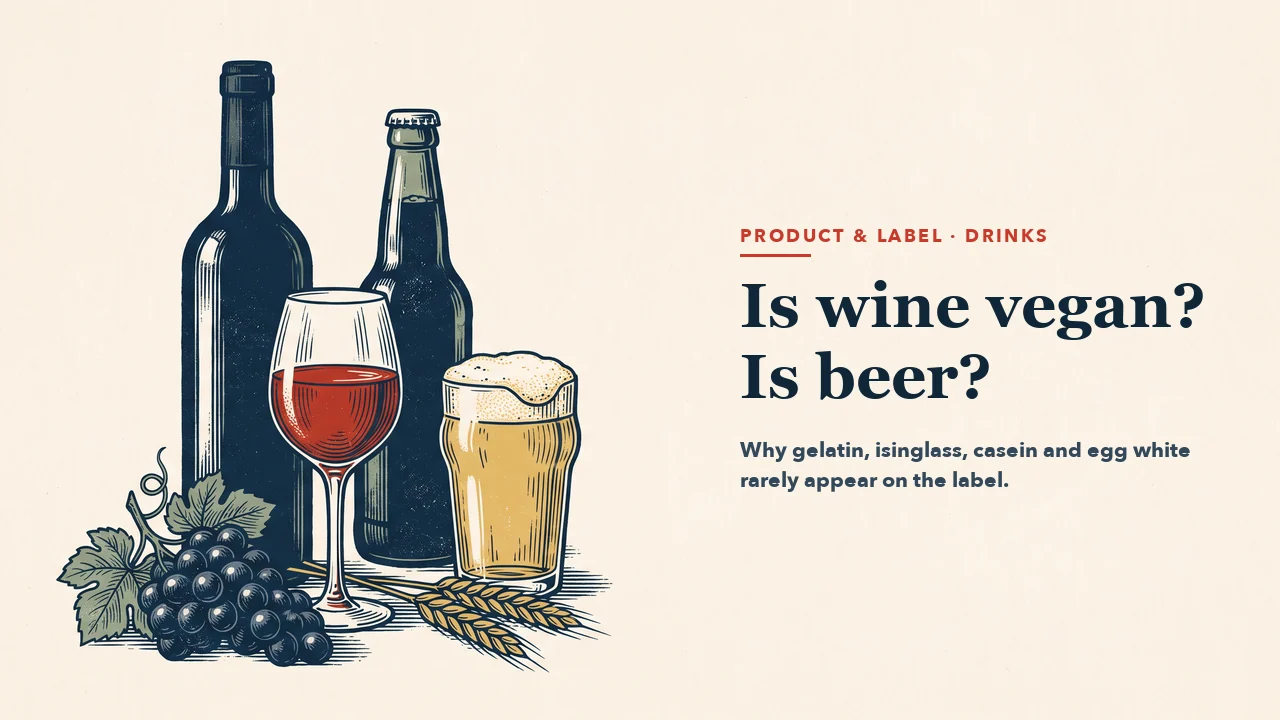
Is Wine Vegan? Is Beer? Fining Agents and Why the Label Rarely Tells You
Short answer: Grapes, barley and hops are plants and yeast is a fungus, so none of them comes from animals, but a wine or beer can still come into contact with animal products on its way to the bottle. To make the drink clear and stable, producers may add a “fining agent” that binds unwanted particles and then settles out. Some fining agents come from animals: gelatin, isinglass (made from fish swim bladders), casein (a milk protein) and egg albumin (egg white). Because they are removed before bottling, the law treats them as processing aids rather than ingredients, so they usually do not appear on the label. A label that says “contains egg” or “contains milk” is a clear sign; a label that says nothing is not a guarantee. A vegan statement or certificate, or a direct answer from the producer, is the reliable route.
What fining is
The International Organisation of Vine and Wine (OIV) describes fining as adding a material to must or wine “in order to reduce or eliminate the presence of certain less desirable components”. Fining agents are used to change a wine’s clarity, colour, texture or flavour, and to keep it stable for as long as possible. The agent reacts with components in the wine to form a new complex that can be separated out. In the OIV’s words, the process “is designed so that the fining agents added do not remain” in the wine.
Which fining agents come from animals
- Gelatin. A review of plant-based fining notes that porcine gelatin is probably the most commonly used protein for wine fining. Animal-derived ingredients also hide behind codes in foods; our article on animal-derived food additives lists the ones to watch for.
- Egg albumin and casein. The same review names egg albumin (from egg whites) and casein (milk protein) as the main animal proteins used for wine fining worldwide.
- Isinglass. A processing aid commonly derived from the dried swim bladders of fish. It is used in both beer and wine.
These sit on the same official lists as plant and mineral alternatives. The EU’s list of authorised clarifying agents for wine includes gelatin, isinglass, casein and egg albumin, but also wheat, pea and potato proteins, clays, silica, tannins and a fungus-derived agent (chitosan). Turkey’s beer rules list the processing aids allowed in beer, among them mineral filters, clays, seaweed extract, enzymes and acids; isinglass is the only animal-derived aid named. So a producer can make a clear wine or beer without animal products; whether it does so is the producer’s choice.
Why the label usually does not say
Three rules work together.
1. Processing aids are not ingredients. EU law counts as an ingredient only what is still present in the finished product. A fining agent that is added and then removed is treated as a processing aid, not an ingredient.
2. Alcoholic drinks have long been exempt from the ingredient list. Under EU food labelling rules, the ingredient list and nutrition declaration are not mandatory for drinks above 1.2% alcohol by volume. Turkey’s food labelling regulation has the same exemption. For wine, the EU changed this: since 8 December 2023, wine labels must carry an ingredient list and a nutrition declaration. The ingredient list may be printed or reached through a QR code. Wine made before that date may still be sold with the old label until stocks run out. The change was made in the EU’s wine rules, so it covers wine and aromatised wine products; for beer, the general exemption still applies, so an ingredient list is not required. An allergen that remains in the beer must still be declared.
Even the new wine ingredient list does not show every fining agent. The European Commission’s guidance on the new rules sums it up: the list “must contain all additives and the processing aids causing allergies or intolerances used in the production of the labelled wine and still present in the finished product”. Gelatin is not on the allergen list, so it does not have to appear.
3. Allergen rules catch egg and milk, but only when they remain. In the EU, egg and milk must be declared on wine only if they are still present in the finished product. The law requires any processing aid that causes allergies or intolerances to be declared if it is “still present in the finished product, even if in an altered form”. For wine, the law sets the wording: look for “egg” or “milk”, sometimes with a word such as “protein” or “casein”. If the ingredient list is given by QR code, these allergens must still be printed on the bottle, after the word “contains”. The OIV’s code of good fining practice recommends filtering and testing fined wine so that no detectable residue remains. In practice, if testing finds no egg protein left in a wine fined with egg white, the label does not have to say “egg”.
Fish is a special case. The EU allergen list covers fish and fish products, but makes an exception for “fish gelatine or Isinglass used as fining agent in beer and wine”. Food Standards Australia New Zealand, assessing a request to exempt isinglass from allergen labelling in beer and wine, found that the main components of isinglass are not clinically relevant in fish allergy and that the allergenic fish protein is present in isinglass only at very low levels.
What the label does and does not tell you
- “Contains egg” or “contains milk” on a wine. Egg or milk was used and some of it is still present. The wine is not vegan.
- No allergen statement. This does not mean the drink is vegan. Under EU rules, gelatin and isinglass used for fining do not trigger an allergen statement, and egg or milk fining does not have to be declared once none remains in the drink.
- A new EU wine label with an ingredient list. It is more informative than before, but it still leaves out processing aids that are not allergens.
- Wine and beer sold in Turkey. Drinks above 1.2% alcohol do not need an ingredient list, so the bottle usually says nothing about fining. Allergens such as egg or milk that remain in the drink must still be declared with the word “contains” (içerir).
How to choose a vegan wine or beer
- Look for a vegan statement or certificate. In Turkey, the Ministry’s labelling guideline allows statements such as “Suitable for vegans”; our article on vegan label rules in Turkey explains them. A certification logo adds an independent check; see our guide to vegan certification labels.
- Ask the producer or importer. The question to ask is specific: “Which fining agents do you use: gelatin, isinglass, casein, egg white, or plant and mineral agents?” A producer who keeps records of its treatments can answer it.
- Do not judge by colour or clarity. Plant proteins, clays and other non-animal agents can also produce a clear drink, so a hazy or a bright bottle says nothing on its own.
- If you have an allergy, read the label every time. Plant-based fining agents are not automatically allergen-free. The review on plant fining notes that plant proteins can also be allergenic, and the EU list includes wheat protein.
This article is about what goes into wine and beer, not a recommendation to drink alcohol.
Limits of this summary
This summary reflects EU and Turkish rules as published in the sources below and read on 12 October 2026. It does not cover every country: rules in the United States, the United Kingdom and elsewhere differ. The documents set out what producers may use and what they must declare; they do not show how often each fining agent is used in practice, or which brands use which agent. The Turkish food labelling regulation and beer communiqué can be amended, so check the current text before relying on a specific point. The article is not legal advice.
Sources
- Regulation (EU) No 1169/2011 on the provision of food information to consumers. Official Journal of the European Union L 304, 22.11.2011.
- Regulation (EU) 2021/2117 amending Regulation (EU) No 1308/2013 and other regulations (wine labelling). Official Journal of the European Union L 435, 6.12.2021.
- Commission Delegated Regulation (EU) 2019/33 (labelling and presentation of wine products), Article 41 and Annex I.
- Commission Delegated Regulation (EU) 2019/934 (authorised oenological practices), Annex I, Part A, Table 2.
- Commission Notice C/2023/1190: Questions and answers on the implementation of new EU wine labelling provisions. 24.11.2023.
- OIV. Resolution OIV-SECSAN 520-2014: Code of good fining practices for wine to be applied in the use of proteinaceous wine fining agents with allergenic potential (casein and egg white).
- Marangon M, Vincenzi S, Curioni A. Wine fining with plant proteins. Molecules 2019;24(11):2186.
- Food Standards Australia New Zealand. Final Assessment Report, Application A490: Exemption of allergen declaration for isinglass. 2009.
- Türk Gıda Kodeksi Gıda Etiketleme ve Tüketicileri Bilgilendirme Yönetmeliği. Resmî Gazete 26.01.2017, sayı 29960 (mükerrer).
- Türk Gıda Kodeksi Gıda Etiketleme ve Tüketicileri Bilgilendirme Yönetmeliği Kılavuzu. T.C. Tarım ve Orman Bakanlığı, Gıda ve Kontrol Genel Müdürlüğü; Revizyon 002, 10.03.2026.
- Türk Gıda Kodeksi Bira Tebliği (Tebliğ No: 2006/33). Resmî Gazete 07.07.2006, sayı 26221.
Editor: Anıl Güler, Pharmacist
Last reviewed: 12 October 2026