Ruth Harrison: The Woman Who Showed Britain the Factory Farm
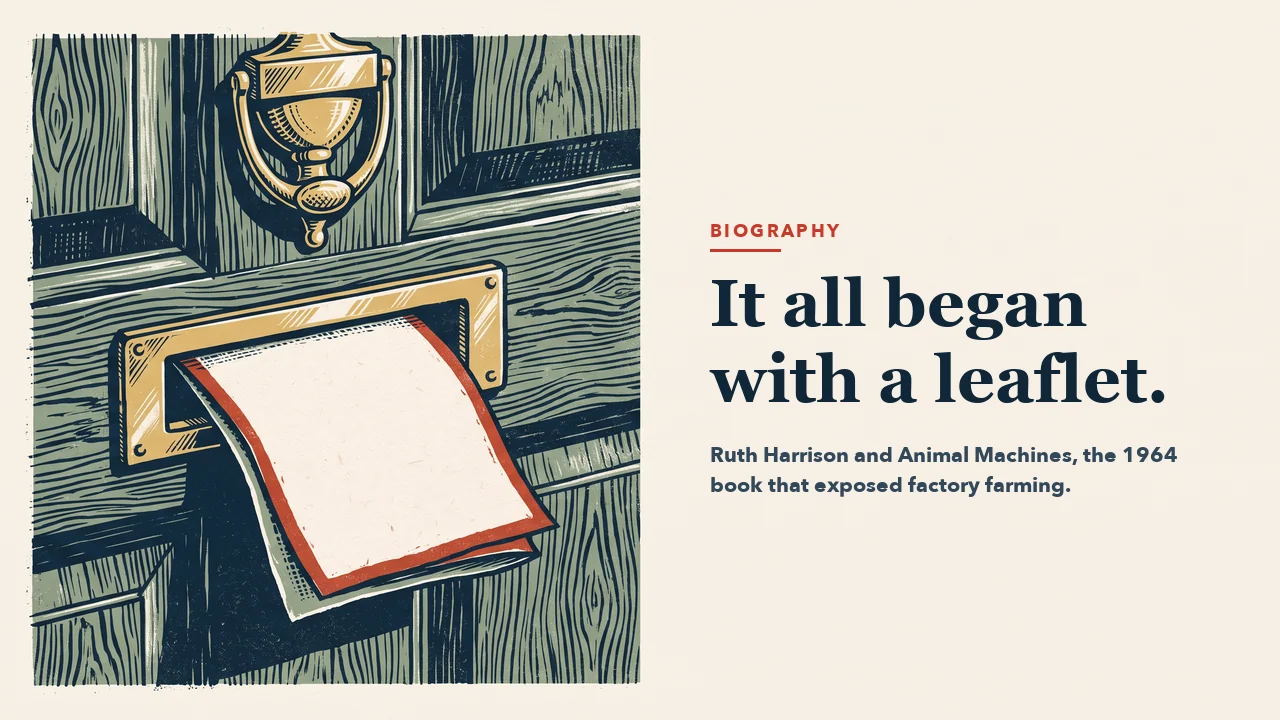
Around 1960, someone pushed a leaflet through the letterbox of a house in London. It came from a group called the Crusade Against All Cruelty to Animals, and it described how veal calves, broiler chickens and laying hens were being raised. The woman who read it, Ruth Harrison, was already a vegetarian. She later explained her reasoning: she did not eat these animals, but she still had a responsibility towards them, and if she did nothing, nothing would be done.
Four years later her book Animal Machines changed how Britain talked about farming. This morning we looked at the film The Game Changers; yesterday, at Peter Singer’s Animal Liberation. Harrison connects to yesterday’s piece: Singer read her book while he was becoming a vegetarian.
Before the book
Ruth Winsten was born in London in 1920. Her father Stephen was a writer and a friend of George Bernard Shaw; her mother Clare was a painter and sculptor. Both parents admired Henry Salt, the 19th-century writer on vegetarianism and animal rights, and both were vegetarian.
Looking back, the roots were already there. She studied English at Bedford College, London, joined the Quakers, worked as a nurse with the Quaker-run Friends’ Ambulance Unit during the war, and afterwards helped displaced people in Germany. Back in London she trained as an actor at the Royal Academy of Dramatic Art. In 1954 she married the architect Dex Harrison.
Checking the leaflet
Harrison did not take the leaflet’s word for it. She set out to see for herself whether what it described was true, and visited farms, good ones and bad ones. Her husband went with her on many visits and took some of the photographs that appeared in the book. Visiting farms and collecting evidence before making a claim stayed her method for the rest of her life.
While she was still writing, in May 1963, she sent six draft chapters to Rachel Carson, whose Silent Spring had warned about pesticides the year before, and asked her for a foreword. Carson agreed. She died in April 1964, weeks after the book came out.
Animal Machines
Animal Machines: The New Factory Farming Industry appeared in March 1964, alongside articles in The Observer. It showed readers practices most of them had never heard of: battery cages for laying hens, crates for veal calves, castration, cutting off tails and the tips of beaks, and antibiotics added to feed. Her main point: many in the industry treated farm animals as mere production objects.
One line from the book sums up her point: “Most people, especially in towns, tend to be ignorant of the processes by which food reaches their table, or if not ignorant, they find it more comfortable to forget.”
According to her biographer Claas Kirchhelle, “within three weeks, Harrison had achieved national fame.” Within little over a month, the Ministry of Agriculture announced an independent committee of inquiry.
Not everyone was impressed. Ministry officials privately wrote that there did not “seem to be anything new in this book”, and critics tried to dismiss her as an over-emotional “housewife”. Kirchhelle himself notes that factory farming was not yet everywhere in Britain in 1964, and calls the book’s picture of the future “carefully staged”.
The Brambell report and the “freedoms”
The committee, chaired by Professor F. W. R. Brambell, reported in 1965. A 2008 biography says Harrison sat on it; Kirchhelle, who worked from the government files, found that she did not. But her book shaped both the setting up of the committee and its report.
The report stated that an animal “should at least have sufficient freedom of movement to be able without difficulty, to turn round, groom itself, get up, lie down and stretch its limbs.” These modest freedoms of movement became the starting point for the “five freedoms”: when the Farm Animal Welfare Council was set up in 1979, an expanded version was written into its brief.
Change was slow. In 1973 Singer quoted proposals from a British government advisory committee, among them that “any animal should at least have room to turn around freely”, and noted that the government had refused to implement them as too idealistic.
Justice, not sentiment
Harrison spent the rest of her life on the same work. She was appointed to the government’s new farm animal welfare advisory committee in 1967 and served on it and its successor until she retired in 1991. She also set up a charity, the Farm Animal Care Trust, to fund welfare research, and worked with the Council of Europe on a 1976 European agreement on how farm animals must be kept.
She said her concern came not from a love of animals but from a sense of justice and what she called “fair play”. She believed that anyone who used animals had an obligation to give them a decent life, free of pain and fear, in which they could behave naturally. In 1971 she wrote that many people repulsed by factory farming had become vegetarian, and that “the vegan … takes the most logical step towards elimination of cruelty”. Still, she spent her own life pushing for better farms rather than the end of farming.
She lived to see some of it change. Britain banned narrow stalls and tethers for pigs in 1999, and the same year a ban on battery cages by 2012 was announced. She was also disappointed that many problems from her book were still there in the 1990s. Ruth Harrison died of cancer in June 2000, a few days short of her 80th birthday.
Why she matters
Harrison was not a philosopher like Singer or Tom Regan. She made one simple demand: look at how your food is produced. Sixty years on, that is still the first step, for welfare reform and for anyone thinking about going vegan.
Sources
- van de Weerd H, Sandilands V. Bringing the issue of animal welfare to the public: a biography of Ruth Harrison (1920–2000). Appl Anim Behav Sci. 2008;113(4):404–410.
- Kirchhelle C. Bearing Witness: Ruth Harrison and British Farm Animal Welfare (1920–2000). Palgrave Macmillan, 2021 (open access).
- Singer P. Animal Liberation. The New York Review of Books, 5 April 1973.
Editor: Anıl Güler, Pharmacist
Last reviewed: 2 October 2026