Does Nutritional Yeast Contain B12? How to Tell From the Label
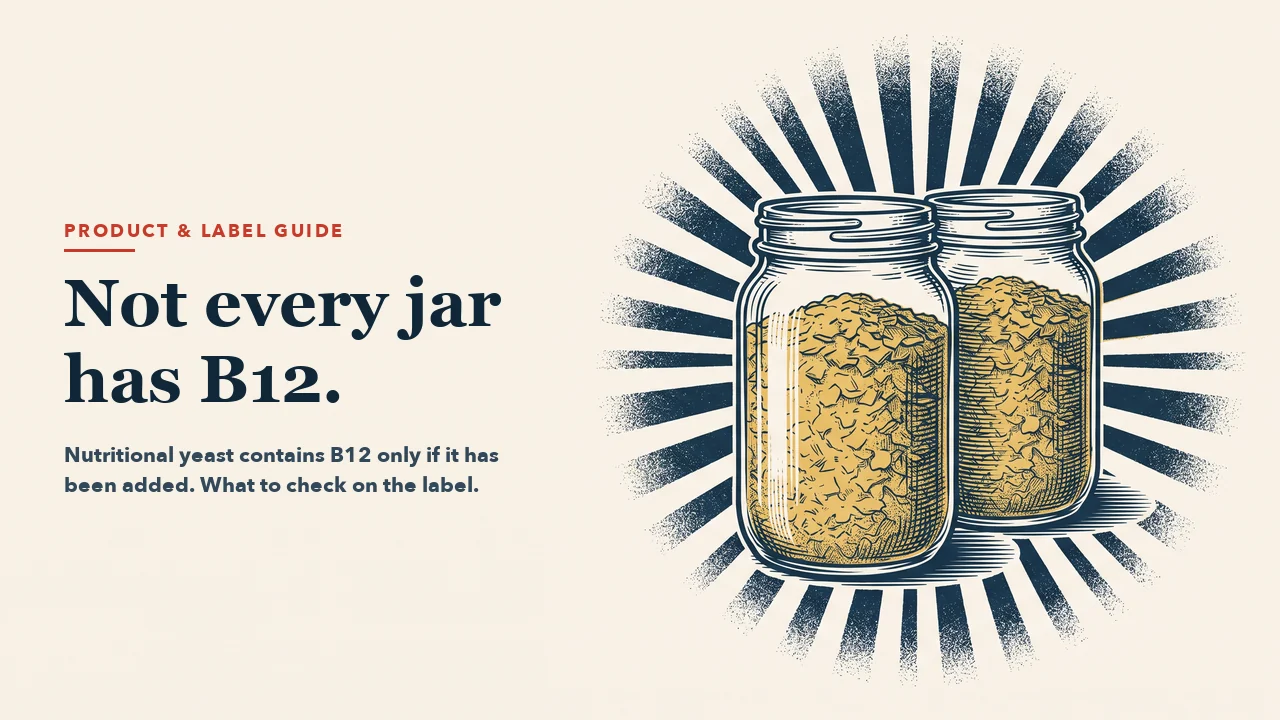
Nutritional yeast is often described as a vegan source of vitamin B12. That is only true of some jars. Yeast does not make B12; the B12 in nutritional yeast is added during production, and fortified and unfortified products are sold under the same name. This guide explains how to tell them apart on the label, how much B12 a serving actually provides, and what else is worth knowing before you rely on it.
What nutritional yeast is
Most commercial yeasts are strains of Saccharomyces, and they are named by what they are used for: baker’s yeast, brewer’s yeast, nutritional yeast. Nutritional yeast is a dried preparation of the whole yeast, sold as flakes or powder and eaten as a seasoning in vegan cooking. It is not the same product as the yeast used to raise bread, and, as the B12 figures below show, it is not always the same product as another jar labelled “nutritional yeast” either.
Does nutritional yeast have B12 naturally?
No. Vitamin B12 is made only by certain bacteria. It builds up in animals higher in the food chain, which is why meat, milk and eggs contain it; unfortified plant foods are not a reliable source.
The food composition data show the difference clearly. In the United States Department of Agriculture’s FoodData Central database, active dry baker’s yeast contains 0.07 µg of B12 per 100 g, practically none. Nutritional yeast products that list B12 on their label report between 44 and 375 µg per 100 g; others have no B12 entry at all, which means no B12 was declared. One producer has two products in the database: one lists B12, the other does not.
So the question is never “does nutritional yeast contain B12?” but “does this product?”.
How to tell from the label
- Look for B12 in the nutrition table, in micrograms (µg). If there is no B12 row, do not count the product as a B12 source.
- Check the amount per serving, not only per 100 g. Nutritional yeast is used in small amounts. The products in the USDA database give serving sizes of 5 to 16 g.
- Do not rely on the words “source of B12” alone. Under Türkiye’s Food Codex Nutrition Claims Regulation (2023), a food may say it is a “source” of a vitamin if 100 g provides at least 15% of the nutrient reference value, and “high” in it at twice that. For B12, the reference value is 2.5 µg, so “source” can mean as little as 0.375 µg per 100 g, and “high” 0.75 µg. At a 5 g serving, a product that just meets the “source” threshold gives about 0.02 µg. This is the legal minimum; the fortified products in the USDA list are far above it, but the words alone do not tell you where a product sits.
The difference between products is large. At the lowest fortified value in the USDA list, 44 µg per 100 g, a 5 g tablespoon gives 2.2 µg. At 117 µg per 100 g, a 15 g serving gives about 17.6 µg. The label is the only way to know which kind you have.
How much is enough?
The Vegan Society recommends one of three approaches: eat fortified foods two or three times a day to get at least 3 µg of B12 a day, or take a daily supplement providing at least 10 µg, or take a weekly supplement providing at least 2,000 µg. The body absorbs B12 more efficiently in frequent small amounts: the intrinsic-factor absorption system is estimated to be saturated at about 1.5–2.0 µg per meal. That is why the daily amount recommended from fortified foods is lower than the amount recommended from a single supplement dose.
Fortified nutritional yeast can be one of those fortified foods, and small-scale human evidence supports this. In a 2000 study of 49 people on a mostly raw vegan diet, 47% had raised urinary methylmalonic acid (MMA) levels, an early sign of B12 deficiency. In an uncontrolled follow-up of those with abnormal results, both sublingual B12 tablets and nutritional yeast significantly lowered the group’s average methylmalonic acid; a probiotic supplement did not.
If you rely on it, do the arithmetic from your own label, and remember that the recommendation is about a regular daily intake, not an occasional sprinkle. If you use nutritional yeast only now and then, a supplement is the simpler way to cover B12. See vitamin B12 for vegans and which blood tests vegans should monitor.
The Vegan Society’s figures are minimum amounts. Higher daily doses, such as 1,000 µg, are also used: about 1% of oral doses of 500 µg or more is absorbed, so a 1,000 µg tablet provides roughly 10 µg. The European Food Safety Authority has not set a tolerable upper intake level for vitamin B12, because no adverse effects have been identified.
Store it away from light
Vitamin B12 is broken down by light. A 1956 experiment, cited in a 2023 review, found that cyanocobalamin, the form of B12 most commonly used for supplementation, lost about 20% per hour in sunlight or UV light; a later study found a 4% loss after 60 minutes of UV exposure. Both were measured in solutions, not in yeast flakes, and we found no study of B12 loss in stored nutritional yeast. Keeping the product in a closed, opaque container is a sensible precaution.
Other questions readers ask
Is it gluten-free?
Yeast is not a grain, but some yeast products contain gluten. In a 2020 analysis, both nutritional yeast products tested were below the 20 mg/kg threshold used by the Codex Alimentarius. A brewer’s yeast supplement, probably made from spent yeast from the brewing industry, contained about 772 mg/kg of barley gluten, and a sourdough starter was also above the threshold. The authors advise people avoiding gluten to be aware of the difference between nutritional yeast and brewer’s yeast supplements. If you have coeliac disease, choose a product labelled gluten-free.
What about gout?
Yeast is rich in purines, which the body turns into uric acid. Nutritional yeast was not among the 270 foods measured in the purine reference study we used, but a brewer’s yeast supplement contained 2,995.7 mg of purines per 100 g. These two products should not be treated as equivalent. The same study notes that in Japan, a daily purine intake below 400 mg is recommended to prevent gout and hyperuricaemia. If you have gout or high uric acid, ask your doctor before using yeast products regularly.
Does it support the immune system?
That claim comes from beta-glucans in yeast cell walls. A 2021 meta-analysis of 13 randomised trials found that yeast beta-glucan supplements reduced the incidence and duration of upper respiratory tract infections in healthy people, but the authors noted high heterogeneity and a small number of studies. Those trials used beta-glucan supplements; a spoonful of nutritional yeast is not the same thing.
In short
- Yeast does not make B12. Only fortified nutritional yeast contains useful amounts.
- Read the B12 value in µg per serving; “source of B12” on its own can mean very little.
- To rely on fortified foods, aim for at least 3 µg a day, spread over two or three meals; otherwise use a supplement.
- Keep it in the dark, choose gluten-free if you need to, and ask your doctor first if you have gout.
References
- Watanabe F, Yabuta Y, Bito T, Teng F. Vitamin B₁₂-containing plant food sources for vegetarians. Nutrients. 2014;6(5):1861–1873.
- U.S. Department of Agriculture. FoodData Central: “Leavening agents, yeast, baker’s, active dry” (SR Legacy 175043) and branded “nutritional yeast” records. Accessed 30 September 2026.
- Türk Gıda Kodeksi Beslenme Beyanları Yönetmeliği (Turkish Food Codex Nutrition Claims Regulation). Official Gazette 32169, 20 April 2023, Annexes 1 and 2. resmigazete.gov.tr. Accessed 30 September 2026.
- The Vegan Society. What every vegan should know about vitamin B12; Vitamin B12. Accessed 30 September 2026.
- Watanabe F. Vitamin B12 sources and bioavailability. Exp Biol Med (Maywood). 2007;232(10):1266–1274.
- Donaldson MS. Metabolic vitamin B12 status on a mostly raw vegan diet with follow-up using tablets, nutritional yeast, or probiotic supplements. Ann Nutr Metab. 2000;44(5–6):229–234.
- Temova Rakuša Ž, Roškar R, Hickey N, Geremia S. Vitamin B12 in foods, food supplements, and medicines: a review of its role and properties with a focus on its stability. Molecules. 2023;28(1):240.
- Allred LK, Nye-Wood MG, Colgrave ML. Analysis of gluten in dried yeast and yeast-containing products. Foods. 2020;9(12):1790.
- Kaneko K, Aoyagi Y, Fukuuchi T, Inazawa K, Yamaoka N. Total purine and purine base content of common foodstuffs for facilitating nutritional therapy for gout and hyperuricemia. Biol Pharm Bull. 2014;37(5):709–721.
- Zhong K, Liu Z, Lu Y, Xu X. Effects of yeast β-glucans for the prevention and treatment of upper respiratory tract infection in healthy subjects: a systematic review and meta-analysis. Eur J Nutr. 2021;60(8):4175–4187.
Editor: Anıl Güler, Pharmacist
Last scientific review: 30 September 2026