Creatine, Carnitine and Taurine: The Three Together
Creatine, carnitine and taurine are sold together, shelved together and written about together. They deserve none of that. Over the past three articles we looked at each one against its own evidence, and the three answers came out so different that treating them as a group is the mistake. This piece is the short version — what separates them, and what to do with that.
The grouping is not arbitrary. All three are concentrated in meat and fish and largely absent from plants. All three are made by the human body, so none of them is a vitamin in the sense of something the diet must supply. And all three end up in front of people who have just stopped eating animals. That is where the similarity ends.
Three substances, three kinds of answer
| Question | Creatine | Carnitine | Taurine |
|---|---|---|---|
| Is it lower in vegans? | Yes — measured by muscle biopsy | Studies disagree; one found it higher | Yes — in plasma and urine |
| Does the body compensate? | Partly; stores stay lower | Yes — absorption adapts | Appears to conserve, barely studied |
| Any trial showing benefit? | Yes, including one in vegans | Not in healthy vegans | None with a health outcome |
| Known cost of supplementing | Moves a kidney blood marker | Raises a cardiovascular marker | Not established |
| Is there a published dose? | Yes | Yes, from general studies | No — no established purpose |
| Short answer | A real case worth discussing | Probably unnecessary | Genuinely unknown |
What separates them is not the biology — it is how much anyone looked
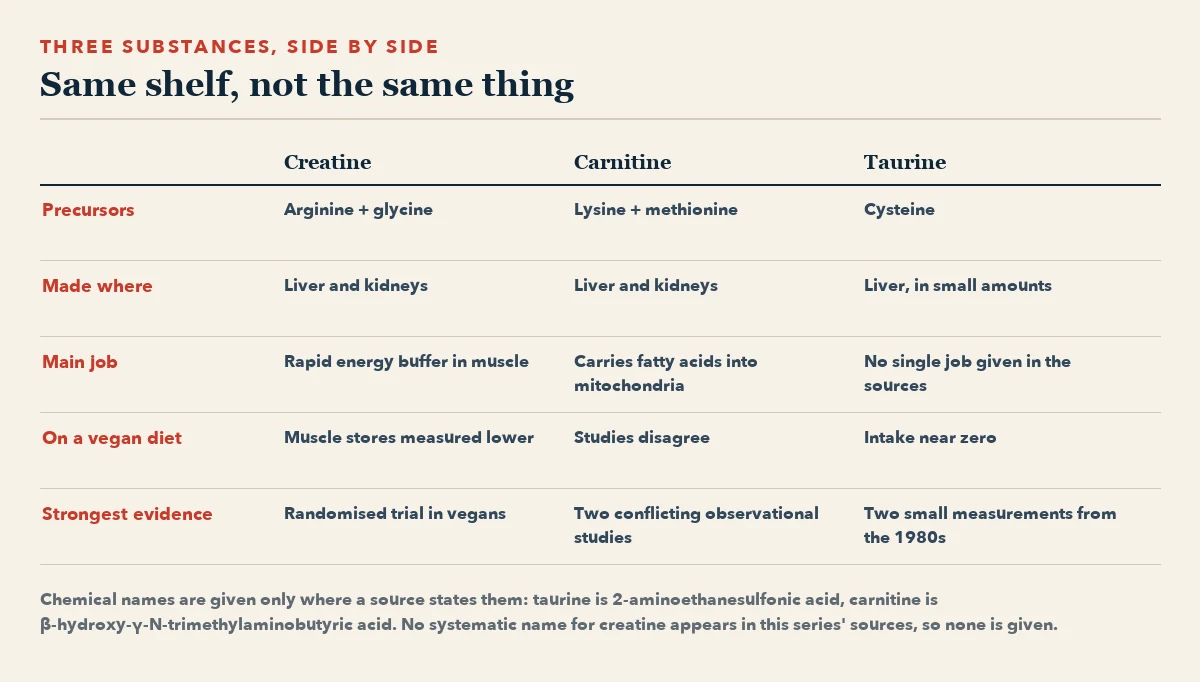
This is the part worth carrying away. The three substances are not ranked by how important they are to the body. They are ranked by how much research exists.
Creatine has biopsy data, several meta-analyses and, as of this year, a randomised controlled trial in vegans specifically. That is why it is possible to say something specific about it — including the size of the effect, which is smaller than the marketing suggests, and the one practical instruction that actually matters, which concerns a blood test rather than a risk.
Carnitine has enough research to show that the simple story is wrong. Two human studies point in opposite directions, and there is a documented mechanism — absorption adapting to a low-carnitine diet — that explains why a large dietary shortfall does not become a bodily one. Supplementing it raises a marker that a plant-based diet otherwise keeps low, in exchange for no demonstrated benefit in this group.
Taurine has almost nothing. The core measurements are from 1986 and 1988, with about a dozen participants each. The most recent figure comes from a diet that included fish. No study has connected taurine status in vegans to any health outcome. The question is open, and anyone who closes it for you — in either direction — is guessing.
How to use this when someone tries to sell you all three
The pattern to notice is a claim that skips a step. “It is found in meat” is a fact about food. “Vegans have less of it” is sometimes true and sometimes not. “Therefore vegans need to supplement it” requires evidence that a lower level causes a problem and that supplementing fixes it — and for two of these three substances, that evidence does not exist.
Three questions cover most of it. Is the level actually lower in people eating this way, measured rather than assumed? If it is lower, does anything follow from that in a study with a health outcome? And if you supplement, what does it change besides the number on a lab report?
For creatine the three questions have answers. For carnitine the second one has a plausible negative answer. For taurine the second and third have no answers at all.
Why all three are concentrated in meat
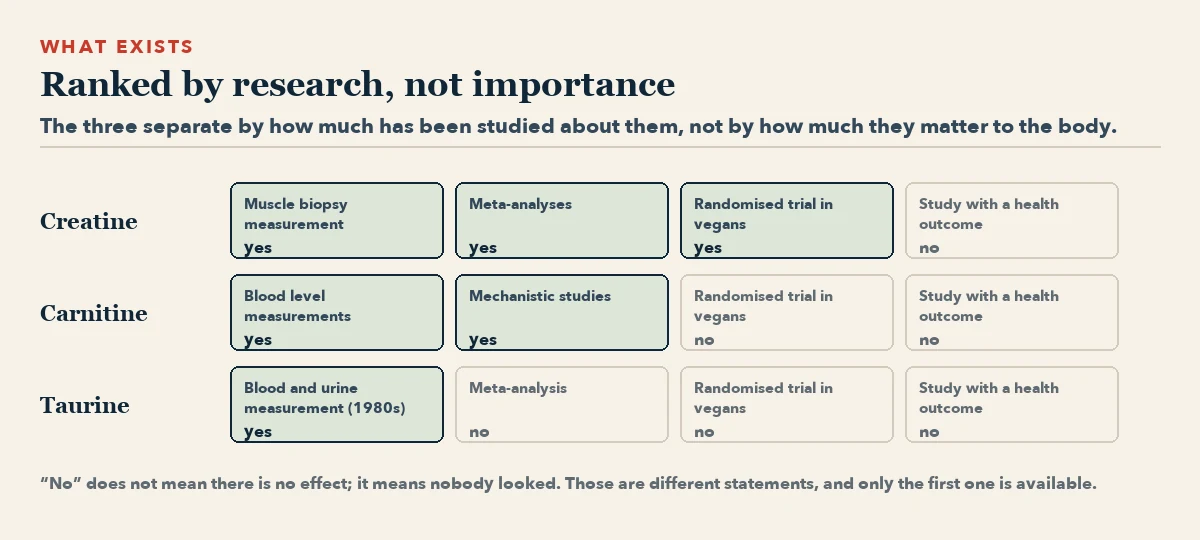
The grouping has a physical explanation, and it is the same one in each case: these are substances that working muscle and metabolically busy tissue need, so animals concentrate them in exactly the tissue we eat. Creatine buffers rapid energy demand in muscle. Carnitine carries long-chain fatty acids into the mitochondria to be burned. Taurine is made in the liver, in small amounts, from sulfur amino acids.
That is why eating animals delivers them and eating plants does not, and it is also why none of this makes them essential nutrients. The human body runs the same machinery. What changes on a plant-based diet is not whether you have these substances, but how much of the supply your own body has to produce rather than absorb.
Framed that way, the real question for each one stops being “is it in my food?” and becomes “can my body cover the difference?” — and that question has been answered properly for one of the three, partially for the second, and not at all for the third.
What would change these answers
None of these verdicts is permanent, and it is worth being specific about what would move them, because that is the difference between a settled question and a neglected one.
For creatine, what is missing is scale and duration. The vegan-specific evidence is one small trial over four weeks. A larger trial running six months or a year — particularly one including women and older adults, where the general literature is weakest — would turn a reasonable inference into a firm answer.
For carnitine, the open question is not the adult average but the two groups the existing studies could not settle: children raised on plant-based diets, which the 1989 authors flagged themselves, and whether the raised TMAO from supplementation matters clinically or is simply a marker moving.
For taurine, almost anything would help. A modern cohort measuring taurine in long-term vegans would be a start; a trial with an actual health endpoint would be the first of its kind. Until then the answer stays the one this series has given: unknown.
What this series does not cover
- None of the studies discussed examined children, pregnancy or breastfeeding, and where authors explicitly left those questions open we have said so in the individual articles.
- Diagnosed carnitine deficiency is a medical condition treated under supervision and has nothing to do with dietary choice.
- These articles are information, not recommendations. If you are considering any of these supplements, the person to ask is your own doctor or pharmacist, who knows your medication and your test results.
Editor: Anıl Güler, Pharmacist
Last scientific review: 8 October 2026