Spreading Legumes Across Your Meals: Portions, Cooking and Gas
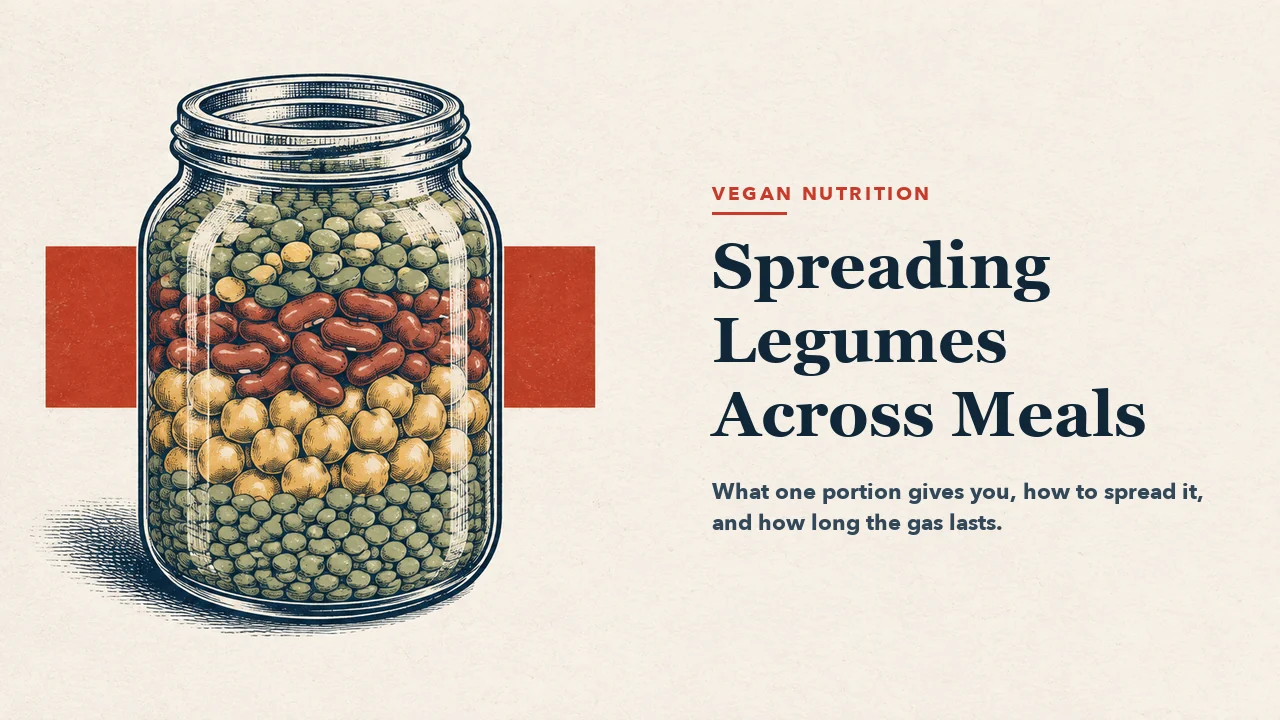
A portion of cooked beans gives you about as much protein as two small eggs, plus fibre, iron and folate that eggs do not. The reason many people still eat legumes only now and then is gas — and in two feeding trials where adults ate half a cup of beans every day, 35% reported more gas in the first week, 11% by the fourth and 3% by the eighth. This guide covers what one portion gives you, how much to aim for, how to spread it across the day, how to cook beans safely, and how to get through the first few weeks.
What one portion gives you
The Turkish Nutrition Guide (TÜBER 2022) defines one standard portion of cooked legumes as 130 g, which is 50 g dry: ¾ cup, two small ladles or 8–10 tablespoons. Its food composition annex gives the content of that portion:
| Per 130 g, cooked | White beans | Chickpeas | Lentils |
|---|---|---|---|
| Energy (kcal) | 156 | 148 | 150 |
| Protein (g) | 12.6 | 11.0 | 11.4 |
| Fibre (g) | 10 | 12 | 5 |
| Iron (mg) | 3.6 | 3.7 | 3.4 |
| Zinc (mg) | 1.6 | 1.7 | 1.8 |
| Calcium (mg) | 66 | 69 | 35 |
| Potassium (mg) | 789 | 373 | 339 |
| Folate (mcg) | 87 | 104 | 62 |
| Vitamin B12 (mcg) | 0.0 | 0.0 | 0.0 |
For comparison, the same annex lists 12.9 g of protein in 100 g of egg, which the guide equates with two small eggs. A portion of white beans matches that closely on protein and adds 10 g of fibre and 3.6 mg of iron. Two rows deserve a note. The guide points out that eating legumes with foods rich in vitamin C improves the body’s use of their iron and calcium; our guide to iron for vegans covers this in detail. And the zeros in the B12 row are real: legumes do not replace a B12 supplement.
How much to aim for
There is no single official figure for vegans, but the reference points line up. TÜBER’s general advice, written for a diet that includes meat, fish and eggs, is legumes 2–3 times a week. The EAT-Lancet planetary health diet goes much further: when Danish researchers translated its 2019 reference diet into real foods, it came to 178 g of cooked legumes in a day’s diet of 10 MJ (about 2,400 kcal) — a little over one TÜBER portion daily. Their own adapted version, which still contained meat, fish and dairy, kept 100 g of cooked legumes a day. The same researchers note that Danes currently eat only a few grams a day.
The health data point the same way. In a 2023 meta-analysis of 32 cohorts with 1,141,793 participants, each additional 50 g of legumes a day was associated with a 6% lower risk of death from all causes (HR 0.94, 95% CI 0.89–0.99); the authors rated the certainty of that evidence as low to moderate. In a second 2023 meta-analysis, the association with lower coronary heart disease risk grew with intake up to about 400 g a week and then levelled off. Both are observational, so they show an association rather than a measured effect.
For a vegan the case is stronger, because there is no meat, fish or eggs to share the protein load. TÜBER itself notes that vegetarians and vegans can raise both the protein content and the protein quality of their diet with legumes. Our reading of these reference points is that a vegan belongs at their upper end: at least one portion a day, and often more, alongside soy foods, nuts and seeds.
A day, meal by meal
Spreading that amount across meals is easier on the gut than one large bowl — TÜBER advises avoiding excessive amounts at once. Using the guide’s own measure, where 8–10 tablespoons of cooked legumes make one portion, a day with two portions might look like this:
- Breakfast: 4–5 tablespoons of cooked chickpeas or beans, mashed into a spread or added to a savoury breakfast — half a portion.
- Lunch: 4–5 tablespoons of cooked lentils in a soup or a grain salad — half a portion.
- Dinner: two small ladles of a bean or chickpea dish with bulgur or rice — one full portion.
No single meal is heavy, yet the day reaches 260 g of cooked legumes. The grain at dinner is not decoration: legumes are low in the sulphur-containing amino acids and tryptophan, and TÜBER’s own examples, chickpeas with bulgur and beans with rice, improve the protein quality of the meal. Our article on protein quality for vegans explains why, for most adults, the combination does not have to happen at every meal, and how to build a balanced vegan plate shows where legumes sit next to grains, vegetables and fats.
Cooking beans safely
This is the part of legume cooking that comes with a real safety rule. Many beans contain phytohaemagglutinin, a lectin that causes acute food poisoning when beans are eaten raw or undercooked; it is most concentrated in red kidney beans (Phaseolus vulgaris). According to the Bad Bug Book, the US Food and Drug Administration’s reference handbook on foodborne pathogens and natural toxins:
- As few as four or five raw beans can trigger symptoms: extreme nausea and vomiting, usually within 1 to 3 hours, followed by diarrhoea. Recovery is usually rapid, within 3 to 4 hours, although some cases have required hospitalisation.
- Red kidney beans contain the most. Raw beans contain 20,000 to 70,000 haemagglutinating units, fully cooked beans 200 to 400. White kidney beans contain about one-third as much as the red variety; broad beans 5% to 10%.
- Boiling destroys it. Boiling at 100 °C for 10 minutes destroyed the toxin completely in the study the handbook cites. For home cooking it advises boiling for at least 30 minutes, and cites British work recommending soaking for at least 5 hours, pouring the water away and boiling in fresh water.
- Do not cook dried kidney beans in a slow cooker. Several outbreaks have been linked to slow cookers; dishes cooked in them often reached only 75 °C or less, which is not enough to destroy the toxin.
Soaking also helps with gas. A 2019 study measured the gas-producing sugars, the alpha-galacto-oligosaccharides, in five legumes: raw seeds contained from 2500 mg per 100 g (chickpea) to over 4000 mg (fenugreek), soaking alone cut the total by between 10% (lentil and faba bean) and 40% (chickpea), and cooking cut it further. A 2024 laboratory study found that at higher temperatures these sugars mainly moved out into the soaking water — one more reason to pour it away.
Getting through the first weeks
The gas figures at the top of this article come from a 2011 paper in Nutrition Journal that brought together three feeding trials, with 17, 29 and 80 participants eating half a cup of beans a day for 8 or 12 weeks; the week-by-week decline was measured in two of them, the crossover trials. As the authors explain, the oligosaccharides in legumes, such as raffinose and stachyose, are not digestible by human intestinal enzymes alone; gut bacteria ferment them, and most flatulence comes from that fermentation. The type of legume mattered: in the first week, 50% of those eating pinto beans reported more gas and 47% of those eating baked beans, but only 19% of those eating black-eyed peas. Even on the control diets without beans, 3% to 11% reported more gas. The authors concluded that concerns about excessive flatulence from beans may be exaggerated, and TÜBER reaches the same practical conclusion: regular, more frequent legume intake reduces gas complaints over time.
So the approach is to start small, eat legumes every day rather than in occasional large servings, soak and cook them well, and give it a few weeks. If gas is still a problem, the enzyme alpha-galactosidase, taken as a digestive supplement, has some trial evidence: in a 2007 double-blind, placebo-controlled study, 8 healthy volunteers ate 420 g of cooked beans with the enzyme or a placebo, and the 1200 GalU dose significantly reduced breath hydrogen and the severity of flatulence. With 8 people, that is a reasonable thing to try rather than a proven fix.
One exception: TÜBER recommends limiting legumes for people with conditions such as ulcerative colitis or irritable bowel syndrome, where they cause marked symptoms. If that applies to you, set your amounts with your doctor or a dietitian.
In short
- One portion is 130 g cooked (50 g dry) and gives 11–12.6 g of protein, 5–12 g of fibre and 3.4–3.7 mg of iron.
- For a vegan, at least one portion a day is a sensible floor, spread across meals and eaten with grains.
- Soak dried beans, pour the water away and boil them properly; never eat kidney beans raw, and do not cook them from dry in a slow cooker.
- Expect some gas in the first week or two; for most people it fades with regular eating.
The health evidence behind these figures is observational, the gas data are self-reported and the soaking figures are laboratory measurements; how to read nutrition research explains what each of those means for how far a finding can be taken.
Sources
- Republic of Türkiye Ministry of Health. Turkish Nutrition Guide (TÜBER) 2022. Ankara; 2022. Annex 2.3.1.
- Lassen AD, Christensen LM, Trolle E. Development of a Danish Adapted Healthy Plant-Based Diet Based on the EAT-Lancet Reference Diet. Nutrients. 2020;12(3):738. doi:10.3390/nu12030738.
- Zargarzadeh N, Mousavi SM, Santos HO, Aune D, Hasani-Ranjbar S, Larijani B, Esmaillzadeh A. Legume Consumption and Risk of All-Cause and Cause-Specific Mortality: A Systematic Review and Dose-Response Meta-Analysis of Prospective Studies. Adv Nutr. 2023;14(1):64–76. doi:10.1016/j.advnut.2022.10.009.
- Mendes V, Niforou A, Kasdagli MI, Ververis E, Naska A. Intake of legumes and cardiovascular disease: A systematic review and dose-response meta-analysis. Nutr Metab Cardiovasc Dis. 2023;33(1):22–37. doi:10.1016/j.numecd.2022.10.006.
- US Food and Drug Administration. Bad Bug Book: Foodborne Pathogenic Microorganisms and Natural Toxins. 2nd ed. Chapter: Phytohaemagglutinin (kidney bean lectin).
- Njoumi S, Amiot MJ, Rochette I, Bellagha S, Mouquet-Rivier C. Soaking and cooking modify the alpha-galacto-oligosaccharide and dietary fibre content in five Mediterranean legumes. Int J Food Sci Nutr. 2019;70(5):551–561. doi:10.1080/09637486.2018.1544229.
- Avezum L, Ollier L, Siguemoto E, Rajjou L, Mestres C. Hydrolysis and diffusion of raffinose oligosaccharides family products in chickpeas, lentils, and beans under different pH and temperature steeping conditions. Food Res Int. 2024;191:114732. doi:10.1016/j.foodres.2024.114732.
- Winham DM, Hutchins AM. Perceptions of flatulence from bean consumption among adults in 3 feeding studies. Nutr J. 2011;10:128. doi:10.1186/1475-2891-10-128.
- Di Stefano M, Miceli E, Gotti S, Missanelli A, Mazzocchi S, Corazza GR. The effect of oral alpha-galactosidase on intestinal gas production and gas-related symptoms. Dig Dis Sci. 2007;52(1):78–83. doi:10.1007/s10620-006-9296-9.
Editor: Anıl Güler, Pharmacist
Last scientific review: 21 September 2026