Tofu and Soy Foods: Protein Quality, Calcium, Hormones and Thyroid, Explained
Tofu has had an unusual few weeks in the news, and most of what circulated about it was a scoreboard, not a study. In late July 2026, a Cambridge researcher who founded an advocacy group called the Better Protein Institute published a “Perspective” article ranking twenty high-protein foods on environmental and health criteria; tofu came out on top, and the ranking spread quickly through plant-based media and, from there, into ordinary social feeds. That is worth knowing before reading further, because a ranking answers a different question than the one most people actually have: not “did a panel of experts vote tofu best,” but “what does tofu do in a body, and is the soy in it safe.”
What is the Better Protein Institute ranking, and how much should it weigh?
The paper behind the recent wave of “tofu is the best protein” posts is real, but it is not quite what the headlines imply. Chris Macdonald, a Cambridge behavioural scientist and founder of the Better Protein Institute, scored twenty high-protein foods on a Planet Score (emissions, water pollution, land and water use per 100 g of protein) and a People Score (sodium, saturated fat, cholesterol, whether the protein is “complete,” price and availability at one UK supermarket chain). Tofu topped both, for a combined 36 out of 40; the whole top group was plant-based, the whole bottom group animal-based.
Two caveats belong alongside that result. The paper is a peer-reviewed “Perspective,” an opinion format, not a study reporting new data; it applies one author’s own scoring framework to existing figures, and that author is also the founder of the organisation behind the score. His own limitations section notes that ethics and opportunity costs were left out of this first version, and the price comparison rests on a single country’s supermarket. None of that makes the environmental figures wrong, but it makes the ranking a viewpoint about trade-offs, not a verdict on tofu’s biology. The questions people actually bring to tofu, protein quality, calcium, hormones, thyroid, cancer risk, need their own evidence, below.
What is tofu, and why do blocks feel so different?
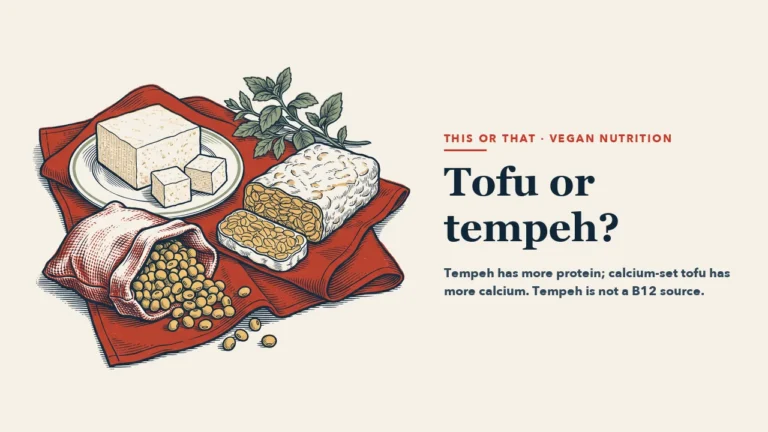
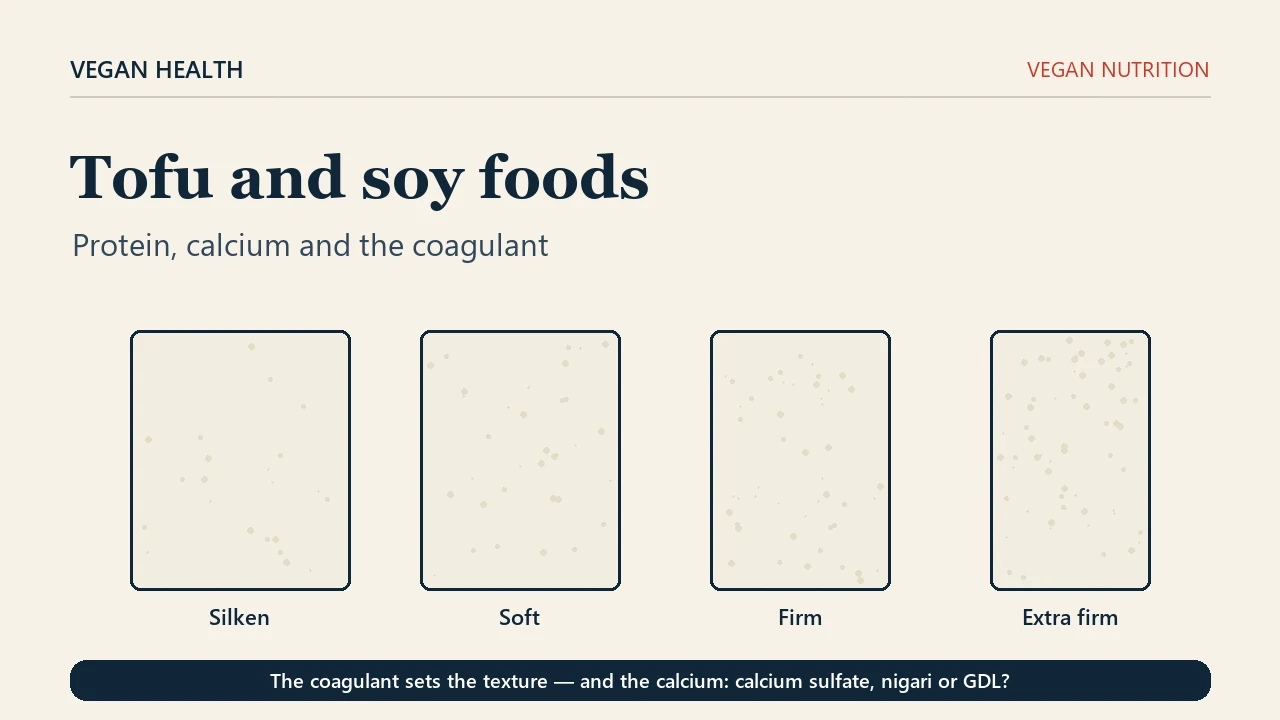
Tofu is made by curdling soy milk with a coagulant and pressing the curds into a block, the same basic logic as cheesemaking applied to a bean instead of milk. The coagulant is what changes from brand to brand: calcium sulfate, nigari (largely magnesium chloride), and glucono-delta-lactone (GDL) are the three in common use, and each sets the curd slightly differently. How much whey is pressed out afterwards then decides the texture: silken tofu is barely pressed and holds most of its liquid, soft and firm tofu are pressed progressively more, and extra-firm loses the most water and packs the most protein and coagulant mineral per gram. None of this is a health grade on its own; it is a guide to what a recipe needs: silken for a blended sauce or dessert, firm or extra-firm for something that has to hold its shape on a grill or in a stir-fry.
How much protein does tofu provide, and how good is it?
Firm tofu made with calcium sulfate provides about 17.3 g of protein per 100 g, alongside 144 kcal, 8.7 g of fat and 2.8 g of carbohydrate. Soy protein is one of the few plant proteins that supplies all nine essential amino acids in meaningful amounts, and EFSA’s dietary reference values put an adult’s average protein requirement at 0.66 g per kilogram of body weight a day and the population reference intake at 0.83 g/kg/day, figures that describe total protein needs rather than a soy-specific target.
Quality scores complicate the simple “complete protein” label a little. A 2022 quantitative review in Frontiers in Nutrition found soy foods as a group score well on DIAAS and PDCAAS, the standard digestibility-adjusted amino acid scales, averaging 84.5 and 85.6, comfortably above the ≥75 threshold for “high quality.” Tofu specifically scored lower than soy milk on the same review, 63.7 on DIAAS and 78.9 on PDCAAS, because coagulating and pressing strip out some digestible amino acids along with the whey. That does not make tofu a poor protein source; a 100 g serving still supplies a substantial share of a day’s needs.
Where does tofu’s calcium actually come from?
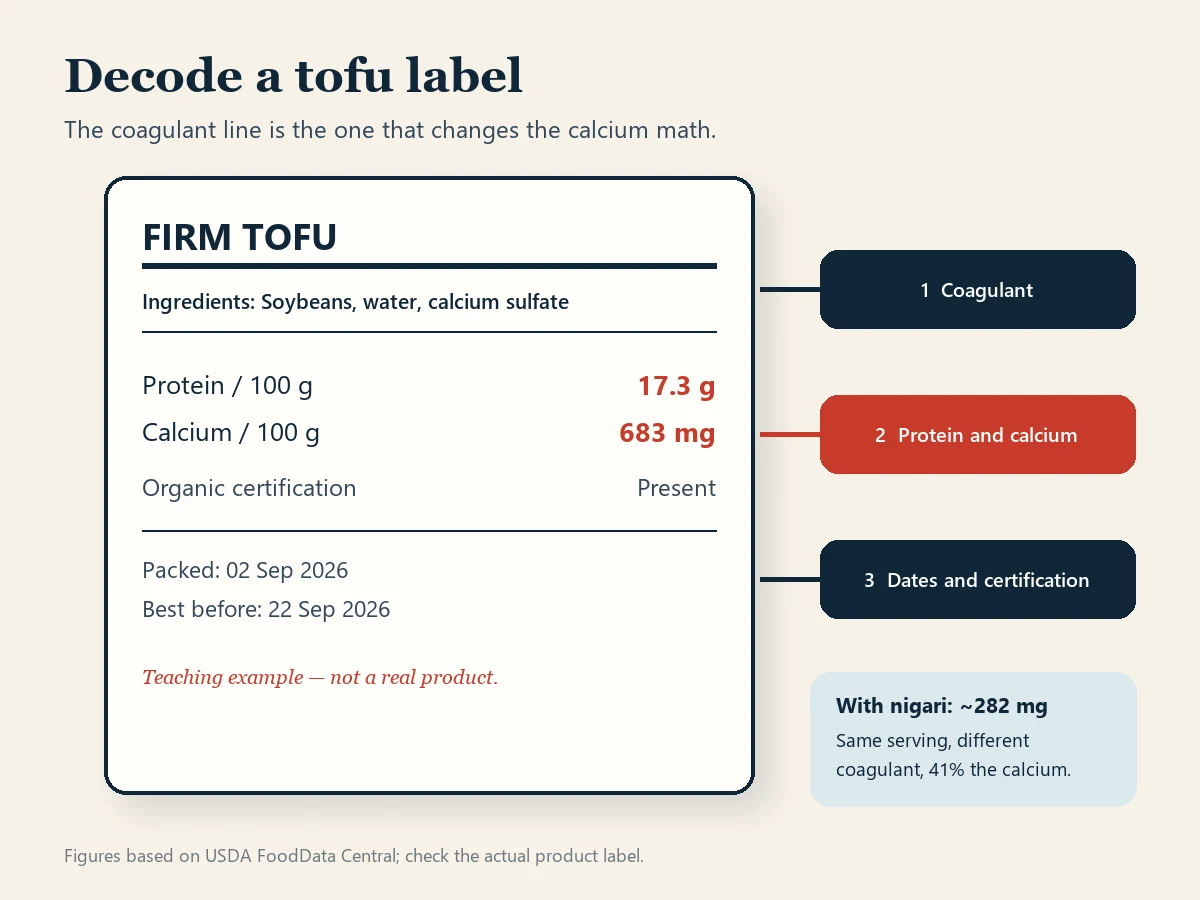
This is the detail most tofu buyers miss: tofu’s calcium content is not fixed; it is set by which coagulant made the block. Tofu set with calcium sulfate carries about 683 mg of calcium per 100 g. Tofu set with nigari carries about 282 mg per 100 g, roughly 41% as much, because magnesium chloride contributes essentially no calcium of its own. Both are legitimately “tofu”; they are not equivalent calcium sources. If calcium is one of the reasons you buy tofu, the label needs to say “calcium sulfate” (sometimes listed as calcium sulphate or E516) among the ingredients; “nigari,” “magnesium chloride” or “GDL” alone means you are buying a lower-calcium block, whatever the marketing on the front says. For readers building calcium into a full day of meals, our calcium guide covers the other sources and the reference intakes.
Does soy affect testosterone or estrogen?
This is the single most searched claim about soy, and it is also the best studied. A 2021 meta-analysis pooled 41 clinical trials measuring total testosterone in 1,753 men and found that neither soy protein nor isoflavone intake, at any dose or duration tested, produced a statistically significant change in total or free testosterone, estradiol, estrone or sex hormone-binding globulin. This updates an earlier, smaller analysis by some of the same authors that reached the same conclusion. It does not mean soy has zero biological activity (isoflavones do bind weakly to estrogen receptors, which is why the question got asked), but across the range of intake studied in men, that binding has not translated into a measurable shift in reproductive hormones.
The equivalent safety question for women concerns isolated isoflavone supplements, not whole soy foods: an EFSA panel review in 2015 found no evidence in human studies that isoflavone supplements, at 35 to 150 mg a day, harm the breast, uterus or thyroid in peri- or postmenopausal women. That was concentrated supplements; tofu or soy milk eaten as food carries less isoflavone and more variably, which is a reason for reassurance when applying the supplement data to ordinary soy foods.
Does soy affect thyroid function?
A 2019 systematic review and meta-analysis of 18 randomised controlled trials found soy supplementation did not significantly change free T3 or free T4, the thyroid hormones themselves. It did find a small average rise in TSH, about a quarter of a milli-international-unit per litre, of unclear clinical significance, not the pattern seen in overt hypothyroidism. The exception that matters in practice is a drug interaction, not thyroid biology: soy protein in large amounts, such as a protein shake, can reduce absorption of levothyroxine, documented in case reports and interaction reviews. Anyone on levothyroxine does not need to avoid tofu; they need to keep the medicine and any soy-heavy meal separated in time, on their doctor or pharmacist’s schedule, the same separation used for coffee, calcium and iron with this drug.
Does soy raise or lower cancer risk?
Two different bodies of evidence answer two different questions here. For breast cancer survivors specifically, a synthesis by the World Cancer Research Fund and American Cancer Society-aligned sources concludes that soy food intake at ordinary levels, roughly one to two servings a day, does not increase recurrence or mortality risk, and some analyses associate it with somewhat better survival; the ACS’s public position states plainly that soy intake does not increase risk for breast cancer survivors. A proposed mechanism is that isoflavones, binding the same receptors as the body’s own, much stronger estrogens, may act more as a mild regulator than an added hormonal load, though this remains partial rather than settled biology.
For cancer risk generally, a 2024 meta-analysis of 52 observational studies, pooling more than 861,000 participants and nearly 45,000 cancer cases, found higher soy intake inversely associated with overall cancer risk, tofu intake specifically associated with about a 22% lower risk. This should not be overstated: it is observational, the association was considerably stronger in Asian populations, the review itself flagged evidence of publication bias, and association is not proof that soy causes the lower risk. The honest summary: decades of research have found no signal that soy raises cancer risk, and observational data associate it with lower risk; neither “soy prevents cancer” nor “soy raises risk” fairly summarises the evidence.
Tofu, tempeh, soy milk, edamame: not one food
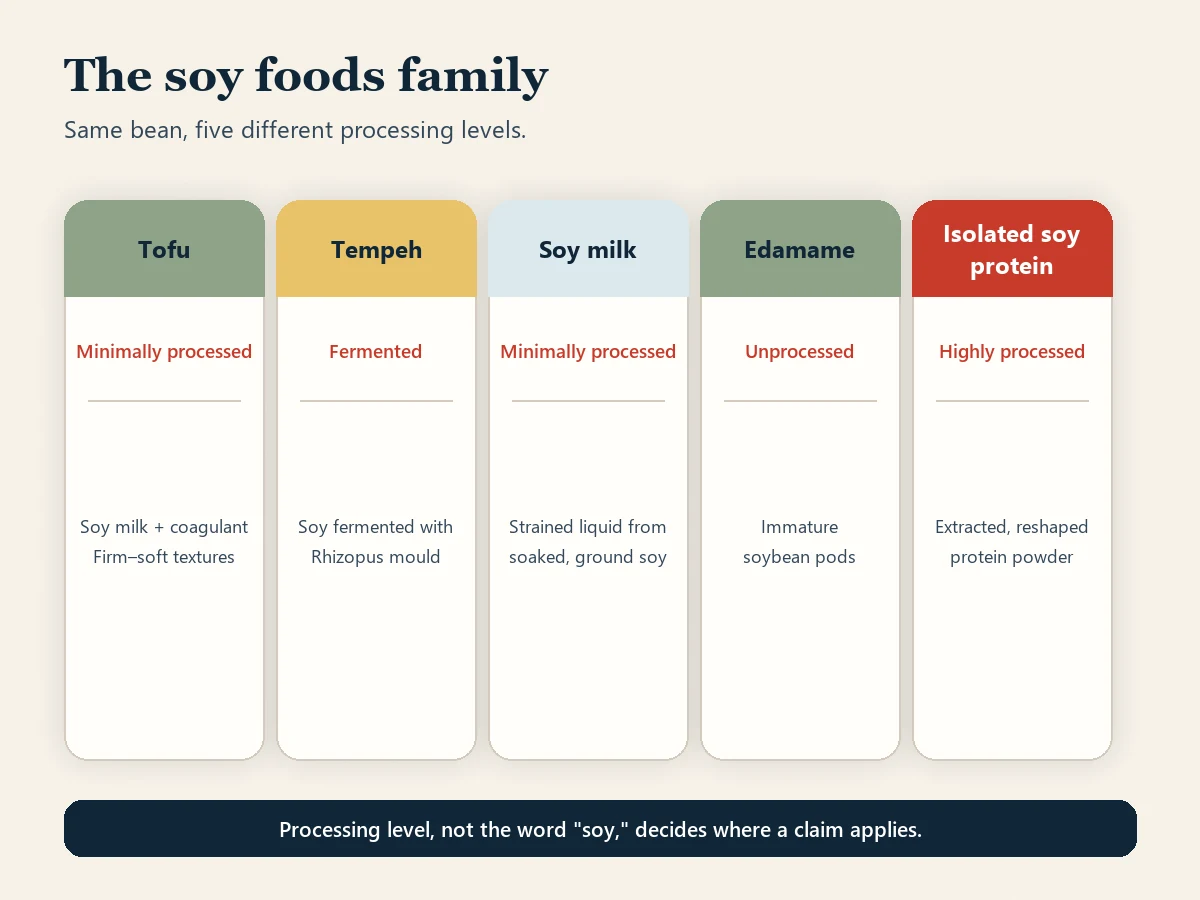
“Soy” covers products with very different processing, and lumping them together is where confused advice starts. Tofu, soy milk and edamame are minimally to moderately processed whole soy foods. Tempeh is soy fermented with the mould Rhizopus oligosporus, generally considered to improve digestibility. Miso, natto and soy sauce are also fermented, but in much smaller, saltier servings that contribute little protein by comparison. Isolated soy protein, the powder in many meat-alternative products, is a different tier: extracted, concentrated and reassembled, with a profile that depends on the finished product’s full ingredient list, not on soy itself. A claim proven true for tofu should not be assumed to hold for a soy-based sausage, or the reverse.
How do you read a tofu label?
- Find the coagulant. “Calcium sulfate” (or calcium sulphate, E516) means higher calcium; “nigari,” “magnesium chloride” or “GDL” alone means lower calcium. Both are legitimate tofu.
- Check protein and calcium per 100 g, not per package. Firmness and brand both shift these numbers; compare like for like.
- Look for organic or non-GMO claims if that matters to you. Soy is one of the world’s most widely grown genetically modified crops, and Turkish food law requires labelling once approved GM content exceeds 0.9%; the label, not a guess about “most soy,” is the only reliable source for a given product.
- Note the production and expiry dates. Fresh tofu is a refrigerated, water-packed food with a shorter shelf life than most pantry staples.
- Naming, in Türkiye specifically: Turkish food law restricts dairy-derived names like “cheese” on plant-based products; popular names such as “tofu peyniri” (tofu cheese) are therefore contested under the rules, so judge the product by its own nutrition label rather than by what the package calls it.
- Compare price per kilogram across brands. Tofu prices in Türkiye vary widely by brand and import status; the nutrition and the price are worth checking separately rather than assuming imported or premium means better.
Where are the safety boundaries?
Soy is a recognised allergen, though genuine allergy is uncommon in adults; European survey data put self-reported soy allergy around 0.4%, clinically confirmed allergy somewhat lower, with country-level estimates ranging up to about 0.6%, one of the least common major allergens in adults. A separate, often confused caution concerns monoamine oxidase inhibitors (MAOIs), an older antidepressant class: the tyramine-rich foods that can trigger a dangerous blood pressure spike with these drugs are fermented soy products, soy sauce, miso, tempeh, not fresh tofu, which is low in tyramine. Anyone on an MAOI should get their specific food list from their prescriber. Beyond these, anyone on regular medication, or considering soy for an infant, during pregnancy, or with a personal history of breast or thyroid cancer, is better served by a doctor, pharmacist or dietitian’s individual judgement than a general article; one branded tofu product’s US recall in August 2026, over a packaging-ink issue, was company-specific, not a signal about tofu as a category.
Frequently asked questions
Is it safe to eat tofu every day?
The evidence reviewed above, on hormones, thyroid and cancer risk, covers intake in the range of roughly one to several servings a day, which is where most regular eaters, including in the East Asian populations most studied, actually sit. Nothing in that evidence points to a problem at ordinary daily intake; there is no research basis here for a specific serving ceiling.
Is soy a problem specifically for men?
Not based on the hormone evidence above. The largest and most recent meta-analysis of male reproductive hormones found no dose-dependent effect from soy or isoflavone intake across the trials pooled. The idea that soy “feminises” men is not supported by the clinical trial data collected so far.
Can tofu be eaten raw, and can it be frozen?
Silken and other soft tofus are commonly eaten cold, straight from a sealed package, in dishes across East and Southeast Asia; once opened, treat it like any refrigerated, water-packed food. Tofu also freezes well: ice crystals pull out water and leave a chewier, more porous block once thawed and pressed, a texture some cooks use deliberately. Nutritionally it remains the same product either way.
A 30-second tofu check
- Read the coagulant: Calcium sulfate for higher calcium; nigari, magnesium chloride or GDL for lower calcium.
- Read protein and calcium per 100 g: Compare brands on the same basis, not by package size.
- Place the claim correctly: Hormone, thyroid and cancer evidence above concerns whole soy foods like tofu, tempeh and soy milk, not isolated soy protein or fermented condiments.
- Separate medicine and soy in time if you take levothyroxine, on your prescriber’s schedule.
- Route special cases to a professional: Infant feeding, pregnancy, a personal cancer history or a soy allergy need individual advice, not a general article.
Tofu is one part of a wider soy-food picture. Our guides to calcium and iodine cover two nutrients that come up often in the same conversation, and the balanced vegan plate guide shows where a soy protein like tofu fits alongside the rest of a day’s meals.
Sources
- Macdonald C. What are the best sources of protein? Introducing the BPI Score. Frontiers in Sustainable Food Systems. 2026;10. Published 29 July 2026.
- USDA FoodData Central. Tofu, raw, firm, prepared with calcium sulfate. FDC ID 172475. Accessed 4 September 2026.
- USDA FoodData Central. Tofu, extra firm, prepared with nigari. FDC ID 174290. Accessed 4 September 2026.
- EFSA Panel on Dietetic Products, Nutrition and Allergies. Scientific Opinion on Dietary Reference Values for protein. EFSA Journal. 2012;10(2):2557.
- van den Berg LA, Mes JJ, Mensink M, Wanders AJ. Protein quality of soy and the effect of processing: a quantitative review. Frontiers in Nutrition. 2022;9:1004754.
- Reed KE, Camargo J, Hamilton-Reeves J, Kurzer M, Messina M. Neither soy nor isoflavone intake affects male reproductive hormones: an expanded and updated meta-analysis of clinical studies. Reproductive Toxicology. 2021;100:60–67.
- EFSA Panel on Food Additives and Nutrient Sources added to Food. Risk assessment for peri- and post-menopausal women taking food supplements containing isolated isoflavones. EFSA Journal. 2015;13(10):4246.
- Otun J, Sahebkar A, Östlundh L, Atkin SL, Sathyapalan T. Systematic Review and Meta-analysis on the Effect of Soy on Thyroid Function. Scientific Reports. 2019;9:3964.
- World Cancer Research Fund / American Institute for Cancer Research. Soy: intake does not increase risk for breast cancer survivors. Accessed 4 September 2026.
- Wang C, Ding K, Xie X, et al. Soy Product Consumption and the Risk of Cancer: A Systematic Review and Meta-Analysis of Observational Studies. Nutrients. 2024;16(7):986.
- London South Bank University, Open Research. From soybeans to tofu: the underlying chemistry. Accessed 4 September 2026.
- Tarım ve Orman Bakanlığı. Türk Gıda Kodeksi Peynir Tebliği (Tebliğ No: 2015/6). Resmî Gazete, 8 February 2015/29261. (Regulates soy use in dairy cheese.)
- Tarım ve Orman Bakanlığı. Türk Gıda Kodeksi Gıda Etiketleme ve Tüketicileri Bilgilendirme Yönetmeliği (Turkish Food Codex Regulation on Food Labelling and Consumer Information). Resmî Gazete, 26 January 2017/29960 (repeated issue). (Rules on the use of dairy product names.)
- PMC. Levothyroxine Interactions with Food and Dietary Supplements — A Systematic Review. Accessed 4 September 2026.
Editor: Anıl Güler, Pharmacist
Scientific review date: 5 September 2026