The Sexual Politics of Meat: Carol J. Adams on Veganism, Feminism, and Ethics
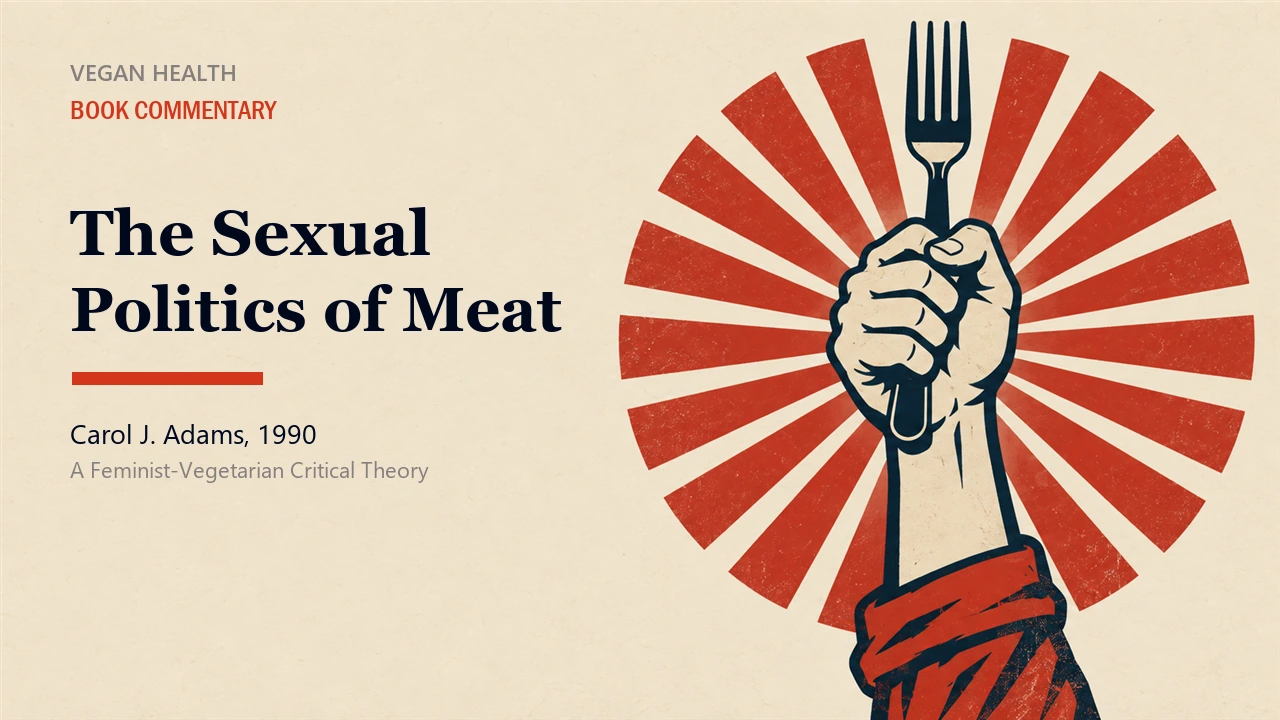
Vegan living is usually discussed through the lens of nutrition, yet for many people the choice rests on an ethical stance. Carol J. Adams’s The Sexual Politics of Meat, first published in 1990, examines that stance with the tools of cultural criticism rather than nutrition science, and it remains one of the most discussed texts in its field. This article is a book commentary; it contains no health or dietary advice.
The book’s central argument
Adams argues that eating meat is not merely an individual food choice: the exploitation of animals and the objectification of women, she contends, are two faces of the same cultural pattern. Drawing on examples that range from advertising to everyday language, the book traces how the two phenomena intertwine — how meat consumption is identified with masculinity and power, and how both women’s bodies and animals’ bodies are fragmented into consumable objects in strikingly similar ways.
The “absent referent”: the book’s conceptual contribution
The book’s most lasting contribution to the debate is the concept of the absent referent. In Adams’s account, the living animal is made linguistically and culturally invisible behind the product on the plate: the animal becomes “meat”, the cow becomes “beef”, and the link between the living being and the consumed product is severed. She argues that the same mechanism operates when women are reduced to bodies in media and advertising. Her notion of “feminized protein” — eggs and dairy, produced from the bodies of female animals — belongs to the same framework.
Who is it for?
This book is for readers interested in veganism’s cultural and social dimensions, not only its health or environmental aspects. For anyone curious about the intellectual foundations of ethical veganism, the intersection of gender studies and animal ethics, or simply a non-nutritional answer to the question “why vegan?”, it can be a landmark read.
A critical note
Widely debated since its publication, the book has drawn its share of criticism: its argument rests on cultural analysis rather than empirical data, its examples come largely from the American media landscape of the early 1990s, and some readers find its generalisations too sweeping. Even so, it is regarded as a founding text of vegan-feminist thought — worth reading to understand the debate itself, whether or not you end up agreeing with it.
Book details
- Original title: The Sexual Politics of Meat: A Feminist-Vegetarian Critical Theory (1990)
- Author: Carol J. Adams
- Turkish edition: Etin Cinsel Politikası, Ayrıntı Yayınları, translated by Serpil Çağlayan, 300 pages — publisher’s page
Editor: Anıl Güler, Pharmacist
Last review: 23 August 2026