Tofu or Tempeh? How They Compare on Protein, Calcium, Fermentation and B12
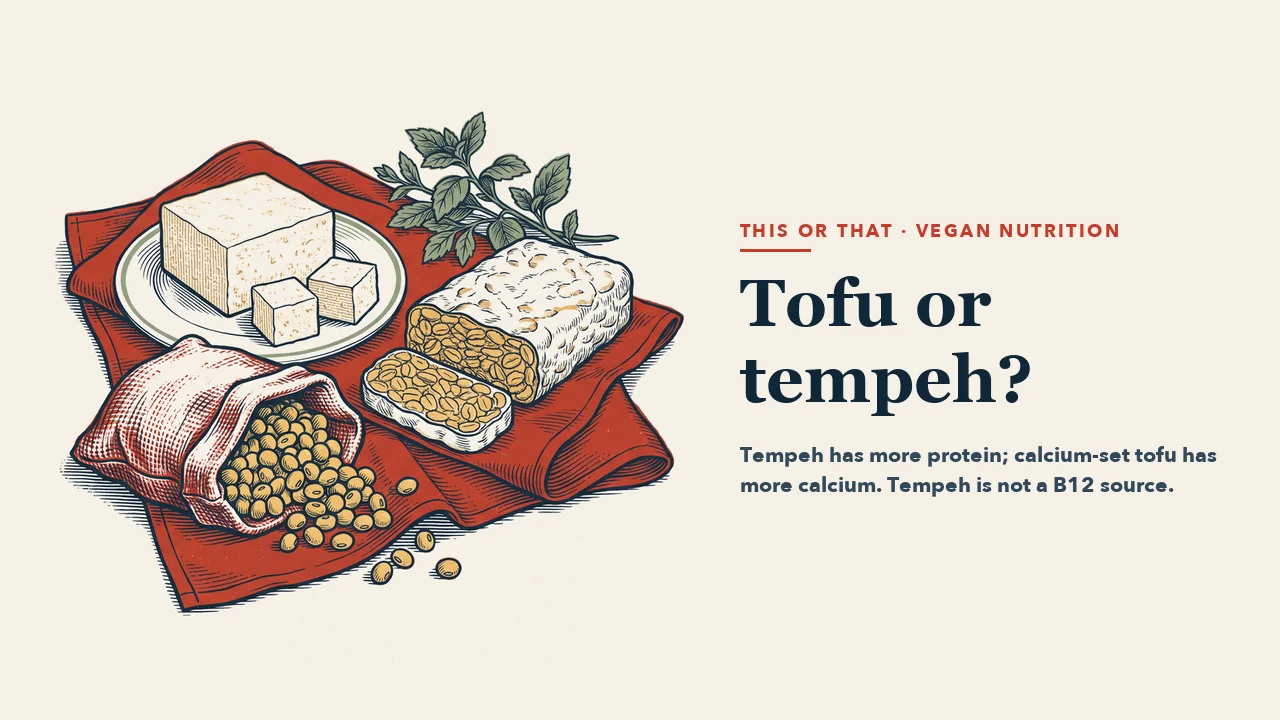
Short answer: Both are good sources of soy protein, and neither is the “healthier” one across the board. Per 100 g, tempeh has more protein, magnesium and potassium. Firm tofu set with calcium sulfate has far more calcium: in US food composition data, 683 mg per 100 g against 111 mg for tempeh. Tempeh is fermented, which lowers phytate and changes the form of soy isoflavones, but there are no tempeh-specific human trials showing that these changes make a difference to health. Tempeh is not a reliable source of vitamin B12.
Same bean, two methods
Tofu is made by curdling soy drink with a coagulant and pressing the curds into a block. Salt coagulants are the oldest and most widely used: calcium sulfate, magnesium chloride (nigari), calcium chloride and others; glucono-delta-lactone is the most common acid coagulant. Silken tofu is set without pressing; for soft, firm and extra-firm tofu, the more liquid is pressed out, the firmer and more concentrated the block.
Tempeh is made from soaked, usually dehulled and cooked soybeans that are fermented, traditionally with Rhizopus moulds, until they bind into a firm, cake-like block with a nutty taste. The beans stay largely intact, so tempeh is closer to a whole legume than tofu is.
Per 100 g: what the numbers show
The figures below come from the U.S. Department of Agriculture’s FoodData Central (SR Legacy), per 100 g, uncooked.
| Per 100 g | Firm tofu (calcium sulfate) | Tempeh |
|---|---|---|
| Energy | 144 kcal | 192 kcal |
| Protein | 17.3 g | 20.3 g |
| Fat | 8.7 g | 10.8 g |
| Carbohydrate | 2.8 g | 7.6 g |
| Calcium | 683 mg | 111 mg |
| Iron | 2.7 mg | 2.7 mg |
| Magnesium | 58 mg | 81 mg |
| Potassium | 237 mg | 412 mg |
| Zinc | 1.6 mg | 1.1 mg |
| Vitamin B12 | 0 µg | 0.08 µg |
| Water | 70 g | 60 g |
Tempeh contains less water, so most nutrients are more concentrated in it. Per calorie the picture changes: firm tofu gives about 12 g of protein per 100 kcal, tempeh about 10.6 g.
Tofu varies a lot between products. In the same database, regular tofu set with calcium sulfate has 8.1 g of protein and 350 mg of calcium per 100 g, and extra-firm tofu set with nigari has 10.0 g of protein and 282 mg of calcium. Names such as “firm” and “extra-firm” are not standardised, and the firm tofu in the table is denser than many products sold under that name. The nutrition panel on the pack is a better guide than any average.
Calcium: it depends on the coagulant
The amount of calcium in tofu depends largely on the coagulant, so a block set with calcium sulfate can be one of the richest plant sources. Tempeh is made without a coagulant and provides much less. A 2022 review of calcium absorption from foods summarises two studies by Weaver and colleagues in premenopausal women, in which calcium absorption from tofu made with calcium sulfate or calcium chloride was similar to that from milk.
If tofu is one of your main calcium sources, check the ingredient list for calcium sulfate (E516 on EU and Turkish labels) and the calcium line in the nutrition table. Our article on bone health on a vegan diet covers calcium in more detail.
What fermentation changes in tempeh
Fermentation is the main difference between the two, and also the most overstated.
- Phytate. Rhizopus moulds and bacteria in tempeh produce phytases, enzymes that break down phytate, which can bind iron and zinc. A 2026 scoping review of 36 laboratory (omics) studies on tempeh notes that this route is plausible but adds that there are no human trials, and that without absorption or isotope tracer studies no conclusions can be drawn about mineral bioavailability.
- Isoflavones. In fermented soy foods such as tempeh, a considerable share of isoflavones occurs as aglycones, the form without a sugar attached. Aglycones are absorbed more quickly, but studies disagree on whether more is absorbed in total, and the isoflavones in unfermented soy are also absorbed once the sugar is removed during digestion. The 2026 scoping review lists tempeh-specific human trials among the research gaps.
- Gas-forming sugars. This is not a difference between them: according to a 2016 review by Messina, in both tempeh and tofu, processing greatly reduces or eliminates the oligosaccharides that can cause bloating.
The 2026 scoping review also found that most studies on tempeh’s health effects are laboratory or animal work. Fermentation makes tempeh an interesting food; it does not make it a medicine.
Tempeh and vitamin B12: not a reliable source
Tempeh is often said to contain vitamin B12. The claim has a basis, but it does not hold up in practice. Soybeans contain little or no B12. In tempeh, B12 is thought to come not from the mould but from bacteria such as Klebsiella pneumoniae and Citrobacter freundii, which may or may not be present. A 2014 review by Watanabe and colleagues cites earlier measurements of 0.7–8.0 µg per 100 g; USDA data list 0.08 µg per 100 g. Much of what is measured may be B12-like analogues of doubtful value; the 2026 tempeh review describes their activity in humans as debated and lists telling true B12 apart from analogues as an open question.
The amount depends on which bacteria happened to be present, and the label rarely tells you. Vegans need a B12 supplement or fortified foods regardless of how much tempeh they eat; our B12 guide explains how.
Isoflavones and safety
Both foods contain soy isoflavones. According to Messina’s review, each gram of protein in traditional soy foods comes with about 3.5 mg of isoflavones, and 100 g of tofu typically provides about 25 mg (denser, higher-protein tofu provides proportionally more); the tempeh review gives 20–60 mg per 100 g of tempeh. Questions about hormones, thyroid and breast cancer apply equally to both and are covered in our article on tofu and soy foods. People with a soy allergy should avoid both.
How to choose
- For calcium, choose tofu made with calcium sulfate and check the nutrition table.
- For protein, magnesium and potassium, tempeh is ahead per 100 g, though it also brings more calories; firm calcium-set tofu has more calcium and zinc, and iron is about the same.
- For B12, neither: use a supplement or fortified foods.
- For taste and cooking, the difference is larger than in nutrition. Tofu takes on marinades well and works in both savoury and sweet dishes; tempeh has a firmer bite and a nutty flavour.
Eating both is a reasonable choice. Both provide all the essential amino acids; our article on protein quality for vegans explains how to combine protein sources across the day.
Sources
- U.S. Department of Agriculture, Agricultural Research Service. FoodData Central, SR Legacy: Tofu, raw, firm, prepared with calcium sulfate (172475); Tofu, raw, regular, prepared with calcium sulfate (172476); Tofu, extra firm, prepared with nigari (174290); Tempeh (174272).
- Yarlina VP, et al. Unraveling Tempeh through omics: a scoping review of fermentation pathways and functional health benefits. NPJ Sci Food 2026;10:122.
- Harahap IA, et al. Fermented soy products: A review of bioactives for health from fermentation to functionality. Compr Rev Food Sci Food Saf 2025;24(1):e70080.
- Watanabe F, Yabuta Y, Bito T, Teng F. Vitamin B12-containing plant food sources for vegetarians. Nutrients 2014;6(5):1861–73.
- Messina M. Soy and Health Update: Evaluation of the Clinical and Epidemiologic Literature. Nutrients 2016;8(12):754. (The author directs an institute funded by the soy industry.)
- Shkembi B, Huppertz T. Calcium Absorption from Food Products: Food Matrix Effects. Nutrients 2022;14(1):180. (Funded by the Dutch Dairy Association; one author works for FrieslandCampina.)
- Geng Y, et al. Research Progress on Tofu Coagulants and Their Coagulation Mechanisms. Foods 2024;13(21):3475.
Editor: Anıl Güler, Pharmacist
Last reviewed: 18 October 2026