Healthy Plant-Based Eating and the Heart: What One US Study Found
Last week, on World Heart Day, we looked at a meta-analysis that pooled 19 cohort studies on plant-based eating and the heart. Its message was simple: it depends on which plants. Tonight’s study is smaller: it follows one group of American adults, and it shows how messy a single study can look next to that tidy average.
The study
The paper was published on 21 August 2026 in The American Journal of Clinical Nutrition. It used data from the REGARDS study (REasons for Geographic and Racial Differences in Stroke), a long-running US cohort. The authors point out why it matters: Black and rural Americans carry a high burden of heart disease and stroke, yet they have had limited representation in plant-based diet research.
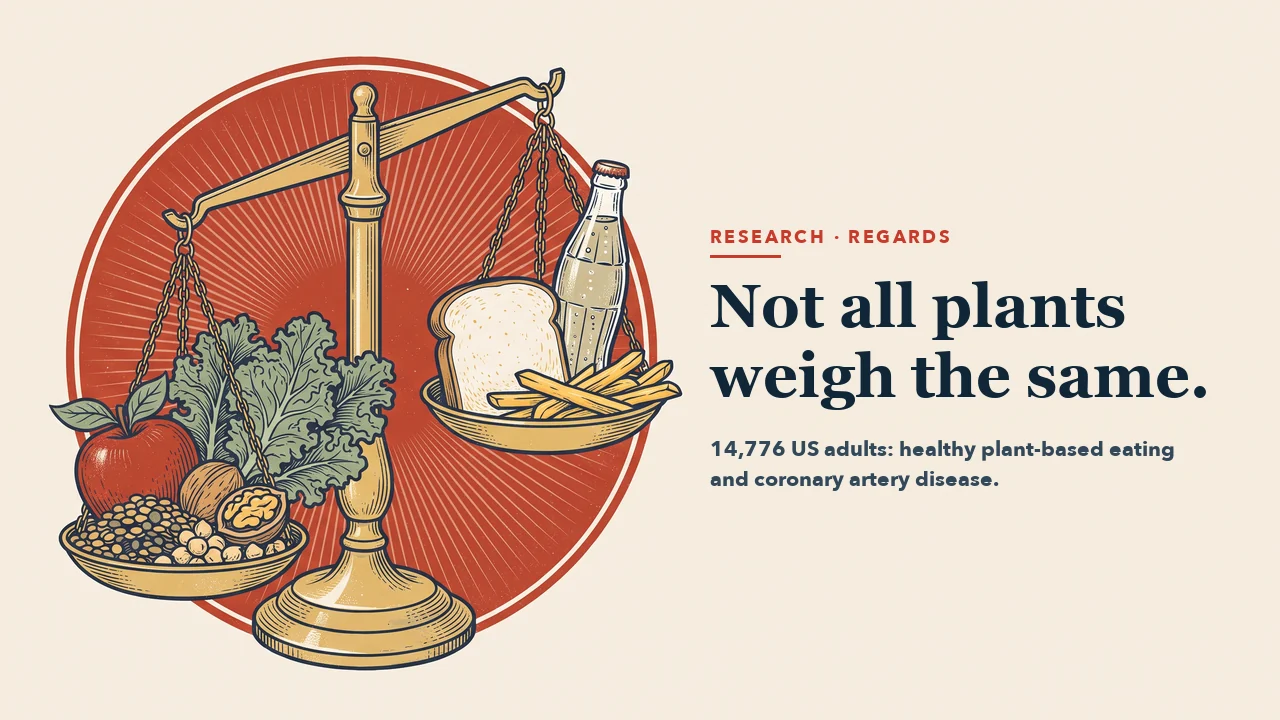
The analysis included 14,776 adults. Their diets were recorded with food frequency questionnaires between 2003 and 2007, and they were followed until 2019. In that time there were 700 strokes, 1,047 new cases of coronary artery disease (the disease behind most heart attacks) and 944 deaths from it.
How diets were scored
The study did not compare vegans with meat eaters. Instead, each person’s diet got three scores, using the standard definitions also used in the meta-analysis:
- Overall plant-based index: points for plant foods, points taken away for animal foods.
- Healthy plant-based index: points for whole grains, fruit, vegetables, nuts, legumes, vegetable oils and tea or coffee; points taken away for juice, sugary drinks, refined grains, potatoes, sweets and animal foods.
- Unhealthy plant-based index: the reverse of the healthy one.
The researchers then compared the top fifth of each score with the bottom fifth, after accounting for social and economic background, health risk factors and calorie intake. A high score means more plants and fewer animal foods, not a vegan diet.
What they found
The healthy index looked good. People with the highest healthy plant-based score had a 28% lower risk of developing coronary artery disease than those with the lowest (hazard ratio 0.72; 95% confidence interval 0.58–0.90). For deaths from coronary artery disease, the healthy index was linked to lower risk in women only.
The overall index was mixed. A high overall plant-based score was linked to a 27% lower risk of dying from coronary artery disease (0.73; 0.59–0.90), but a 60% higher risk of developing it (1.60; 1.09–2.33). The higher risk appeared only in people who did not live in rural areas.
The rest showed nothing. None of the three scores was linked to stroke. The unhealthy index was not linked to coronary artery disease either way. The results did not differ by race.
The authors’ own summary is balanced: a healthy plant-based diet was associated with lower risk, but overall plant-based diets “had heterogeneous associations” with coronary artery disease.
Why the 1.60 does not cancel the 0.72
The 60% figure is the eye-catching one, so it is worth being careful with it. The paper’s summary does not explain why the same score points one way for new cases and the other way for deaths, and we could not read the full text, which is behind a paywall. The confidence interval is also wide: the data fit anything from a 9% to a 133% increase, so the size of the effect is very uncertain.
One possible explanation, which the summary does not test, is that the overall index rewards any plant food, including white bread, fries and sugary drinks. That is exactly the weakness the healthy index was designed to fix. A high overall score can come from a diet that is low in meat but high in refined food.
There is also a caution about the scores themselves. In 2024 a different team used the same REGARDS data to test this scoring method. In a preprint that has not been peer reviewed, they could not reproduce the significant links between these scores and coronary heart disease reported in earlier research. Small changes to which foods counted as “healthy” or “unhealthy” shifted the results, and any of the plant food groups they studied could end up in an index that looked protective or harmful. Their phrase for it: “guilt (or benefit) by association”. Diet scores are useful tools, but blunt ones.
How it fits with the bigger picture
This is one cohort; the meta-analysis from 29 September combined 19. On the main point they agree. In the meta-analysis, the healthy index was linked to 23% lower coronary heart disease risk; here, 28% lower. Neither found a clear link with stroke.
Where they differ is the overall index. In the pooled studies it was linked to slightly lower risk (9% lower for coronary heart disease); in REGARDS, to higher risk of new cases. A single study that goes against the average is not a reason to throw the average away, but it is a reminder that averages hide variation between populations. If you want a refresher on reading results like these, see how to read nutrition research.
What to take from it
The practical message is the same as last week’s, now from a cohort that includes Black and rural Americans, groups that are rarely studied. The kind of plant food matters more than the label. Build meals around whole grains, legumes, nuts, vegetables and whole fruit, and keep sugary drinks, juice, white bread and sweets as extras. If you are also watching your cholesterol, our piece on whether going vegan lowers cholesterol covers what changes and how fast.
This study cannot prove that diet caused the differences it found. It shows associations, measured with questionnaires, in one country. But it adds one more piece of evidence that a plant-based diet is only as good as the plants in it.
Sources
- Belarmino EH, Blair J, Zakai NA, et al. Plant-based diets, stroke, and heart outcomes: a prospective study of the REasons for Geographic and Racial Differences in Stroke Cohort. Am J Clin Nutr. 2026;124(5). PMID: 42628748.
- Satija A, Bhupathiraju SN, Spiegelman D, et al. Healthful and unhealthful plant-based diets and the risk of coronary heart disease in U.S. adults. J Am Coll Cardiol. 2017;70(4):411–422.
- Jamshidi-Naeini Y, Henschel B, Shikany JM, Allison DB, Brown AW. Guilt by association: plant-based foods can be incorporated into both healthy and unhealthy plant-based diet indices associated with coronary heart disease. medRxiv. 2024 (preprint, not peer reviewed).
Editor: Anıl Güler, Pharmacist
Last reviewed: 3 October 2026