Carnitine on a Vegan Diet
Carnitine is the middle case in this series, and the most misrepresented. The supplement pitch is simple: it is concentrated in meat, vegans get almost none, therefore vegans are short of it. Every step of that sentence is either uncertain or wrong. This is the second of three short pieces on creatine, carnitine and taurine.
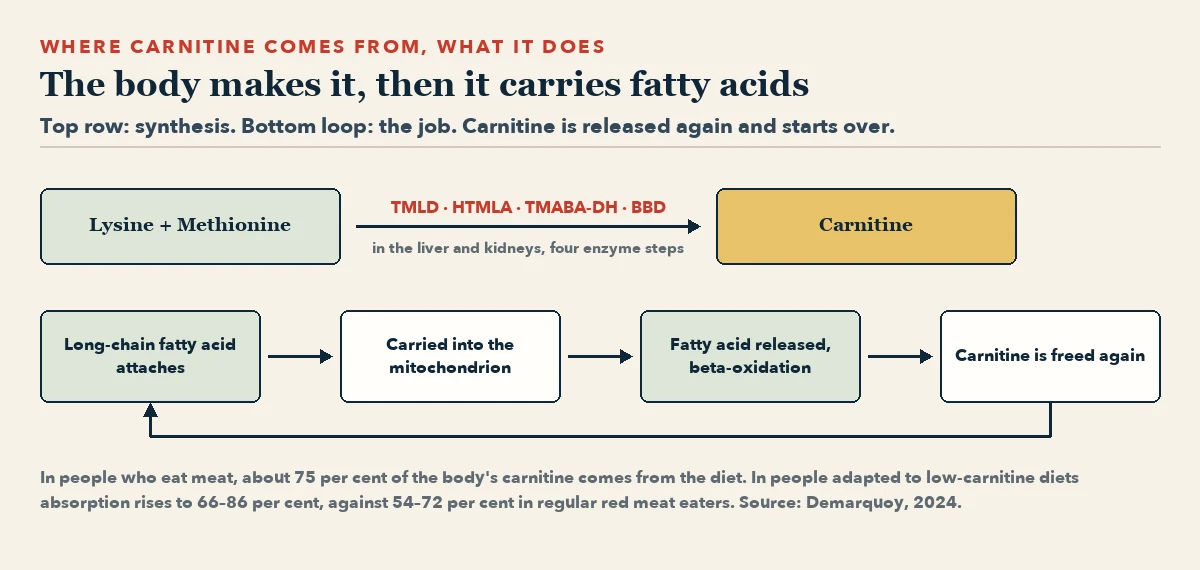
L-carnitine is a derivative of the amino acid lysine. It is synthesised in the liver and kidneys from lysine and methionine, and its main metabolic job is carrying long-chain fatty acids into the mitochondria to be burned for energy. In people who eat meat, about 75 per cent of the carnitine in the body comes from the diet. That figure is where the worry starts — and it is also where most articles stop reading.
The measurements do not agree with each other
The starting observation is real. A 1989 study measured plasma carnitine and urinary carnitine excretion in adults and children eating strict vegetarian, lacto-ovo-vegetarian or mixed diets. In adults, both strict vegetarians and lacto-ovo-vegetarians had significantly lower values than the mixed-diet group, and did not differ from each other. In children the differences were larger and separated all three groups.
What the authors concluded from their own data is the part usually left out of supplement copy: “Small differences between diet groups in adults do not suggest a nutritionally significant difference in carnitine status.” They added, carefully, that whether vegetarian children face a greater risk of overt deficiency was not answered by their study — and as far as we can tell, it still has not been answered directly.
Then the picture stops being consistent at all. A 2019 comparison of 32 healthy vegetarians and 31 omnivores found L-carnitine — along with methionine and ascorbic acid — significantly higher in the vegetarians, not lower. That is a small cross-sectional study and it should not overturn the 1989 finding. But it does mean “vegans are low in carnitine” is a weaker generalisation than it sounds, and anyone stating it as settled fact has not looked at both papers.
There is a mechanism for the body making up the difference
This is the part that resolves the apparent paradox, and it is rarely mentioned. Absorption adapts to intake. In people adapted to low-carnitine diets, such as vegetarians, the bioavailability of L-carnitine is reported at 66 to 86 per cent, against 54 to 72 per cent in regular red meat eaters. Meanwhile endogenous synthesis continues regardless of what you eat, because the raw materials — lysine and methionine — are amino acids a plant-based diet supplies.
A system that manufactures its own supply, and extracts more from the little it receives, is not a system running a deficit. For healthy adults on a plant-based diet, that is what the evidence shows: lower intake, adapted absorption, no described deficiency disease.
The TMAO problem, kept in proportion
Carnitine is the one substance in this series where supplementing has an argument against it, and it is worth understanding precisely rather than dramatically.
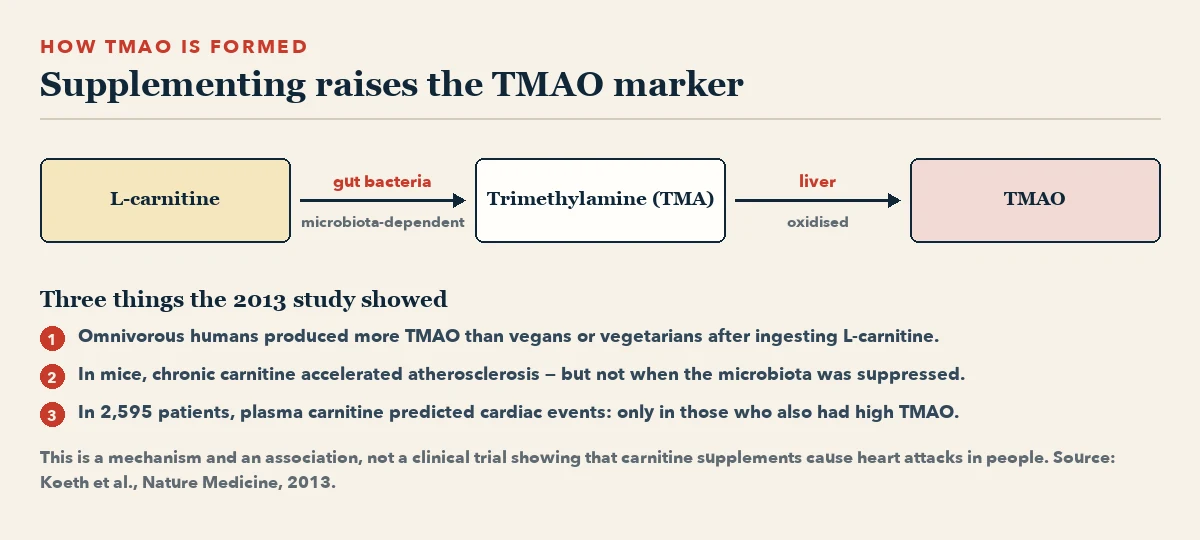
Gut bacteria metabolise L-carnitine to trimethylamine, which the liver oxidises to trimethylamine N-oxide (TMAO). The landmark 2013 paper in Nature Medicine established three things. Omnivorous humans produced more TMAO than vegans or vegetarians after ingesting L-carnitine, through a microbiota-dependent mechanism. Chronic carnitine feeding accelerated atherosclerosis in mice with an intact gut microbiota, but this did not occur when the microbiota was concurrently suppressed. And in 2,595 patients undergoing cardiac evaluation, plasma carnitine predicted cardiovascular events — but only among those who also had high TMAO.
That final clause is the whole finding, and it is routinely dropped in the retelling. The paper builds a mechanism and an association. It is not a clinical trial showing that carnitine supplements cause heart attacks in people.
What supplementation does to the marker is clearer. A 2020 systematic review of 11 studies in healthy adults taking 1 to 4 g a day for 12 or 24 weeks found that L-carnitine, taken with carbohydrate, did raise muscle carnitine content — and also raised fasting plasma TMAO, without associated changes in the inflammatory or oxidative stress markers that were measured. The benefits it found were narrow: 24 weeks did not affect muscle strength in healthy older women, while increased muscle mass, improved physical effort tolerance and improved cognitive function were reported in centenarians.
Why that adds up to “probably not”
Put the two halves together and the logic for a healthy vegan is straightforward, without needing to settle the TMAO debate.
Lower TMAO is one of the measurable metabolic features of a plant-based diet — it is a consequence of eating this way, not something you have to work for. Supplementing carnitine reliably raises that marker. In exchange it offers no demonstrated benefit in this population: the trials showing benefit were not in vegans, and the one finding that consistently appears in healthy adults is the TMAO rise itself. Trading a measurable feature of your diet for an unmeasured benefit is a poor deal, whatever the eventual verdict on TMAO’s clinical importance turns out to be.
That reasoning applies to healthy people choosing a supplement. It has nothing to say about diagnosed carnitine deficiency, which is a medical condition rather than a dietary category, and is treated with prescribed carnitine under medical supervision. If a doctor has told you that you have it, this article is not about you.
Limits of this article
- The two human studies on carnitine status in vegetarians point in opposite directions. The 1989 study is the larger body of evidence on plasma and urinary carnitine; the 2019 study is small, cross-sectional, and found the opposite. Neither settles the question.
- The question of vegetarian children was explicitly left open by the 1989 authors and we found nothing that closes it.
- The TMAO evidence is mechanistic and observational in humans, and interventional only in mice. No trial has tested whether carnitine supplements change cardiovascular outcomes in people.
- The supplementation review covered healthy adults in general, not vegans.
- This is information, not a recommendation. Decisions about supplements belong with your own doctor or pharmacist.
Sources
- Lombard KA, Olson AL, Nelson SE, et al. Carnitine status of lactoovovegetarians and strict vegetarian adults and children. Am J Clin Nutr. 1989;50(2):301-6. doi:10.1093/ajcn/50.2.301.
- Lin TJ, Tang SC, Liao PY, et al. A comparison of L-carnitine and several cardiovascular-related biomarkers between healthy vegetarians and omnivores. Nutrition. 2019;66:29-37. doi:10.1016/j.nut.2019.03.019.
- Demarquoy J. Revisiting the Role of Carnitine in Heart Disease Through the Lens of the Gut Microbiota. Nutrients. 2024;16(23). doi:10.3390/nu16234244.
- Koeth RA, Wang Z, Levison BS, et al. Intestinal microbiota metabolism of L-carnitine, a nutrient in red meat, promotes atherosclerosis. Nat Med. 2013;19(5):576-85. doi:10.1038/nm.3145.
- Sawicka AK, Renzi G, Olek RA. The bright and the dark sides of L-carnitine supplementation: a systematic review. J Int Soc Sports Nutr. 2020;17(1):49. doi:10.1186/s12970-020-00377-2.
Editor: Anıl Güler, Pharmacist
Last scientific review: 6 October 2026