Do Plant-Based Alternatives Add Mycotoxins to Your Diet? A 413-Product Risk Model
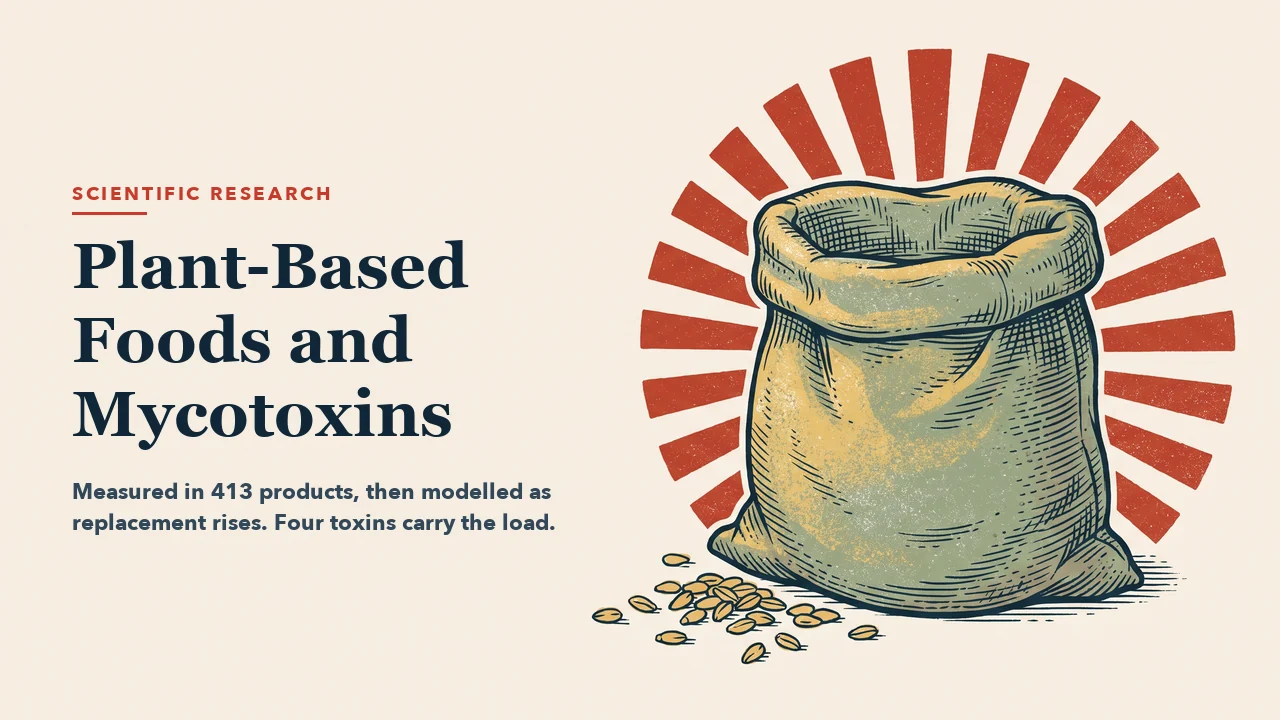
Swapping meat and milk for plant-based versions changes more than the protein on your plate: it changes which mould toxins come with it. A new risk assessment pooled measurements from 413 plant-based meat alternatives and drinks sold in Italy and the UK and modelled what happens when 25%, 50% or 100% of meat and milk is replaced. In Italy, the share of modelled exposures that crossed a safety threshold ran from 17.9% (adults replacing a quarter) to 38.4% (infants replacing everything); in the UK the same range was 9.5% to 28.9%. Four toxin groups did all the work, the other six stayed within their limits throughout, and the studies that measured real people instead of modelling them disagree with each other. Here is what the numbers say and what they do not.
What the study actually did
Mycotoxins are toxins made by moulds — mainly Aspergillus, Penicillium, Fusarium and Alternaria — that grow on crops in the field and in storage. Cereals, nuts, dried fruit and pulses are the classic carriers, which is precisely what plant-based meat alternatives and plant drinks are made of.
The team, from Parma, Valencia and Cranfield, did not buy and test new products. They took mycotoxin measurements from three of their own earlier surveys, all run with the same validated UHPLC-MS/MS method so the numbers could be pooled: 105 meat alternatives and 96 plant drinks from Italy, and 92 meat alternatives and 120 plant drinks from the UK. That is 413 products and 19 target toxins, from the regulated ones (aflatoxins, ochratoxin A, deoxynivalenol, fumonisins, T-2, HT-2, zearalenone) to the “emerging” ones that carry no EU limit at all (Alternaria toxins, enniatins, beauvericin).
Then came the modelling. National food consumption surveys do not yet record plant-based alternatives, so the authors simulated the swap: the grams of meat someone eats become grams of meat alternative, the grams of cow milk become plant drink, at 25%, 50% and 100% replacement. Estimated daily intake was calculated as mean contamination multiplied by consumption and divided by body weight, for six age bands from infants under one to people aged 65–74. Left-censored results were handled with the substitution method recommended by WHO/IPCS and used by EFSA, so every scenario was run twice: non-detections counted as zero (lower bound, LB) and as the detection or quantification limit (upper bound, UB). Italian intakes came from the IV SCAI surveys (2017–2020), British ones from the National Diet and Nutrition Survey 2019–2023.
Which toxins crossed the line
Two yardsticks are used, because two kinds of toxin behave differently. For toxins that are both genotoxic and carcinogenic — aflatoxins and ochratoxin A — no health-based guidance value can be set, so risk is expressed as a margin of exposure (MOE): the benchmark dose lower confidence limit from animal studies (BMDL10) divided by the estimated human intake. A margin of 10,000 or more is taken as low concern; below that, EFSA expects risk managers to look again. For the four aflatoxins together the authors used a total margin of exposure, the reciprocal of the summed reciprocals of the individual margins. For the others there is a tolerable daily intake, and exposure is divided by it to give a hazard quotient (or hazard index when several are added up): under 1 is tolerable.
| Toxin group | Health-based reference | Result in the model |
|---|---|---|
| Aflatoxins (B1, B2, G1, G2) | MOET; BMDL10 0.4 µg/kg bw/day (hepatocellular carcinoma, rats); concern below 10,000 | Below 10,000 in every Italian scenario at all ages and substitution levels. In the UK the same held, with one exception: under LB assumptions, adolescents, adults and the elderly replacing only milk with plant drinks at 25% stayed within safe margins |
| Ochratoxin A | MOE; BMDL10 14.5 µg/kg bw/day (neoplastic effects); concern below 10,000 | Fine for adolescents, adults and the elderly at partial substitution; below threshold mainly in infants and children, and in adults and the elderly mainly at full replacement with both product types |
| Alternaria toxins (AOH + AME) | TTC 0.025 µg/kg bw/day (genotoxic); HI < 1 | Above 1 for all Italian age groups once meat alternatives were included; plant drinks alone stayed under for most age groups |
| HT-2 + T-2 | Group TDI 0.02 µg/kg bw/day (reduced leukocyte count, rats); HI < 1 | Above 1 mainly in infants, toddlers, children and adolescents; in adults only under full substitution with both |
| Deoxynivalenol, zearalenone, fumonisins, enniatins, beauvericin, tentoxin | TDI 1 µg/kg bw/day (DON, fumonisins), 0.25 (zearalenone); TTC 1.5 (enniatins, beauvericin, tentoxin); HQ / HI < 1 | Below the guidance values in every scenario, in both countries |
So the headline is narrower than “plant-based food is contaminated”. Six toxin groups stayed comfortably inside their limits even at full substitution — including deoxynivalenol, which the same group’s biomonitoring study of 300 Italian adults found at the highest mean urinary concentration of the 24 mycotoxins measured (7.10 µg/g creatinine), despite a detection rate of only 34%. The pressure came from aflatoxins, ochratoxin A, the Alternaria pair and the T-2/HT-2 pair.
The absolute intakes are small numbers. The highest single aflatoxin intake modelled was 0.027 µg per kg of body weight per day, in Italian toddlers drinking soy-based beverages alongside vegetable-based meat alternatives under the pessimistic assumption. The BMDL10 for aflatoxins, from hepatocellular carcinoma in rats, is 0.4 µg/kg bw/day — only about fifteen times higher, and a margin of fifteen is a long way from the 10,000 that regulators want. That gap, not the raw microgram, is the finding.
One more pattern is worth naming: meat alternatives mattered more than drinks. Plant drinks on their own mostly stayed under the thresholds; it was the meat alternatives, and above all the two together, that pushed the indices up. The authors put this down to composition — a meat alternative often combines several cereal and legume ingredients at once, so several contamination sources stack.
Why children come out highest
In every scenario, infants and toddlers were the most exposed group, and the reason is arithmetic rather than biology: a toddler eats far more food per kilogram of body weight than an adult, so the same contamination in the same product delivers a larger dose. This is the one finding that all the comparable studies agree on — the same age gradient appears in the Italian, British, German and Belgian assessments.
It also explains why substitution level mattered so much more for children. Adults replacing a quarter of their meat and milk stayed inside the guidance values for everything except aflatoxins. Children replacing all of it did not.
What the numbers do not say
This is a modelling study, and every limitation pulls in the direction of caution rather than alarm. Nobody in it actually ate anything: consumption surveys that predate the plant-based shelf were re-used, with meat and milk swapped gram for gram — an assumption the authors themselves call conservative, since a glass of oat drink is not nutritionally a glass of milk and portion sizes differ. Exposure was calculated from mean concentrations, so it describes a category, not a person or a brand. Sample numbers in some categories were small (ten cereal-based British products, sixteen Italian rice drinks). The upper-bound scenario deliberately treats every non-detection as if the toxin were present at the detection limit. And the data are Italian and British: contamination depends on crop, climate and storage, so these figures cannot be read as measurements of the Turkish market, where no products were sampled.
The studies that measured mycotoxins in people rather than modelling them are genuinely inconsistent, and that is the most important context for this paper. An Icelandic comparison of 47 vegans with 171 omnivores found no support for the idea that vegans are more exposed: urinary deoxynivalenol was essentially identical (1.84 vs 2.04 ng/g creatinine, p = 0.54) and ochratoxin A was about ten times lower in vegans (0.01 vs 0.11 ng/g, p < 0.001), while zearalenone was detected in all vegan samples but only 52% of omnivore ones. The German RBVD study found the opposite for one toxin: serum ochratoxin A was twice as high in vegans (0.24 vs 0.12 ng/mL). And a German randomised trial that put 63 adults on either a vegan or a meat-rich diet for eight weeks found higher urinary deoxynivalenol, ochratoxin A and zearalenone in the vegan arm — but higher T-2 in the meat-rich arm. Read together, these say exposure patterns differ by diet. They do not establish that one diet is more exposed overall.
Is this a plant-based problem?
Partly, and less exclusively than the framing suggests. A Dutch total diet study of children aged 3–11 — an ordinary mixed-diet population — concluded that a health concern could not be excluded for aflatoxins, alternariol, alternariol monomethyl ether, ochratoxin A and the T-2/HT-2 sum. The foods contributing most were bread, breakfast cereals, chocolate, fruit juice, oils and fats, nuts, and tomato products. In other words, the same toxin groups that this new study flags in plant-based alternatives are already at the edge of their limits from everyday food. A separate Portuguese modelling exercise that compared an omnivorous and a vegetarian dietary model across 73 contaminants in 16 everyday foods found the omnivorous model slightly higher overall, with both models exceeding EFSA reference levels for arsenic, lead, cadmium, fumonisin B1 and ochratoxin A at the upper percentiles.
What is specific to plant-based alternatives is the regulatory gap. EU maximum levels for mycotoxins (Commission Regulation 2023/915, also applied in the UK) are set for raw commodities; finished meat alternatives and plant drinks are not covered. Cereals are monitored, but among pulses only soybeans are, and only for ochratoxin A. Alternaria toxins have no EU limits at all, only indicative levels. A product can therefore be fully compliant and still deliver a low margin of exposure to a small child — which is exactly what Germany’s Federal Institute for Risk Assessment (BfR) found for almond drinks, concluding that aflatoxin exposure could “cause health impairments in children in the age group of 0.5 to < 6 years old with a medium likelihood”.
What you can actually do
None of this argues for going back to meat; the authors frame it as a monitoring and formulation problem, not a dietary one. But some of it is actionable at home.
- Vary the base, not just the brand. The toxins track the raw material: T-2 and HT-2 with oats, aflatoxins with nuts. In the Italian biomonitoring study, cereals, nuts, legumes, fruit and vegetables were each significantly associated with higher exposure, chiefly to aflatoxins, ochratoxin A, enniatins and deoxynivalenol. Rotating oat, soy, almond and rice drinks spreads the load in a way that drinking two litres of one base every week does not. The highest exposures in the model came from one fixed combination repeated across every meal.
- Do not count on cooking. Conventional heat — boiling, roasting, baking, pasteurisation — has limited effect on mycotoxins, and little is known about what extrusion does in alternative protein manufacture except that bound (“masked”) forms can form. Unlike bacteria, these toxins are not a hygiene problem you can cook away.
- Treat oats with a little more respect than granola marketing does. A 2026 study from Aberdeen found T-2, HT-2 and their glucosides in 85–100% of unprocessed food oats, with T-2/HT-2 prevalence of 90% in porridge oats, 73% in oatcakes and 40% in granola and muesli — and 73–82% of it was bioaccessible in digestion. De-hulling removed 89–100%, which is the miller’s job, not yours; the encouraging detail is that no mycotoxins were detectable in the infant cereals tested.
- For young children, keep plant drinks as one item in a varied diet, not the single staple. This is where every assessment converges, for nutritional reasons as much as this one: our fortified plant drink checklist covers what a drink has to be fortified with before it can carry that much weight.
- Store dry goods cool and dry, and discard what looks off. Humidity and temperature drive fungal growth and toxin production during storage; visibly mouldy, shrivelled or discoloured nuts and dried fruit are worth throwing out rather than sorting through.
- Cook from whole ingredients when it is easy. The products in this study were processed composites; a pot of lentils or chickpeas you cook yourself carries one raw material rather than five. That is an inference from the composition data, not a recommendation the authors make.
In short
- 413 products, two markets, 19 toxins, three substitution scenarios. Threshold exceedances ranged from 17.9% to 38.4% of modelled exposures in Italy and 9.5% to 28.9% in the UK, rising with substitution level and falling with age.
- Four culprits: aflatoxins (margins below 10,000 almost everywhere), ochratoxin A, Alternaria toxins and T-2 + HT-2. Deoxynivalenol, zearalenone, fumonisins, enniatins, beauvericin and tentoxin stayed within limits throughout.
- Meat alternatives weighed more than drinks, and infants and toddlers more than adults, because dose follows body weight.
- It is a model, not a measurement. Human biomonitoring studies point in conflicting directions, and the toxins flagged here are already near their limits in ordinary mixed diets.
- The gap is regulatory: limits apply to raw commodities, not to finished alternatives, and Alternaria toxins have no limits at all.
This is a risk profiling exercise built on measured contamination and simulated diets; how to read nutrition research explains why a modelled scenario and a measured outcome deserve different weight.
Sources
- Mihalache OA, Torrijos R, Patriarca A, Medina A, Dall’Asta C. Dietary transitions to plant-based meat and milk alternatives and their impact on mycotoxin exposure: A risk profiling study in Italy and the UK. Food Res Int. 2026;242:120167. doi:10.1016/j.foodres.2026.120167.
- Kanonier PS, Kowarschik S, Huber R, Storz MA. Mycotoxin exposure following an eight-week vegan or meat-rich dietary intervention: a randomized-controlled trial. npj Sci Food. 2026;10:284. doi:10.1038/s41538-026-01152-4.
- Halldorsson TI, Birgisdottir BE, Eiríksdóttir ÁV, et al. Is adherence to plant-based diet associated with higher exposure to mycotoxins? J Expo Sci Environ Epidemiol. 2026;36:871–877. doi:10.1038/s41370-026-00879-2.
- Penczynski KJ, Cramer B, Dietrich S, Humpf HU, Abraham K, Weikert C. Mycotoxins in Serum and 24-h Urine of Vegans and Omnivores from the Risks and Benefits of a Vegan Diet (RBVD) Study. Mol Nutr Food Res. 2022;66(7):e2100874. doi:10.1002/mnfr.202100874.
- Boon PE, de Pagter-de Witte L, Vrijenhoek NG, et al. Dietary exposure to mycotoxins for children aged 3–11 years from a Dutch Total Diet Study. Food Chem Toxicol. 2026;218:116383. doi:10.1016/j.fct.2026.116383.
- Gordon MJ, Daud N, Cantlay L, Gratz SW. Fusarium Mycotoxins Are Frequently Detected in Oat Grains and Oat Foods and T-2, HT-2 and HT-2-Glucoside Are Highly Bioaccessible in Oat Porridge. Toxins. 2026;18(7):295. doi:10.3390/toxins18070295.
- Ramos H, Reis-Mendes A, Silva M, et al. Exposure Scenarios for Estimating Contaminant Levels in Healthy Sustainable Dietary Models: Omnivorous vs. Vegetarian. Foods. 2024;13(22):3659. doi:10.3390/foods13223659.
- Mihalache OA, Mignogna C, Torrijos R, et al. Multi-mycotoxin biomonitoring in Italian adults: Revealing the connection between diet habits and mycotoxin exposure. Environ Int. 2026;214:110372. doi:10.1016/j.envint.2026.110372.
Editor: Anıl Güler, Pharmacist
Last scientific review: 23 September 2026