Which Blood Tests Should Vegans Monitor? Serum B12 and Its Limits
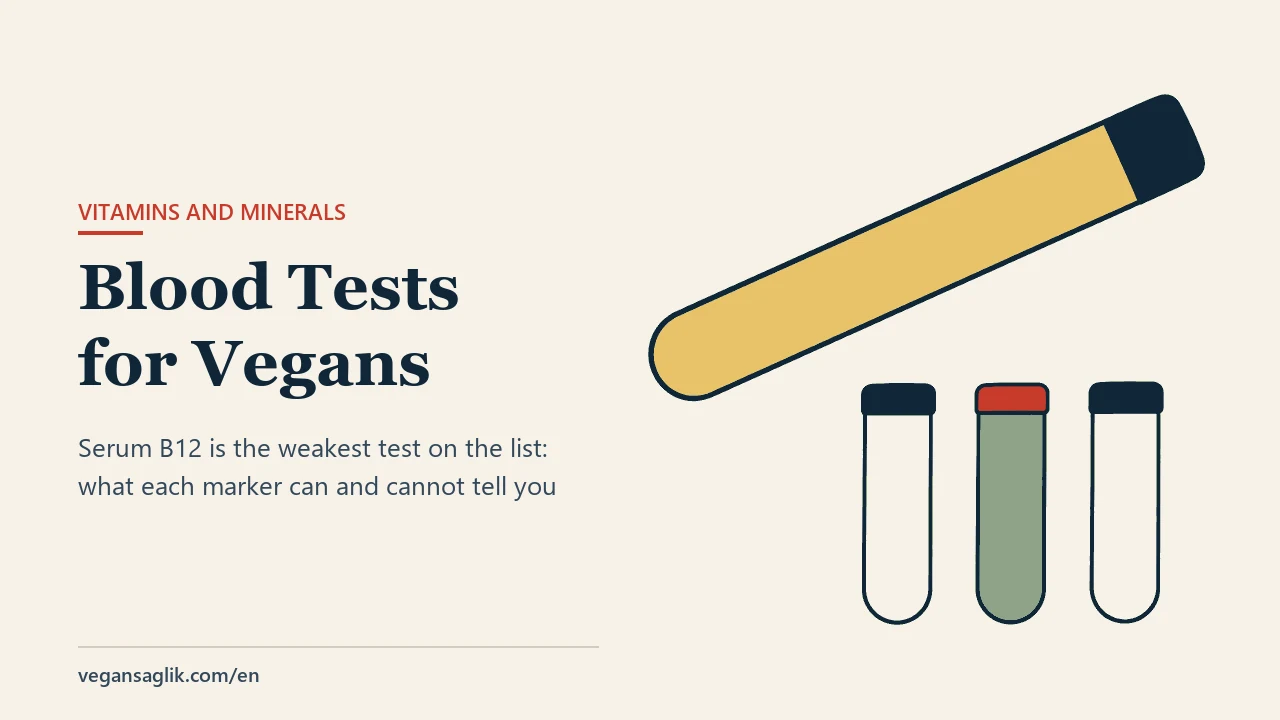
Serum B12, the test most vegans are given, is the weakest one on the list. A 2024 meta-analysis of 17 studies found vegan adults sit lower on serum B12 and higher on homocysteine than meat-eaters — but the two more specific markers, methylmalonic acid and holotranscobalamin, did not separate the groups at conventional significance. A blood panel is worth having. Knowing what each number can and cannot tell you is worth more.
Why a vegan panel is not the same as a general one
A 2021 systematic review in Nutrients pooled 141 studies comparing adults on plant-based diets with meat-eaters. The nutrients where vegans came out lower were consistent across the literature: vitamin B12, vitamin D, iron, zinc, iodine and calcium. Fibre, folate, magnesium, vitamin C and vitamin E ran higher. That asymmetry is the whole reason a targeted panel makes sense: you are not screening for everything, you are checking a short, predictable list.
One consequence deserves saying out loud. A diet high in folate can mask the blood-count changes of B12 deficiency, so the hematological warning signs that would normally show up first may simply not appear. The neurological damage is the part that does not reverse. This is the single strongest argument for testing rather than waiting for symptoms.
Vitamin B12: the test everyone gets, and its limits
The Nutrition Bulletin meta-analysis screened 4,002 records, included 19 studies and carried 17 into the analysis. It reports standardised mean differences, where a negative value means the vegan group sat lower on that marker.
| Marker | Vegans vs meat-eaters | Vegans vs vegetarians |
|---|---|---|
| Serum B12 | −0.72 (−1.26 to −0.18) p = 0.01 | −0.25 (−0.40 to −0.10) p = 0.001 |
| Total homocysteine | 0.57 (0.26 to 0.89) p < 0.001 | 0.24 (0.09 to 0.39) p = 0.002 |
| Methylmalonic acid | 0.28 (−0.01 to 0.57) p = 0.06 | −0.05 (−0.29 to 0.20) p = 0.708 |
| Holotranscobalamin | −0.42 (−0.91 to 0.07) p = 0.09 | 0.04 (−0.28 to 0.35) p = 0.814 |
Two things read straight off that table. Against meat-eaters, only serum B12 and homocysteine cleared conventional significance — methylmalonic acid and holotranscobalamin, the two markers that are supposed to show functional deficiency, did not. And against vegetarians, vegans separated on the same first two markers and not on the other two. Read honestly, the functional-deficiency signal here rests mainly on homocysteine.
The subgroup analysis found what you would hope: vegans taking a B12 supplement had significantly better values on every marker than vegans who took none.
The pooled status figures from the Nutrients review answer a different question — not the gap between groups, but the absolute levels. Mean serum B12 was 309 pmol/L in meat-eaters, 226 pmol/L in vegans and 220 pmol/L in vegetarians, with deficiency counted below 150 pmol/L.
Where serum B12 misleads. A 2022 review in the American Journal of Lifestyle Medicine sets out the problem plainly: diagnostic thresholds vary widely between laboratories, and deficiency can exist above the commonly used cutoff of 156 pg/mL. Values under 70 pg/mL usually mean deficiency with clinical signs; between 100 and 300 pg/mL there is a wide band of uncertainty in which methylmalonic acid or holotranscobalamin may add something. Because there is no reference method or gold standard for assessing B12 deficiency, that review argues it may be prudent to treat mild deficiency while other diagnoses are evaluated. That review recommends at least 250 mcg of oral cyanocobalamin daily for most people on plant-predominant diets, and notes that deficiency can develop within the first 2 years of starting such a diet — not after decades, as is often assumed.
A 2024 narrative review in Food and Nutrition Bulletin adds a caution that matters for anyone already in treatment: diagnostic assays differ markedly in performance, and the second-line biomarkers — holotranscobalamin, methylmalonic acid and total homocysteine — are themselves unreliable. Its practical weight, though, falls on treatment, and that needs one piece of context. When deficiency comes from malabsorption rather than from diet, oral supplementation is likely to be insufficient and intramuscular injection is preferred — under British National Formulary guidance, many such patients can be maintained on 1000 mcg of hydroxocobalamin every two months after an initial loading course, while clinical experience suggests up to 50% need a more frequent, individualised schedule to stay symptom-free. That is where the review draws its firmest line: injection frequency is set by how the person actually feels, and titrating it against serum B12 or methylmalonic acid values should not be practised.
Iron: ferritin, not hemoglobin
This is where a normal result is most often misread. Across the pooled studies, mean hemoglobin was essentially identical between groups — 139 g/L in meat-eaters, 136 g/L in vegans, 140 g/L in vegetarians — while iron stores were not. Mean ferritin was 55.5 µg/L in meat-eaters against 33.8 µg/L in vegetarians and 31.3 µg/L in vegans, and 24.3 µg/L in vegetarian women. Iron deficiency defined as ferritin below 15 µg/L was found in 15% of vegans, 11% of vegetarians and 7% of meat-eaters. A normal hemoglobin does not rule out depleted stores; ferritin is the marker that shows them.
Vitamin D, zinc and the bone markers
Vitamin D status is measured as serum 25(OH)D. Mean levels were 26.2 µg/L in meat-eaters, 22.8 µg/L in vegetarians and 21.9 µg/L in vegans. Deficiency below 10 µg/L was rare in meat-eaters, 0 to 6% across studies, but ranged from 3% to 67% in vegans — a spread that reflects latitude and season as much as diet.
For zinc, mean serum levels were 0.90 mg/L in meat-eaters, 0.81 mg/L in vegetarians and 0.79 mg/L in vegans. Deficiency prevalence was 13% in meat-eaters and 14% in vegetarians but 30% in vegans. The sample is thin — seven studies on status — and the test requires fasting.
Calcium is the trap. Serum calcium is tightly regulated and does not tell you about intake. What the review found instead was higher parathyroid hormone in vegans (5.21 pmol/L) and vegetarians (4.91 pmol/L) than in meat-eaters (4.04 pmol/L), alongside raised bone turnover markers — while bone mineral density of the lumbar spine was comparable across diet groups.
Iodine is not a blood test
Worth knowing before you ask for it. Iodine status is assessed in urine, not serum. In the pooled data, mean urinary iodine was similar between groups (111 µg/L in meat-eaters, 105 µg/L in vegans, 103 µg/L in vegetarians), yet all three studies that compared vegans with meat-eaters directly found vegans significantly lower. Deficiency below 100 µg/L was recorded in 92% of vegans, 51% of meat-eaters and 37% of vegetarians. Mean iodine intake in vegans was 111 µg/d against 170 µg/d in meat-eaters.
What this does and does not settle
- None of these sources sets a testing interval. How often you are tested, and whether you are tested at all, is a clinical decision made with your own doctor, based on your diet, your supplements, your symptoms and your history.
- Most of the status data is observational and cross-sectional, drawn from studies with different assays, different cutoffs and populations mostly from Europe, South and East Asia and North America.
- Supplement users were excluded from many of the pooled comparisons, which is what makes those figures informative about diet — and less applicable to a vegan who supplements properly.
- A panel does not replace supplementation. The evidence for B12 supplementation in vegans does not depend on your test result; the test tells you where you stand, not whether to take it.
A practical note for readers
If you eat plant-based and want a meaningful panel rather than a long one, the short list the literature supports is serum B12 with a functional marker alongside it where available, ferritin and 25(OH)D — plus iodine, which is checked in urine rather than blood. Ask what cutoff your laboratory uses; the B12 thresholds in particular are not standard between labs, and a result reported as normal in one may be borderline in another.
Take any abnormal result to a doctor rather than to a supplement shelf. Ordering tests, interpreting them against your own history and deciding what follows are clinical judgements, and the reviews cited here are explicit that treatment decisions do not follow mechanically from a number. Our guide to vitamin B12 for vegans covers dosing and forms, and how to read nutrition research explains why a confidence interval that crosses zero, as it does for methylmalonic acid above, changes what a finding is allowed to claim.
Sources
- Niklewicz A, Hannibal L, Warren M, Ahmadi KR. A systematic review and meta-analysis of functional vitamin B12 status among adult vegans. Nutr Bull. 2024;49(4):463–479. doi:10.1111/nbu.12712.
- Neufingerl N, Eilander A. Nutrient Intake and Status in Adults Consuming Plant-Based Diets Compared to Meat-Eaters: A Systematic Review. Nutrients. 2021;14(1):29. doi:10.3390/nu14010029.
- Wolffenbuttel BHR, McCaddon A, Ahmadi KR, Green R. A Brief Overview of the Diagnosis and Treatment of Cobalamin (B12) Deficiency. Food Nutr Bull. 2024;45(1_suppl):S40–S49. doi:10.1177/03795721241229500.
- White ND. Vitamin B12 and Plant-Predominant Diets. Am J Lifestyle Med. 2022;16(3):295–297. doi:10.1177/15598276221076102.
Editor: Anıl Güler, Pharmacist
Last scientific review: 21 September 2026