Vegan Diet and Muscle in Older Adults: What a New 12-Week Trial Found
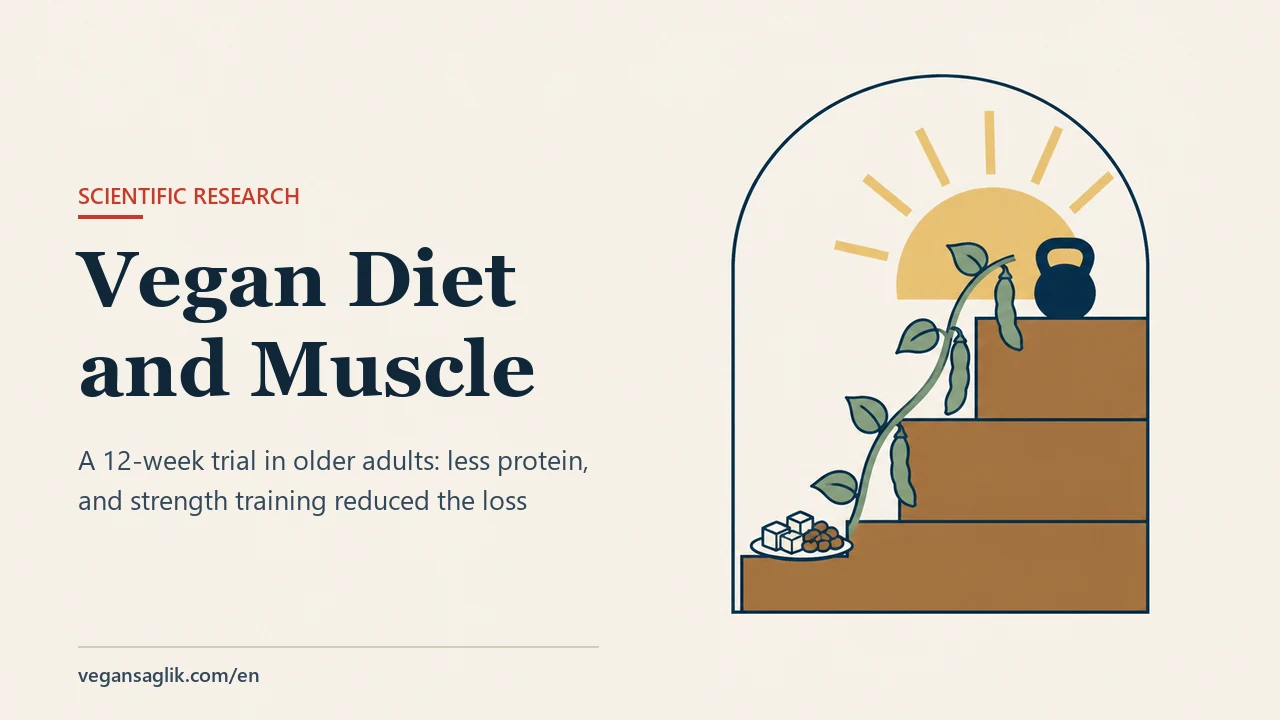
A randomized trial from the Netherlands found that older adults who switched to a vegan diet they put together themselves ate less protein and lost measurable muscle within 12 weeks. Those who also did resistance exercise lost noticeably less. The study is small and short, and it tested a sudden, unguided switch rather than a long-planned vegan diet. It is still worth reading closely, because it is one of the few controlled trials on this question in people over 65.
The study is “A self-selected vegan diet reduces skeletal muscle mass in healthy older adults: a randomized controlled trial” by Domić and colleagues, published in the American Journal of Clinical Nutrition in 2026.
What was published
The paper, “A self-selected vegan diet reduces skeletal muscle mass in healthy older adults: a randomized controlled trial”, appeared in The American Journal of Clinical Nutrition (September 2026 issue, volume 124, article 101416; published online 14 August 2026). The authors are from Wageningen University and Maastricht University Medical Centre+, and the trial was registered in advance as NCT05809466.
What the researchers did
The trial included 72 healthy, community-dwelling adults aged 65 or older who normally ate animal foods at least five days a week. They were randomly assigned to one of three groups for 12 weeks:
- a self-selected vegan diet;
- their usual omnivorous diet;
- a self-selected vegan diet plus resistance exercise twice a week.
“Self-selected” means participants built their own vegan meals rather than eating a menu designed by the researchers. Thigh muscle volume was measured with MRI (the main outcome), lean mass in the arms and legs with a DXA scan, and strength with a dynamometer. Muscle protein synthesis, the rate at which the body builds new muscle protein, was measured over the first 10 days with a stable-isotope method. The people who assessed the outcomes did not know which group participants were in.
What they found
Protein intake fell in both vegan groups but not in the omnivorous group. In the vegan group, protein intake was 27.7 g a day lower than at the start in week 1, 22.0 g lower in week 6 and 19.3 g lower in week 12.
After 12 weeks, compared with the start:
- Thigh muscle volume fell by 0.61 litres in the vegan group, by 0.35 litres in the vegan group that exercised, and by 0.01 litres in the omnivorous group.
- Lean mass in the arms and legs fell by 1.15 kg in the vegan group and by 0.62 kg in the vegan group that exercised, while the omnivorous group changed by +0.05 kg.
- Muscle protein synthesis was 1.09% a day in the vegan group, 1.24% in the vegan group that exercised and 1.27% in the omnivorous group.
All three differences between the vegan group and the other two groups were statistically significant. Resistance exercise did not stop the loss, but it made it smaller: about 43% less thigh muscle volume lost and about 46% less lean mass lost than in the vegan group without exercise. The authors conclude that a self-selected vegan diet reduced protein intake, muscle mass and muscle protein synthesis in older adults, and that resistance exercise can mitigate the effect on muscle mass.
What it does not show
- It is not a test of a well-planned vegan diet. Participants normally ate animal foods, switched at the start of the trial and chose their own food. The trial shows what can happen when protein intake drops during that kind of switch, not that plant protein cannot maintain muscle.
- Twelve weeks and 72 people. Short trials catch early changes; they cannot say whether the body adapts later, or what this means for falls, frailty or independence.
- We read the abstract and the trial registration, not the full paper. The abstract does not report the strength results, energy intake or body-weight change in numbers, so we do not describe them here. Part of the muscle loss could be linked to eating less overall; the full text would be needed to judge that.
- Conflicts of interest. One author has received research funding and fees from companies producing dairy, meat and plant-derived proteins; two others have received public grants and precompetitive funding that includes the food industry. The authors state that the funders did not influence the study.
A practical note for older readers
The clearest lesson is about protein amount and training, not about avoiding a vegan diet. An expert group on protein in ageing (PROT-AGE) recommends that healthy people over 65 eat at least 1.0 to 1.2 g of protein per kilogram of body weight a day, and at least 1.2 g if they are exercising or otherwise active; people with severe kidney disease who are not on dialysis are an exception and should follow their doctor’s advice. For someone weighing 70 kg, 1.0 to 1.2 g/kg means 70 to 84 g a day.
If you are over 65 and moving towards a plant-based diet, include a protein-rich plant food such as lentils, beans, chickpeas, tofu, tempeh or soy drink at most meals, and keep up or start strength exercise that is safe for you. Our guide to protein quality in a vegan diet explains how to combine foods over the day, and how to read nutrition research explains why one trial is a starting point rather than a final answer.
Sources
- Domić J, Grootswagers P, Pinckaers P, et al. A self-selected vegan diet reduces skeletal muscle mass in healthy older adults: a randomized controlled trial. Am J Clin Nutr. 2026;124(3):101416. doi:10.1016/j.ajcnut.2026.101416.
- ClinicalTrials.gov. The effect of a 12-week self-composed vegan diet with or without concurrent resistance exercise on thigh muscle volume in older adults (NCT05809466). Accessed 15 September 2026.
- Bauer J, Biolo G, Cederholm T, et al. Evidence-based recommendations for optimal dietary protein intake in older people: a position paper from the PROT-AGE Study Group. J Am Med Dir Assoc. 2013;14(8):542–559.
Editor: Anıl Güler, Pharmacist
Last scientific review: 15 September 2026