Omega-3 for Vegans: ALA, EPA, DHA, Algal Oil and Label Reading
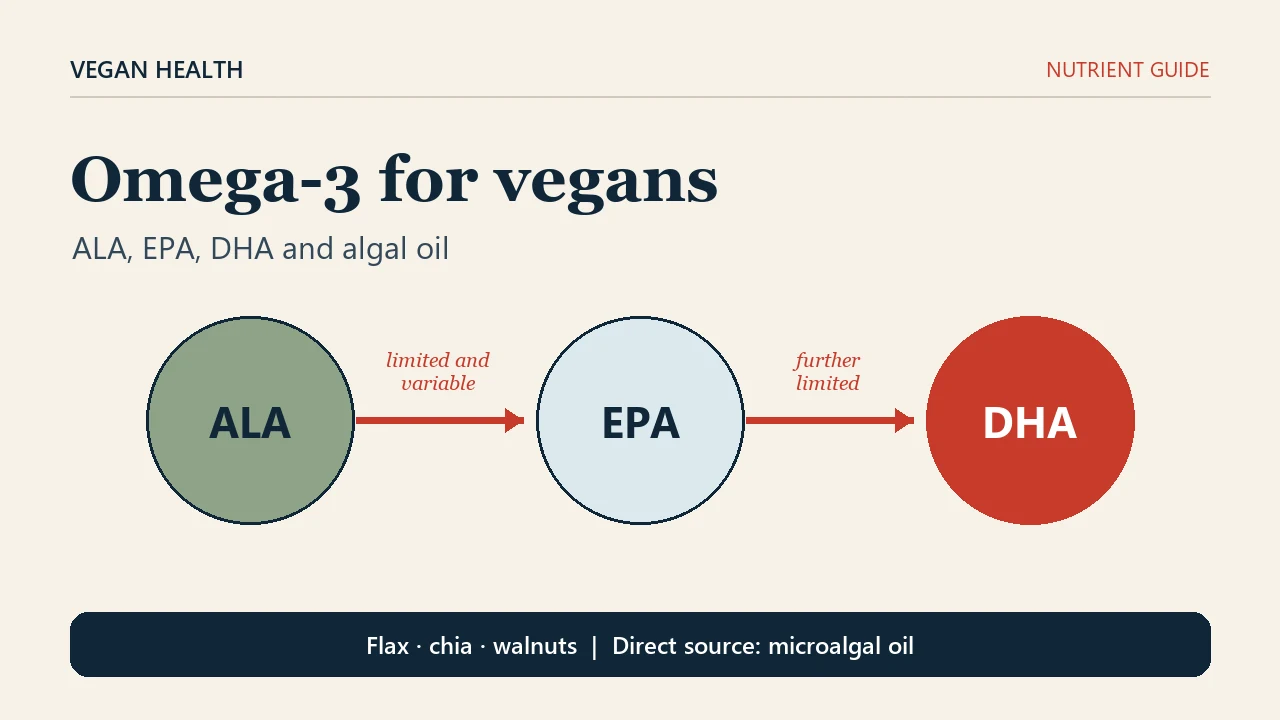
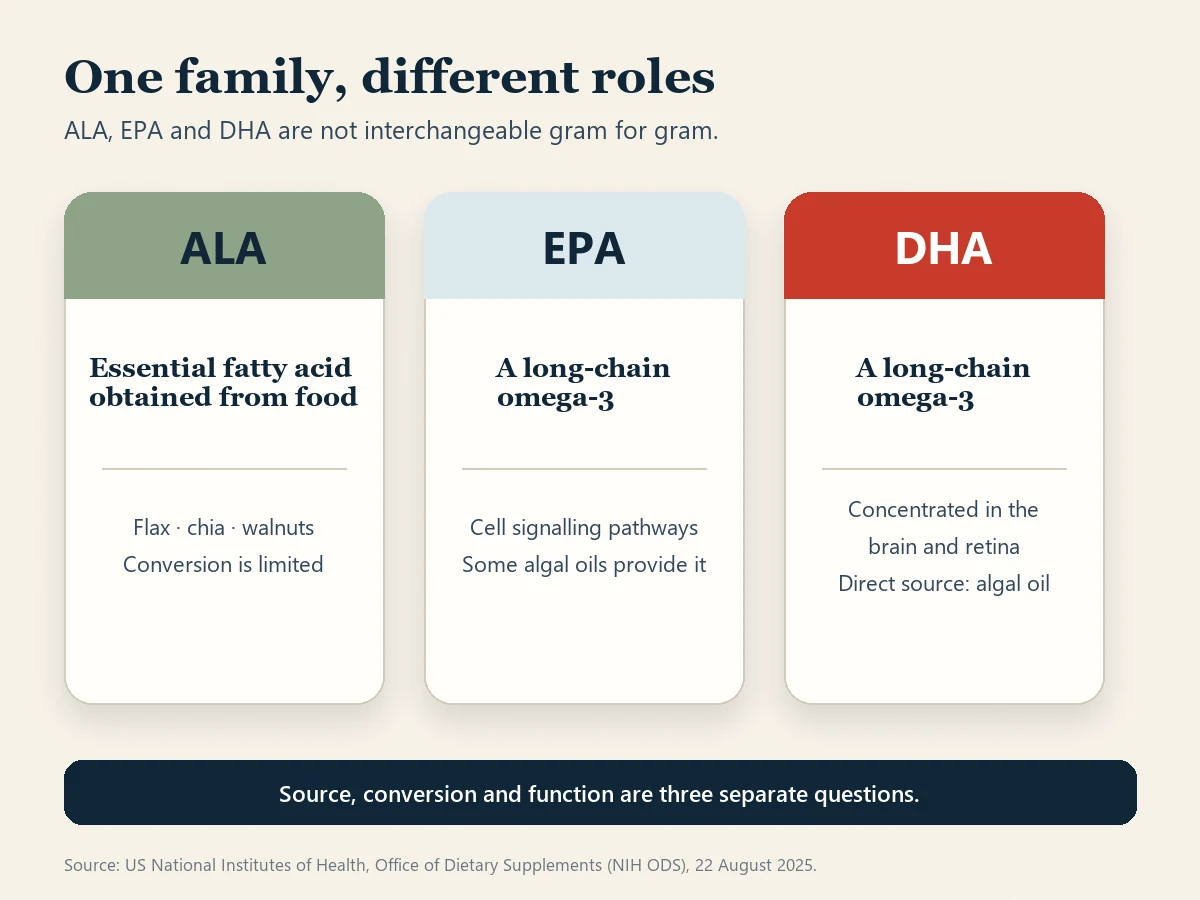
Omega-3 is a family, not a single nutrient. Alpha-linolenic acid (ALA) in flax, chia and walnuts belongs to the same family as eicosapentaenoic acid (EPA) and docosahexaenoic acid (DHA) in algal oil, but the three are not interchangeable gram for gram. A useful vegan plan answers two separate questions: Do you have a regular source of ALA, and—if you choose a direct source of EPA or DHA—how much does the daily serving of algal oil actually provide?
What is the difference between ALA, EPA and DHA?
ALA is an 18-carbon essential fatty acid. “Essential” means that the body cannot make enough of it and it must come from the diet. Flaxseed, chia, walnuts, canola oil and soybean oil are important plant sources.
EPA and DHA are longer-chain omega-3 fatty acids. DHA is concentrated in neural and retinal tissue; EPA and DHA are incorporated into cell membranes and used to produce signalling molecules. Fish are familiar food sources, but microalgae sit at the origin of the aquatic food chain. Oil grown from microalgae can therefore provide DHA—and, depending on the product, EPA—without using fish.
The body can convert ALA to EPA and then DHA. The US National Institutes of Health (NIH) describes this conversion, which occurs mainly in the liver, as very limited. Applying one percentage to every person is misleading: sex, genetics, the overall diet, metabolic state and the measurement method can all affect estimates. Grams of ALA in a food cannot be entered into a simple calculator to predict an equivalent personal dose of EPA or DHA.
How much omega-3 do adults need?
There is no single global number because authorities use different evidence frameworks. The US National Academies set an Adequate Intake for ALA of 1.6 g/day for adult men and 1.1 g/day for adult women. The figures are 1.4 g during pregnancy and 1.3 g during lactation. That system did not set a separate adult intake recommendation for EPA or DHA.
The European Food Safety Authority (EFSA) sets an Adequate Intake for ALA at 0.5% of energy and for combined EPA+DHA at 250 mg/day in adults. During pregnancy and lactation it adds 100–200 mg DHA to the adult EPA+DHA figure. These are population nutrition references for generally healthy people. They are not treatment doses or proof that every person should buy the same supplement.
How much ALA is in plant foods?
| Food and example serving | ALA | How to read it |
|---|---|---|
| Flaxseed oil, 1 tablespoon | 7.26 g | A concentrated source; follow storage and use-by instructions. |
| Chia seeds, 1 ounce (about 28 g) | 5.06 g | The serving is defined by weight; it is not interchangeable with “one spoonful.” |
| English walnuts, 1 ounce (about 28 g) | 2.57 g | They also provide energy and other fats, so use the amount in dietary context. |
| Whole flaxseed, 1 tablespoon | 2.35 g | The database figure is for whole seed; use the current label for a ground product if available. |
| Canola oil, 1 tablespoon | 1.28 g | The choice of everyday cooking oil can contribute to total ALA. |
ALA in a food does not guarantee that a specified amount of DHA will be produced from it. The opposite mistake is to dismiss ALA: it is an essential fatty acid and a regular food source remains a foundation of the plan. The useful distinction is not “flax versus algal oil.” The two answer different questions.
Do vegans actually have lower EPA and DHA status?
A systematic review published in 2026 included 45 studies. It found that vegetarian and especially vegan groups could have higher ALA intakes but lower EPA and DHA concentrations than omnivorous groups. The studies differed in dietary definitions, sample sizes, food records and biomarkers. The result therefore cannot be translated into a diagnosis of clinical deficiency in every vegan individual.
NIH also notes that there are no accepted EPA or DHA blood cut-offs below which visual, neural or immune function is known to become impaired. Plasma and serum fatty acids can reflect recent meals, whereas red-blood-cell measurements cover a longer period. The “omega-3 index” is used in research, but there is no universally accepted diagnostic range or requirement for routine screening of healthy adults.
A lower biomarker is a relevant dietary difference. On its own, it is not a disease diagnosis, an explanation for nonspecific symptoms or a universal supplement prescription.
What does algal oil change?
Microalgal oil provides DHA and, in some formulations, EPA without relying on conversion from ALA. In a randomized, double-blind, placebo-controlled crossover trial published online in 2022 and assigned to a 2023 journal volume, 116 adults received 250 mg/day of microalgal DHA or placebo for two five-week periods. The supplement increased serum DHA in vegan, lacto-ovo vegetarian and omnivorous participants; the increase was greatest in the vegan group.
The boundary of that result matters. The trial shows that 250 mg DHA can raise a biomarker. It does not by itself prove fewer heart attacks, less cognitive decline or a benefit for every clinical outcome. Other interventions have also found that algal DHA or DHA+EPA can raise blood levels, but doses, durations and participants are not identical.
Algal oil is not simply “plant fish oil.” Its source is microalgae. Some products contain DHA only; others include EPA. Check the capsule separately: an oil can be suitable for vegans while the shell contains gelatin. The current vegan claim, capsule material and ingredient list need to agree.
How do you read an algal-oil label?
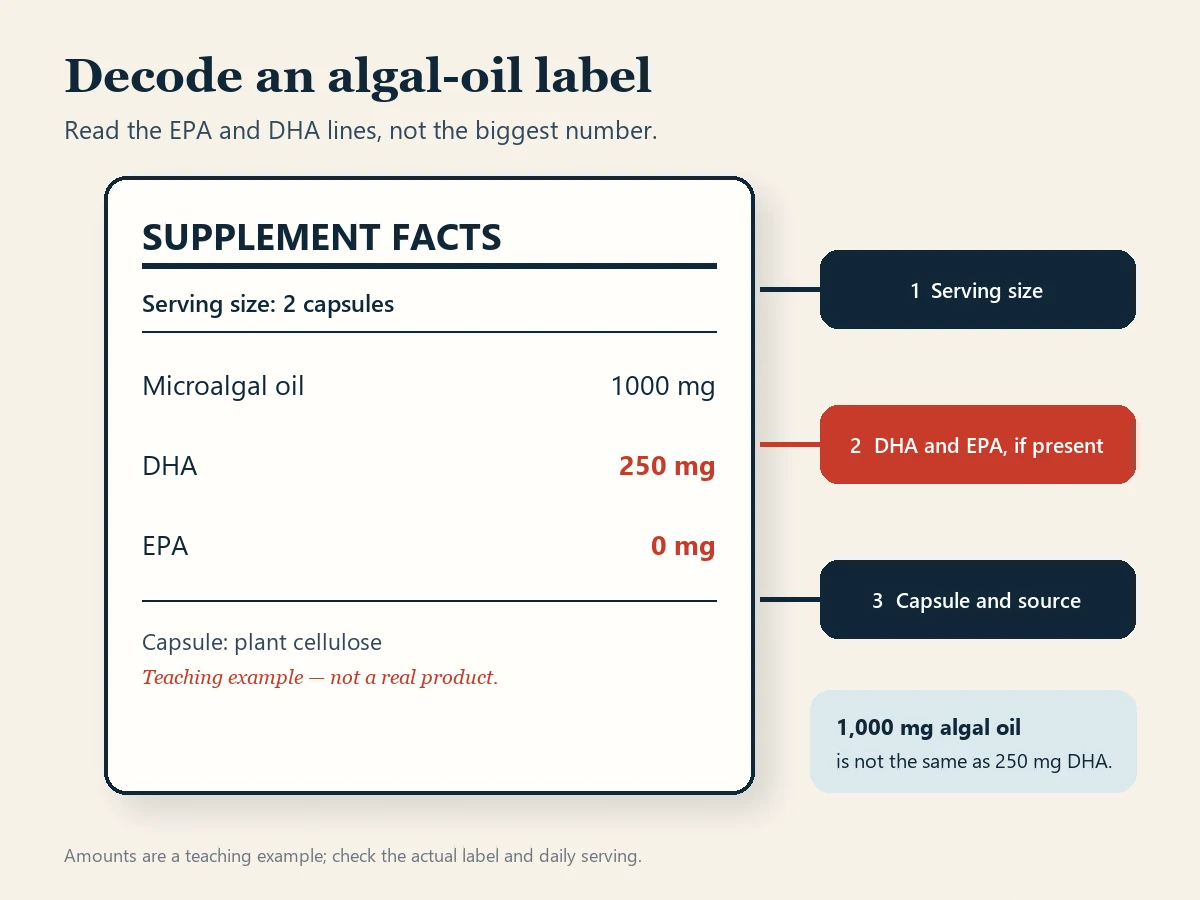
- Find the serving size. Are the amounts for one capsule or a two-capsule daily serving?
- Read DHA and EPA separately. “1,000 mg algal oil” can describe the weight of the whole oil, not 1,000 mg of DHA.
- Check the total yourself. If a serving lists 250 mg DHA and 125 mg EPA, it provides 375 mg of stated EPA+DHA.
- Check the source and capsule. A species of microalga may be named; the shell might contain plant cellulose, starch or gelatin.
- Read storage instructions. Oils can deteriorate with heat, light and oxygen. Follow directions for closing, refrigeration or use after opening.
Front-of-pack phrases such as “high strength,” “brain support” or “pure omega-3” do not quantify the active fatty acids. Compare products using EPA and DHA per daily serving, capsule count and price together. This is similar to separating the per-100-ml and real-portion columns in our guide to fortified-food labels.
Does every vegan need an algal-oil supplement?
Current evidence does not support writing one supplement prescription for all vegan adults. A regular source of the essential fatty acid ALA is one part of the question. Authorities also differ in how they frame EPA and DHA intakes. Direct algal oil is a measurable option for people who choose to obtain EPA or DHA, but the decision belongs in the context of the whole diet, life stage, health status, medicines and preferences.
Pregnancy and lactation, infancy and childhood, treatment of high triglycerides, cardiovascular disease, arrhythmia and bleeding risk move beyond a general adult article. EFSA specifies additional DHA during pregnancy and lactation, but the product, dose and overall plan need individual assessment by an appropriately qualified professional.
Where are the safety boundaries?
A safety ceiling is not an intake target. EFSA and FDA have concluded that EPA+DHA supplements providing up to about 5 g/day are generally safe when used as recommended; that figure is not a goal for routine self-supplementation. Two large trials using 4 g/day for several years found a small increase in atrial fibrillation among people with cardiovascular disease or high cardiovascular risk. Prescription gram-level omega-3 treatment for high triglycerides is a different decision from choosing an over-the-counter supplement.
High-dose omega-3s can affect platelet function. Research has not consistently shown a clinically important increase in bleeding at usual doses, but people using warfarin or similar anticoagulants should discuss a new product with their clinician or pharmacist and continue any required monitoring. Do not self-start high doses when surgery, a bleeding disorder, arrhythmia or multiple medicines are involved.
Common adverse effects are usually mild and include unpleasant taste, reflux, nausea, abdominal discomfort and diarrhoea. “No fishy smell” does not prove freshness; the use-by date, package integrity and storage instructions are more useful.
Frequently asked questions
Are flax or chia enough on their own?
Flax and chia are valuable ALA sources, and algal oil does not replace the need for ALA. They do not, however, provide meaningful direct EPA or DHA. The answer to “enough” depends on which fatty acid and which reference framework you mean.
Does lowering omega-6 guarantee better conversion?
Omega-6 and omega-3 pathways share some enzymes, but a single ideal omega-6:omega-3 ratio cannot calculate personal conversion. Avoid removing seeds, nuts and vegetable oils as a category. Secure a regular ALA source and assess overall dietary quality.
Can a DHA-only product work if it contains no EPA?
DHA-containing algal oil can raise DHA biomarkers, and some interventions have reported a smaller rise in EPA. That does not make DHA-only and DHA+EPA products identical. Read what the product provides and follow individual clinical advice when there is a specific medical purpose.
Should I have an omega-3 blood test?
Most clinicians do not routinely assess omega-3 status. Tests can describe recent or longer-term fatty-acid status, but there are no universally accepted diagnostic cut-offs for everyone. Do not interpret an isolated result as a deficiency without clinical context.
A 30-second vegan omega-3 check
- Name your ALA source: Is flax, chia, walnuts, canola or another verified source used regularly?
- See the serving: Do not confuse spoonfuls, grams and the amount actually eaten.
- If you use algal oil, read the active lines: How many milligrams of DHA and EPA are in the daily serving?
- Complete the vegan check: Verify the capsule shell and other ingredients as well as the source of the oil.
- Separate special circumstances: Seek individual advice for pregnancy or breastfeeding, childhood, cardiovascular disease, high triglycerides, bleeding risk or relevant medicines.
Place omega-3 planning inside the wider dietary pattern. Our balanced vegan plate guide covers meal structure, while the guides to iodine and vitamin B12 address other nutrients that need deliberate planning.
Sources
- NIH Office of Dietary Supplements. Omega-3 Fatty Acids: Fact Sheet for Health Professionals. Updated 22 August 2025.
- European Food Safety Authority. Dietary Reference Values for nutrients: Summary report.
- Chamorro R, et al. Vegetarian Diets and Their Effect on n-3 Polyunsaturated Fatty Acids Status in Humans: Systematic Review. Lipids. 2026;61(1):29–53.
- García-Maldonado E, et al. Changes in fatty acid levels after consumption of a novel docosahexaenoic supplement from algae: a crossover randomized controlled trial in omnivorous, lacto-ovo vegetarians and vegans. Eur J Nutr. 2023;62(4):1691–1705.
- Sarter B, et al. Blood docosahexaenoic acid and eicosapentaenoic acid in vegans: associations with age and gender and effects of an algal-derived omega-3 fatty acid supplement. Clin Nutr. 2015;34(2):212–218.
- Arterburn LM, et al. Algal-oil capsules and cooked salmon: nutritionally equivalent sources of docosahexaenoic acid. J Am Diet Assoc. 2008;108(7):1204–1209.
Editor: Anıl Güler, Pharmacist
Scientific review date: 2 September 2026