How to Read a Fortified Food Label
“Fortified” sounds reassuring, but it tells you only that one or more nutrients were added during manufacturing. It does not tell you whether the amount is useful, whether the product is balanced overall, or whether it meets your personal needs. Two products can both carry vitamin claims while differing substantially in vitamin B12, vitamin D, calcium, iodine, protein, sugars and salt.
This guide offers a practical way to read fortified-food labels, with plant-based drinks as the main example. The same method also works for fortified breakfast cereals, nutritional yeast, yoghurts and other packaged foods.
What does “fortified” actually mean?
A fortified food has one or more vitamins or minerals added to it. The nutrient may be added to replace something lost during processing, to increase the food’s nutritional value, or to make its nutrient profile closer to that of a food it commonly replaces. The exact legal language and mandatory label format vary between countries.
Fortification is useful, particularly for nutrients that are difficult to obtain reliably from an unfortified vegan diet. It is not, however, a complete quality seal. A product may contain added calcium while being low in protein; another may supply vitamin B12 but also contain substantial added sugar. “Fortified” therefore begins the assessment rather than ending it.
Start with the basis of the numbers
Use 100 g or 100 ml to compare products
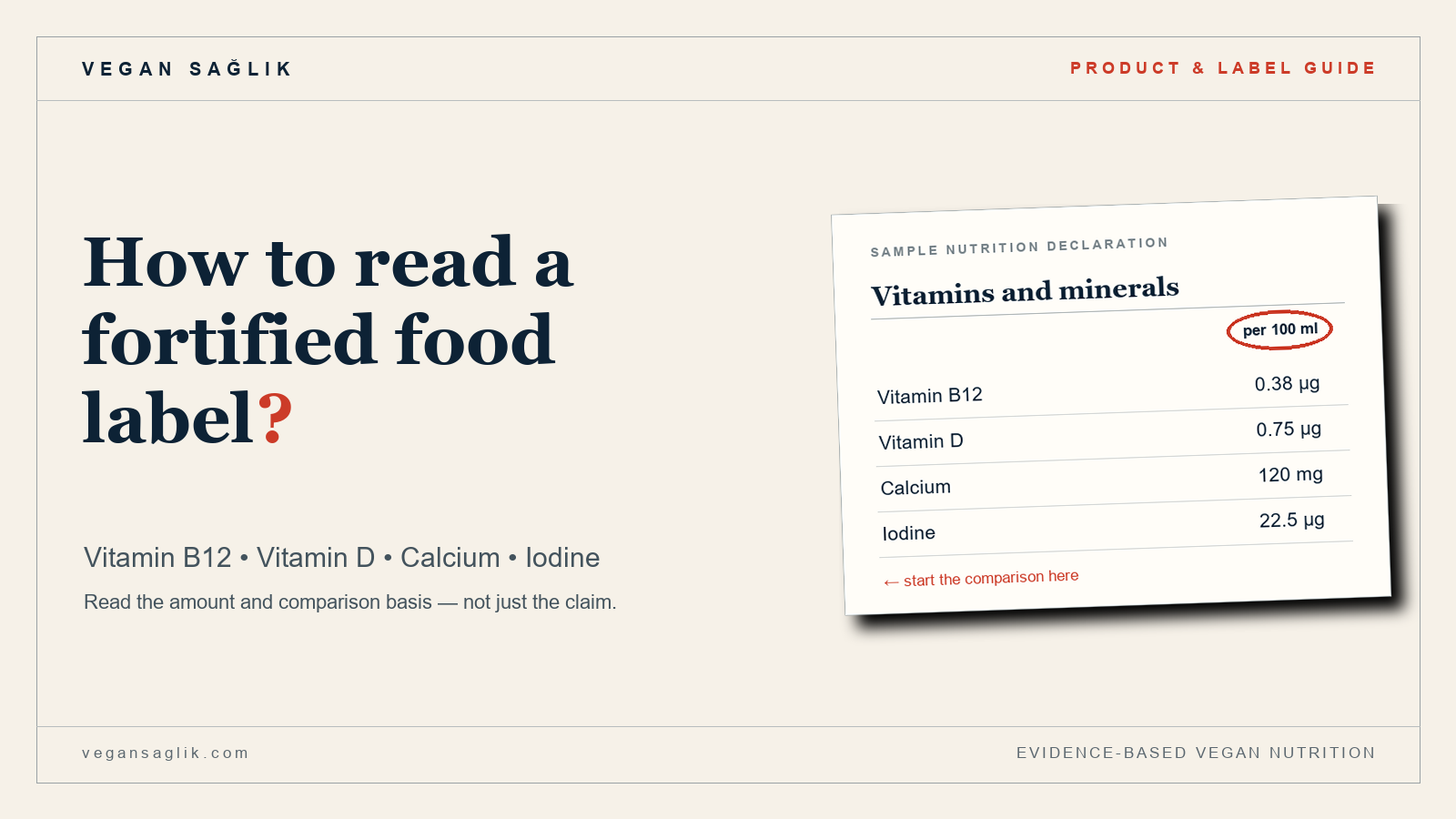
When two labels provide values per 100 g or 100 ml, use that column first. It puts the products on the same scale and prevents a smaller stated serving from making one product appear richer or lighter than another.
On packaged foods sold in Türkiye, the mandatory nutrition declaration is generally expressed per 100 g or 100 ml; information per portion or consumption unit may be added. Labels governed by European Union rules use the same per-100 g or per-100 ml basis. Other countries may organise labels differently, so always check the heading above the numbers.
Use the portion column to estimate what you consume
After comparing products, translate the result into your actual portion. If a drink contains 120 mg calcium per 100 ml, a 250 ml glass provides 300 mg. If the label gives values for a 200 ml serving but your glass holds 300 ml, the listed amounts need to be multiplied by 1.5.
A serving size is the quantity to which the label numbers apply; it is not necessarily a recommendation of how much you personally should eat or drink. Also check the number of servings in a bottle or package. Nutrient and energy values must be adjusted if you consume more or less than the stated serving.
How should you use %DV or %RI?
Labels may show a percentage Daily Value (%DV), Reference Intake (%RI) or a comparable reference percentage. This indicates how much a stated quantity contributes to a general population reference value. It is useful for comparing products and seeing whether a serving contributes a little or a lot.
It is not a measure of your nutritional status, a personalised prescription or proof that you have met your individual requirement. Needs can differ with age, pregnancy, medical conditions, medication use and other factors. Reference values also differ between regulatory systems, so percentages on products from different countries may not be directly interchangeable.
For micronutrients, read the absolute amount — milligrams (mg) or micrograms (µg) — together with the percentage. Pay particular attention to the unit: 1 milligram equals 1,000 micrograms.
Four nutrients worth checking on a vegan label
Vitamin B12: look for an actual amount
Unfortified plant foods do not provide a reliable source of vitamin B12. A product being vegan, organic or marketed as “natural” does not mean it contains B12. Look for “vitamin B12” or a named cobalamin in the ingredient list and, more importantly, an amount in micrograms in the nutrition panel.
Fortified foods can contribute to a reliable B12 plan, but the usefulness of one product depends on the amount per serving and how consistently it is consumed. Do not assume that an occasional fortified food automatically replaces a deliberately planned B12 source. For the wider evidence and supplementation principles, see our vitamin B12 guide for vegans.
Vitamin D: do not infer it from the product type
Many plant-based drinks and breakfast cereals are fortified with vitamin D, but not all are. Check the actual amount on the current package. Labels may use micrograms, international units (IU), or both; compare products only after confirming that you are using the same unit.
Vitamin D may be listed as D2 or D3. The term “D3” alone does not identify whether its manufacturing source is suitable for vegans. If origin matters to you, look for a clear vegan statement or certification, or ask the manufacturer rather than guessing from the vitamin name.
Calcium: quantity matters, but the label cannot show everything
Calcium-fortified plant-based drinks and juices, along with tofu made with calcium salts, can make a meaningful contribution to calcium intake. Compare the amount in milligrams per 100 ml and then calculate the amount you actually consume. A large percentage claim on the front of the package is less informative than the number in the nutrition declaration.
The label reports how much calcium the product contains, not exactly how much a particular person will absorb. Calcium absorption varies with the form used, the food matrix, vitamin D status and individual factors. This is another reason not to convert a label number into a precise “absorbed dose.” Follow any storage and preparation instructions on the package.
Iodine: often absent and easy to overlook
Iodine deserves a separate check because an otherwise well-fortified product may contain calcium, B12 and vitamin D but no iodine. Vegans who consume little or no dairy, seafood and eggs may have fewer dependable dietary iodine sources.
Look for iodine in micrograms and for an iodine-containing ingredient, such as potassium iodide or potassium iodate. Do not assume that every plant-based drink contains iodine. Likewise, sea salt, Himalayan salt and other speciality salts are not automatically iodised; the label should state whether iodine has been added.
A fortified product still needs a whole-label check
Protein
Added micronutrients do not compensate for very low protein when a product is being used in place of a meaningful protein source. This is particularly relevant to plant-based drinks: protein content can differ substantially between products. In the UK assessment cited below, soy drinks were closer to cow’s milk in protein quantity and quality than almond or oat drinks. Compare grams per 100 ml rather than relying on the plant pictured on the package.
Sugars
Check both the sugar value and the ingredient list. Depending on the country, the panel may distinguish total sugars from added or free sugars. A product can be fortified and sweetened at the same time. When comparing similar everyday products, an unsweetened option is usually the clearer starting point.
Salt, saturated fat and energy
These values still matter. Fortification does not neutralise a high salt or saturated-fat content, and a very low-energy product may not serve the same dietary role as the food it replaces. Judge the product according to how you intend to use it and the rest of your diet.
Do not rely on front-of-pack claims alone
Statements such as “with calcium,” “source of B12” or “supports immunity” are not substitutes for the nutrition panel. Terms such as “source of” and “high in” can have regulated definitions, but those definitions vary by jurisdiction. Read the actual amount and the basis on which it is stated.
Also distinguish nutrient content from ingredient origin. A vitamin may be present at a useful level while its source remains unclear from the label. Conversely, a vegan certification can help with ingredient-origin questions but does not guarantee that the product contains B12, iodine or any other particular nutrient.
A practical comparison sequence
- Confirm the comparison basis: put both products on a per-100 g or per-100 ml basis.
- Read absolute nutrient amounts: check B12, vitamin D, calcium and iodine in mg or µg.
- Calculate your real portion: multiply or divide the label values according to what you actually consume.
- Check the wider profile: compare protein, sugars, saturated fat, salt and energy.
- Read the ingredient list: confirm that nutrients are added and examine sweeteners, oils and the source information that matters to you.
- Check the package in front of you: formulations change, and online product databases can lag behind the current label.
For plant-based drinks, our Plant Drink Label Comparator can place up to three products on the same scale. Its database results should still be checked against the current package.
Sources
- Republic of Türkiye Ministry of Agriculture and Forestry. Turkish Food Codex labelling and consumer information regulation.
- European Parliament and Council. Regulation (EU) No 1169/2011 on food information to consumers.
- US Food and Drug Administration. How to Understand and Use the Nutrition Facts Label.
- UK Scientific Advisory Committee on Nutrition and Committee on Toxicity. Assessment of the health benefits and risks of consuming plant-based drinks, 2025.
- NIH Office of Dietary Supplements. Vitamin B12: Fact Sheet for Health Professionals.
- NIH Office of Dietary Supplements. Vitamin D: Fact Sheet for Health Professionals.
- NIH Office of Dietary Supplements. Calcium: Fact Sheet for Health Professionals.
- NIH Office of Dietary Supplements. Iodine: Fact Sheet for Health Professionals.
Editor: Anıl Güler, Pharmacist
Scientific review date: 24 August 2026