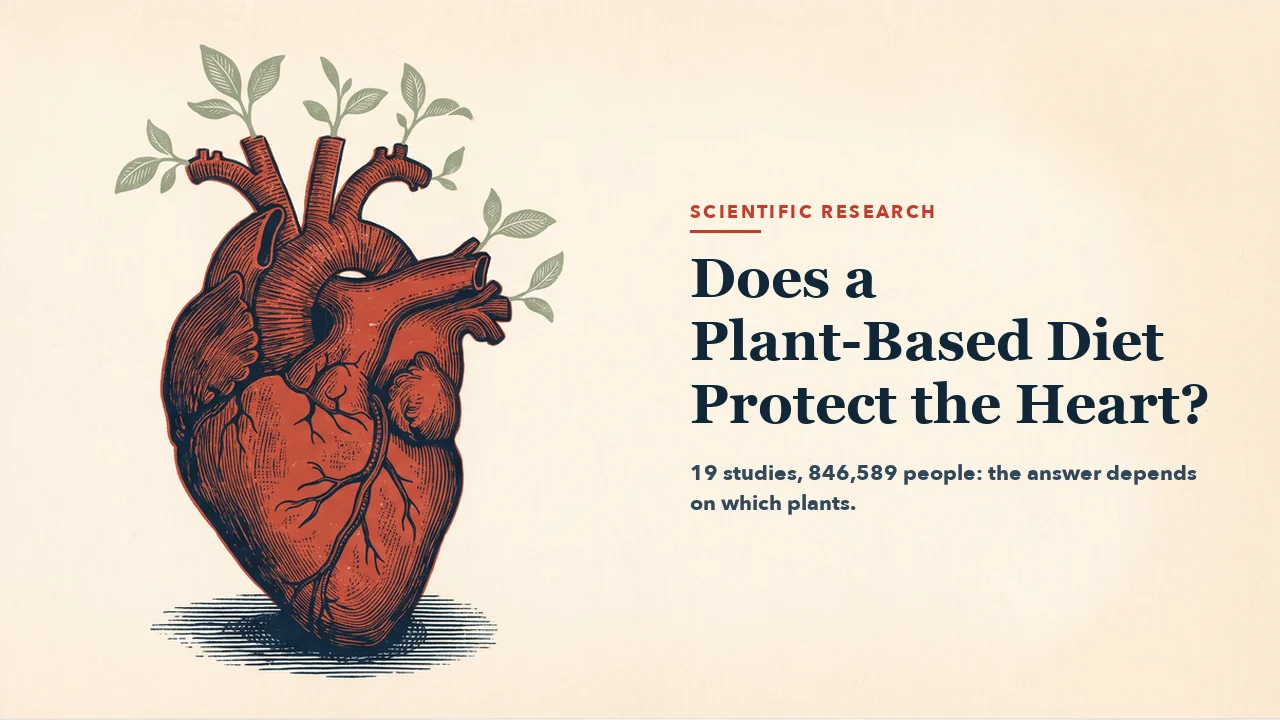
Does a Plant-Based Diet Protect the Heart? It Depends on Which Plants
Today, 29 September, is World Heart Day. Cardiovascular disease is still the leading cause of death worldwide: the World Health Organization estimates that 19.8 million people died from it in 2022, about 32% of all deaths, and that 85% of those deaths were due to heart attack and stroke.
So it is a good day to ask a plain question: does eating more plants protect the heart? A meta-analysis published in Nutrients on 25 August 2026 pooled 19 prospective cohort studies — 22 articles, 846,589 people and 139,652 cases — to answer it. The short answer is yes, but with a condition that matters more than the headline: it depends on which plants.
What was measured?
Most of these studies did not compare vegans with meat eaters. They scored everyone’s diet on a plant-based diet index, developed by Harvard researchers in 2016. In the overall index, plant foods received positive scores and animal foods received reverse scores. Two further versions split the plant foods in two:
- Healthful plant-based index: whole grains, fruits, vegetables, nuts, legumes, vegetable oils and tea/coffee score up; fruit juices, sweetened beverages, refined grains, potatoes, sweets/desserts and animal foods score down.
- Unhealthful plant-based index: the reverse — the less healthy plant foods score up, while healthy plant foods and animal foods score down.
One thing to keep in mind throughout: a high score is not the same as a vegan diet. The index rewards eating more plant foods and fewer animal foods; it does not require eating none. The meta-analysis compared the highest adherence with the lowest.
The results
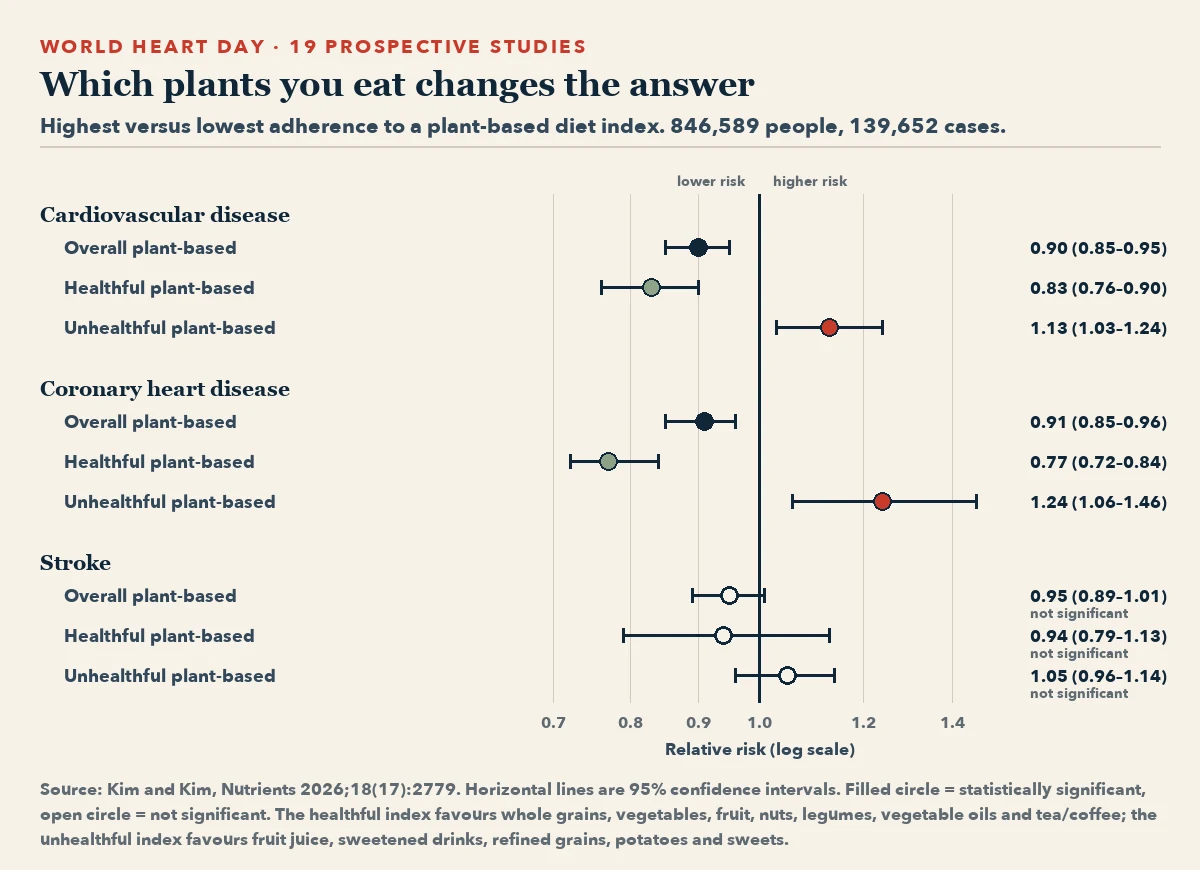
For overall plant-based eating, the highest group had a 10% lower risk of cardiovascular disease (relative risk 0.90, 95% CI 0.85–0.95) and a 9% lower risk of coronary heart disease (0.91).
The healthful version did better: 17% lower risk of cardiovascular disease (0.83, 0.76–0.90) and 23% lower risk of coronary heart disease (0.77, 0.72–0.84).
The unhealthful version went the other way: 13% higher risk of cardiovascular disease (1.13, 1.03–1.24) and 24% higher risk of coronary heart disease (1.24, 1.06–1.46).
That is the most useful finding in the paper. A diet can be “plant-based” and still raise risk, if its plants come mostly as sugary drinks, juice, white bread and desserts. The authors point to one likely reason: the unhealthful pattern contains more sugar.
A single US cohort published in August 2026, REGARDS, found the same benefit for the healthful index but mixed results for the overall index; we look at it in Healthy plant-based eating and the heart: what one US study found.
Stroke is a different story
None of the three indices showed a significant link with stroke (overall 0.95, 0.89–1.01; healthful 0.94; unhealthful 1.05). Only four articles reported stroke, so the evidence here is thin.
For vegetarians specifically, the best-known data point comes from EPIC-Oxford in the UK, published in the BMJ in 2019. Over 18.1 years of follow-up, vegetarians (vegans included) had 22% lower rates of ischaemic heart disease than meat eaters — about 10 fewer cases per 1,000 people over 10 years — but 20% higher rates of total stroke, about three more cases per 1,000 over 10 years, mostly due to haemorrhagic stroke. It is a single cohort, and it is one reason to be careful before saying a plant-based diet protects the whole cardiovascular system.
What about vegetarians versus meat eaters?
Four of the articles compared vegetarians directly with meat eaters. Pooled, the relative risk for cardiovascular disease was 0.82, with a 95% confidence interval of 0.66–1.02. Because the interval crosses 1, this is not a statistically significant result, and the four studies disagreed strongly with each other (heterogeneity I² = 85.5%). So this meta-analysis does not show that simply being vegetarian lowers cardiovascular risk. Its clearer message is about diet quality.
What to do with this
The healthful index is, in effect, a shopping list. If you eat plant-based, or are moving that way, the evidence points to building meals around:
- whole grains instead of refined grains,
- legumes and nuts,
- vegetables and whole fruit rather than fruit juice,
- vegetable oils,
and keeping sweetened drinks, sweets and desserts occasional. This fits what we found in our piece on whether going vegan always lowers cholesterol: the type of fat and food in the diet changes the result. It also connects with the question of ultra-processed food on a vegan diet, where “processed” and “unhealthy” are not always the same thing.
Limits
- These are observational studies. They show associations, not proof of cause. Most adjusted for age, smoking, physical activity, alcohol and body mass index, but people who eat well may differ in other ways too.
- Diet was self-reported, and may not reflect changes in long-term habits.
- The studies did not agree closely. Heterogeneity was 48.9% for the overall index, 67.0% for the healthful and 71.4% for the unhealthful.
- Most cohorts were American. For the overall index, 9 of the 13 cohorts were from the U.S.; which foods count as “healthy” can differ between cultures.
- Coronary heart disease and stroke had few studies, and the authors themselves advise caution there.
With those limits in mind, the pattern across these studies is consistent: the more of a diet that came from whole plant foods, the lower the heart risk — and the more of it that came from sugary drinks, refined grains and sweets, the higher.
References
- Kim Y, Kim Y. A Plant-Based Diet and Cardiovascular Disease, Coronary Heart Disease, and Stroke: A Systematic Review and Meta-Analysis of Prospective Cohort Studies. Nutrients. 2026;18(17):2779. doi:10.3390/nu18172779.
- Satija A, Bhupathiraju SN, Rimm EB, et al. Plant-Based Dietary Patterns and Incidence of Type 2 Diabetes in US Men and Women: Results from Three Prospective Cohort Studies. PLoS Med. 2016;13(6):e1002039. doi:10.1371/journal.pmed.1002039.
- Satija A, Bhupathiraju SN, Spiegelman D, et al. Healthful and Unhealthful Plant-Based Diets and the Risk of Coronary Heart Disease in U.S. Adults. J Am Coll Cardiol. 2017;70(4):411-422. doi:10.1016/j.jacc.2017.05.047.
- Tong TYN, Appleby PN, Bradbury KE, et al. Risks of ischaemic heart disease and stroke in meat eaters, fish eaters, and vegetarians over 18 years of follow-up: results from the prospective EPIC-Oxford study. BMJ. 2019;366:l4897. doi:10.1136/bmj.l4897.
- World Health Organization. Cardiovascular diseases (CVDs). Fact sheet, 31 July 2025. Accessed 29 September 2026.
- World Heart Federation. World Heart Day. Accessed 29 September 2026.
Editor: Anıl Güler, Pharmacist
Last scientific review: 29 September 2026