Does Going Vegan Always Lower Cholesterol?
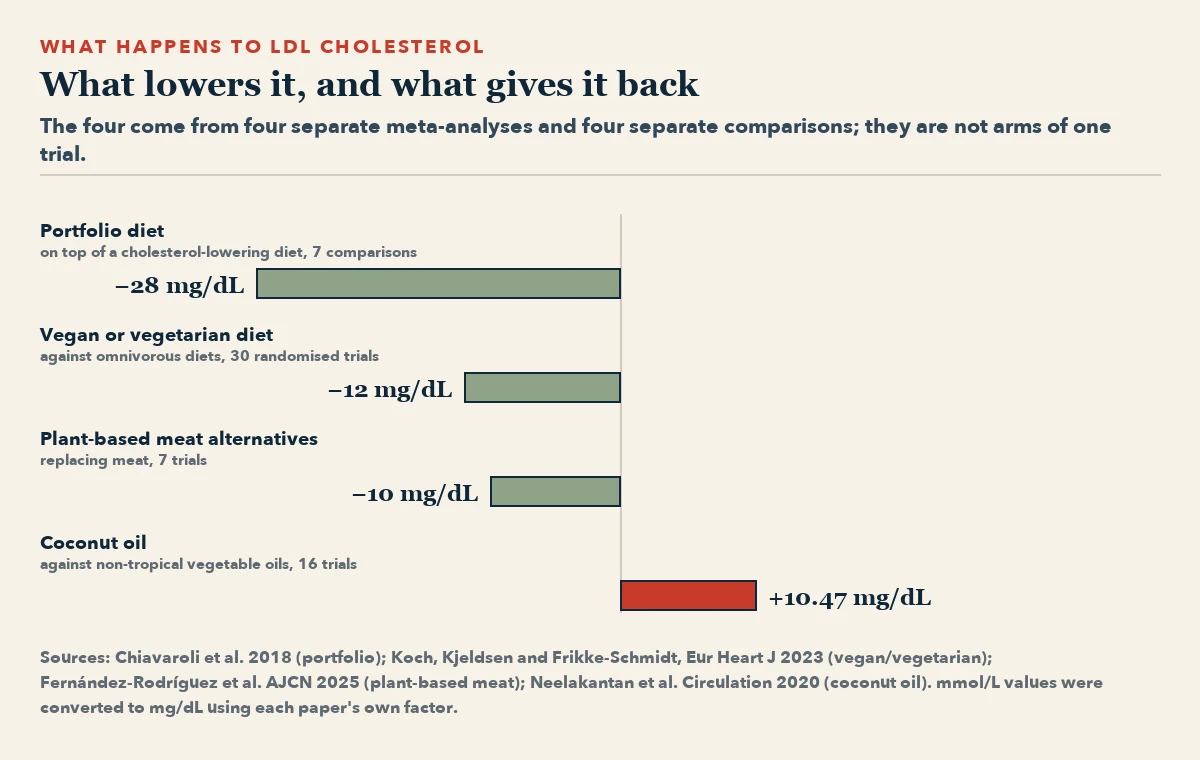
On average, switching to a vegan or vegetarian diet lowers cholesterol, but by less than many expect, and a trial average cannot promise the same result for every individual. The best answer to “always?” comes from a 2023 meta-analysis in the European Heart Journal that pooled 30 randomised trials. On average, LDL cholesterol fell by 0.30 mmol/L, about 12 mg/dL, or 10 per cent. The same paper also shows who gets less than that, and why.
What the trials measured
Researchers at Copenhagen University Hospital collected randomised controlled trials published between 1982 and 2022 that put adults on a vegetarian or vegan diet and compared them with people eating an omnivorous diet. Thirty trials met the criteria, with 2,372 participants in total. Half tested a vegan diet (15 trials), and half a vegetarian one. Trials lasted from ten days to five years, with a mean of 29 weeks. Most participants were overweight or had a condition such as type 2 diabetes or heart disease. Only five trials enrolled solely healthy people with a mean BMI under 30.
How much it fell
| Blood marker | Change vs. omnivorous diet | Relative change |
|---|---|---|
| LDL cholesterol | −0.30 mmol/L (about −12 mg/dL) | −10% |
| Total cholesterol | −0.34 mmol/L (about −13 mg/dL) | −7% |
| Apolipoprotein B | −12.92 mg/dL | −14% |
| Triglycerides | no significant change | — |
Apolipoprotein B (apoB) is the main protein on LDL and on the other particles that can carry cholesterol into an artery wall, so its blood level estimates how many of those particles there are, rather than how much cholesterol they hold. Its fall of 14 per cent points the same way as LDL. The authors warn that it comes from only six trials, two of which combined diet with other lifestyle changes.
Does a drop of 12 mg/dL matter? A European Atherosclerosis Society consensus statement, drawing on genetic studies, cohort studies and drug trials involving more than 2 million people, concluded that LDL causes atherosclerotic cardiovascular disease. Lowering it reduces risk in proportion to how much it falls and for how long. So a modest reduction kept for decades likely counts for more than the same reduction kept for a few weeks.
Why it falls
The authors point to the make-up of a plant-based diet. It is usually lower in saturated fat, dietary cholesterol and total fat, and higher in polyunsaturated fat. The polyunsaturated fat that lowers LDL is omega-6, especially linoleic acid, which makes the liver produce more of the receptors that pull LDL out of the blood. Omega-3 fats, the paper notes, have no significant effect on LDL.
Could weight loss explain the result? The authors think not: weight loss usually lowers triglycerides, and triglycerides did not change.
The mechanism explains why “vegan” alone guarantees nothing. What matters is the fat on the plate, not the absence of meat.
Who sees less of the effect
The pooled result is an average, and the trials disagreed with each other more than chance would explain (heterogeneity of 74 per cent for LDL). The subgroup analyses show where the effect was smaller:
- People whose LDL was already low. Trials where baseline LDL was at or below 2.8 mmol/L (about 108 mg/dL) saw a smaller fall than trials that started higher.
- People already on cholesterol-lowering drugs. The effect was smaller in trials that included treated participants. The authors’ explanation is that these drugs already increase the same liver receptors, leaving less room for the diet. The fall remained significant in both groups.
- People with obesity. In this group total cholesterol fell less. The authors suggest the body makes more of its own cholesterol in obesity, so dietary changes reach less of it.
- In larger and newer trials. Trials with fewer than 80 participants, and trials published before 2005, reported bigger falls. Tests for publication bias found that small trials with large effects are over-represented. The true average may therefore be somewhat smaller than 10 per cent.
Age, continent, trial length, health status and study design made no significant difference. Neither did the choice between a vegetarian and a vegan diet.
When it falls less, or not at all
When the fat is coconut oil. A 2020 meta-analysis in Circulation pooled 16 trials and found that coconut oil raised LDL by 10.47 mg/dL compared with non-tropical vegetable oils. That is an effect of similar size to the average vegan-diet benefit, in the opposite direction, although the two were measured against different comparisons. A vegan diet can be built around coconut oil, and the ingredient list is where you find out.
When the effect is expected to last forever. The authors cite earlier studies in which the effect on LDL halved after a few months, probably because people drifted from the diet. In their own data they did not see the effect weaken in trials longer than three months, but most trials still lasted less than a year.
What about plant-based meat?
It is not the obvious culprit. A 2025 meta-analysis in the American Journal of Clinical Nutrition covered 7 trials and 369 adults without cardiovascular disease and found that replacing meat with plant-based meat alternatives lowered LDL by 0.25 mmol/L (about 10 mg/dL). The trials lasted eight weeks or less, and the authors say longer studies are needed. Until then, the saturated fat on the label is what to check.
If you want a larger drop
The Portfolio diet adds four groups of foods with known cholesterol-lowering effects to a plant-based pattern: nuts, plant protein such as soy, viscous fibre such as oats and barley, and plant sterols. A 2018 meta-analysis of 7 trial comparisons in 439 people with high cholesterol found that it lowered LDL by about 17 per cent (0.73 mmol/L, about 28 mg/dL). That was on top of an existing cholesterol-lowering diet (the NCEP Step II diet), and the certainty of the evidence for LDL was rated high. The comparison with the roughly 10 per cent of the European Heart Journal analysis is indirect, because the control diets and participants differed, but it suggests that what you add matters as much as what you remove.
In practice, that means:
- Choose the fats. Use liquid vegetable oils, nuts and seeds for most of your fat, and keep coconut oil to a minimum.
- Add the Portfolio foods rather than just removing animal foods: a handful of nuts, soy foods such as tofu and soy milk, and oats or barley.
- Measure it. The paper notes that blood lipids settle about three to four weeks after a diet change. A lipid test taken earlier than that shows a moving target. Your own result is the one that counts: if LDL stays high on retesting, diet alone may not be enough. Our guide to blood tests for vegans covers the rest of the panel.
- Do not stop prescribed medication on your own. The authors state that statins lower LDL more than a plant-based diet does, and that the two do not exclude each other. They expect the combination to work better than either alone. Any change to a prescription is a conversation with your doctor.
Limits of the evidence
None of the trials blinded participants to their diet. Thirteen of the thirty did not describe how participants were randomised. In most trials, people reported their own food intake. The apoB finding rests on six trials. Tests pointed to publication bias. The analysis did not look at HDL, and it cannot tell us whether the same fall is seen in someone who has already been vegan for years. It measured blood fats, not heart attacks: the link to cardiovascular events comes from the separate body of evidence on LDL itself. Our earlier piece on how a vegan diet lowered dietary energy density shows another route by which the same diet can affect heart health.
Sources
- Koch CA, Kjeldsen EW, Frikke-Schmidt R. Vegetarian or vegan diets and blood lipids: a meta-analysis of randomized trials. Eur Heart J. 2023;44(28):2609-2622. doi:10.1093/eurheartj/ehad211.
- Ference BA, Ginsberg HN, Graham I, et al. Low-density lipoproteins cause atherosclerotic cardiovascular disease. 1. Evidence from genetic, epidemiologic, and clinical studies. A consensus statement from the European Atherosclerosis Society Consensus Panel. Eur Heart J. 2017;38(32):2459-2472. doi:10.1093/eurheartj/ehx144.
- Neelakantan N, Seah JYH, van Dam RM. The effect of coconut oil consumption on cardiovascular risk factors: a systematic review and meta-analysis of clinical trials. Circulation. 2020;141(10):803-814. doi:10.1161/CIRCULATIONAHA.119.043052.
- Fernández-Rodríguez R, Bizzozero-Peroni B, Díaz-Goñi V, et al. Plant-based meat alternatives and cardiometabolic health: a systematic review and meta-analysis. Am J Clin Nutr. 2025;121(2):274-283. doi:10.1016/j.ajcnut.2024.12.002.
- Chiavaroli L, Nishi SK, Khan TA, et al. Portfolio dietary pattern and cardiovascular disease: a systematic review and meta-analysis of controlled trials. Prog Cardiovasc Dis. 2018;61(1):43-53. doi:10.1016/j.pcad.2018.05.004.
Editor: Anıl Güler, Pharmacist
Last scientific review: 28 September 2026