Seitan: Protein Value, Lysine, Sodium and the Coeliac Warning
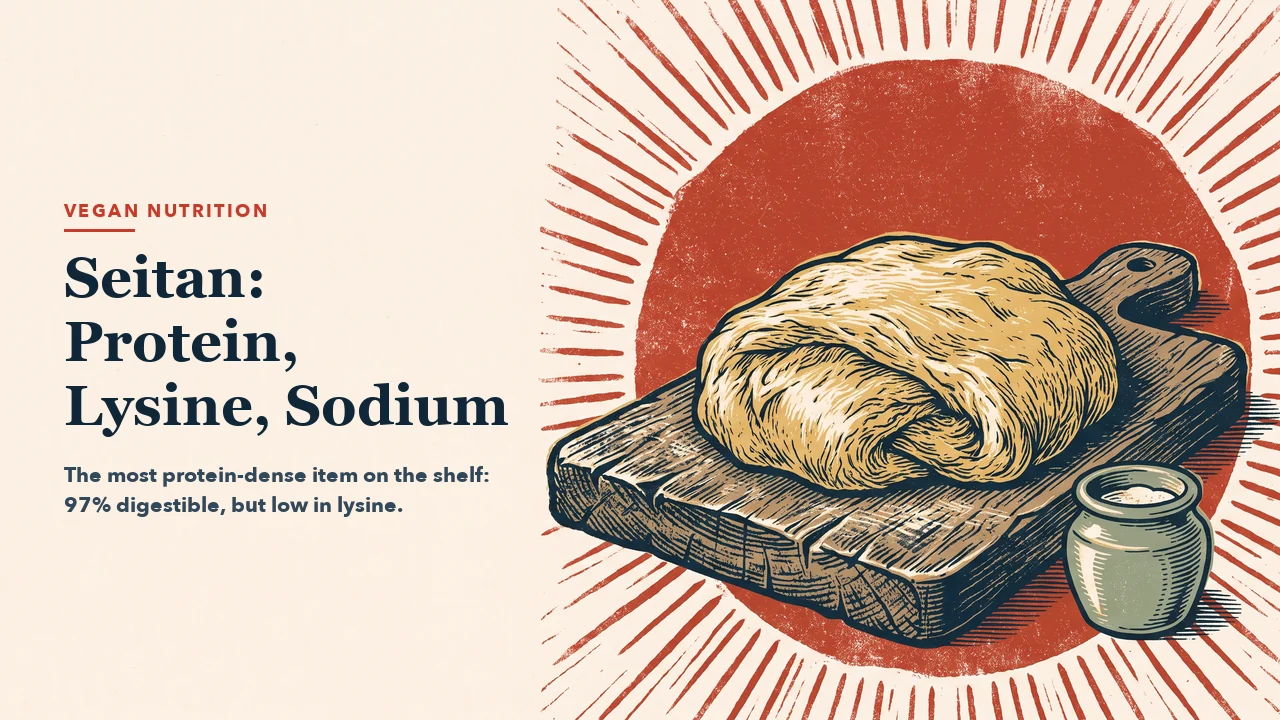
Seitan is the most protein-dense thing on most vegan shelves: 100 g of a ready-made block carries about 24.7 g of protein, more than firm tofu or tempeh. Two things complicate that headline. Its protein is the most digestible of the common plant-based foods in the one study that measured it properly — 97% true ileal digestibility, meaning measured at the end of the small intestine — and yet it scores last on protein quality, because it is short of lysine. And the same block carries 447 mg of sodium, roughly a fifth of a whole day’s limit. For people with coeliac disease or wheat allergy it is not a food at all. Here is what seitan is worth, and what to do about each of its weak spots.
What is seitan? Wheat gluten, and almost nothing else. Wheat flour is kneaded into a dough and the starch is washed out; what stays behind is the gluten network, which is then boiled, steamed or baked.
What is seitan, and how is it made?
Seitan is wheat gluten, and almost nothing else. Wheat flour is kneaded into a dough and the starch is washed out; what stays behind is the gluten network, which is then boiled, steamed or baked. Industry does the same thing at scale through the Martin and batter processes, and sells the dried result as “vital wheat gluten” — the powder home cooks rehydrate. The two proteins that survive the washing give seitan its texture: gliadin brings cohesiveness, glutenin brings elasticity, and their disulphide bonds are what make the finished block chewy in a way that few plant foods manage.
That also means seitan is not a formulated product in the way a burger patty is. It is a single raw material, concentrated. Everything good and everything problematic about it follows from that one fact.
What it gives you, next to the alternatives
These are USDA FoodData Central figures per 100 g. The first column is the dry powder, which is not eaten as such; the second is a commercial ready-to-eat seitan block.
| Per 100 g | Vital wheat gluten, dry | Seitan, ready-made | Tofu, firm | Tempeh |
|---|---|---|---|---|
| Protein (g) | 75.2 | 24.7 | 17.3 | 20.3 |
| Energy (kcal) | 370 | 141 | 144 | 192 |
| Iron (mg) | 5.2 | 1.69 | 2.66 | 2.7 |
| Calcium (mg) | 142 | 24 | 683 | 111 |
| Zinc (mg) | 0.85 | — | 1.57 | 1.14 |
| Sodium (mg) | 29 | 447 | 14 | 9 |
| Fibre (g) | 0.6 | 1.2 | 2.3 | — |
| Vitamin B12 (µg) | 0 | — | 0 | 0.08 |
Three things stand out. Seitan wins on protein per 100 g and loses on almost everything else: a twenty-eighth of tofu’s calcium, less iron than either soya food, and little fibre. The database has no zinc figure for the ready-made block; the dry powder has 0.85 mg per 100 g, roughly half of tofu’s. It carries no B12. The 0.08 µg per 100 g that FoodData Central lists for tempeh comes from fermentation, is not consistent between batches and is not accepted as a reliable source either; B12 comes from a supplement or fortified food. And the sodium gap between the dry powder and the finished block — 29 mg against 447 mg — is entirely added salt and soy sauce, not something inherent to gluten.
The protein: highly digestible, poorly balanced
Protein quality has two halves: how much of it you actually absorb, and whether its amino acids match what you need. Seitan splits those two neatly.
On absorption it does very well. In that minipig study seitan came top at 97%, ahead of tofu (95%), pea emulsion (94%) and soya milk (92%). The measurement is taken at the outlet of the ileum, the last stretch before the colon; that is more accurate than a faecal measurement, because it comes before colonic bacteria alter the amino acids. Whatever else is true of seitan, your gut is not the bottleneck.
The amino acid profile is the bottleneck. In the same study, ranking by digestible indispensable amino acid score (DIAAS) inverted: soya milk scored 117%, tofu 97%, and pea emulsion and seitan came last. Wheat protein does not carry enough lysine, and no amount of digestibility repairs a missing amino acid. A 2025 optimisation study of protein foods put a number on cooked seitan in its ingredient table: an amino acid score of 0.42 with lysine as the limiting amino acid, a digestibility of 77.3% in that preparation, and a resulting protein digestibility-corrected amino acid score (PDCAAS) of 0.32. With one caveat: the measurement was made on seitan fried in sunflower oil and coated in wheat flour. So it is the figure for one prepared dish, not for seitan in general. For comparison, wheat as a grain scores 46, 56 and 66 for infants, children and adults, and plant-based sausages built on wheat and soya were limited by lysine at 33% and 41%.
The practical fix is old and dull: eat lysine somewhere else in the day. Legumes are the obvious source, which is why seitan belongs next to a portion of lentils or chickpeas rather than instead of one. And the fix mostly happens by itself in a varied diet: in a review of vegetarian protein intakes, vegans were estimated to take in 43 mg of lysine per kg of body weight a day against an average requirement of 30 mg, so outright lysine shortfall is not what the numbers predict. Seitan is a poor sole protein and a perfectly good second one. Our guide to protein quality in a vegan diet covers how these scores are built and why single-food scores mislead.
The sodium problem is yours to solve
447 mg of sodium per 100 g is not a rounding error. The WHO recommendation for adults is less than 2,000 mg of sodium a day (under 5 g of salt), so a 150 g serving of that block spends about a third of it before anything else on the plate is salted. The number comes from the marinade, not the gluten: the dry powder has 29 mg. Made at home from vital wheat gluten, seitan can be simmered in an unsalted or lightly salted broth and the sodium is whatever you put in. Read the label on ready-made blocks; between brands this is the single most variable figure.
Who should not eat it
Seitan is concentrated gluten, which makes it the clearest possible “no” for three groups.
- Coeliac disease. A lifelong gluten-free diet is the only treatment; there is no tolerated dose and no cooking method that changes this. Seitan is the single worst food to get wrong here, because gluten is not a contaminant in it — it is the entire product.
- IgE-mediated wheat allergy, including wheat-dependent exercise-induced anaphylaxis (WDEIA). The major allergens are gliadins, particularly ω-5-gliadin, and glutenins — exactly the fraction seitan concentrates. WDEIA only appears when wheat is combined with a cofactor: physical exercise, aspirin or other NSAIDs, alcohol, or an infection. Reactions run from urticaria and angioedema to breathlessness, hypotension and shock, and the most reliable prevention is a gluten-free diet. One more detail worth knowing: sensitisation can begin through the skin, from hydrolysed wheat protein in cosmetics, which is a reason to know what is in the products you put on your face.
- Non-coeliac gluten/wheat sensitivity. This is a real clinical picture but a contested one: there is still no validated biomarker and no genetic profile, so it remains a diagnosis made after coeliac disease and wheat allergy have been ruled out. If you suspect it, get those two excluded first — both become harder to diagnose once you are already avoiding gluten.
Worth keeping in proportion, too: in a 2023 position paper on vegan diets from an allergy perspective, wheat is named the most important trigger of anaphylaxis in adults. Not a reason for anyone else to avoid seitan; a reason to take a reported wheat reaction seriously rather than treating it as fashion.
One more thing: mycotoxins concentrate here
This is the newest and least-known part of the picture. A 2026 German analysis measured 15 mycotoxins in 32 plant-based products from German and Belgian supermarkets, nine of them seitan, and found that seitan-based products carried the highest contamination of any category. Deoxynivalenol was detectable in all nine seitan products, averaging 164 µg/kg and reaching 333 µg/kg; the two Alternaria toxins peaked in seitan as well, at 28 µg/kg for alternariol monomethyl ether and 1,430 µg/kg for tenuazonic acid. Acetylated deoxynivalenol derivatives turned up only in seitan products. The authors’ risk assessment flagged a potential concern chiefly for toddlers, and mainly from the Alternaria toxins.
The mechanism is the one from the beginning of this article: seitan is a single cereal raw material, concentrated, and mould toxins in wheat concentrate along with the protein. Cooking does not remove them. This is not an argument against eating seitan as an adult who eats it occasionally; it is an argument against making concentrated wheat gluten the daily protein staple of a small child, and an argument for variety across bases — soya, legumes, nuts — rather than one favourite repeated daily. Our piece on mycotoxin exposure from plant-based alternatives sets out how these exposures are modelled and what the thresholds mean.
How to use it well
- Treat it as a protein-dense addition, not a base. 100–150 g covers a large part of a meal’s protein; pair it with a lysine source the same day.
- Make it at home when you can. Vital wheat gluten plus water and a simmering broth gives you control over the sodium, which is the one thing a shop-bought block decides for you.
- Do not rely on it for calcium, iron, zinc or B12. On calcium it is nowhere near calcium-set tofu; B12 has to come from a supplement or fortified food, as always.
- Rotate your protein bases. Both the amino acid gap and the mycotoxin finding point the same way: seitan once or twice a week alongside legumes and soya foods, not seitan every day.
- If you react to wheat, stop and get tested properly — before removing gluten, not after.
In short
- Protein: 24.7 g per 100 g ready-made, the densest common vegan option; 75.2 g in the dry powder.
- Quality: digestibility is excellent (97%, top of the tested foods) but the score is last, because lysine is limiting; fried, flour-coated seitan scored 0.32.
- Watch the sodium: 447 mg per 100 g in a commercial block against 29 mg in the powder.
- Absolute no for coeliac disease and IgE-mediated wheat allergy, including exercise-triggered anaphylaxis, where ω-5-gliadin is the main allergen.
- New finding: among plant-based products measured in 2026, seitan carried the highest mycotoxin levels — deoxynivalenol in all nine samples, up to 333 µg/kg — with toddlers the group of concern.
The figures here come from a food composition database, one animal-model digestibility study, one market survey and clinical guidance for three distinct conditions; how to read nutrition research explains why those four kinds of evidence carry different weight.
Sources
- US Department of Agriculture, Agricultural Research Service. FoodData Central: vital wheat gluten; seitan, wheat protein, cubed; tofu, raw, firm, prepared with calcium sulfate (FDC 172475); tempeh (FDC 174272). Accessed 25 September 2026.
- Reynaud Y, Buffière C, Cohade B, Vauris M, Liebermann K, Hafnaoui N, Lopez M. True ileal amino acid digestibility and digestible indispensable amino acid scores (DIAASs) of plant-based protein foods. Food Chem. 2021;338:128020. doi:10.1016/j.foodchem.2020.128020.
- Mariotti F, Gardner CD. Dietary Protein and Amino Acids in Vegetarian Diets—A Review. Nutrients. 2019;11(11):2661. doi:10.3390/nu11112661.
- Schneidemann-Bostelmann S, Otting Y, Dick F, Lefever T, Asam S, Rychlik M. Mycotoxin occurrence and risk assessment in plant-based meat, cheese, and fish alternatives based on an adapted UHPLC-MS/MS multi-method. Mycotoxin Res. 2026;42(1):22. doi:10.1007/s12550-026-00636-2.
- Srisuwatchari W, Kanchanapoomi K, Pacharn P. Molecular Diagnosis to IgE-mediated Wheat Allergy and Wheat-Dependent Exercise-Induced Anaphylaxis. Clin Rev Allergy Immunol. 2025;68(1):47. doi:10.1007/s12016-025-09059-w.
- Scherf KA, Brockow K, Biedermann T, Koehler P, Wieser H. Wheat-dependent exercise-induced anaphylaxis. Clin Exp Allergy. 2016;46(1):10–20. doi:10.1111/cea.12640.
- Manza F, Lungaro L, Costanzini A, Caputo F, Carroccio A, Mansueto P, Seidita A. Non-Celiac Gluten/Wheat Sensitivity—State of the Art: A Five-Year Narrative Review. Nutrients. 2025;17(2):220. doi:10.3390/nu17020220.
- Reese I, Schäfer C, Ballmer-Weber B, et al. Vegan diets from an allergy point of view — Position paper of the DGAKI working group on food allergy. Allergol Select. 2023;7:57–83. doi:10.5414/ALX02400E.
- National Institute of Diabetes and Digestive and Kidney Diseases. Celiac Disease; Eating, Diet, & Nutrition for Celiac Disease. Accessed 25 September 2026.
- Zhang M, Jia R, Ma M, Yang T, Sun Q, Li M. Versatile wheat gluten: functional properties and application in the food-related industry. Crit Rev Food Sci Nutr. 2023;63(30):10444–10460. doi:10.1080/10408398.2022.2078785.
- Rolands MR, Mainardi F, Bochud M, Lê KA. Identifying the optimal ratio from protein foods for protein and nutrient quality in plant-based meals using a non-linear optimisation approach. Front Nutr. 2025;12:1624633. doi:10.3389/fnut.2025.1624633. (Table 1: fried seitan, limiting amino acid and PDCAAS)
- Oh J, Park N, Kim BG. Determination of Digestible Indispensable Amino Acid Scores for Plant Proteins and Skim Milk Powder Measured in Pigs. Animals. 2025;15(5):650. doi:10.3390/ani15050650.
- Khamzaeva N, Hieronimus B, Kunz C, Pferdmenges LE, Briviba K. Plant-Based vs. Pork Sausages: Protein Nutritional Quality and Antioxidant Potential in the Bioaccessible Fraction. Foods. 2025;14(24):4271. doi:10.3390/foods14244271.
- World Health Organization. Salt reduction (fact sheet). Accessed 25 September 2026.
Editor: Anıl Güler, Pharmacist
Last scientific review: 25 September 2026