Why Do Vegans Eat Foods That Resemble Meat?
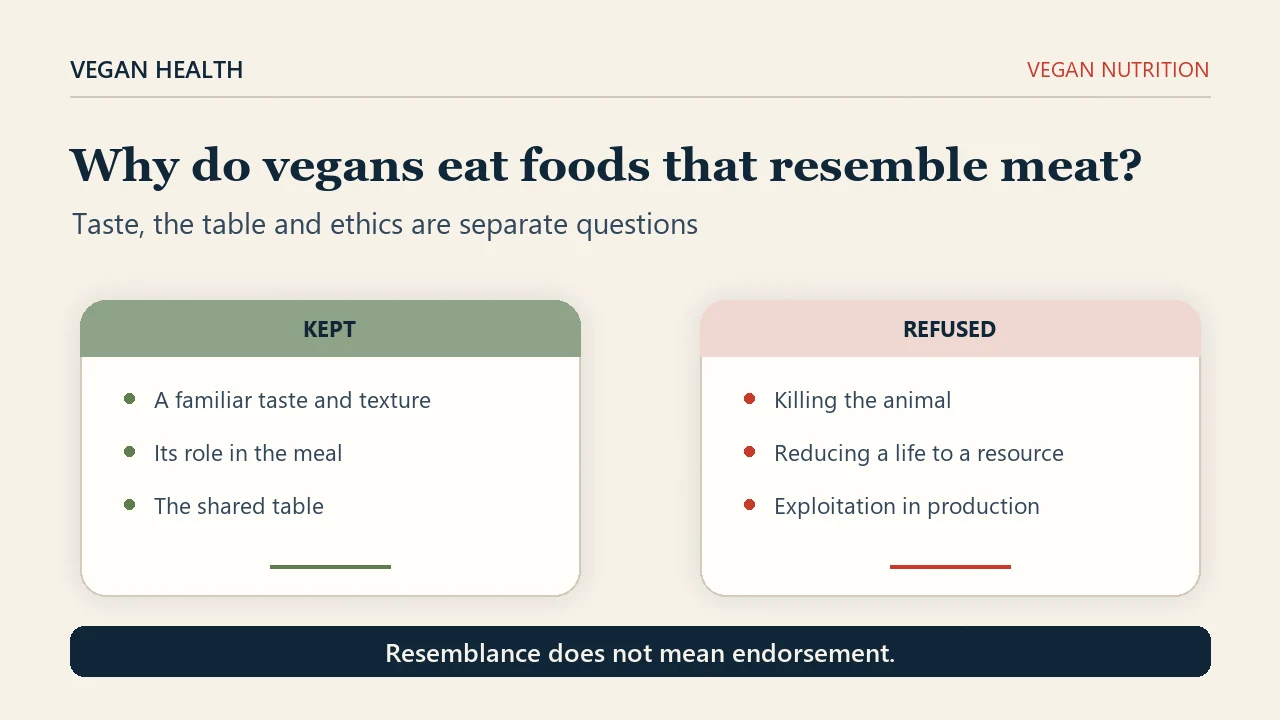
A change of values need not mean losing every flavour you love. Someone may miss the taste of a burger, its browned crust or a meal shared with family, and still refuse to accept an animal being killed for it. There is no necessary contradiction between those two preferences.
The ethical position developed here starts from that distinction. The objection concerns killing animals, reducing their lives to a usable resource, and the ecological damage and exploitation that food production can involve. Enjoying a sensory experience does not, by itself, endorse every way of producing it.
Plant-based meat alternatives make this distinction visible. They also open a harder question: if the ingredients change while the relations that organise production stay the same, how far does the transformation actually go?
A dish can change and keep its place at the table
Imagine a family preparing a barbecue. Someone joining the table brings a plant-based patty. They may be keeping the bread, the seasoning, the ritual of preparation and the experience of eating together, while changing what goes on the grill. This scene is not a research finding about how all vegans behave; it is an example for thinking through one possibility.
From a culinary perspective, resemblance need not mean the search for a perfect replica. The shape of a food, its texture and its role on the plate can matter in different degrees. A patty can fit inside a sandwich without reproducing every property of beef. A lentil dish, equally, does not have to resemble meat to earn a place at dinner.
Research with Dutch consumers suggests that resemblance is not always the easiest route. Elzerman and colleagues used product photographs in an exploratory survey in 2004 and an online survey in 2019. Participants rated how appropriate each product was for different eating situations on a 7-point scale. The researchers were therefore not asking how much people liked a product in general, but in which situation they judged it to belong on the table.
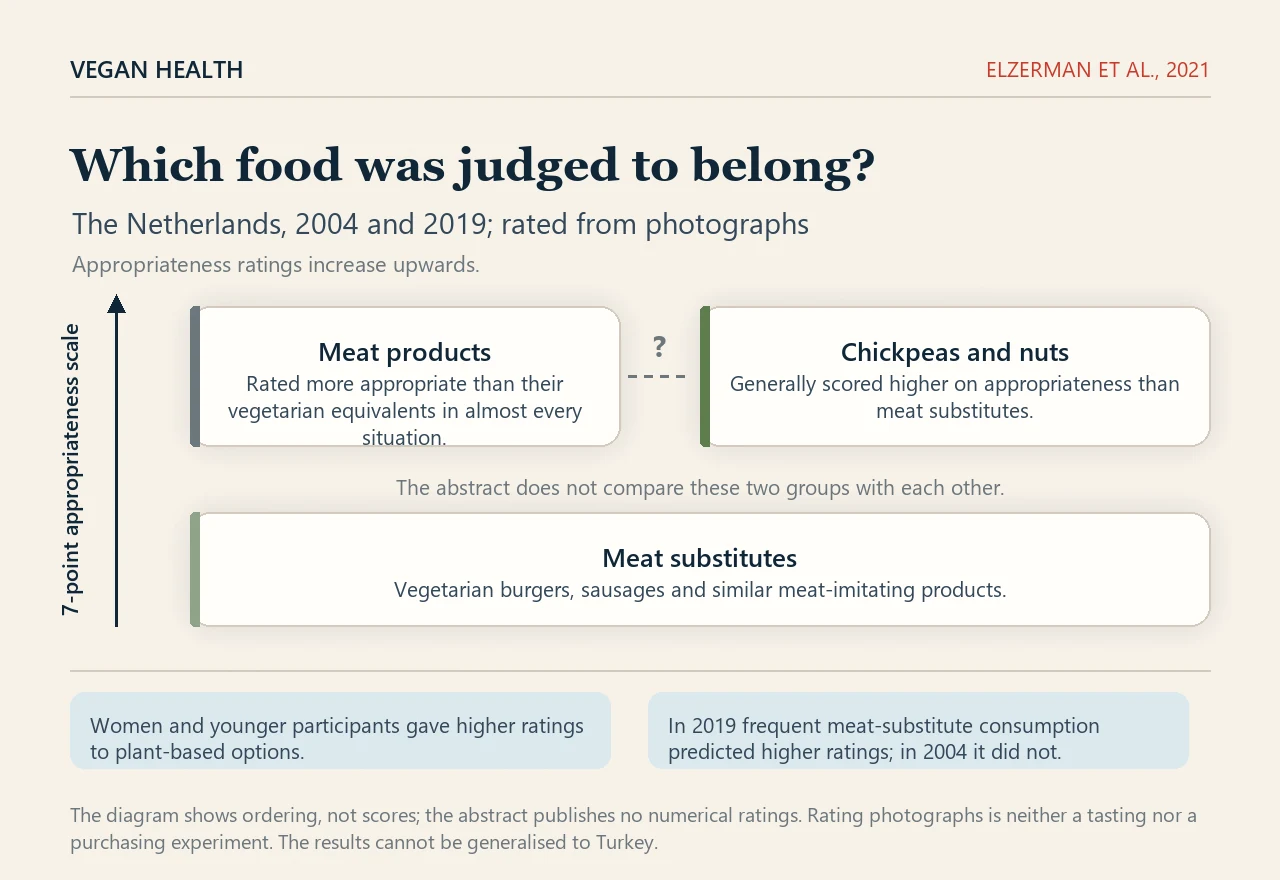
Meat products were rated more appropriate than their vegetarian equivalents in almost every situation; chickpeas and nuts, by contrast, generally scored higher on appropriateness than meat substitutes did. Women and younger participants gave higher ratings to plant-based options. In the 2019 data, eating meat substitutes more frequently was a predictor of higher appropriateness ratings, a relationship not seen in 2004. This points to the weight of familiarity, but does not on its own prove that frequent consumption increases acceptance. Rating photographs is neither a tasting nor a real purchasing experiment, and the results cannot be generalised to Turkey or to all vegans.
There is more than one route in the kitchen: adapt a familiar recipe, enjoy a dish that is already plant-based, or try something new. None of them has to become a sincerity test for veganism.
Changing the table also means talking about relationships
At a shared table an ingredient can turn into a question of hospitality: will there be something I can eat? If I decline a dish, will I be understood as rejecting the person who prepared it?
A qualitative study in Iceland approaches these questions through in-depth interviews with 18 vegans and open-ended questionnaire responses from 35 vegans. Viðarsdóttir analyses the responses with a method that builds concepts and patterns out of participants’ own accounts. The focus is on how vegans experience the social difficulties that arise with new food choices, and how they sustain their bonds with non-vegan relatives and friends.
The finding is not simply that disagreement appears at the table. Everyday practices of eating together also create a space in which both sides adjust to each other and new food values can settle in. The evidence here is not a sales figure or a success rate, but accounts of how people negotiate their relationships. The study does not test whether buying meat substitutes increases social acceptance, and these narratives, from a small and meat-centred society, do not numerically represent what all vegans experience.
Does resemblance carry the same ethical meaning?
If the objection is to killing an animal, creating a similar flavour from plant ingredients does not repeat that act of killing. On the view defended here, the ethically decisive relationship concerns what is done to a living being, not whether lunch takes the shape of, say, a sausage.
Bacchini and Bossini examine the problem on two separate planes. First they ask about consequences: does resemblance increase consumption of meat alternatives, and are the consequences of that consumption better than those of eating animal meat? Then they move to a second question: even if the consequences are favourable, is there something that makes the act of imitation itself wrong? This separates whether a product works from what imitation means morally.
On the definition the authors adopt, a substitute need not carry every property of what it replaces; if it did, it would be the thing itself rather than a substitute. Keeping some of its functions while leaving others out can be precisely the reason to prefer it. A plant-based patty that preserves a familiar taste and the role of a meal, while not being made from an animal’s body, is one example. The article discusses the resemblance strategy through food preferences, wariness towards unfamiliar foods and the social meanings of meat eating, and finds no compelling reasons for treating imitation as morally undesirable in itself. This philosophical assessment is neither an experiment showing that imitation has the same effect on everyone nor an ethical consensus. The article also covers cultured meat; the discussion here focuses on plant-based options.
An objection worth discussing remains: constantly judging plant-based dishes by how closely they resemble meat may keep meat as the measure of the kitchen. That criticism helps us think about our recipes and our language. It does not show that a person eating a plant-based burger secretly approves of animals being killed. A food can keep its familiar form while the ethical meaning it carries changes.
Ecological assessment requires a comparison
An environmental assessment has to state which product is replacing which, how it is produced and which impacts are being measured. The 2023 review by Shanmugam and colleagues examines life-cycle assessments of plant-based meat analogues published up to 2021. To reduce differences in method, the researchers harmonised the calculations and compared climate impact up to the factory gate.
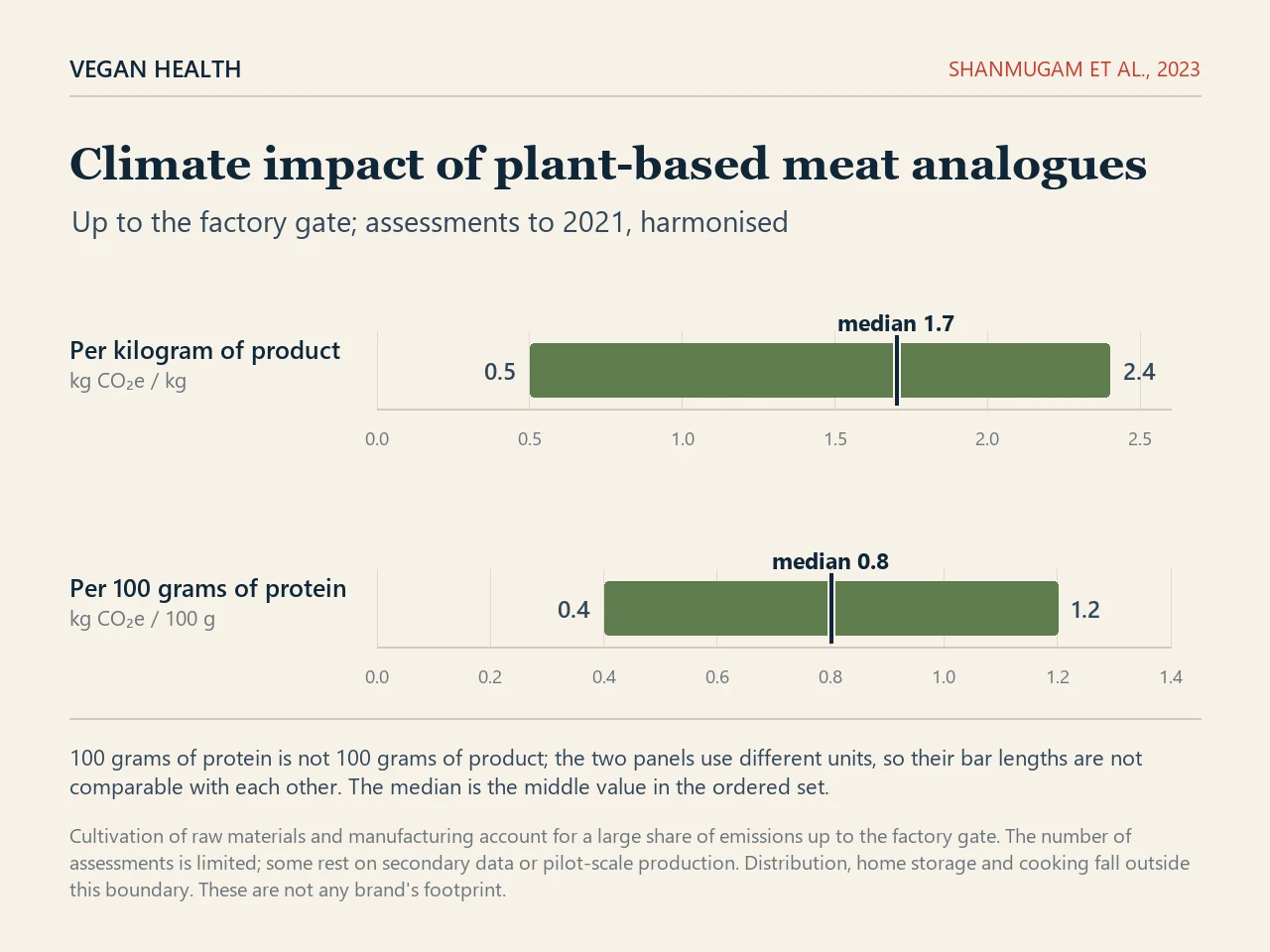
Across the products reviewed, the median impact was 1.7 kg CO₂ equivalent per kilogram of product, with values ranging from 0.5 to 2.4 kg CO₂ equivalent. The median is the middle value in the ordered set; it does not mean every product has the same impact.
Measured against protein content, the median impact was 0.8 kg CO₂ equivalent per 100 grams of protein, with a range of 0.4 to 1.2 kg CO₂ equivalent. Here 100 grams of protein is not the same as 100 grams of product. Cultivation of raw materials and manufacturing account for a large share of emissions up to the factory gate. The authors note that the number of assessments is limited and that some calculations rest on secondary data or on pilot-scale production. The figures therefore cannot be used as the footprint of any brand sold in Turkey. Distribution beyond the factory gate, storage at home and cooking also fall outside this harmonised boundary.
These boundaries matter. Climate impact does not describe all other environmental outcomes, such as water use and biodiversity. Working conditions are a separate social question that has to be assessed on its own. A favourable comparison between products does not on its own show how much animal meat consumption actually falls. The ethical objection to killing an animal can be discussed separately; it does not need to be reduced to a carbon calculation to carry weight.
A system critique that does not end with changing the ingredient
The critique of commodification asks whose interests food production is organised around. When an animal is reduced mainly to saleable output, labour to a cost item and land to a source of income, the matter extends beyond the shopping basket. The connection drawn here is not a claim that human workers and farmed animals have identical experiences or legal positions. It is a criticism directed at an order that subordinates life and labour to profitability.
The 2025 commentary by Sievert and colleagues uses financialisation to understand shared problems in the food system: production decisions shaped around returns on investment and the goal of growing shareholder value. The authors do not treat ultra-processed foods and intensive animal production merely as product categories that consumers must give up one by one. They discuss the common economic mechanisms that support corporate power and growth in both sectors. This approach is not a claim that the nutritional or environmental consequences of the two groups are equal.
The interventions they propose also go beyond shopping choices: competition policy to break up concentrated market power; stronger environmental, animal welfare and labour standards; and corporate boards mandated to consider the interests of a broader range of communities rather than shareholders alone. They also argue for supporting diversified and decentralised food economies. These are policy proposals drawn from a critical analysis, not a package whose success rate has been measured experimentally. This article does not audit the wages, supply chain or working conditions of any particular plant-based burger brand.
A product being plant-based does not by itself answer questions about wages, ownership, price and access. A product that uses no animal ingredients may still be expensive, may be made under poor working conditions, or may be marketed as though buying it were enough for social change. These are not accusations to level at a particular brand without examining it; they are questions we need to investigate.
We can support replacing animal ingredients with plant-based options while also defending fair working conditions, affordable food and a democratic say over production. Enjoying a familiar meal is not the whole of that responsibility. The broader aim is a food order in which the lives of animals, people and ecological communities matter beyond their capacity to generate revenue.
Scope note: This article is an opinion essay supported by academic sources; it is not a systematic review. It does not assess any specific product, brand or dietary pattern, and it is not medical advice. If you are planning a change to your diet, consult a qualified health professional.
Sources
- Elzerman JE, Keulemans L, Sap R, Luning PA. Situational appropriateness of meat products, meat substitutes and meat alternatives as perceived by Dutch consumers. Food Quality and Preference, 2021. Method and findings summary.
- Viðarsdóttir A. “People don’t feel good if they can’t feed you:” the role of commensality and kinship making in plant-based dietary transformations from the perspective of vegans. Food, Culture & Society, 25 August 2025. University of Iceland research record.
- Bacchini F, Bossini E. The Ethics of Imitation in Meat Alternatives. Food Ethics, 2023. Open-access full text.
- Shanmugam K, Bryngelsson S, Östergren K, Hallström E. Climate Impact of Plant-based Meat Analogues: A Review of Life Cycle Assessments. Sustainable Production and Consumption, vol. 36, pp. 328–337, 2023.
- Sievert K, Wood B, Gajurel H, Johnson H, Percival R, Northcott T, Sacks G, Parker C. Common Leverage Points to Address the Health, Environmental Sustainability, and Justice Challenges of Financialised Food Systems. Food Ethics, 2025. Commentary, open access.
Editor: Anıl Güler, Pharmacist
Scientific review date: 11 September 2026