What Is Vegan Leather Made Of?
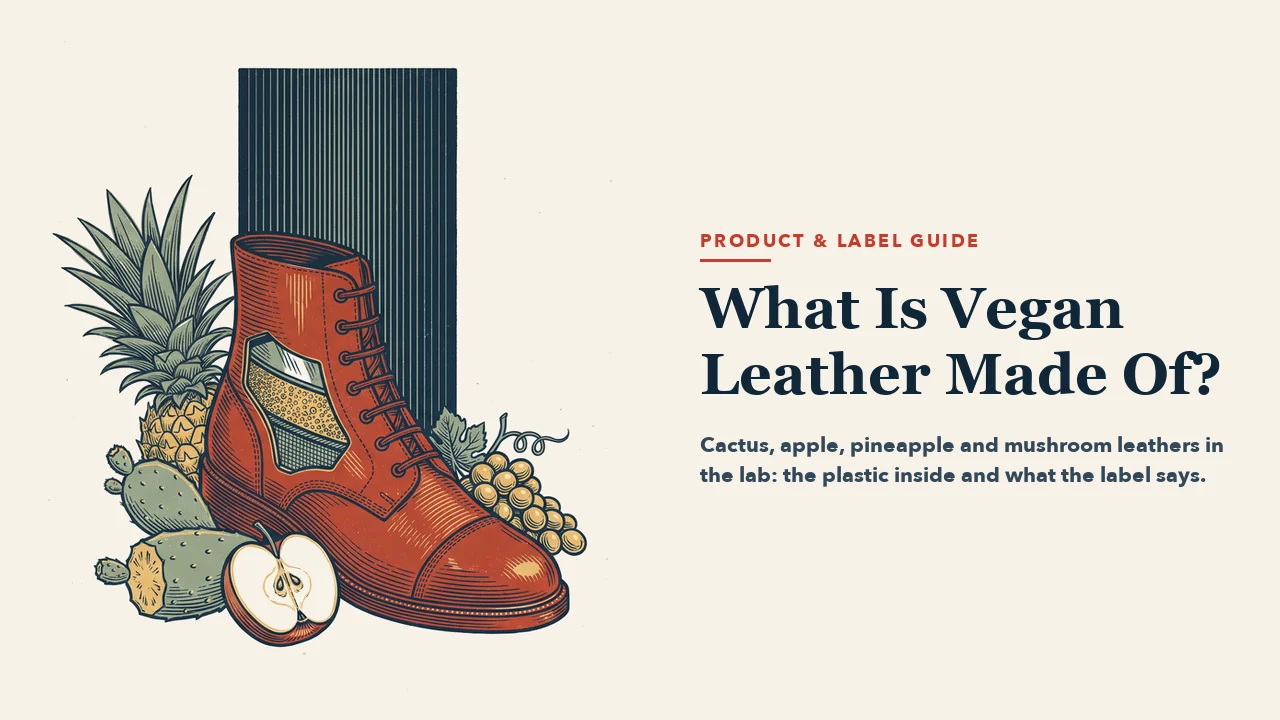
“Vegan leather” sounds like one material. It is at least two. The older and far more common kind is artificial leather: a polyester fabric coated with polyurethane (PU) or polyvinyl chloride (PVC). The newer kind is sold as plant-based or bio-based leather, made with pineapple leaf fibre, apple or grape pomace, cactus, or mushroom mycelium. Both are free of animal hide. They are not equally free of plastic, and the marketing rarely tells you how much plastic each one contains.
The common kind: plastic on fabric
Artificial leather usually consists of a textile support covered by two or more synthetic polymer layers: a foamed middle layer, a compact layer and a topcoat, often embossed with a grain pattern so that it looks like hide. When the fabric is polyester and the coating is PVC or polyurethane, the result is, in the words of a 2021 study, “a completely fossil-based material”. A 2025 review in Gels notes that most vegan leather on the market is still made from these petroleum-based polymers.
That is a trade-off rather than a verdict. A 2023 patent review of mycelium materials by Elise Elsacker and colleagues notes that plastic-based leathers have a lower carbon footprint than animal leather during production, but that they depend on fossil resources and bring their own problems: microplastic pollution, landfill and accumulation in the ocean.
What a lab found inside the plant-based alternatives
One of the most detailed lab comparisons is a 2021 study by Meyer and colleagues in the journal Coatings. They tested nine commercially available leather alternatives against a shoe-upper leather and a conventional PU-coated fabric, using microscopy, infrared spectroscopy and the standard tests for shoe, glove and clothing materials. The samples were donated by the German Leather Association (VDL), the German leather industry’s trade association, which is worth keeping in mind; the authors declared no conflict of interest. The study measured structure and performance only. It did not assess carbon footprint, environmental impact or biodegradability.
Six of the nine fell into three groups:
| Type | What the lab found |
|---|---|
| Cactus, apple and grape-based (as marketed) | Built like ordinary artificial leather: a foamed polyurethane middle layer containing plant-based filler, on a polyester fabric (cellulose in one case), with a polymer topcoat. Part of the polyurethane was replaced by plant-based filler, but, in the authors’ words, “the bulk of the materials remains to consist of polyurethane”. |
| Pineapple leaf fibre | A non-woven mat of plant fibres with a thin coating. The coating was marketed as polylactic acid (PLA), a plant-derived plastic, but the analysis found “at least a remarkable content of PUR/acrylate” in it. |
| Grown materials (a tree fungus and a kombucha film) | Single layers of natural polysaccharides with no plastic coating or fabric support, but nowhere near strong enough for shoe uppers. |
One more finding is worth knowing. A belt sold as vegan, with an animal-rights group’s approval mark embossed on it, turned out to have a middle layer of leather board, a sheet made from leather fibres. Two further samples, a paper-like fibre material held together with an acrylic binder and a teak-leaf material, did not fit these groups.
The authors could not measure how much of each material was actually plant-based. They concluded that adding agricultural by-products to the polymer layers of artificial leather raises its bio-based content but brings no measurable physical advantage over ordinary artificial leather, and that only a proper life-cycle assessment could show whether it brings an environmental one.
How the alternatives performed
None of the nine alternatives matched leather overall. Leather had the highest tensile and tear strength in the study. The coated fabrics reached 9 to 20 N/mm², against a specification of more than 15 N/mm² for shoe-upper leather. The grown, fungus-based sample had extremely low values (about 0.2 N/mm², as later cited by other researchers).
Breathability split the field. Leather, the fungus-based sheet and the paper-fibre material let water vapour through easily, and the PU-coated reference and the pineapple fibre material also met the shoe-upper standard; the other six did not. The authors point out what that means in practice: worn as shoes, these tight materials would make feet sweat, but as a bag or a rain jacket they would keep the rain out.
Restricted substances in the samples
The lab also screened the materials for volatile substances by heating small samples. All of them released volatile organic compounds. Restricted substances were found in the PU-coated reference, in the cactus, apple and grape-based materials and in the pineapple fibre material:
- the PU-coated reference: considerable amounts of dimethylformamide (DMF) and toluene;
- the cactus-based material: five restricted substances: butanone oxime, toluene, free isocyanate, the pesticide folpet and traces of the plasticiser diisobutyl phthalate (DIBP);
- the apple-based material: butanone oxime and traces of DMF;
- the grape-based material: toluene;
- the pineapple fibre material: DIBP.
This was a screening test on one sample of each material, obtained for a study published in 2021; current products may differ. The study does not report amounts against legal limits. It shows what a material can release when heated in a laboratory, not how much reaches a wearer’s skin, so it does not by itself show a health risk. What it does show is that a plant-based label says nothing about the solvents, plasticisers and coatings used to make the material.
Mushroom leather
Mycelium, the root-like network of a fungus, can be grown into sheets and processed into a leather-like material. The 2023 patent review found a clear rise in patent filings since 2019. Untreated mycelium becomes stiff and brittle when dry, so it is softened with plasticisers such as glycerol and often cross-linked and coated. The review found that most mycelium products now on the market have some kind of polyurethane coating, 10 to 500 μm thick. The authors note that such non-sustainable synthetic coatings are a drawback the field still has to overcome.
Research prototypes are getting stronger. In a 2025 study in Scientific Reports, Kanishka Wijayarathna and colleagues grew a fungus on bread waste, tanned the biomass with plant tannins and pressed it into layered sheets; the strongest reached a tensile strength of 20.5 MPa (the same unit as N/mm²). These were laboratory sheets, not products you can buy, and were tested separately, so the figure is not directly comparable with the 2021 results.
What the label tells you
In both the EU and Turkey, shoes must carry a label for three parts: the upper, the lining and sock, and the outer sole. The EU footwear labelling directive (94/11/EC) defines leather as animal hide or skin with its original fibrous structure more or less intact. If hide is broken down into fibres, small pieces or powder and pressed into sheets, “such sheets or forms are not leather”. There is a separate category for coated leather; everything else is labelled either as textile or as “other materials”. If no single material reaches 80% of a part, the directive requires the two main materials to be listed.
Turkey’s footwear labelling regulation follows the same directive. The label must name the material that makes up at least 80% of the upper and of the lining and sock, and at least 80% of the volume of the outer sole. The label must not mislead the consumer, and shops must display a poster of at least A4 size explaining the pictograms. According to the 2021 study, a European standard (EN 15987) also restricts the use of terms such as “faux leather” or “PU leather”; standards like this are voluntary unless a law refers to them.
What none of these rules does is define “vegan” or “plant-based”. The leather pictogram tells you whether the main material is animal hide. It does not tell you whether a plant-based alternative is mostly plastic. For certification marks, see our guide to vegan certification labels.
How to choose
- Check the shoe label first. If the label shows the upper as leather, its main material is animal hide, whatever the marketing says.
- Plant-based does not mean plastic-free. Ask what the coating and backing are made of, and how much of the material is plant-derived by weight.
- Bio-based and biodegradable are different claims. A material can contain plant matter and still not break down if it is bonded with polyurethane.
- For shoes, breathability matters. Six of the nine alternatives in the 2021 study did not meet the shoe-upper standard for water-vapour permeability.
- Durability counts. Whichever material you choose, a product you can wear for many years means fewer replacements.
The same questions apply to cosmetics; see how to read a vegan cosmetics label.
Sources
- Meyer M, Dietrich S, Schulz H, Mondschein A. Comparison of the Technical Performance of Leather, Artificial Leather, and Trendy Alternatives. Coatings 2021;11(2):226.
- Elsacker E, Vandelook S, Peeters E. Recent technological innovations in mycelium materials as leather substitutes: a patent review. Front Bioeng Biotechnol 2023;11:1204861.
- Wijayarathna ERKB, Svensson SE, Sar T, Zamani A. Multilayer biocomposite vegan leather materials derived from vegetable-tanned fungal biomass cultivated on food waste. Sci Rep 2025;15:15366.
- Choi SM, Lee DH, Zo SM, Sood A, Han SS. Gel-Based Approaches to Vegan Leather: Opportunities and Challenges in Mimicking Leather Properties. Gels 2025;11(6):395.
- Directive 94/11/EC on the labelling of the materials used in the main components of footwear for sale to the consumer. OJ L 100, 19.4.1994.
- Turkish Ministry of Customs and Trade (now Ministry of Trade). Regulation on the labelling of materials used in the main components of footwear purchased by consumers (in Turkish; prepared in line with Directive 94/11/EC).
Editor: Anıl Güler, Pharmacist
Last reviewed: 22 October 2026