World Vegetarian Day: How 1 October Began
Today, 1 October, is World Vegetarian Day. It was started 49 years ago by a single organisation, the North American Vegetarian Society (NAVS), and endorsed by the International Vegetarian Union the following year. Here is who started it, what it was for, and how it connects to World Vegan Day on 1 November.
The organisation behind it
NAVS was founded in 1974, and the following year it organised the 23rd World Vegetarian Congress of the International Vegetarian Union (IVU), which has brought vegetarian societies together since 1908. The historians Karen and Michael Iacobbo write in Vegetarian America that with the formation of NAVS “the stage was set” for the congress. It was held from 16 to 28 August 1975 at the University of Maine in Orono, the first IVU congress on the North American continent. The Iacobbos call it “arguably” the most important gathering of vegetarians in the United States in the twentieth century.
The numbers were large for the time, although estimates differ. Vegetarian Times reported 1,500 people, three times the previous IVU record; the IVU General Secretary’s report counted “some 1,400 (plus)” participants, more than 100 speakers and lectures running in up to 26 halls at once. The report in Vegetarian Times also noted how varied the diets were, from “ovo-lacto (egg & milk)” to fruit only.
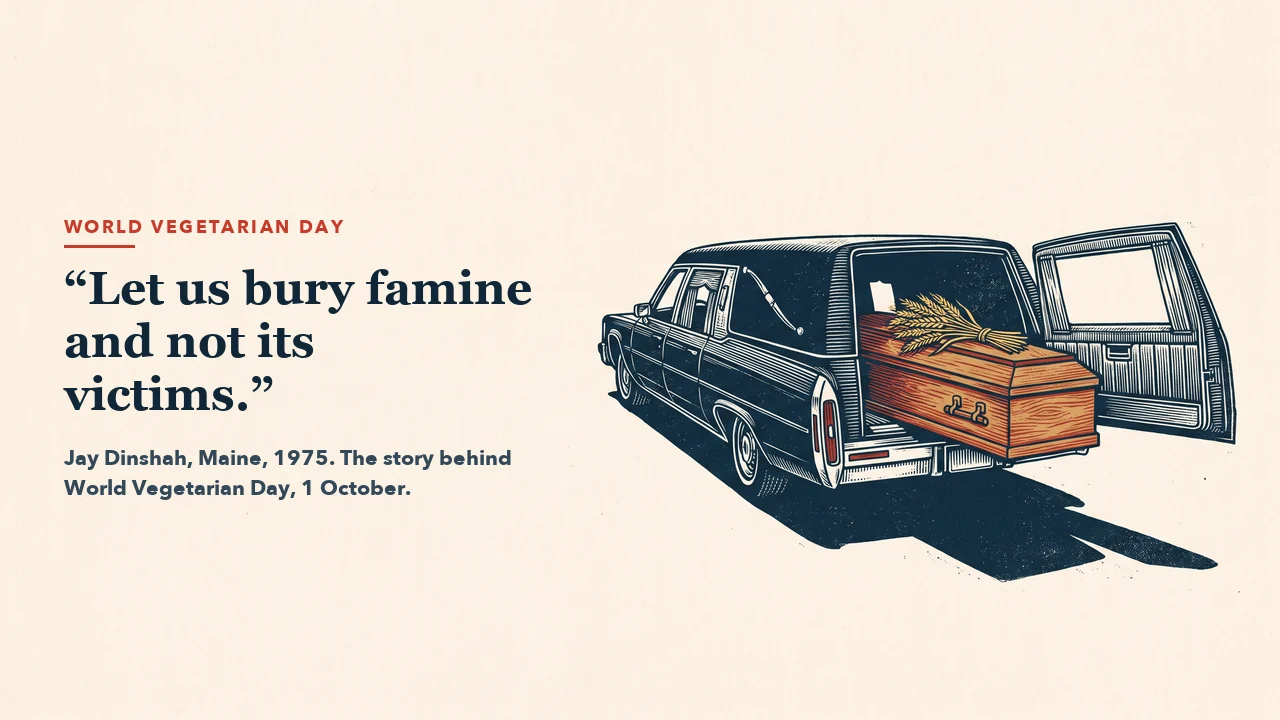
One of the events that drew the most attention was a “Funeral for Famine” on the evening of 20 August. After a speech by Richard St. Barbe Baker, the NAVS president Jay Dinshah called on people to adopt a vegetarian diet as the only alternative to mass starvation, with the line “Let us bury famine and not its victims”. A coffin was then loaded into a hearse in front of reporters; according to the IVU report, the event was covered by the three main national television networks.
1977 and 1978
Two years after the congress, in 1977, NAVS started World Vegetarian Day. The society’s own description of its purpose is “to promote the joy, compassion and life-enhancing possibilities of vegetarianism”, and to inform the public that vegetarian diets have health benefits, save animals’ lives and help to preserve the Earth. At the time, according to the IVU General Secretary’s 1977 report, NAVS had about 65 affiliated groups and societies in North America and Hawaii.
In 1978 the IVU endorsed the day. 1 October is the official date, but NAVS says people may hold their events on a nearby date if needed. Neither NAVS nor the IVU records we found explain why 1 October was chosen, so we have not speculated.
A month that ends with World Vegan Day
NAVS describes 1 October as the start of Vegetarian Awareness Month. The day after that month ends, 1 November, is World Vegan Day.
World Vegan Day has a separate origin. The Vegan Society was founded in November 1944, when its founding members coined the word “vegan”. For the society’s 50th anniversary, Louise Wallis, a former president of the society, created World Vegan Day on 1 November 1994. It was later extended to a week and then to World Vegan Month, which is held every November. We have told how the word “vegan” was born, and how the first vegetarian society was founded in Ramsgate in 1847.
Vegetarian or vegan?
The two days mark two different things, and the difference is easy to blur.
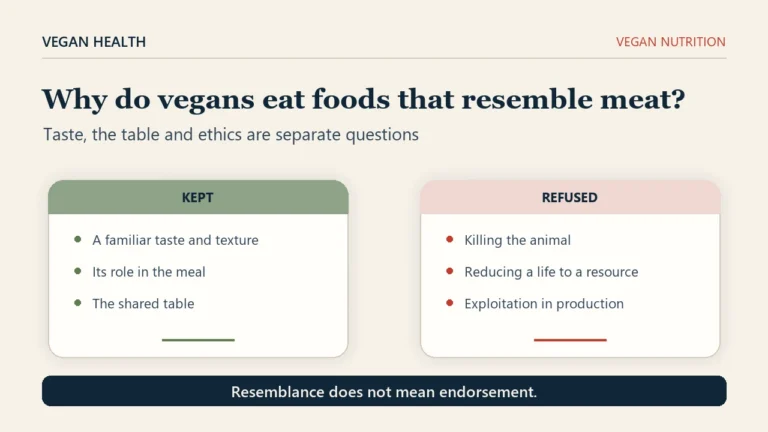
- Vegetarian: no meat, fish or poultry. In the Vegetarian Society’s words: “Simply stop eating meat, fish and chicken.” The definition does not mention eggs or dairy; lacto-ovo vegetarians eat both.
- Lacto-, ovo- and lacto-ovo vegetarian: the prefixes say what is kept. “Lacto” is milk, “ovo” is egg; the 1975 congress report already used “ovo-lacto (egg & milk)”.
- Vegan: no animal products at all. The Vegan Society’s definition describes veganism as a way of living that “seeks to exclude—as far as is possible and practicable—all forms of exploitation of, and cruelty to, animals for food, clothing or any other purpose”. In dietary terms, it means “dispensing with all products derived wholly or partly from animals”.
That is why “lacto-vegan” and “ovo-vegan”, which do turn up in searches, are not correct terms: a diet that includes milk or eggs is by definition not vegan. The correct terms are lacto-vegetarian and ovo-vegetarian.
If you are trying it this month
Whether you drop only meat or all animal products, a few nutrients deserve planning from the start. Our guides cover each one with sources:
References
- World Vegetarian Day (North American Vegetarian Society). Home page. Accessed 29 September 2026.
- North American Vegetarian Society. Purposes & Programs. Accessed 29 September 2026.
- International Vegetarian Union. 23rd IVU World Vegetarian Congress 1975, Orono, Maine, USA, quoting Iacobbo K, Iacobbo M. Vegetarian America: A History. Praeger; 2004. Accessed 29 September 2026.
- Vegetarian Times no. 12, 1975. 1975 World Vegetarian Congress (reproduced by the International Vegetarian Union). Accessed 29 September 2026.
- International Vegetarian Union. Hon. General Secretary’s Report, 24th World Vegetarian Congress, New Delhi, 1977. Accessed 29 September 2026.
- International Vegetarian Union. History of the IVU. Accessed 29 September 2026.
- The Vegan Society. World Vegan Month. Accessed 29 September 2026.
- The Vegan Society. Definition of veganism. Accessed 29 September 2026.
- Vegetarian Society. Eating veggie. Accessed 29 September 2026.
Editor: Anıl Güler, Pharmacist
Last scientific review: 30 September 2026