Protein Quality in a Vegan Diet: DIAAS, Combining Foods and Protein Needs After 65
A vegan diet can supply all the protein an adult needs, but “enough protein” has two parts: the amount, and how well the mix of amino acids matches what the body uses. Plant proteins are not missing any essential amino acids; some simply carry less of one or two than would be ideal. Over a varied day this rarely matters. It matters more when total intake is low, and it matters most after 65, when muscle is harder to keep. This guide explains what protein quality scores mean, when combining foods actually helps, and how older vegans can plan for it.
How much protein does an adult need?
The European Food Safety Authority (EFSA) sets an average requirement of 0.66 g of protein per kilogram of body weight a day for adults, and a population reference intake of 0.83 g/kg a day, the amount that covers the needs of almost everyone. For a 70 kg adult, 0.83 g/kg is about 58 g a day. EFSA’s table gives the same figures for everyone aged 18 and over; there is no separate, higher value for older adults.
These values assume protein of top quality. The Türkiye Dietary Guidelines (TÜBER 2022) take EFSA’s 0.83 g/kg as the reference for a diet with a protein quality score (DIAAS) of 100, and then calculate a higher adequate intake of 1.04 g/kg a day for the average diet in Türkiye, which they score at 83. In other words, the guideline already builds a correction for lower-quality protein into its numbers.
What does “protein quality” mean?
Proteins are built from 20 amino acids. Nine of them are indispensable (essential): the body cannot make them, so they must come from food. A protein quality score asks two questions: does this protein supply each indispensable amino acid in the proportion the body needs, and how much of it is actually digested and absorbed?
Two scores are used:
- PDCAAS (Protein Digestibility Corrected Amino Acid Score), developed by a joint FAO/WHO expert consultation in 1989. It estimates digestibility from what is left in faeces, and scores above 1.00 are truncated to 1.00, so very good proteins cannot be told apart.
- DIAAS (Digestible Indispensable Amino Acid Score), recommended to replace PDCAAS by a 2011 FAO expert consultation whose report was published in 2013. It uses digestibility measured at the end of the small intestine, which better reflects the amino acids actually absorbed. Scores above 100 are not truncated, except when mixed diets or sole-source foods are being assessed.
For DIAAS, the ratio is calculated for each indispensable amino acid and the lowest one becomes the score. For food labelling, the FAO report suggested example cut-offs: a DIAAS of 100 or more for an “excellent/high” protein claim, 75 to 99 for a “good/source” claim, and no protein claim below 75. Later studies often use these as quality bands.
Where plant proteins fall short, and by how much
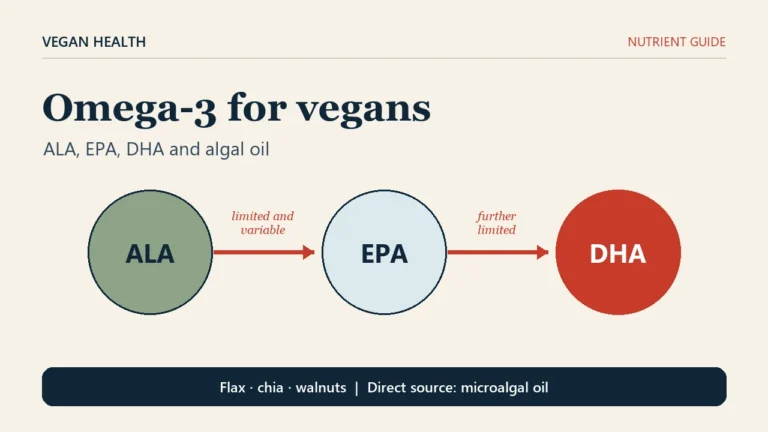
Saying plant foods “lack” essential amino acids is inaccurate. A 2019 review in Nutrients points out that plant foods contain all 20 amino acids, including the nine indispensable ones; the difference is in proportions. Grains carry less lysine than would be optimal, and legumes carry very slightly less of the sulphur-containing amino acids (methionine and cysteine). As the review’s authors put it, this would matter for someone who ate only rice or only beans every day.
A 2020 analysis in Food Science & Nutrition calculated DIAAS values for isolated proteins using the FAO reference pattern for young children (a demanding benchmark). On average, soy protein scored 75 or above, while pea and rice proteins each scored below 75. Combining them changed the picture: in a pea and rice protein mixture, the highest DIAAS, 84, was reached when rice made up 41% of the protein. Values varied considerably between samples of the same protein, so these are illustrations, not fixed properties of a food. (Soy foods are covered in more detail in our tofu and soy guide.)
Do you need to combine proteins at every meal?
For most adults, no. The 2019 review concludes that when a diet is at least slightly varied, advice to eat well above the reference intake or to match complementary proteins carefully at each meal is over-precautious; a reasonable variety of protein sources over the course of the day appears to be appropriate. Mixing complementary sources in the same meal may be a practical way to secure adequacy when total protein intake is low.
Lysine, the amino acid most often raised, illustrates this. Using intake data from the EPIC-Oxford study and an average body weight of 65 kg, the review’s authors calculated lysine intakes of 43 mg/kg a day in vegans, well above the estimated average requirement of 30 mg/kg. They add that low lysine intake is more likely if a very high share of protein comes from cereals alone.
A simple rule follows: include legumes (lentils, beans, chickpeas, peas) or soy foods (tofu, tempeh, soy drink) every day, alongside whole grains, nuts and seeds.
Why a score is not the whole story
Protein quality scores are useful, but they have limits worth knowing before reading too much into a single number.
- The reference pattern changes the result. FAO recommends different amino acid reference patterns for infants, for young children aged 6 months to 3 years, and for older children, adolescents and adults, who are scored against the pattern for a 3 to 10-year-old child. The same protein can therefore score differently depending on the pattern used. A 2020 review in Nutrients notes that pea and rice protein blends containing 40 to 90% pea protein can reach a PDCAAS of 1.00 when the FAO reference pattern for adults is used.
- Processing matters. Heat and other severe processing can make part of the lysine in a food unavailable; the formation of Maillard reaction products is the most common example. For foods susceptible to this kind of damage, FAO recommends using “reactive” rather than total lysine.
- Anti-nutritional factors. One of the criticisms that led FAO to review PDCAAS was that it overestimates the protein quality of products containing anti-nutritional factors.
- A food is not a day. The FAO report also shows how to calculate DIAAS for a mixture of foods. In practice, the combination you eat and the total amount matter more than the score of any one ingredient.
Do vegans actually get enough protein?
Most do. The 2019 review found that most vegetarians, including vegans, have an adequate protein intake overall, and that there is no evidence of protein deficiency among vegetarians in Western countries. It also found a minority at risk: in one sample of vegans it analysed, average intake was 0.99 g/kg a day, yet 16.5% of men and 8.1% of women were below the average requirement of 0.66 g/kg. The authors note that low protein intake in this group may primarily reflect low energy intake. Eating too little overall is often the real problem.
After 65: why the picture changes
Whether older adults need more protein than younger adults is still debated. EFSA does not set a separate value for them. Two expert groups, however, recommend more for healthy older people:
- The PROT-AGE Study Group (2013) recommends an average intake of at least 1.0 to 1.2 g/kg a day for people over 65, at least 1.2 g/kg for those who exercise or are otherwise active, and 1.2 to 1.5 g/kg for most older adults with acute or chronic disease. People with severe kidney disease who are not on dialysis are an exception and may need to limit protein.
- The ESPEN Expert Group (2014) recommends at least 1.0 to 1.2 g/kg a day for healthy older people, and daily physical activity or exercise, such as resistance training or aerobic exercise, for all older people for as long as possible.
How much per meal? The 2019 review notes considerable evidence that older people respond less to the protein in a meal, and that this resistance can be overcome by eating protein-rich meals. Meals with about 30 g of protein are usually considered necessary to pass this “anabolic threshold”. Data from the NuAge cohort have challenged that view: a more even distribution of protein across meals was associated with higher lean mass and muscle strength in older men and women, typically with less than 30 g per meal. A threshold of 3 g of leucine per meal has also been proposed.
Leucine in plant proteins. Leucine is the amino acid most closely linked to switching on muscle building after a meal, and most plant proteins are similarly rich in it to animal proteins. In one set of 18 plant proteins from the USDA database, leucine averaged 8 g per 100 g of protein (range 6 to 14 g), compared with 9.5 g (range 8 to 12 g) in six animal proteins. A 2020 review describes a study in which muscle protein synthesis after exercise with soy protein was about 80% of that with whey protein; soy protein contains about 8% leucine against about 12% in whey, and the review’s authors suggest that a little more soy protein may be all that is needed to reach a comparable response.
Who is most likely to fall short. The 2019 review expects marginal protein intake to be most likely among older vegan women of small stature with an inactive lifestyle, and notes that protein intake is usually lower in vulnerable older people, such as those living in care institutions.
Two studies published in 2026 show why this matters for older people eating plant-based diets. In a small cross-sectional study in The Journal of Nutrition, 20 vegetarians and 6 vegans in the Netherlands, median age 76, were compared with an omnivorous reference group: protein intake below the recommended amount was found in 83% of vegans, 40% of vegetarians and 25% of omnivores, and protein quality over the day was below the adequate level in all the vegans. The authors also note that well-composed plant-based meals can provide adequate protein quality. In a 12-week randomized trial in The American Journal of Clinical Nutrition, older adults who switched to a vegan diet they composed themselves ate less protein and lost thigh muscle volume and lean mass compared with those on their usual diet, while resistance exercise reduced the loss.
Neither study shows that a plant-based diet cannot maintain muscle in older age. Both show that protein does not look after itself during an unplanned switch or in a diet low in legumes and soy.
Putting it into practice
- Adults: a varied vegan diet with legumes or soy foods every day usually covers protein needs. You do not need to weigh amino acids.
- Over 65: the expert recommendations above mean roughly 70 to 84 g a day for a 70 kg person (1.0 to 1.2 g/kg). Include a protein-rich plant food at most meals.
- Eat enough overall: low appetite and small portions cut protein along with energy.
- Keep muscles working: both expert groups pair protein with exercise; choose strength exercise that is safe for you.
A 30-second protein check
- Did I eat legumes or soy foods today?
- Did most meals include a protein-rich plant food?
- Am I eating enough overall, or has my appetite dropped?
- If I am over 65: am I near 1.0 to 1.2 g/kg a day, and am I doing some strength exercise?
- If I have kidney disease: have I agreed my protein intake with my doctor?
Health note
This guide is general information, not individual advice. People with kidney disease, those who have lost weight or appetite without trying, and anyone managing a chronic condition should plan protein intake with a doctor or dietitian.
Sources
- EFSA NDA Panel. Scientific Opinion on Dietary Reference Values for protein. EFSA Journal. 2012;10(2):2557. Summarised in Dietary Reference Values for nutrients: Summary report, 2017.
- T.C. Sağlık Bakanlığı. Türkiye Beslenme Rehberi (TÜBER) 2022, Ek 1.2.1.
- FAO. Dietary protein quality evaluation in human nutrition: report of an FAO Expert Consultation. FAO Food and Nutrition Paper 92. Rome: FAO; 2013.
- Hertzler SR, Lieblein-Boff JC, Weiler M, Allgeier C. Plant proteins: assessing their nutritional quality and effects on health and physical function. Nutrients. 2020;12(12):3704.
- Mariotti F, Gardner CD. Dietary protein and amino acids in vegetarian diets—a review. Nutrients. 2019;11(11):2661.
- Herreman L, Nommensen P, Pennings B, Laus MC. Comprehensive overview of the quality of plant- and animal-sourced proteins based on the digestible indispensable amino acid score. Food Sci Nutr. 2020;8(10):5379–5391.
- Bauer J, Biolo G, Cederholm T, et al. Evidence-based recommendations for optimal dietary protein intake in older people: a position paper from the PROT-AGE Study Group. J Am Med Dir Assoc. 2013;14(8):542–559.
- Deutz NEP, Bauer JM, Barazzoni R, et al. Protein intake and exercise for optimal muscle function with aging: recommendations from the ESPEN Expert Group. Clin Nutr. 2014;33(6):929–936.
- Wildemast S, Verlaan S, Grootswagers P. Long-term vegetarian and vegan diets in older adults are associated with inadequate intakes of protein and micronutrients. J Nutr. 2026:101822.
- Domić J, Grootswagers P, Pinckaers P, et al. A self-selected vegan diet reduces skeletal muscle mass in healthy older adults: a randomized controlled trial. Am J Clin Nutr. 2026;124(3):101416.
Editor: Anıl Güler, Pharmacist
Last scientific review: 15 September 2026