Selenium for Vegans: How Much You Need, Where to Get It and Why More Is Not Better
Selenium is the one mineral where the field matters more than the food. Plants do not need selenium themselves; they take up whatever the soil offers. The same loaf of whole-wheat bread can therefore be a good source in one country and a poor one in another, and a diet built entirely on plants is more exposed to the soil its food grows in. The good news is that the gap is small and easy to close. The less obvious news is that the safe range is narrow, and the richest plant source is also the least predictable.
What does selenium do?
Selenium works inside proteins. The European Food Safety Authority (EFSA) counts 25 selenoproteins in humans, with roles in antioxidant defence, T-cell immunity, thyroid hormone metabolism and muscle function.[1] One of them, selenoprotein P, carries selenium from the liver to other tissues. EFSA used the point at which blood selenoprotein P stops rising with extra intake as its sign that all tissues are supplied, and built its reference value on that plateau.[1]
Severe deficiency is rare and linked to regions with very poor soils: Keshan disease, a heart muscle disease that occurs almost exclusively in children, is the only human disease firmly linked to selenium deficiency and has been seen in selenium-deficient populations in China.[1,3] For most people in Europe the practical question is not disease but whether intake sits comfortably inside the range where selenoproteins are fully made.
How much selenium do adults need?
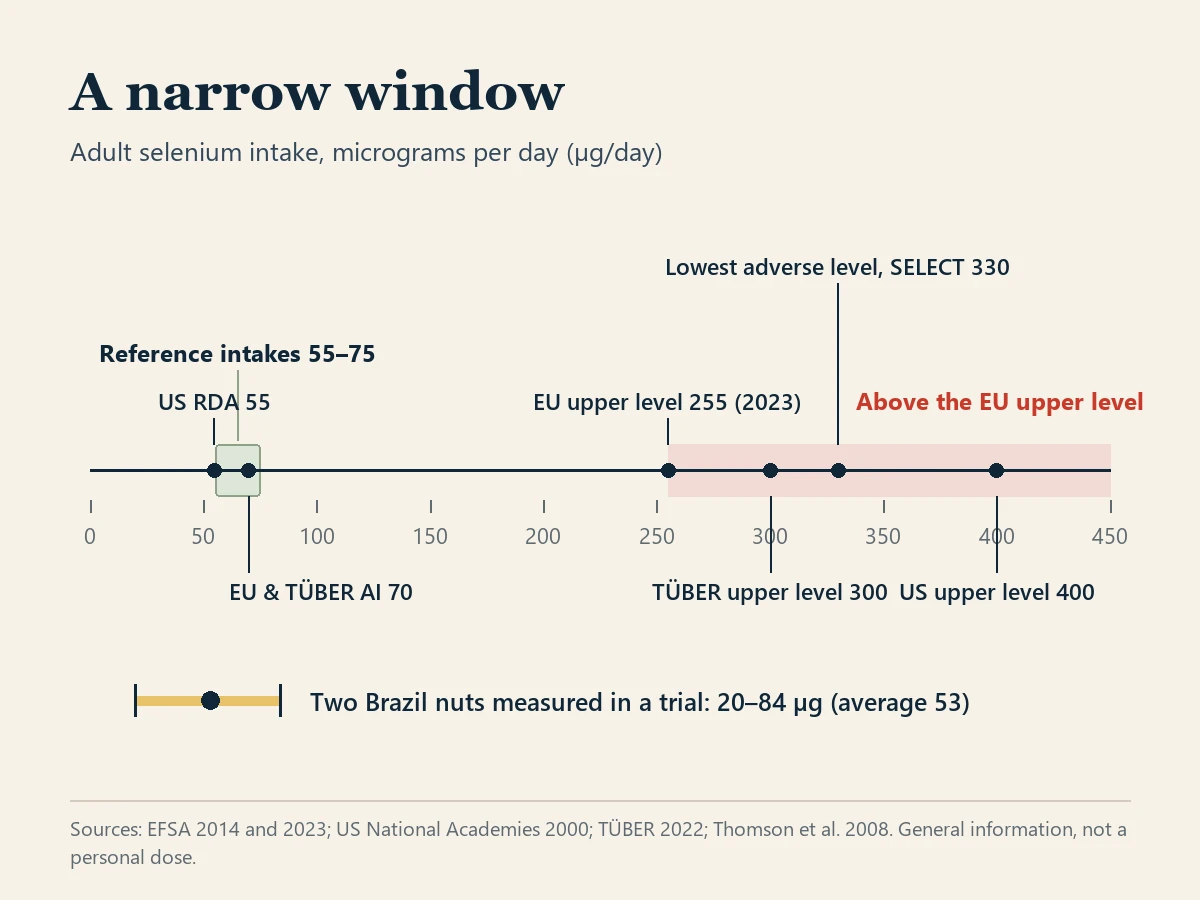
Reference bodies agree on the order of magnitude but not on the exact number, because they use different markers and different assumptions about uncertainty.
| Source | Adults | Pregnancy / breastfeeding | Upper level (adults) |
|---|---|---|---|
| EFSA (EU) | 70 µg/day (Adequate Intake) | 70 / 85 µg/day | 255 µg/day (2023), including pregnancy and breastfeeding |
| US National Academies | 55 µg/day (RDA) | 60 / 70 µg/day | 400 µg/day |
| UK (NHS) | 60 µg women, 75 µg men | — | 350 µg/day or less from supplements “unlikely to cause any harm” |
| Türkiye (TÜBER 2022) | 70 µg/day (Adequate Intake) | 70 / 85 µg/day | 300 µg/day (taken from EFSA before its 2023 revision) |
The European upper level was lowered in 2023. EFSA’s panel took hair loss, an early and well-established sign of selenium excess, as the critical effect, identified 330 µg a day as the lowest intake with adverse effects in the Selenium and Vitamin E Cancer Prevention Trial (SELECT), and applied an uncertainty factor to reach 255 µg.[2] The panel added that adults are unlikely to exceed it from ordinary food, except regular users of high-dose supplements or regular consumers of Brazil nuts.[2] That sentence is the reason this guide spends so much time on one nut.
Why does selenium in plant foods vary so much?
Because the soil sets the ceiling. The Vegan Society puts it plainly: the amount of selenium in a plant food depends on how much was in the soil it grew in, and vegans in Europe may have lower intakes than people in countries with higher soil selenium or with widespread use of high-selenium imported produce such as Canadian wheat flour.[5] The US National Academies make the same observation from the other side: the lowest selenium intakes in the world occur in populations eating vegetarian diets of plants grown in low-selenium areas.[3]
Two consequences follow. First, food composition tables are only a rough guide. EFSA notes that because selenium content varies considerably between foods and its analysis is complex, tables are often inaccurate and intake estimates imprecise.[1] The US values in the next section reflect North American soils and flour. Second, the picture may shift over time. A modelling study of 33,241 soil data points predicted that climate change and falling soil organic carbon will lower soil selenium overall, particularly in agricultural areas, by 2080–2099.[12] We could not find national soil or food selenium data for Türkiye that we were able to verify, so this guide does not estimate Turkish intakes.
Which vegan foods contain selenium?
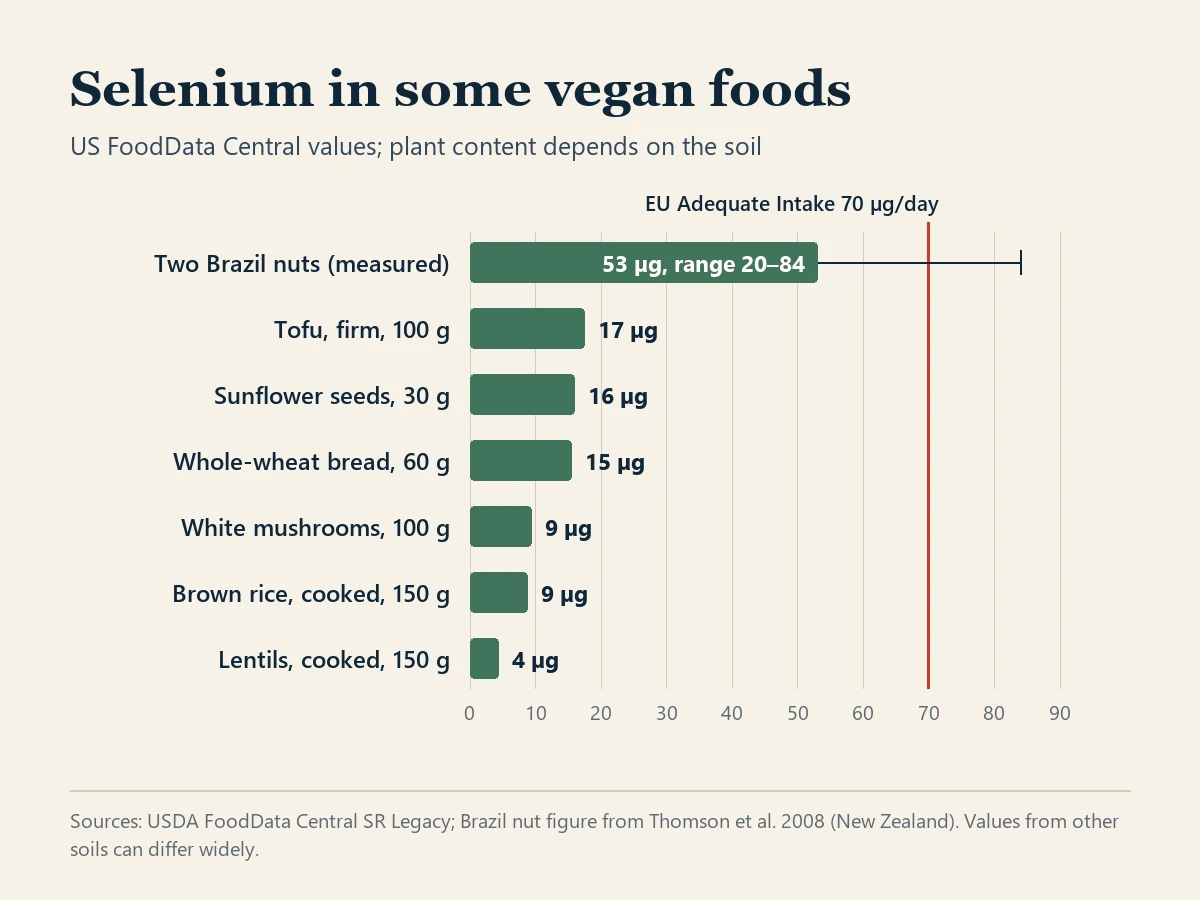
With that caveat, these are typical values from the US FoodData Central database, per 100 g:[6]
| Food (as listed) | Selenium per 100 g | Note |
|---|---|---|
| Brazil nuts, dried | 1,920 µg | Extremely variable; see below |
| Sunflower seed kernels, dried | 53 µg | A 30 g handful gives roughly 16 µg |
| Whole-wheat bread | 25.7 µg | Depends heavily on where the wheat grew |
| Tofu, firm | 17.4 µg | |
| White mushrooms, raw | 9.3 µg | |
| Brown rice, cooked | 5.8 µg | |
| Lentils, cooked | 2.8 µg |
Seeds, whole grains, tofu and mushrooms all contribute; the Vegan Society names mushrooms, sunflower seeds, sesame seeds, tofu and brown rice.[5] On European soils, however, it is hard to know how close a varied plant diet gets to 70 µg without either Brazil nuts or a supplement.
What do Brazil nuts really deliver?
Brazil nuts work. In a 12-week randomised trial in 59 New Zealand adults, two Brazil nuts a day raised plasma selenium by 64% and were as effective as 100 µg of selenium given as selenomethionine.[7] A 2022 meta-analysis of randomised trials confirmed a large effect on blood selenium.[8]
The same New Zealand trial also shows the problem. The nuts were chosen to provide about 100 µg, but when researchers analysed them, the actual intake averaged 53 µg a day, with a possible range of 20 to 84 µg.[7] The amount in any particular packet is not something you can see or count on. The Vegan Society describes Brazil nut selenium as “particularly variable” and notes that some research has raised concerns about barium and radium in the nuts.[5]
So Brazil nuts are best treated as a strong but imprecise tool: a small, regular amount rather than a handful, and not stacked on top of a selenium supplement without checking the total. EFSA’s warning about regular consumers exceeding the upper level applies here.[2]
If Brazil nuts are hard to find or expensive where you live: you do not have to build your selenium plan around them. A 30 g handful of sunflower seeds gives roughly 16 µg by US values,[6] and whole grains, tofu and mushrooms add more. Because it is hard to know how close these foods get you to 70 µg, a multivitamin or supplement containing selenium is the most predictable option.[5]
Do vegans actually have lower selenium status?
On intake, the evidence is consistent. A systematic review of 48 studies in European populations listed selenium among the nutrients vegans tend to consume in low amounts.[9] In a UK study of women, the vegan group recorded 24.7 µg a day on average, significantly lower than vegetarians and omnivores, whose intakes were also below the national recommendation.[10]
On blood markers, the best recent data come from children. In the German VeChi Youth study of 342 children and adolescents, vegans and vegetarians had lower serum selenium and lower selenoprotein P than omnivores, while the activity of the selenoenzyme glutathione peroxidase 3 did not differ between groups.[11] The authors recommend monitoring selenium in young people on these diets.
Two Scandinavian studies add an important nuance: the problem is not unique to vegans. In Swedish 16- to 24-year-olds, every dietary group, omnivores included, showed a risk of inadequate selenium intake.[13] In Norwegian young people, the highest shares at risk of inadequate intake were among lacto-ovo vegetarians (70%) and omnivores (65%).[14] Where soils are poor, selenium is a population issue; a vegan diet simply removes the animal foods that partly buffer it.
Can a blood test settle it?
Not easily. Plasma selenium includes selenium that has slipped into ordinary proteins in place of the amino acid methionine, so it is not a direct measure of the working selenium pool.[1] Glutathione peroxidase activity levels off at lower intakes than selenoprotein P, and selenoprotein P, which EFSA regards as the most informative marker, is not a routine test.[1,15] For most healthy adults, looking at the diet is more useful than a single blood value. If a doctor orders a test for another reason, the result is best interpreted with them.
Is more selenium better?
No. This is where selenium differs from most nutrients discussed on this site.
- Cancer: SELECT randomised 35,533 men to 200 µg of selenium a day, vitamin E, both or placebo. Selenium did not prevent prostate cancer (hazard ratio 1.04) or any other prespecified cancer.[16] A Cochrane review of randomised trials with low risk of bias found no effect on overall cancer incidence (risk ratio 1.01).[17]
- Type 2 diabetes: In a trial of 1,202 people given 200 µg a day or placebo for an average of 7.7 years, diabetes developed more often in the selenium group (hazard ratio 1.55); the authors concluded that supplementation “does not seem to prevent type 2 diabetes, and it may increase risk”.[18] A later colorectal adenoma trial with the same dose did not show a significant overall increase (hazard ratio 1.25), but found a higher risk in older participants.[19]
- Toxicity: Too much selenium causes selenosis; in its mildest form it leads to loss of hair and nails.[4] In 2008, a misformulated supplement sold in the United States contained 22,300 to 32,200 µg per daily dose and caused long-term adverse effects in people who took it.[20] This was a manufacturing error, but it shows how small the margin is.
Studies that follow people over time do link higher selenium levels with lower mortality,[21] but such associations cannot show cause, and the review’s authors note that trials in selenium-deficient populations are still needed. For now, the sensible target is enough, not extra.
Where do supplements fit?
The Vegan Society considers a supplement containing selenium the most reliable way to guarantee an adequate intake.[5] If you use one, the useful questions are about totals rather than brands: how much selenium the product provides per daily serving, whether your multivitamin and any separate product both contain it, and whether you also eat Brazil nuts regularly. Food plus supplements should stay well below 255 µg a day.[2] A pharmacist can help you read the label.
Frequently asked questions
Is one Brazil nut a day safe?
Two nuts a day was the amount used in the New Zealand trial, and the nuts actually supplied an average of 53 µg.[7] One nut a day is well within that. Because content varies so much, larger habitual amounts can push intake towards the upper level, especially together with a supplement.[2,5]
Does a vegan multivitamin cover selenium?
Some do and some do not. Check the label for selenium and the amount per daily serving, then add up all sources.
Should vegan children take selenium?
Children have lower reference values and lower upper levels, and EFSA advises caution with selenium supplements in children based on individual needs.[2] Decisions for children belong with a paediatrician or dietitian. Our balanced vegan plate guide covers the everyday basics.
A 30-second vegan selenium check
- Do you eat seeds, whole grains, tofu or mushrooms most days? Good, but on European soils that may still fall short of 70 µg.
- Do you eat Brazil nuts? Keep it to a small, regular amount, not handfuls.
- Brazil nuts hard to find or too expensive? Add a handful of sunflower seeds, and look at a multivitamin containing selenium for a predictable baseline.
- Do you take a supplement? Find the selenium figure on every product and add food, especially Brazil nuts.
- Is the total well under 255 µg a day? If you are unsure, ask a pharmacist.
- Pregnant, breastfeeding, a child, or living with thyroid or kidney disease? Talk to your doctor first.
Related: zinc for vegans · how to read nutrition research.
Sources
- EFSA NDA Panel. Scientific Opinion on Dietary Reference Values for selenium. EFSA Journal. 2014;12(10):3846. Summarised in Dietary Reference Values for nutrients: Summary report, 2017, section 4.12.
- EFSA NDA Panel. Scientific opinion on the tolerable upper intake level for selenium. EFSA Journal. 2023;21(1):7704.
- Institute of Medicine. Selenium. In: Dietary Reference Intakes for Vitamin C, Vitamin E, Selenium, and Carotenoids. Washington, DC: National Academies Press; 2000.
- NHS. Vitamins and minerals: Others — Selenium. Accessed 13 September 2026.
- The Vegan Society. Selenium. Accessed 13 September 2026.
- U.S. Department of Agriculture. FoodData Central, SR Legacy (FDC IDs 170569, 170562, 172688, 172475, 169251, 169704, 172421). Accessed 13 September 2026.
- Thomson CD, Chisholm A, McLachlan SK, Campbell JM. Brazil nuts: an effective way to improve selenium status. Am J Clin Nutr. 2008;87(2):379–384.
- Godos J, et al. Effect of Brazil nuts on selenium status, blood lipids, and biomarkers of oxidative stress and inflammation: a systematic review and meta-analysis of randomized clinical trials. Antioxidants. 2022;11(2):403.
- Bakaloudi DR, et al. Intake and adequacy of the vegan diet. A systematic review of the evidence. Clin Nutr. 2021;40(5):3503–3521.
- Fallon N, Dillon SA. Low intakes of iodine and selenium amongst vegan and vegetarian women highlight a potential nutritional vulnerability. Front Nutr. 2020;7:72.
- Simon R, et al. Selenium, zinc, and copper intake and status of vegetarian, vegan, and omnivore children and adolescents: results of the VeChi Youth study. Eur J Nutr. 2025;64(5):247.
- Jones GD, et al. Selenium deficiency risk predicted to increase under future climate change. Proc Natl Acad Sci USA. 2017;114(11):2848–2853.
- Mulkerrins I, et al. Micronutrient intake and nutritional status in 16-to-24-year-olds adhering to vegan, lacto-ovo-vegetarian, pescatarian or omnivorous diets in Sweden. Eur J Nutr. 2025;64(5):231.
- Groufh-Jacobsen S, et al. Micronutrient intake and status in young vegans, lacto-ovo-vegetarians, pescatarians, flexitarians, and omnivores. Eur J Nutr. 2024;63(7):2725–2741.
- Combs GF Jr. Biomarkers of selenium status. Nutrients. 2015;7(4):2209–2236.
- Lippman SM, et al. Effect of selenium and vitamin E on risk of prostate cancer and other cancers: the Selenium and Vitamin E Cancer Prevention Trial (SELECT). JAMA. 2009;301(1):39–51.
- Vinceti M, et al. Selenium for preventing cancer. Cochrane Database Syst Rev. 2018;1:CD005195.
- Stranges S, et al. Effects of long-term selenium supplementation on the incidence of type 2 diabetes: a randomized trial. Ann Intern Med. 2007;147(4):217–223.
- Thompson PA, et al. Selenium supplementation for prevention of colorectal adenomas and risk of associated type 2 diabetes. J Natl Cancer Inst. 2016;108(12):djw152.
- Morris JS, Crane SB. Selenium toxicity from a misformulated dietary supplement, adverse health effects, and the temporal response in the nail biologic monitor. Nutrients. 2013;5(4):1024–1057.
- Cui Z, et al. Associations of selenium status with all-cause and cause-specific mortality: a systematic review and meta-analysis of cohort studies. Redox Biol. 2025;85:103755.
Editor: Anıl Güler, Pharmacist
Last scientific review: 13 September 2026