Ramsgate, 1847: How the Vegetarian Society Was Founded
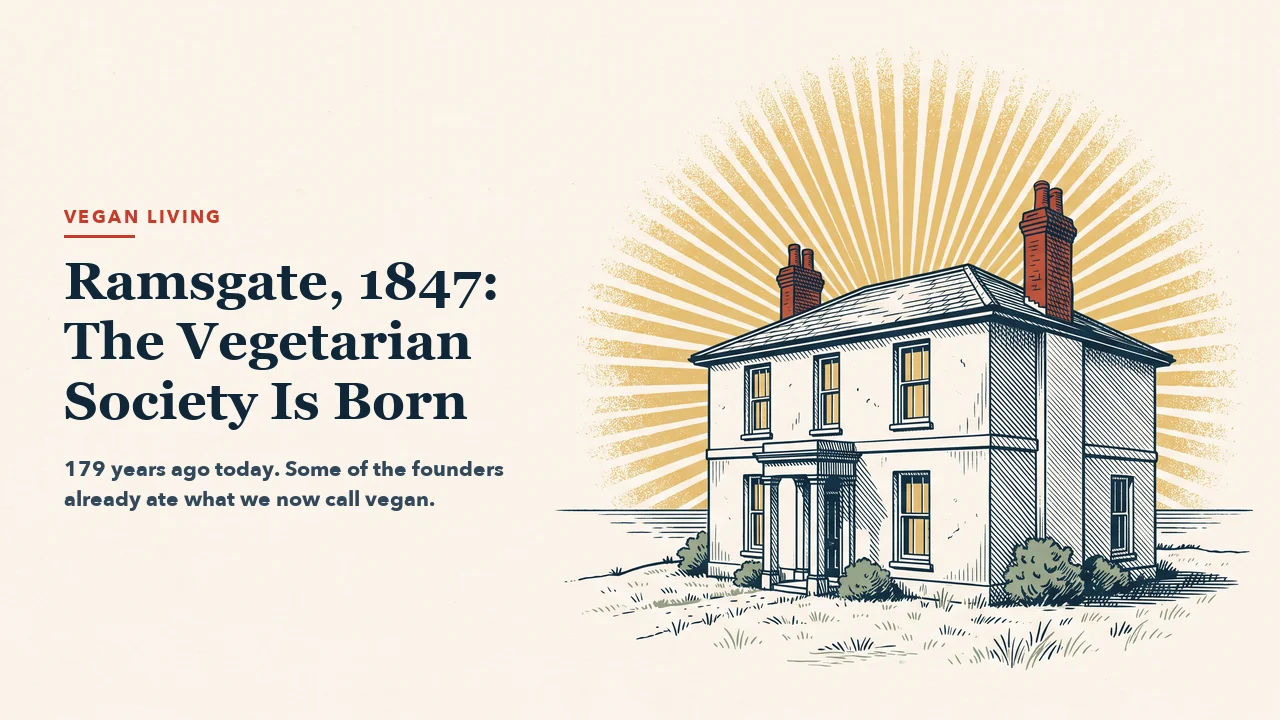
On Thursday, 30 September 1847 — 179 years ago today — a group of people met at a hydropathic clinic called Northwood Villa, near Ramsgate on the Kent coast, and founded the Vegetarian Society. Some of them had travelled at least 300 miles to be there. By the end of the day more than 150 people had joined, and a word that had barely existed a few years earlier had an organisation behind it.
The story of that day is worth knowing, partly because it is the start of the organised movement, and partly because some of the people who first called themselves “vegetarians” were closer to what we now call vegans than most people assume.
Three groups, one meeting
According to John Davis, historian of the International Vegetarian Union, there were three main vegetarian groups in England by 1847.
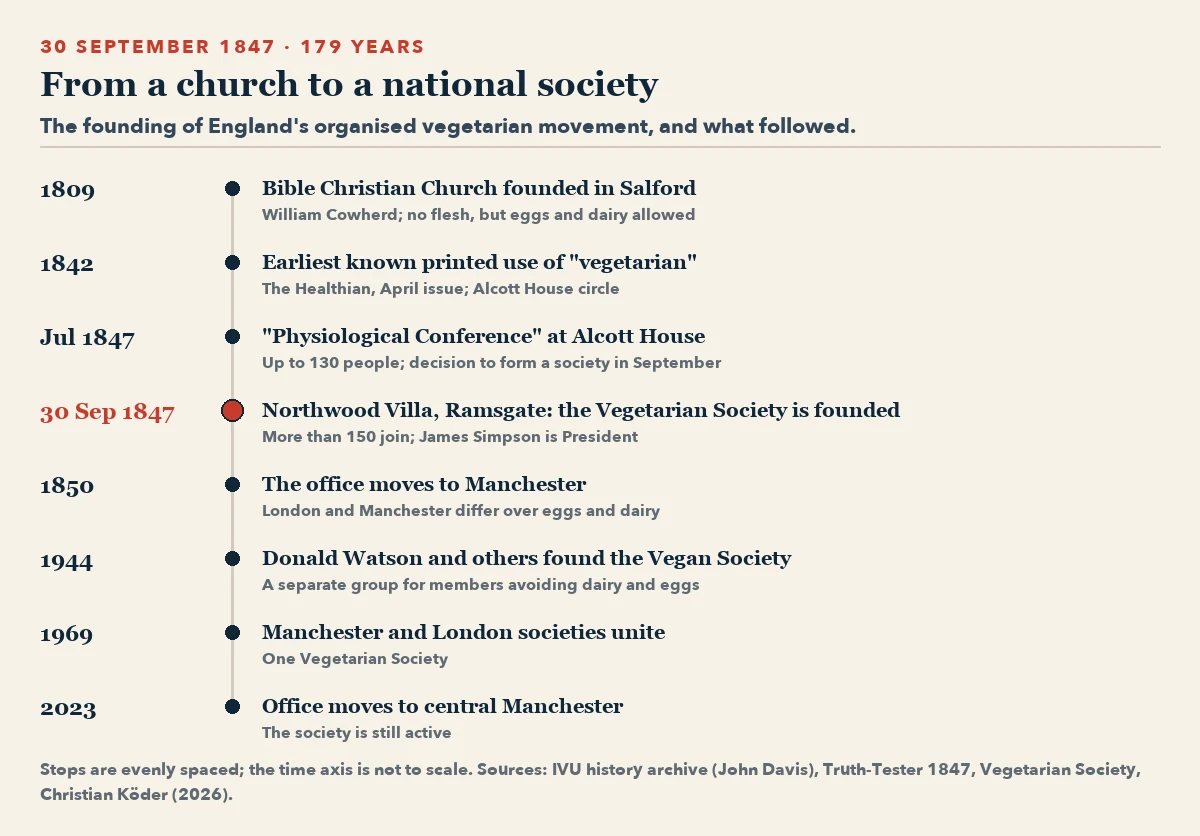
- The Bible Christians of Salford, near Manchester. The Rev. William Cowherd broke away to form this church in 1809, and its members avoided flesh (but not eggs and dairy) for their health and out of compassion for animals.
- Alcott House, a school on Ham Common, Surrey, near London. It followed what Davis describes as “what we now call a vegan diet” for all its pupils.
- Northwood Villa in Ramsgate, a hydropathic institution whose “Governor” was William Horsell. The Vegetarian Society’s own history describes it as a vegetarian, “but in fact what we now call vegan”, venue.
Horsell also edited a magazine, the Truth-Tester. It began as a temperance paper, but he steered it towards the “vegetable diet”. Early in 1847 a letter in its pages proposed a vegetarian society. William Oldham of Alcott House then called a “Physiological Conference” there on 8 July, with up to 130 people present. It voted to meet again at the end of September to form a society.
What happened on the day
The Truth-Tester‘s report of the meeting survives. Joseph Brotherton, the Member of Parliament for Salford and a Bible Christian, took the chair. The paper noted that nine of those present had abstained from flesh and alcohol for more than 30 years, most of them for 38. The morning went on the rules, the society was formed, and dinner was served at half past one.
James Simpson, a Bible Christian from Salford, became the first President. William Oldham of Alcott House became Treasurer, and William Horsell became Secretary. The rules gave these three officers the running of the society, with the Secretary in the leading role; Davis notes that 25% of the society’s income went to the Secretary to pay for his work.
Joining was simple. A new member declared that they had “abstained from the flesh of animals as food, for the space of one month and upwards”. Anyone above 14 years of age could join, “male or female”, by declaring it to a nearby member or by letter to Horsell at Northwood Villa.
Where the word came from
“Vegetarian” was not coined at Ramsgate, but Ramsgate made it common. The earliest known printed use is in the April 1842 issue of The Healthian, a short-lived magazine linked to Alcott House. The Online Etymology Dictionary gives an earlier date, 1839, and quotes the Oxford English Dictionary: “the general use of the word appears to have been largely due to the formation of the Vegetarian Society in Ramsgate in 1847”.
Davis argues that the word came from the Alcott House circle rather than the Bible Christians, whose records speak of “the vegetable diet” until 1847. He also dismisses a popular story that “vegetarian” comes from the Latin vegetus, “lively”: a writer in the society’s own magazine called it a myth as early as 1906.
Who joined
The leaders included an MP and manufacturers, but the members were mostly working people. Julia Twigg’s 1981 doctoral thesis on the English vegetarian movement took the society’s monthly membership breakdown from its magazine. Twigg concludes that well over two-thirds of the membership were “tradesmen, mechanics and labourers”. In February 1853, for example, 466 of the 889 members were listed in that group, with 242 women counted separately and their class not recorded. Activity was strongest in the northern industrial towns, such as Manchester, Liverpool, Leeds and Sheffield.
Twigg also shows how close the movement was to the campaign against alcohol: nearly all the early vegetarians were teetotal, and they often called vegetarianism “the higher phase of temperance”.
What came next
The Ramsgate period was short. The first annual general meeting was held in Manchester in 1848, Alcott House closed the same year, and in 1850 the society’s office moved to Manchester. There were differences between London and Manchester, Davis writes, mainly over eggs and dairy.
That question never went away. In 1944 a member, Donald Watson, proposed a separate group for people who avoided dairy and eggs; it became the Vegan Society. We told that story in how the word “vegan” was born. The Vegetarian Society itself carried on: its separate Manchester and London societies unified in 1969, and in 2023 it moved to an office in central Manchester.
Why it matters today
Two things stand out after 179 years. First, its members were mostly working people, and it was organised around a simple, practical pledge: one month without meat. Second, the debate over eggs and dairy is as old as the word “vegetarian” itself: two of the three places the founders came from already followed, by their own historians’ account, what we would now call a vegan diet.
References
- Davis J. The Origins of the ‘Vegetarians’. International Vegetarian Union history archive. Accessed 29 September 2026.
- Truth-Tester, 1847, vol. II, pp. 19–20, 29 (extracts). Physiological/Vegetarian Conferences, Surrey/Kent, England 1847. International Vegetarian Union. Accessed 29 September 2026.
- Twigg J. The Vegetarian Movement in England, 1847–1981: A Study in the Structure of its Ideology, chapter 5. PhD thesis, London School of Economics, 1981. Published by the International Vegetarian Union with the author’s permission. Accessed 29 September 2026.
- Vegetarian Society. History. Accessed 29 September 2026.
- Köder C. First use of the word “vegetarian” in English (1842). 2 August 2026. Accessed 29 September 2026.
- Online Etymology Dictionary. vegetarian. Accessed 29 September 2026.
Editor: Anıl Güler, Pharmacist
Last scientific review: 29 September 2026