Empty Cages: Tom Regan on Animal Rights
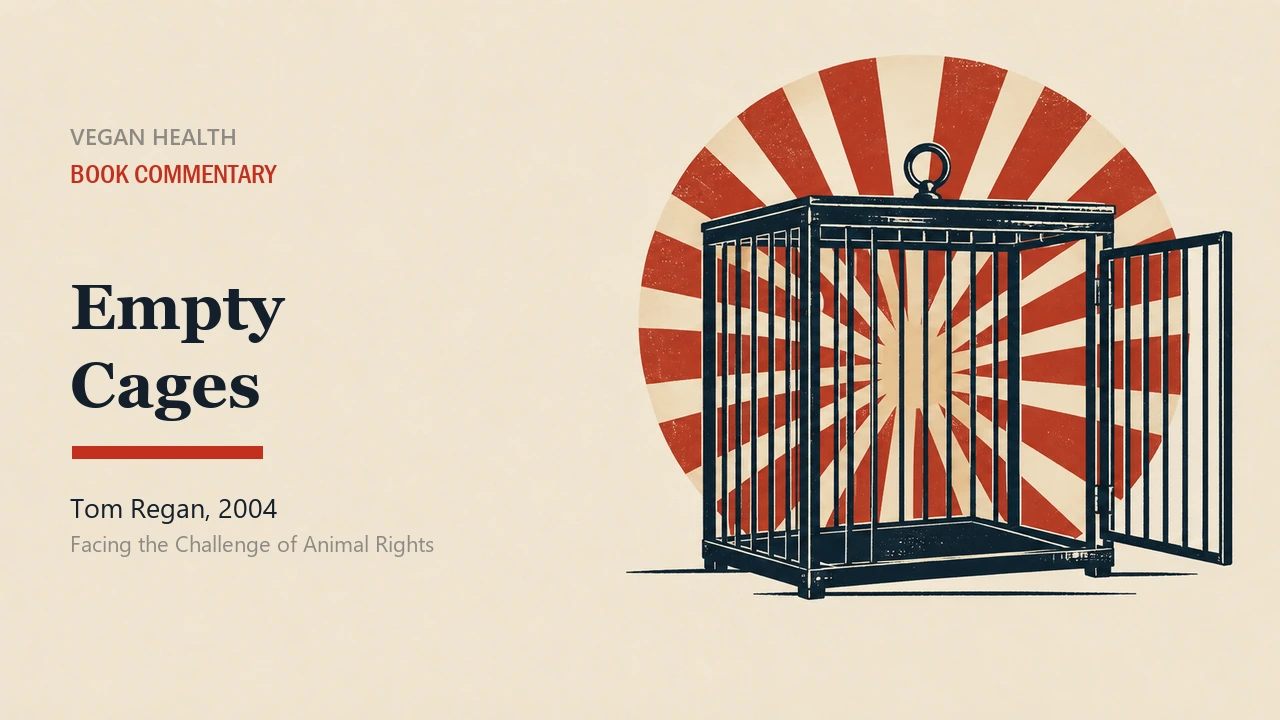
Most conversations about veganism begin with food. Tom Regan began with a different question: can animals be wronged? Empty Cages: Facing the Challenge of Animal Rights (2004) was his attempt to put that question to readers who were not yet convinced.
Publishers Weekly called it a “friendly but uncompromising manifesto”. Regan, the review noted, intended it as a “popular companion to his scholarly treatments of the subject”, a book for general readers rather than philosophers.
The author
Regan, who died on 17 February 2017 at the age of 78, was professor emeritus of philosophy at North Carolina State University. His major scholarly work, The Case for Animal Rights, appeared in 1983.
He liked to point out how unlikely an advocate he had been. In a 2006 interview with The Vegan Society, he said he grew up eating “‘meat’ of every cut and description” and worked as a butcher to help pay for college. In 2011 he added that he had once bought his wife Nancy “a stylish mink hat” and written in a letter to her that elephants are “things”. Their miniature poodle Gleco was hit by a car and killed while they were away, and Regan said the dog’s death “helped change our life”. Even then the change came slowly. They lived for several years as lacto-ovo vegetarians before becoming vegan. His own summary: “Nothing in the genes. No Road to Damascus conversion experience. Just a long slog to animal rights advocacy.”
The argument
Regan’s 1985 essay “The Case for Animal Rights” gives a compact statement of the position the book defends. It appeared in In Defense of Animals, a collection edited, as it happens, by Peter Singer.
The starting point is something humans share with many animals. Each of us, he wrote, is “the experiencing subject of a life, a conscious creature having an individual welfare that has importance to us whatever our usefulness to others.” Such beings have what he called inherent value, and they have it equally. According to the Publishers Weekly review, Empty Cages counts “mammals, birds and (maybe) fish” among these subjects of a life.
This is where Regan parts ways with utilitarianism, the approach best known in animal ethics through Singer. A utilitarian looks for the act that brings about the best overall balance of satisfaction over frustration. Regan’s objection was that utilitarianism “has no room for the equal moral rights of different individuals because it has no room for their equal inherent value”. On a rights view, some things may not be done to an individual even when the totals come out ahead.
His conclusion is uncompromising: “The fundamental wrong is the system that allows us to view animals as our resources”. The 1985 essay names three goals: the total abolition of the use of animals in science, the total dissolution of commercial animal agriculture, and the total elimination of commercial and sport hunting and trapping.
Why empty cages
The book’s title compresses this into one contrast. Regan put it this way in a summary of his position that he first wrote for a 1986 booklet and reproduced, lightly edited, in a 2011 interview with Animal Rights Zone: “It is not larger, cleaner cages that justice demands in the case of animals used in science, for example, but empty cages; not ‘traditional’ animal agriculture, but a complete end to all commerce in the flesh of dead animals”.
The same summary makes the comparison with other struggles explicit. Justice did not demand reformed slavery or reformed child labour, he argued, but abolition: “Merely to reform absolute injustice is to prolong injustice.” That did not mean doing nothing until the day of abolition. Regan favoured campaigns that end one practice at a time, and said of such campaigns: “I listed a few examples in Empty Cages.”
What the book covers
According to Publishers Weekly, the real force of the book comes from its accounts of cruelty in factory farms, mink ranches, hunting preserves, dolphin shows and research labs. The review describes a strict view in which animals may not be exploited for food, clothing, entertainment or even medical research of great benefit to humans. It also asks readers to see farmed animals as individuals, in a line the review quotes: “our culture teaches us not to see hens like Penny and Sweet Pea as distinct individuals”.
Regan also defends the people who make this argument. The review says he describes animal rights advocates as “Norman Rockwell Americans”, ordinary citizens rather than violent zealots, and retells several conversion experiences. The publisher’s description adds that the book challenges the negative media image of advocates, questions the rhetoric of “humane treatment” and explains why existing laws serve to legitimise institutional cruelty.
Regan himself pointed to two chapters. Discussing arson by activists, he said the story the media tells is about “domestic terrorists,” not the dungeons of animal abuse, and that he had more to say about this in the book’s first chapter. The eleventh deals with violence, which he discussed at length in 2011 drawing on that chapter. There he argued that destroying property is also a form of violence, citing Gandhi and Martin Luther King, and said of the Animal Liberation Front: “I don’t agree with the A.L.F.’s means.”
A review by Frank and Mary Hoffman describes a section titled “Objections to Animal Rights”, in which Regan answers “What about plants?” and ten more familiar objections, ending with “Let’s Solve the Human Problems First!”
The myth of humane treatment
Regan was suspicious of the word “humane”. In the 2006 interview, discussing his essay on the “myth” of humane treatment, he said most people believe animals are treated well on farms and in laboratories because that is what the industries tell them, and that government inspectors “basically serve as arms of the industries themselves”. Critics of that story, he added, are pictured as “extremist wackos”. His suggested response was to place industry spokespeople’s claims about humane treatment next to images of how the animals actually live.
The same interview put him at odds with Singer. The interviewer quoted Singer imagining a world in which people mostly eat plants but occasionally have free-range eggs, or meat from animals killed humanely on the farm. Regan said he could imagine such a world, but it was not the one advocates should work for. Ending the life of an animal who is dying and suffering can be humane, he said, but killing a healthy animal is something else: “What kindness, what compassion, what mercy do we show to these animals by slitting their throat?”
Who it is for
Regan described three kinds of animal rights advocates. Some are like Leonardo da Vinci, who from an early age would not hurt animals and needed no argument to protect them; Regan called them DaVincians. Some are changed by a single experience, as Saul was on the road to Damascus; these are Damascans. The third group are Muddlers, who arrive slowly, one question at a time, asking for reasons.
He said he dedicated the book “To Muddlers, everywhere!” and counted himself among them. “I’m in the muck with the Muddlers,” he said, “trying to encourage them to move forward, to take another step.”
What critics said
Publishers Weekly also had reservations. It found the book’s philosophical underpinnings “not overly rigorous”, its treatment of counterarguments “sometimes impatient and exasperated”, and its sentimental portrayal of animals liable to “seem cloying”.
Deeper questions about the theory itself had been raised almost two decades earlier. In a 1985 review of Regan’s 1983 book in Reason Papers, the philosopher John Hospers presented his points “more in the form of questions than outright criticisms.” Where does the category of subject of a life end? At the time, Hospers noted, Regan included mammals a year or more old and admitted he did not know about reptiles, birds, fish and insects. In Regan’s example of a crowded lifeboat holding four men and a dog, where one must be sacrificed, Hospers reports that Regan would not hesitate to throw the dog overboard; Hospers was “at a loss to see why, if all subjects-of-a-life, human and animal, have equal inherent value, and thus equal claims to life.” And if rights require active help and not only restraint, he argued, “there is no foreseeable end to the duties one is required to discharge.”
Hospers also warned that the 1983 book’s abstract style would overwhelm general readers. Empty Cages was written for Muddlers, the kind of reader Hospers thought the earlier book would lose. None of these questions refutes the view on its own, but a careful reader should bring them to the book.
Bibliographic details
- Original: Empty Cages: Facing the Challenge of Animal Rights, Tom Regan, Rowman & Littlefield, 2004, 229 pages.
- Turkish edition: Kafesler Boşalsın: Hayvan Haklarıyla Yüzleşmek, İletişim Yayınları, Başvuru series no. 121.
- Translator: Serpil Çağlayan.
- Edition: 2nd edition, 1st printing, October 2022, 304 pages. ISBN 9789750533785.
Sources
- İletişim Yayınları. Kafesler Boşalsın: Hayvan Haklarıyla Yüzleşmek, book page and bibliographic record (Turkish).
- Rowman & Littlefield. Empty Cages: Facing the Challenge of Animal Rights, publisher description, Google Books record.
- Regan T. “The Case for Animal Rights”. In In Defense of Animals, ed. Peter Singer, 1985.
- Animal Rights Zone. Interview with Tom Regan, 20 May 2011.
- The Vegan Society. Tom Regan, philosopher and animal rights pioneer, 1938–2017, 20 February 2017. Republishes an interview first printed in The Vegan, Winter 2006.
- Hospers J. Tom Regan’s The Case for Animal Rights. Reason Papers, no. 10, Spring 1985, pp. 113–124.
Editor: Anıl Güler, Pharmacist
Last reviewed: 13 September 2026