How the Word “Vegan” Was Born
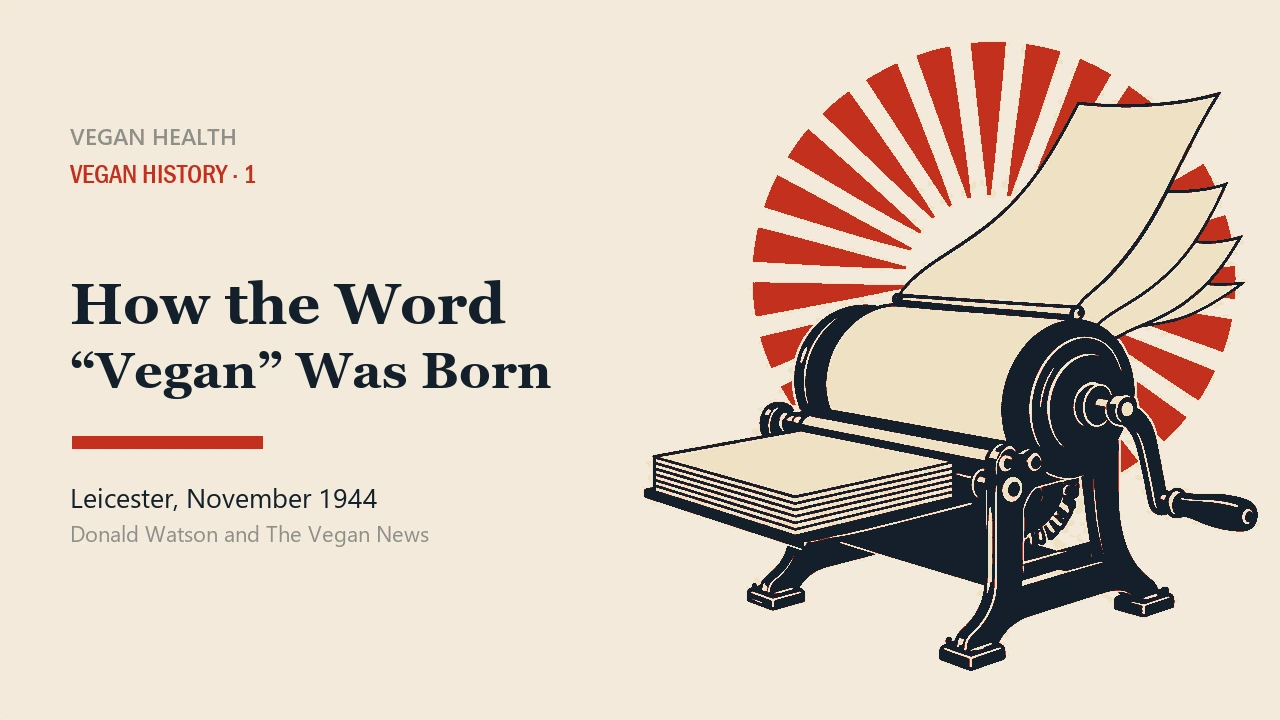
Words have birthdays. Most of them are impossible to date, because a word seeps into a language through a thousand conversations nobody wrote down. “Vegan” is a rare exception. We can name the month, the town, the four sheets of paper it was duplicated on, and the man who typed it.
In short: the word first appeared in The Vegan News No. 1, the four-page newsletter Donald Watson duplicated in November 1944. The familiar explanation, that “vegan” takes the first three and last two letters of “vegetarian”, is how Watson described it in 2004; the 1944 newsletter itself gives no etymology.
That precision is why this article exists. It is the first in an occasional series on the history of vegetarianism and veganism, and it starts here because this is the point where the vocabulary itself begins. Before November 1944 there were people who ate no animal products at all. There were no vegans, because the word did not exist. Calling anyone before that date a vegan is an anachronism, and this site will not do it.
What the document actually is
The Vegan News, No. 1, is four typed and duplicated pages. The masthead is hand-lettered. Under it, in capitals, sits the subtitle that tells you the word in the title was not yet a settled identity: “QUARTERLY MAGAZINE OF THE NON-DAIRY VEGETARIANS.” The price is twopence, threepence post free, one shilling for a year’s subscription. The last page is signed from 67 Evesham Road, Leicester, and dated November 24th, 1944. The signature reads Donald Watson.
Watson was thirty-four, a woodwork teacher, and secretary of the Leicester Vegetarian Society. The newsletter tells you, in his own faintly self-mocking words, how small the operation was. Twenty-five members, scattered too widely for a committee. He had taken on the duties of honorary secretary, treasurer and auditor himself, and if this “undemocratic Constitution” offended anyone, he added, he was open to suggestions for any scheme that would let him embezzle the group’s funds from subscriptions of a shilling a year.
This is worth holding onto. The founding document of modern veganism is a one-man duplicated bulletin with twenty-five members and a joke about embezzlement.
Why a new word was needed
The naming problem gets its own section, headed “WANTED — A NAME.” Watson lays out the difficulty plainly.
The group was calling itself non-dairy. That phrase, he explained, had become a generally understood colloquialism, but like “non-lacto” it was “too negative.” Worse, it did not say anything about eggs. A name built on a negation tells people what you refuse; it says nothing about the food you actually eat. “We need a name that suggests what we do eat,” he wrote, and ideally one conveying that even with every animal food ruled out, nature still offered a bewildering assortment to choose from.
The obvious existing words were taken. “Vegetarian” and “fruitarian,” he noted, were already attached to societies that permitted the “fruits'(!) of cows and fowls” — the exclamation mark is his. So, he concluded, “it seems we must make a new and appropriate word.”
Then comes the sentence that names a movement:
“As this first issue of our periodical had to be named, I have used the title ‘The Vegan News’. Should we adopt this, our diet will soon become known as a VEGAN diet, and we should aspire to the rank of VEGANS. Members’ suggestions will be welcomed.”
Note what that is and is not. It is not a proclamation. It is a working title, offered for approval, with an open invitation to do better. The closing argument for it is not philosophy but typing: the virtue of a short title, he noted, is best known to those who as secretaries of vegetarian societies have to write the word vegetarian thousands of times a year.
The famous etymology is missing
Everyone repeats the same explanation: Watson built “vegan” from the first three and last two letters of “vegetarian,” because it marked “the beginning and end of vegetarian.”
He did say that. He said it in 2004, sixty years later. The line is elegant, and it may well describe what he was thinking in 1944. But it is not in the document. The four pages of The Vegan News No. 1 contain no etymology at all, no explanation of where the letters came from, and no guidance on how to say the word. Readers received a new word in the post with no instructions.
The trail of what he said afterwards is worth following, because it shows how an origin story hardens. In February 1945, in the second issue, Watson gave a different account, and it is the earliest one we have: before the first issue appeared, Mr and Mrs G. A. Henderson had suggested the word “Allvega,” with “Allvegan” as a magazine title, “and it was from this that the word Vegan was taken.” In 1989 he recalled that the responsibility for choosing the name had been his alone. In 1994 a Vegan Society editor printed the first-three-last-two explanation, citing no source. In 2002 he said only that he had settled on the word “in an inspired moment.” In 2004 he gave the version everyone now quotes.
There is a fourth account. At Watson’s funeral in 2005, his daughter Janet said her parents had been at a dance where Dorothy Morgan — later Watson’s wife — proposed “vegan” on the grounds that its letters were the beginning and end of vegetarian. That story concerns an evening before Janet was born and cannot be checked against any document. It is not evidence in the way a printed page is evidence. It is also not obviously wrong, and it would explain how a longer suggestion from the Hendersons became the short word that went to press.
The honest summary is this. We know exactly when and where the word was first used, because we have the page. We do not know with certainty who thought of it or how it was built, because the only contemporary statement credits the Hendersons’ “Allvega” as the source, and everything else was recalled decades later.
What the readers suggested instead
Watson asked for better ideas and got them. The February 1945 issue printed the list: Allvega, Allvegan, Total Vegetarian Group, Allveg, Allvegist, The True Vegetarian, Neo-Vegetarian, Dairyban, Vitan, Benevore, Benevorous News, Sanivore, Beaumanger, Bellevore.
Looking back in 1989, Watson was blunt about the near miss: “How would you like to have been called a ‘vitan’, or a ‘dairyban’, or a ‘beaumanger’?” He also remembered instructing readers how the new word should be pronounced — “not ‘veggan’ or ‘veejan’.”
The break with the vegetarians was not a rupture
The story is usually told as a schism: the vegetarians refused to face the dairy question, so the vegans walked out. The surviving records are gentler and more interesting than that.
In September 1944 Watson wrote to the Vegetarian Society in Manchester on behalf of about a dozen people. The executive committee’s minutes of 19 September 1944 record his two proposals: that the Society establish a section for members who abstain from dairy produce, or that such a group be formed outside the Society. The committee resolved that it could not see its way to establishing such a section, but that if a group were formed outside the Society, space would continue to be given in its magazine to the group’s activities.
Watson’s own account in the first issue is consistent and conciliatory. The suggestion, he wrote, “was considered sympathetically by the Committee, who decided that the full energies of the Society must continue to be applied to the task of abolishing flesh-eating, and that any such Group would, therefore, be freer to act as an independent body.” He went further: there need be no animosity between his group and the “lactos,” and several of them were spending a great deal of their time working for the lacto-vegetarian cause.
There was an appeal. It went to the Society’s annual general meeting on 18 November 1944, where the committee’s decision was upheld. Six days later Watson finished the first Vegan News.
It is also worth recording that the dairy argument was not a fringe position. At a debate in Croydon in April 1944, the motion “that vegetarians should aim at eliminating all dairy produce” was carried by roughly thirty votes to two, as Watson reported it. The contemporary report in the Vegetarian Society’s own magazine gave three against and no figure for those in favour. Both numbers point the same way.
The 1944 definition was not today’s definition
Here is the part that most surprises people. In November 1944 there was no Vegan Society and no definition of veganism. There was a group of non-dairy vegetarians, a new word on trial, and a stated purpose that was modest: “The object of our Group is to state a case for a reform that we think is moral, safe and logical.”
The group renamed itself the Vegan Society on 8 April 1945. The first written definition appeared at the top of the May 1945 issue, and it is almost entirely about food:
VEGANISM is the practice of living on fruits, nuts, vegetables, grains and other wholesome non-animal products.
VEGANISM excludes as human food: flesh, fish, fowl, eggs, honey; and animals’ milk, butter and cheese.
VEGANISM aims at encouraging the manufacture and use of alternatives to animal products.
A diet, a list of exclusions, and an aim about alternatives. No mention of clothing, of animals used for work or entertainment, of exploitation as a principle.
That came later. In 1951 Leslie Cross, then the Society’s vice-president, wrote that the Society’s object and the meaning of the word had “until now been matters of inference and personal predilection,” and set out the new rules: “The object of the Society shall be to end the exploitation of animals by man,” and “the word veganism shall mean the doctrine that man should live without exploiting animals.” In one revision veganism stopped being a way of eating and became a principle from which a way of eating follows.
The Vegan Society’s current definition, which it says has been in use since the winter of 1988, keeps that shape while softening its edges: a philosophy and way of living which seeks to exclude, as far as is possible and practicable, all forms of exploitation of and cruelty to animals for food, clothing or any other purpose.
So the word is older than the idea it now carries. Someone who called themselves vegan in 1945 was making a claim about their plate. Someone who calls themselves vegan today is, by the official definition, making a claim about their relationship to animals in general. The word stayed; its content was rewritten twice.
A note on anniversaries
World Vegan Day is 1 November. The date was chosen in 1994, for the fiftieth anniversary. It is a good date for a celebration and a poor one for a history, because no 1944 document we have records anything happening on it. The newsletter that introduced the word is dated 24 November. The name “Vegan Society” was adopted in April 1945. Anniversaries are decisions made afterwards, and it is useful to know which of our dates are records and which are choices.
Why the small details matter
Two things in this story are easy to miss.
The first is that Donald Watson’s memory was not reliable in every detail, and he never claimed it was. In 2002 he recalled charging five shillings a year. The newsletter in front of us says one shilling. This is not a scandal; it is what happens to any human being recalling paperwork from six decades earlier. It is the ordinary reason historians go back to the document.
The second is that the founder of veganism spent the first issue of his own magazine asking to be talked out of his own word. He put “vegan” forward as a proposal, invited alternatives, printed the alternatives when they arrived, and said the options remained open to anyone who wanted to add to the English language. The word won because it was short and because nobody produced a better one, not because it was decreed.
Scope note: This is a history article. It makes no nutritional, health or medical claim and offers no dietary advice. Health opinions quoted from period texts are reported as history, not as current science.
Sources
- The Vegan News, No. 1, November 1944. Donald Watson. Four-page facsimile: PDF. Every direct quotation in this article was read from that copy.
- Davis J. The Origins of the Vegans: 1944-46, 2016. The author is the former Manager and Historian of the International Vegetarian Union. The quotations from the February 1945 and May 1945 issues, and the Vegetarian Society executive committee minutes of 19 September 1944 held in the Manchester Archives, are reproduced there.
- Rodger GD. Interview with Donald Watson, 15 December 2002, unabridged transcript. The Vegan Society.
- Cross L. Veganism Defined, 1951. Reprint.
- The Vegan Society. History and definition of veganism.
Editor: Anıl Güler, Pharmacist
Last reviewed: 12 September 2026